
Food Bowls Caked With Crud and Cats’ Skulls Cut Open at Wake Forest

Wake Forest University experimenters have a long, blemished history of animal torment stretching from their U.S. laboratories to China—and PETA found out that it just got a little longer.

PETA recently obtained disturbing photos corresponding to a November 2021 U.S. Department of Agriculture (USDA) inspection report of a monkey at Wake Forest who was locked in a restraint chair. The photos show her neck clamped by metal rods and two supports under her arms, but the chair beneath her is too low for her to sit on, so experimenters left her dangling by her neck and underarms.
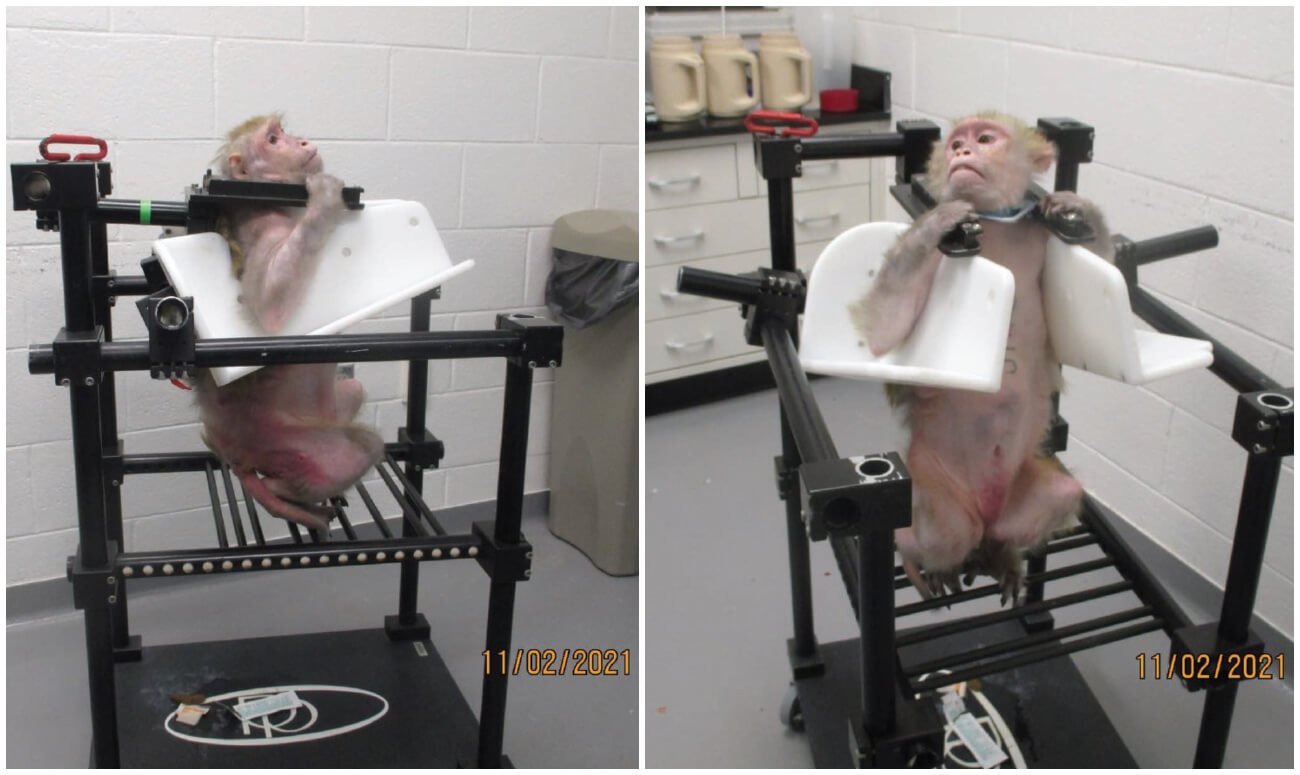
wake forest monkey experiments

The experiment was scheduled to last 90 minutes—meaning Wake Forest experimenters intended to let this monkey dangle by her neck and underarms for an hour and a half. The experimental protocol—and common decency—stipulates that the monkey should have been able to sit in the chair before being subjected to whatever quackery was to ensue, so inspectors cited Wake Forest for the cruelty.

During that same visit, inspectors found the food bowls of two pigs coated in a crusty brown grime as well as a bungled description of an eye surgery performed on a pig that failed to describe possible surgical risks.
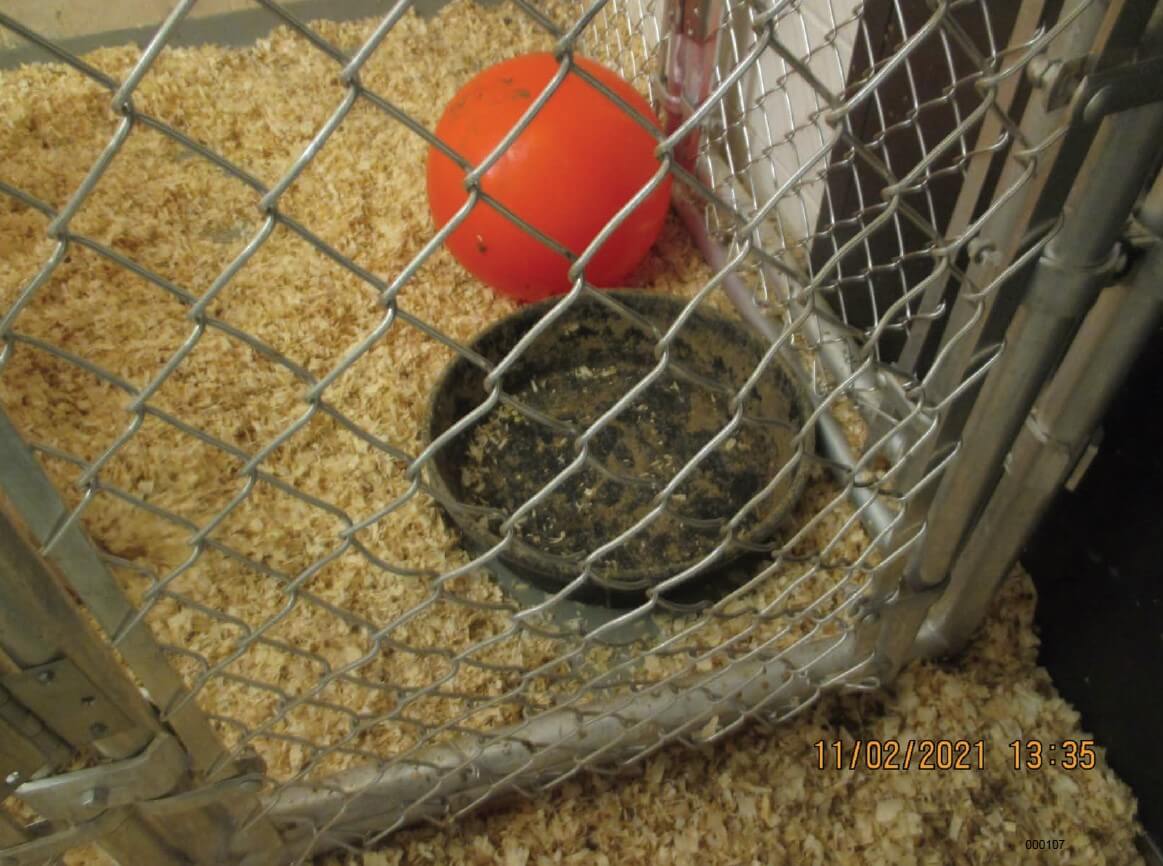
dirty food bowl wake forest pig experiments

A Shameful History of Animal Suffering at Wake Forest

Wake Forest experimenters have long run afoul of the law. In 2014, inspectors found a monkey strangled in his cage after he became entangled in an “enrichment” device. Since then, inspectors found that an untrained experimenter had carved into cats’ skulls and implanted hardware into their brains without cleaning the implants as required.

Another experimenter stitched up a pig’s abdomen but left a towel inside the animal’s body—leading to complications and death. A laboratory worker failed to handle a rabbit carefully, and the animal died of asphyxiation.

The callousness and ineptitude with which Wake Forest experimenters treat animals have forced the USDA to cite them repeatedly (including for the following) for failing to provide animals with the bare minimum protections afforded them in laboratories under the federal Animal Welfare Act:

  • An unqualified experimenter was cited for 15 separate incidents involving the use of four cats in invasive brain surgeries, including shoddy record keeping and failure to give the cats pain medication after cutting open and removing part of their skulls.
  • A worker fractured a rabbit’s leg while taking her out of her cage, and she was euthanized.
  • After two incompatible monkeys were thoughtlessly caged together, the stressed animals fought so viciously that both required surgery and multiple weeks of veterinary care.
  • After the doors between two outdoor enclosures were left open, a monkey moved into a different pen and was injured by other monkeys, requiring surgery.
  • Ten sheep were left outside without shade on a humid, 95-degree day.
  • A monkey was recorded as being hypothermic throughout a four-hour anesthesia and vomited during recovery. However, his condition wasn’t reported to the veterinary staff, and the next morning, he was found unresponsive in his cage and was subsequently euthanized.
  • Five cats were used in an experimental procedure but didn’t recover as anticipated. The experimenters failed to report their condition to the veterinary staff, who later determined that they were experiencing pain and in shock.

Wake Forest’s Overseas ‘Black Site’ Torture

PETA previously exposed Wake Forest experimenter Carol A. Shively, who had initially reported using federal grant money to fund CIA black site–style torture methods on monkeys in China—a country with lax animal protection laws. Purportedly to study mental illness in humans, experimenters blasted monkeys with water cannons, bombarded them with jackhammer-like sounds, blinded them with strobe lights, and sent electric shocks through their feet.
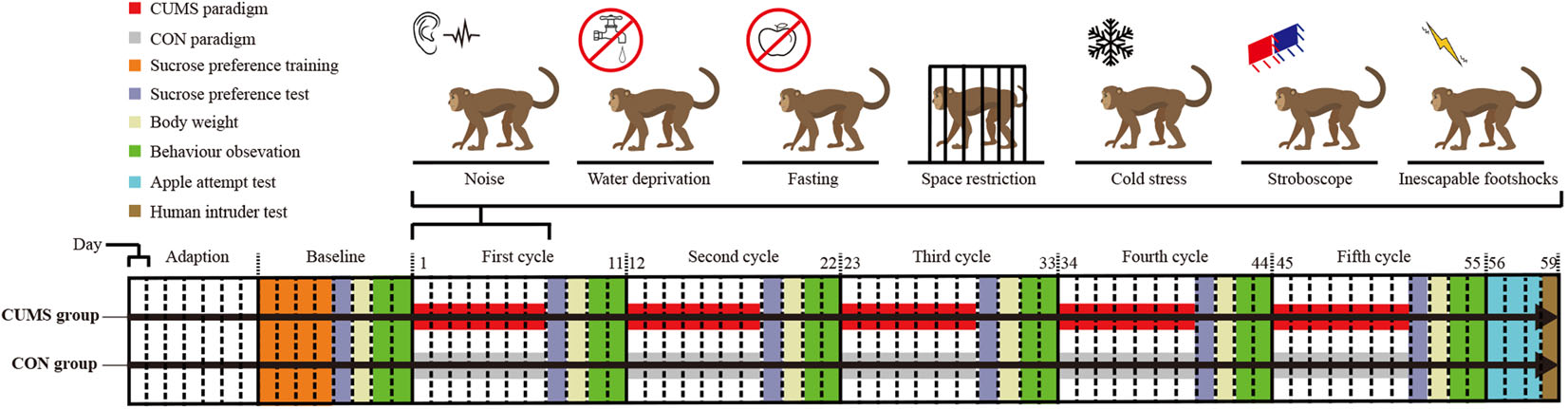
wake forest cruel monkey experimentsTeng, T., Shively, C.A., Li, X. et al. Chronic unpredictable mild stress produces depressive-like behavior, hypercortisolemia, and metabolic dysfunction in adolescent cynomolgus monkeys. Translational Psychiatry 11, 9 (2021). Creative Commons—Attribution 4.0 International—CC BY4.0
In a paper co-authored by Carol Shively of Wake Forest University, experimenters included this illustration outlining their plan to induce depression in monkeys by exposing them to numerous unpredictable stressors—from noise to food deprivation to cold stress to inescapable and repeated electric shocks to their feet.

What You Can Do

In 2021, Wake Forest raked in more than $123 million in federal taxpayer money, but it’s either incapable or unwilling to bring itself into compliance with minimum animal welfare regulations and guidelines. The school’s callousness and incompetence cause almost unimaginable pain to animals. It’s time that Wake Forest got out of the animal torture business and into the business of improving human health by adopting non-animal, human-relevant research methods.

You can join thousands of PETA supporters who have already called on Congress to stop throwing away taxpayer money on cruel, useless animal experiments and instead focus on modern, non-animal research methods.

The post Food Bowls Caked With Crud and Cats’ Skulls Cut Open at Wake Forest appeared first on PETA.
Steer’s Tail Twisted Until Broken; PETA Seeks Criminal Probe

PETA has obtained a U.S. Department of Agriculture report revealing a recent violation of law at Wilson Farm Meats in Elkhorn, in which a manager repeatedly twisted a steer’s tail—fracturing it so severely that bone apparently punctured the skin—while screaming expletives, causing the animal to cry out and bleed. In response, PETA sent a letter this morning to Walworth County District Attorney Zeke Wiedenfeld calling on him to review the matter and, as appropriate, file criminal cruelty-to-animals charges against the manager.

“This disturbing report shows that this steer experienced agonizing, prolonged pain at Wilson Farm Meats before his death,” says PETA Senior Vice President Daphna Nachminovitch. “PETA is calling for a criminal investigation on this steer’s behalf and urging everyone to help prevent more animals from suffering in slaughterhouses by going vegan.”

PETA—whose motto reads, in part, that “animals are not ours to eat”—opposes speciesism, a human-supremacist worldview. The group notes that cows, sheep, pigs, chickens, and other animals feel pain and fear and value their lives, just as humans do.

For more information on PETA’s investigative newsgathering and reporting, visit PETA.org or follow the group on Twitter, Facebook, or Instagram.

PETA’s letter to Wiedenfeld follows.

April 11, 2022

The Honorable Zeke Wiedenfeld

Walworth County District Attorney

Dear Mr. Wiedenfeld:

I hope this letter finds you well. I would like to request that your office (and the proper local law-enforcement agency, as you deem appropriate) investigate and file suitable criminal charges against the Wilson Farm Meats Inc. manager responsible for twisting a steer’s tail so severely that a vertebra inside apparently broke and punctured the skin—causing the animal to cry out repeatedly—on March 9 at its slaughterhouse located at 406 S. Wisconsin St. in Elkhorn. The U.S. Department of Agriculture’s Food Safety and Inspection Service (FSIS) documented the incident in the enclosed report, which states the following:

Establishment Manager, Mr. Justin Corman, was using loud, explicit language while twisting the tail of Hereford steer as [the animal] was repeatedly pulling [his] head out of the stunning area head restraint. IPP [Inspection Program Personnel] was able to see the employee’s arm rotating with the tail within the restrainer. IPP observed the animal vocalizing with [his] mouth open, tongue hanging out, and eyes bulged. … When IPP moved closer, the establishment manager stopped tail twisting and was … smacking the rump with his hands. The hand smack was audible but the steer did not respond. … IPP stepped off the floor briefly to contact his supervisor for clarification. While off the floor, he heard the animal vocalizing again. Once he got back to the floor, the animal was effectively stunned and unconscious. He noticed that there was fresh blood on the back of the stunning area (away from the head). … Upon inspection, IPP noticed blood at the end of the animal[’]s white tail. … Upon her inspection, [a Supervisory Public Health Veterinarian] confirmed that there was fresh blood on the tail and on the restrainer. There was a small open wound in the hide (approximately ½ inch) about 2–2.5 inches from the tip of the tail. When running her fingers over the wound, it was not smooth, there was a noticeable bump consistent with a break. The tail was then examined after dehiding. The injured tail was red and bruised in the same area where the wound was observed with the hide on. The bruised area was also curved and flexible, consistent with a fractured tail.2

This conduct appears to violate Wis. Stat. § 951.02. Importantly, FSIS’ action carries no criminal or civil penalties and does not preempt criminal liability under state law for slaughterhouse workers who perpetrate acts of cruelty to animals.2

Please let us know what we might do to assist you. Thank you for your consideration and for the difficult work that you do.

Sincerely,

Colin Henstock

Assistant Manager of Investigations

1FSIS District 25 Manager Dawn Sprouls, D.V.M., Notice of Suspension, Wilson Farm Meats, Inc. (March 9, 2022) https://www.fsis.usda.gov/sites/default/files/media_file/2022-03/M34554-NOS-03092022.pdf. Last accessed March 22, 2022.

2See Nat’l. Meat Assoc. v. Harris, 132 S. Ct. 965, 974 n.10 (2012) (“States may exact civil or criminal penalties for animal cruelty or other conduct that also violates the [Federal Meat Inspection Act (FMIA)]. See [21 U.S.C.] §678; cf. Bates v. Dow Agrosciences, LLC, 544 U.S. 431, 447 (2005), holding that a preemption clause barring state laws ‘in addition to or different’ from a federal Act does not interfere with an ‘equivalent’ state provision. Although the FMIA preempts much state law involving slaughterhouses, it thus leaves some room for the States to regulate.”).

The post Steer’s Tail Twisted Until Broken; PETA Seeks Criminal Probe appeared first on PETA.

22 Million Birds Slaughtered en Masse Amid Nationwide Bird Flu Outbreak

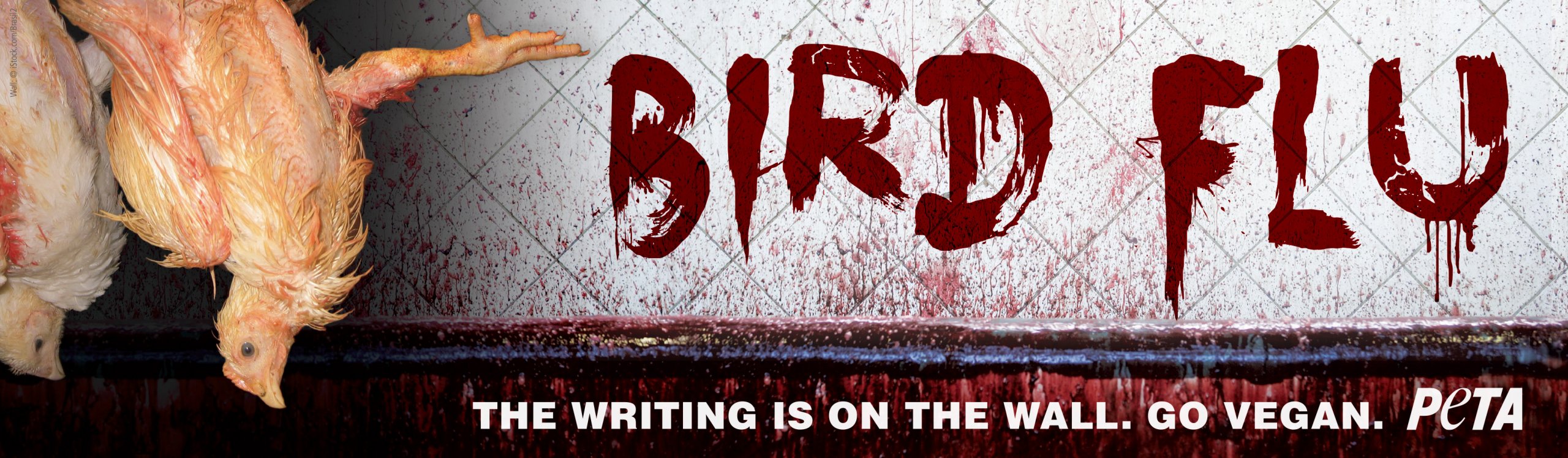
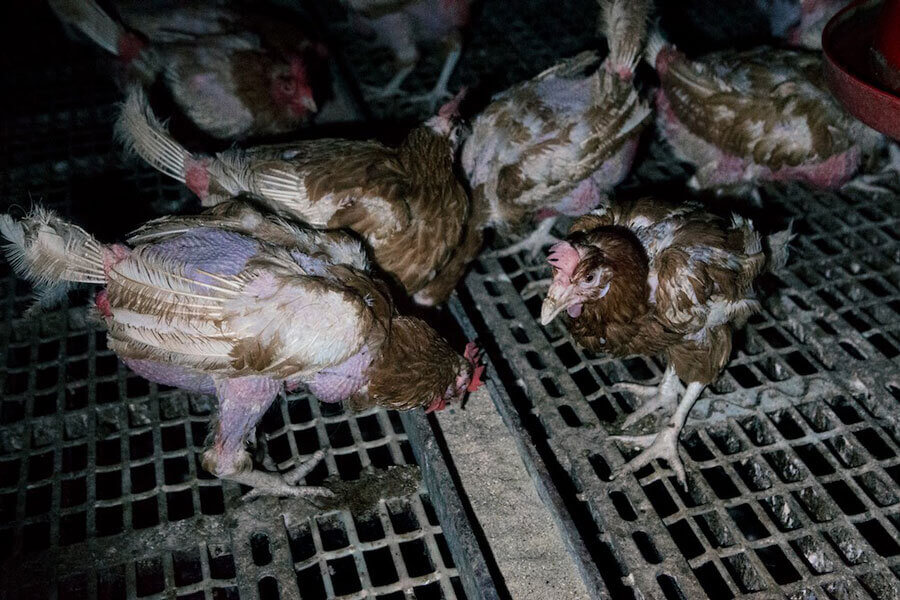
Avian influenza—or “bird flu”— is ripping through the U.S., and more than 22 million chickens and turkeys have been killed in cruel ways since February 2022 in a futile attempt to stop the virus from spreading like wildfire across the country.

Outbreaks have been reported on commercial and “backyard” farms in at least 24 states, and once an animal is determined to have the bird flu, the entire flock is killed.

In the U.S., farms may slaughter farmed animals en masse for “disease control” in horrific ways: Some companies kill birds with a water-based foam, slowly suffocating them to death (sometimes for up to 14 minutes). Others kill animals by shutting off all ventilation in the sheds in a process known as “ventilation shutdown” (VSD), which sometimes incorporates heat, humidity, and carbon dioxide (known as “VSD Plus”)—suffocating them and baking them alive. Egg farms typically gas the birds to death.

photo of chickens on factory farm

As long as the poultry and egg industries continue to raise sensitive birds for slaughter—typically cramming tens of thousands of chickens into filthy, windowless sheds, which are breeding grounds for disease outbreaks—this will keep happening. The best form of disease control on farms and at other facilities—including ones that falsely label their products as “free-range” or “organic”—is for them to stop raising and killing animals for food.

You can help spare animals, decrease the risk of future pandemics, protect the environment, and more by going vegan.

Take Action for Our Fellow Animals Killed in Cruel Ways for ‘Disease Control’

Our fellow animals don’t want to be killed under any circumstance, but the least farms can do is not use extremely cruel and painful methods to slaughter them for “disease control.” The American Veterinary Medical Association (AVMA) still lists VSD and VSD Plus as “permitted in constrained circumstances,” even though they can cause other animals to suffer in agony for hours. Tell the AVMA that these methods of killing are never acceptable, and urge it to not allow them to be used in the future:

The post 22 Million Birds Slaughtered en Masse Amid Nationwide Bird Flu Outbreak appeared first on PETA.