PETA created a tasty campaign to gotell it on the mountain, over the hills, and everywhere that the single best way to celebrate Earth Day each year is to go vegan. To help spread that message in 2022, businesses from coast to coast participated in the effort to encourage people to eat vegan for the day, at least.
Below, see just a few examples of businesses that participated in PETA’s “Go Vegan for the Earth” Day push this year—then learn how you can carry on the legacy of this animal- and eco-friendly holiday each and every day.
Lincoln Market and Royal Market in New York City advertised vegan products for Earth Day in their online circulars:
Huckleberry’s Natural Market in Spokane, Washington, did the same:
Algorithm Restaurants in Philadelphia held a vegan hot wing challenge, featuring hot sauces by Mammoth Sauce Co. and FAIYA, and encouraged followers on social media to go vegan for Earth Day:
Foodflo and Fresh n’ Lean promoted their humane and environmentally friendly vegan meal delivery services with the #VeganForEarthDay hashtag and image:
As part of the Earth Day push, PETA also placed pro-vegan ads on buses in New Orleans and Louisville, Kentucky. In Birmingham, Alabama, a PETA supporter showered on the sidewalk to highlight how animal agriculture drains freshwater supplies and pollutes groundwater, lakes, and rivers.
A PETA member in Alabama showered outdoors to show how the meat and dairy industries guzzle water and fuel the climate catastrophe.
Animal agriculture is also the leading cause of ocean dead zones, species extinction, and habitat destruction—and by some estimates, it creates more greenhouse gas emissions than all the world’s transportation systems combined.
Take Action for the Planet and Animals Every Day
Every vegan saves 1,100 gallons of water, nearly 40 pounds of grain, and 30 square feet of forested land each day. So if planet Earth means the world to you (see what we did there?), follow the example that these businesses set on Earth Day and do it a favor: Go vegan!
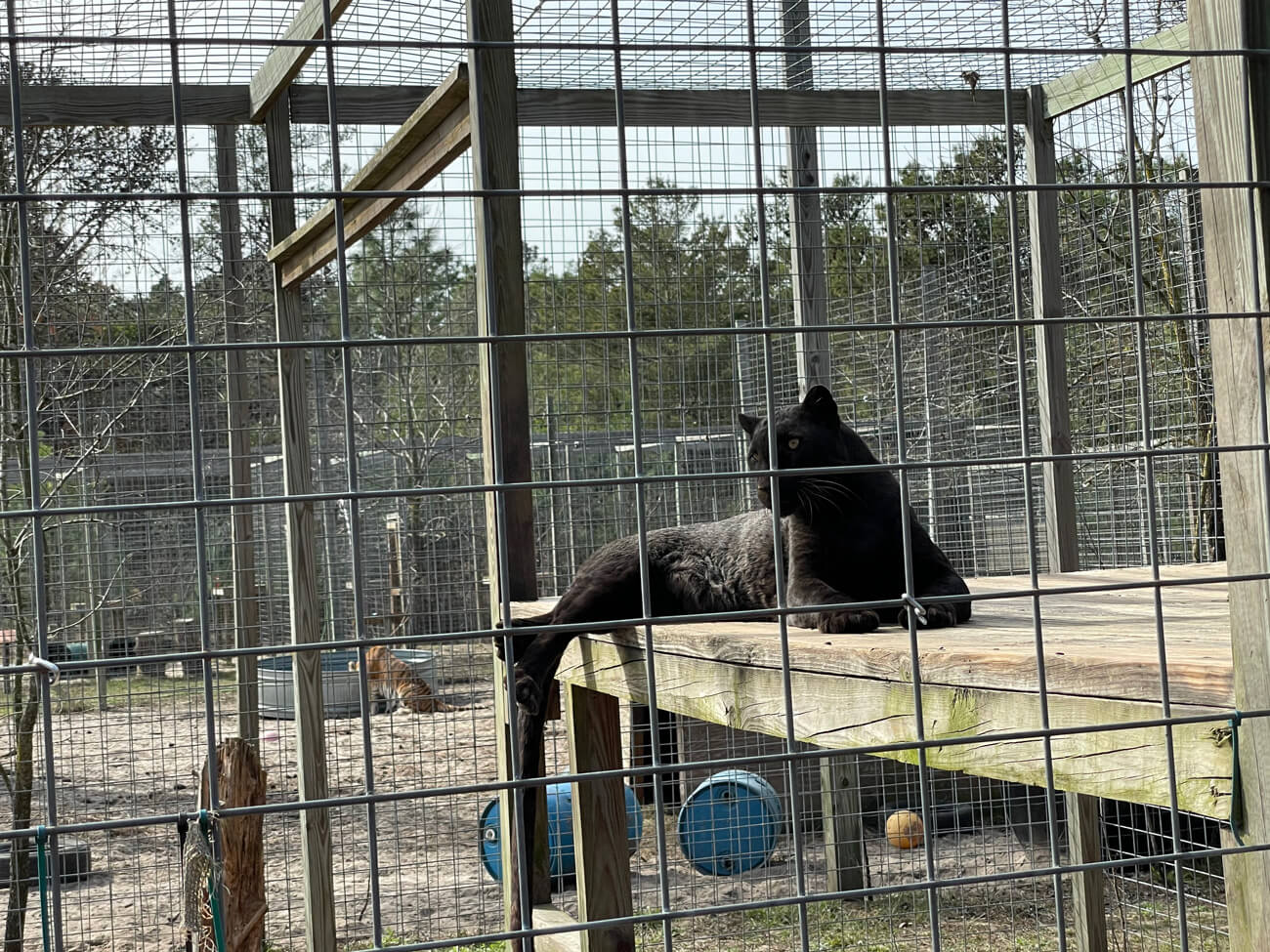
We’ve got our sights set on helping animals at Single Vision. After PETA reported an incident in which a member of the public held a juvenile jaguar at the roadside zoo in Melrose, Florida, the U.S. Department of Agriculture (USDA) cited the facility over that incident and dozens of other public encounters with adult big cats and other wild animals. The agency also cited Single Vision—which has received nearly 20 citations in just two years—for lying to federal authorities, providing fraudulent documentation of a veterinary care program, and failing to provide two thin, geriatric tigers and other animals with adequate veterinary care.
Single Vision has repeatedly put animals and visitors at risk of injury and even death. It’s one of only a few roadside zoos left in the U.S. still offering harmful cub-petting encounters, which rely on tearing vulnerable cubs away from their mothers.
PETA is urging Single Vision to end its pattern of neglect, recklessness, and dishonesty by sending the animals to accredited sanctuaries.
USDA Report Reveals Dangerous Encounters With Animals at Single Vision
The USDA’s inspection report details more than 30 incidents shared on social media revealing that members of the public engaged in hands-on interactions with animals at Single Vision without any safety barriers in place. A child was allowed to swim with juvenile lion cubs, a visitor touched a bear’s muzzle, a bear reached through enclosure wire to remove someone’s sunglasses, and “rowdy bears” were seen “continuously nipping at the public members’ clothing, hands and hair.”
According to the report, federal inspectors also found a hyena living in the home of the Single Vision licensee, animals in shoddy enclosures in need of repair, and animals living near an “accumulation of feces.”
What You Can Do
Please urge Single Vision to end its cruel public encounters and send the animals to reputable facilities where they could live in vast, lush habitats and get the care that they deserve.
This morning, PETA sent a letter to Meg Ham, president of locally based Food Lion, asking her to reexamine the company’s relationship with chicken supplier Wayne Farms—the seventh-largest poultry producer in the U.S.—in light of video footage from a whistleblower revealing that unprofitable, injured, and overlooked chicks at a hatchery in Georgia were kept in stacked, filthy crates for prolonged periods before being dropped into a macerator and ground up alive. If the whistleblower hadn’t taken the initiative to check the crates each day, the chicks allegedly would have suffered into the following day before being killed. Grinding up unwanted chicks is standard practice in the chicken industry.
“The video footage is shocking and shows that injured chicks were left to suffer before being dumped alive into a grinder as if they were trash,” says PETA Vice President of Evidence Analysis Dan Paden. “PETA urges Wayne Farms’ customers to reexamine their ties to this company, and we remind the public that the only truly humane meal is a vegan one.”
In response to the allegations, PETA also sent letters to other grocery chains doing business with Wayne Farms—including Whole Foods, Walmart, and Harris Teeter—calling on them to reconsider their relationship with the supplier, which markets its chicken flesh as “humane” and boasts that animal welfare is “always a top priority.”
PETA—whose motto reads, in part, that “animals are not ours to eat”—opposes speciesism, a human-supremacist worldview. For more information on PETA’s investigative newsgathering and reporting, please visit PETA.org or follow the group on Twitter, Facebook, or Instagram.
17 Monkeys Changed One Cop’s Life Forever—Read How!
Order the 30th anniversary edition of Free the Animals by Ingrid Newkirk and read the thrilling real-life stories of the boldest animal rescues in U.S. history.
A mother’s worst nightmare is for her babies to be taken away from her, but that’s exactly what many mother bears endure when used as baby-making machines for roadside zoos. Yellowstone Bear World, Oswald’s Bear Ranch, and Cherokee Bear Zoo all keep baby bears away from their mothers and exploit them as photo props or for bottle-feeding and cub-petting encounters with the public.
The bear cubs are torn away from their moms when they’re just weeks old, sometimes before they even see their mothers, as bears don’t open their eyes for the first four to six weeks. In nature, they would be in their mother’s protective and nurturing care for up to two years. But they’re denied that opportunity at roadside zoos, where the premature maternal separation can result in lifelong psychological distress and behavioral abnormalities.
The cub-petting industry tears families apart. Some bear cubs are shipped off to exotic-animal dealers or other roadside zoos, and some are forced to endure the groping hands of strangers while they want nothing more than to rest. When they outgrow their profitability, some are reportedly sent to slaughter, likely to make room for next year’s cubs, and the cycle of abuse continues: More mothers and babies are traumatized, all so that humans can get photos with these sensitive cubs.
Take action below to urge Yellowstone Bear World, Oswald’s Bear Ranch, and Cherokee Bear Zoo to stop exploiting bear cubs.
Yellowstone Bear World
Yellowstone Bear World in Idaho breeds black bears and forces their babies into public photo ops and bottle-feeding encounters. Some cubs have been taken away from their mothers forever and shipped across the country to other animal exploiters, including the infamous “Joe Exotic” of Tiger King. Yellowstone Bear World has also shipped 87 black bears, including three cubs in 2022, to the exotic-animal wholesaler Gregg Woody, who has sent dozens of bears to slaughter over the last two decades.
Urge Yellowstone Bear World to stop breeding bears and taking babies away from mothers—and to end cub photo ops and other public encounters:
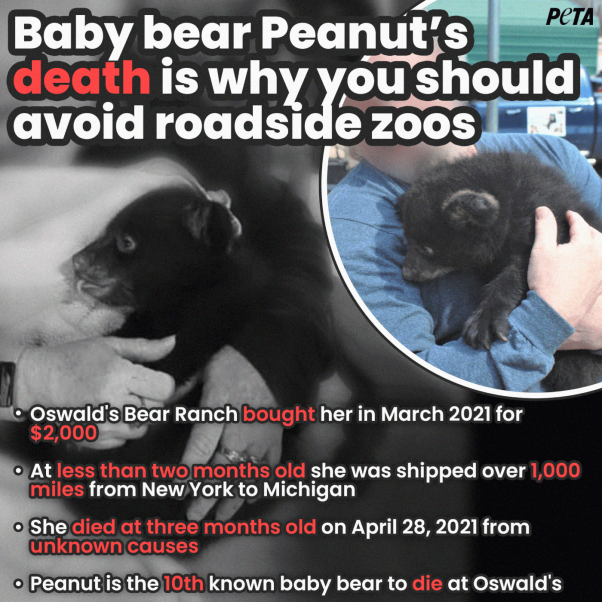
Oswald’s Bear Ranch in Michigan regularly purchases cubs who were torn away from their mothers, exploits them as photo props, and confines them to concrete-floored pens. The facility is apparently responsible for the deaths of more than a dozen cubs, two of whom—Peanut and “Pink String”—died when they were only a few months old.
It’s the industry norm for cubs to travel thousands of miles and, in some cases, to exchange hands multiple times. For instance, “Pink String” was born at Yellowstone Bear World, sent to Gregg Woody, shipped to Animal Entertainments Inc. (an exotic-animal dealer in Wisconsin), and then sold to Oswald’s. These babies have to endure the danger and stress of being trucked thousands of miles from state to state at an age when they should still be with their mothers in their dens—they’re barely able to walk on their own!
Please tell Oswald’s to send the remaining bears to accredited sanctuaries before more die.
Cherokee Bear Zoo in North Carolina imprisons bears in concrete pits, breeds them, and uses their cubs or acquires cubs from other disreputable operations for photo ops. When those cubs become too big to interact with humans, the roadside zoo either ships them off to other dingy facilities or relegates them to the same barren concrete pits that the older bears are in, where they have nothing to do but stare at the walls, pace in circles, and beg for food. Some of the bears suffer from early-onset arthritis and have been seen struggling to walk due to being forced to live on concrete. Bears belong in nature, where they can roam for miles, forage for a variety of food, and live happily with members of their family.
Mail a letter to Cherokee Bear Zoo owners Barry and Collette Coggins urging them to release all the bears to an accredited sanctuary where they won’t be confined to barbaric pits and cubs won’t be used as photo props:
Please feel free to use our sample letter below, but remember that using your own words is always more effective.
Sample Letter Subject Line
Please stop exploiting cubs and close the bear pits immediately
Sample Letter Content
Dear Mr. and Mrs. Coggins:
Gigi, Coco, Sugar, Yogi, Leo, and all the other cubs didn’t ask to be taken from their mothers, used as props for human entertainment, and then dumped into a concrete pit or shipped off to other roadside zoos. No animal deserves to be treated like this. These cubs should have been playing, exploring, learning, socializing, and bonding with their mothers.
Please end your practice of using cubs for photo ops and close the bear pits immediately. There’s no excuse for confining bears to concrete pits that a district court judge found “archaic.” They’re miserable in these pits, with nothing to do but walk in circles and beg tourists for food.
Accredited sanctuaries stand ready to take in these bears. There, they could roam vast acreage, forage for their own food, and act on their natural instincts. They didn’t choose to live in concrete pits, but you can choose to have a different business—one that doesn’t profit from animals’ suffering. The bears are depending on you to let them have a better life. Please allow them to go to an accredited sanctuary. Thank you.