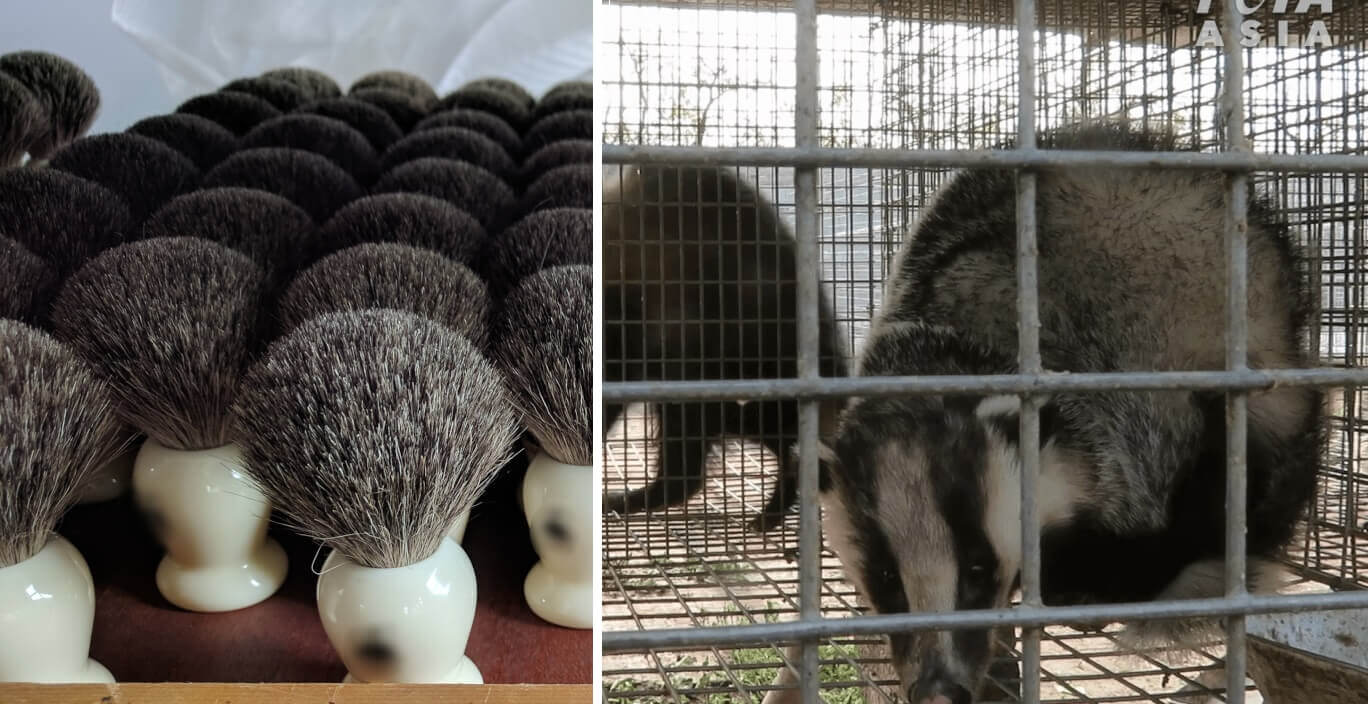
Victory! Companies Ban Badger-Hair Brushes After Shocking PETA Exposé

After PETA shared a horrifying video exposé of China’s badger-brush industry with Procter & Gamble – which owns The Art of Shaving – it quickly agreed to stop sourcing badger hair immediately.

Since hearing from PETA, 100 brands have said NO to this bloody business, including Edgewell Personal Care, the owner of brands such as Wilkinson Sword, Schick, and Skintimate.

  • 1Beauty.us
  • Baxter of California
  • Beau Brummell
  • Beauty4Pros
  • Bestt Liebco
  • Bevel
  • Bob Ross, Inc.
  • Bonanza
  • Braun Brush
  • Bulldog
  • Caswell-Massey
  • Claudio Riaz
  • Cremo
  • Crown
  • Czech & Speake
  • The Executive Shaving Co.
  • Fine Accoutrements
  • Floris London
  • FM Brush Company
  • French Kiss Cosmetics
  • Garden City Essentials
  • GENTS/GBS
  • The Good Liver
  • Grooming Lounge
  • Jack Black
  • Kent Brushes
  • L’Oréal Group
  • LovelySkin
  • MinWax
  • Morphe
  • My Makeup Brushes
  • NARS Cosmetics
  • The New York Shaving Company
  • Olivina Men
  • Overstock.com
  • Penhaligon’s
  • Personna
  • Phoenix Shaving
  • Pomades
  • Procter & Gamble (The Art of Shaving)
  • Prospector Co.
  • Purdy
  • Royal Brush Manufacturing
  • RoyalShave
  • Schick
  • SHANY Cosmetics
  • Sherwin-Williams
  • Silver Brush Limited
  • Skintimate
  • The Stache
  • The Executive Shaving Co.
  • The Good Liver
  • The New York Shaving Company
  • The Stache
  • The Vermont Country Store
  • Unique Bargains
  • Universal Beauty
  • Valspar
  • Van Der Hagen
  • The Vermont Country Store
  • Wilde & Harte
  • Wilkinson Sword

Badger hair brush bans

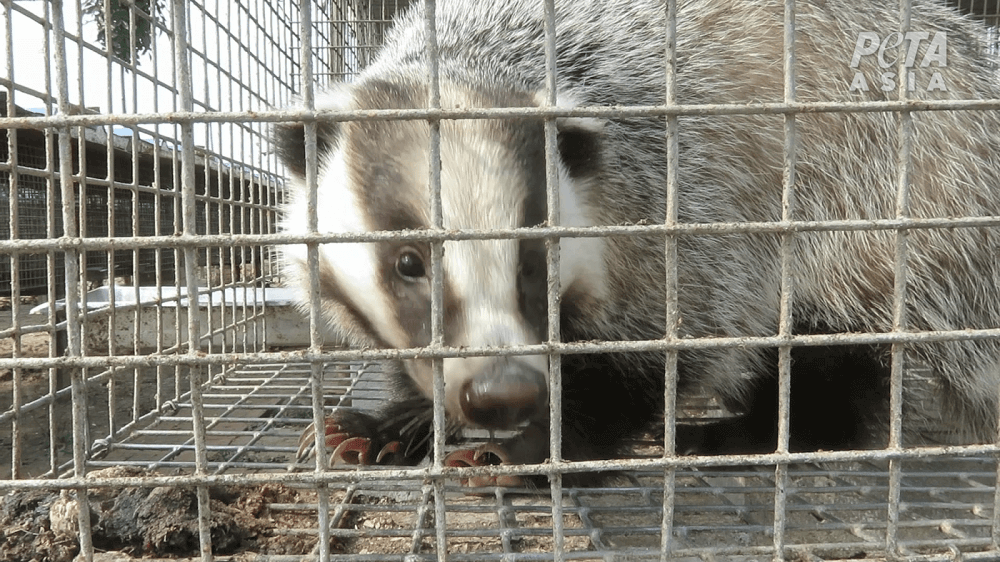
PETA’s exposé—which is the first of its kind—shows badgers on the farms held in tiny wire cages exposed to the elements. The stressful conditions often caused badgers to exhibit behavior patterns indicative of severe psychological distress, such as pacing back and forth. Many badgers suffered from untreated injuries, and one was even missing a foot, which the farm owner attributed to a fight with another badger caged nearby.

At the slaughterhouse, workers beat crying badgers over the head with anything that they can find, including a chair leg, before slitting their throats. One animal continued to move for a full minute after their throat was cut.

Badgers are extremely social animals who, in nature, construct elaborate underground burrow systems, some of which are centuries old and have been inhabited by many generations of the same clan. They are fastidious and have separate rooms for sleeping and giving birth as well as designated outside “bathroom” areas.

Sure, humans may look different from badgers, but when it comes to the ability to feel excitement, create family bonds, cherish life, and experience pain, we’re all the same. They are individuals who deserve to live their complex lives on their own terms, not inside a prison cage while awaiting death. Their skin, fur, and hair belong to them alone.
You Can Help Save Badgers Right Now

There’s no justification for stealing others’ hair to make brushes. For the sake of badgers suffering on farms, please, buy only cruelty-free, synthetic brushes. Click the button below to urge Dick Blick Art Materials to drop badger-hair brushes immediately in favor of cruelty-free synthetic ones.

The post Victory! Companies Ban Badger-Hair Brushes After Shocking PETA Exposé appeared first on PETA.

Little Free Library Ribbon-Cutting Brings Together Burgwyn Family, Author Shelia P. Moses, and PETA

The family of the late Margaret Burgwyn will join writer Shelia P. Moses and PETA representatives as they cut the ribbon on a new Little Free Library, dedicated to Burgwyn and donated by PETA for Moses’ Northampton County Little Free Library Project. Because this Little Free Library is outside a retirement community and near a Head Start office, it will offer books for both adults and children, provided by the Burgwyn family and PETA’s Barks & Books program, which gives away children’s books with messages of compassion for animals.

When:    Tuesday, June 14, 11 a.m.

Where:    Woodland Olney Apartments, 507 W. Main St., Woodland

“Margaret Burgwyn devoted her life to education and community service. The animal-friendly books in this Little Free Library will pass on her values by offering lessons in empathy for children and adults alike,” says PETA Senior Vice President Daphna Nachminovitch. “It’s PETA’s honor to support the Northampton County Little Free Library Project and readers of all ages in the area.”

The Northampton County Little Free Library Project was designed to help put books into the hands of every family in the county, with the hope of benefiting generations to come. PETA previously donated the Doris Majette Little Free Library outside Cuz Mini-Mart in Garysburg and the Bishop Little Free Library in Rich Square. Its other work in Northampton County includes more than 20 years of helping families care for dogs by delivering sturdy wooden doghouses, insulating straw bedding, and nutritious food; providing preventive care, such as deworming, flea, and flystrike treatment; and transporting animals to and from spay/neuter surgeries—all free of charge.

The live ribbon-cutting ceremony, which will be broadcast on Moses’ Facebook Live page, will honor Burgwyn for her work in education, particularly her work at Paul D. Camp Community College, Roanoke-Chowan Community College, and Halifax Community College and as an elementary school counselor in Northampton County Schools. Later in life, Burgwyn—who held degrees from the University of North Carolina–Chapel Hill and Appalachian State University—served the Woodland community as mayor and town commissioner.

For more information, please visit PETA.org or follow the group on Twitter, Facebook, or Instagram.

The post Little Free Library Ribbon-Cutting Brings Together Burgwyn Family, Author Shelia P. Moses, and PETA appeared first on PETA.

Federal Documents Confirm PETA’s Allegations of Abuse in UAB’s Baboon Organ Transplant Lab

Newly obtained federal documents corroborate PETA’s allegations of acute animal suffering and violations of federal animal welfare regulations and guidelines at the University of Alabama-Birmingham (UAB), including inside the xenotransplantation laboratory, in which the organs of genetically modified pigs are transplanted into baboons. Records show that UAB experimenters failed to comply with veterinary standards of practice, failed to ensure that medications administered to animals had not expired, and failed to maintain adequate records and even falsified records

PETA filed a complaint in 2020 after a whistleblower provided evidence on a host of problems in the transplant lab, including that the transplant of a kidney from a genetically modified pig into the body of a female baboon named Laja caused pockets of fluid to collect under her skin along the incision site and that experimenters apparently applied a syringe of Woolite laundry detergent to the wound. Federal reports confirm that “a detergent for cleaning topical areas on animals [was used instead of] a more appropriate … product.”

Earlier this year, this same laboratory was involved in the transplant of kidneys from pigs into a brain dead human.

PETA is now calling on university President Ray L. Watts to address the incompetence and chronic neglect and bar experimenters who violate regulations from testing on animals and to implement PETA scientists’ Research Modernization Dealing, a strategy to ending failed animal experiments and implement modern, animal-free research methods.

“UAB experimenters apparently don’t care at all about regulations, animal suffering, or good science,” says PETA Vice President Dr. Alka Chandna. “PETA is calling on President Watts to embrace our Research Modernization Deal and replace useless animal experiments with modern, animal-free technology.”

The reports also reveal dozens of additional incidents in which UAB experimenters failed to comply with federal animal welfare guidelines between February 2018 and December 2021. Among other serious issues, UAB experimenters failed to provide more than 400 animals who were used in surgeries or other painful procedures with adequate pain relief. In fiscal year 2021, UAB received more than $327 million in taxpayer money from the National Institutes of Health, and half of that is estimated to have funded experiments on animals.

PETA—whose motto reads, in part, that “animals are not ours to experiment on”—opposes speciesism, a human-supremacist worldview. For more information on PETA’s investigative newsgathering and reporting, please visit PETA.org or follow the group on Twitter, Facebook, or Instagram.

The post Federal Documents Confirm PETA’s Allegations of Abuse in UAB’s Baboon Organ Transplant Lab appeared first on PETA.