Heads Up! Commanders Fans to Catch Vegan Messaging Blitz

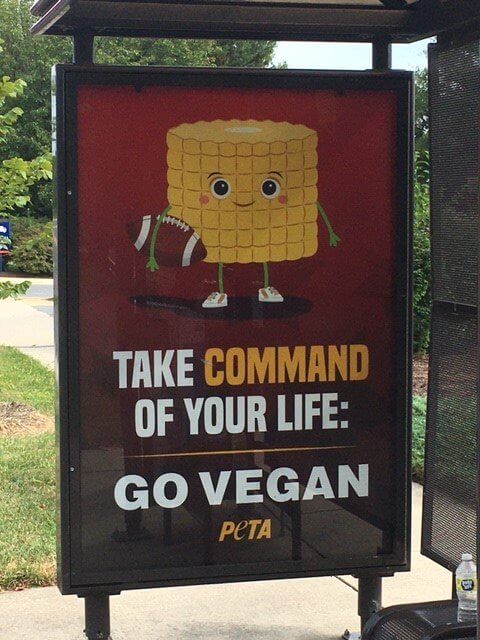
As the Washington Commanders kick off the season, PETA has plastered bus shelters near FedExField with can’t-miss messages encouraging fans to “take command” of their lives by going vegan—a move that saves nearly 200 animals a year per person and can help everyone avoid the health penalties of eating meat, including heart disease, diabetes, strokes, obesity, and various forms of cancer.

“The animals who become burgers, bacon, and Buffalo wings are smart, sensitive individuals who want to live as much as we do,” says PETA President Ingrid Newkirk, a vegan for almost 50 years. “PETA’s appeal reminds football players and fans that everyone wins when we choose vegan meals, which are good for animals, our arteries, and the planet.”

In addition to sparing animals a terrifying death, each person who goes vegan shrinks their carbon footprint and their risk of developing America’s top (appropriately named) “killer diseases,” like cancer and heart disease. Meat and milk contain no fiber whatsoever and are packed with artery-clogging saturated fat and cholesterol, while eggs are cholesterol bombs.

Chickens killed for their flesh are crammed by the tens of thousands into filthy sheds and bred to grow such unnaturally large upper bodies that their legs often become crippled under the weight. Pigs’ tails are chopped off, their teeth are cut with pliers, and males are castrated—all without any painkillers. At slaughterhouses, workers shoot cows in the head with a captive-bolt gun, hang them up by one leg, cut their throats, and skin them.

The messages can be found at bus shelters on Sheriff Road at its intersection with Village Green Drive and on Brightseat Road at its intersections with Evarts Street and Harry S Truman Drive.

PETA—whose motto reads, in part, that “animals are not ours to eat”—opposes speciesism, a human-supremacist worldview. For more information, please visit PETA.org or follow the group on Twitter, Facebook, or Instagram.

#

The post Heads Up! Commanders Fans to Catch Vegan Messaging Blitz appeared first on PETA.
AELF FlightService’s Illegal Monkey Shipment Prompts PETA Complaint to Feds

Armed with information that Maleth Aero reportedly shipped 360 endangered long-tailed macaque monkeys this month from Cambodia to Houston, ultimately destined for a notorious Alice, Texas, monkey facility, PETA filed a complaint with the U.S. Department of Agriculture (USDA) calling for an urgent investigation. Maleth Aero, acquired by AELF FlightService in 2021, allegedly transported the monkeys despite failing to possess a carrier registration through the USDA, which constitutes a clear violation of the federal Animal Welfare Act (AWA). This is the second airline in as many months that appears to be flying monkeys into the U.S. illegally.

PETA filed a complaint on August 23 with the USDA after learning that Hainan Airlines reportedly illegally shipped 720 monkeys to another facility in Alice in August—even though the USDA had canceled the airline’s registration in May, making this shipment another apparent violation of the AWA. Both Alice facilities are operated by Inotiv, whose notorious Envigo beagle-breeding facility was recently shut down following PETA’s exposure of its horrific treatment of dogs.

Long-tailed macaques are now recognized as an endangered species by the International Union for Conservation of Nature—in large part due to their trapping and exploitation as part of the international wildlife trade to U.S. laboratories, where they’re mutilated, poisoned, deprived of food and water, forcibly immobilized in restraint devices, infected with painful and deadly diseases, psychologically tormented, and killed. Many are imported from filthy farms in Asia and can harbor infectious zoonotic diseases.

“Hundreds of terrified, endangered monkeys were crammed into wooden crates and forced to endure a long, harrowing journey, only to end up in a laboratory. These monkeys will never return to the forests of Asia,” says PETA Senior Vice President Kathy Guillermo. “AELF FlightService is not above the law, and PETA is calling on the USDA to investigate this company’s reported shady monkey shipments, for everyone’s sake.”

PETA is also asking the USDA to investigate AELF FlightService for possibly illegally transporting monkeys on flights in August from Vietnam and Cambodia to Dulles International Airport outside Washington, D.C.

PETA—whose motto reads, in part, that “animals are not ours to experiment on”—opposes speciesism, a human-supremacist worldview. For more information on PETA’s newsgathering and reporting, please visit PETA.org or follow the group on Twitter, Facebook, or Instagram.

#

The post AELF FlightService’s Illegal Monkey Shipment Prompts PETA Complaint to Feds appeared first on PETA.

This Is Why the Taiji Dolphin Slaughter Exists—and How We Stop It

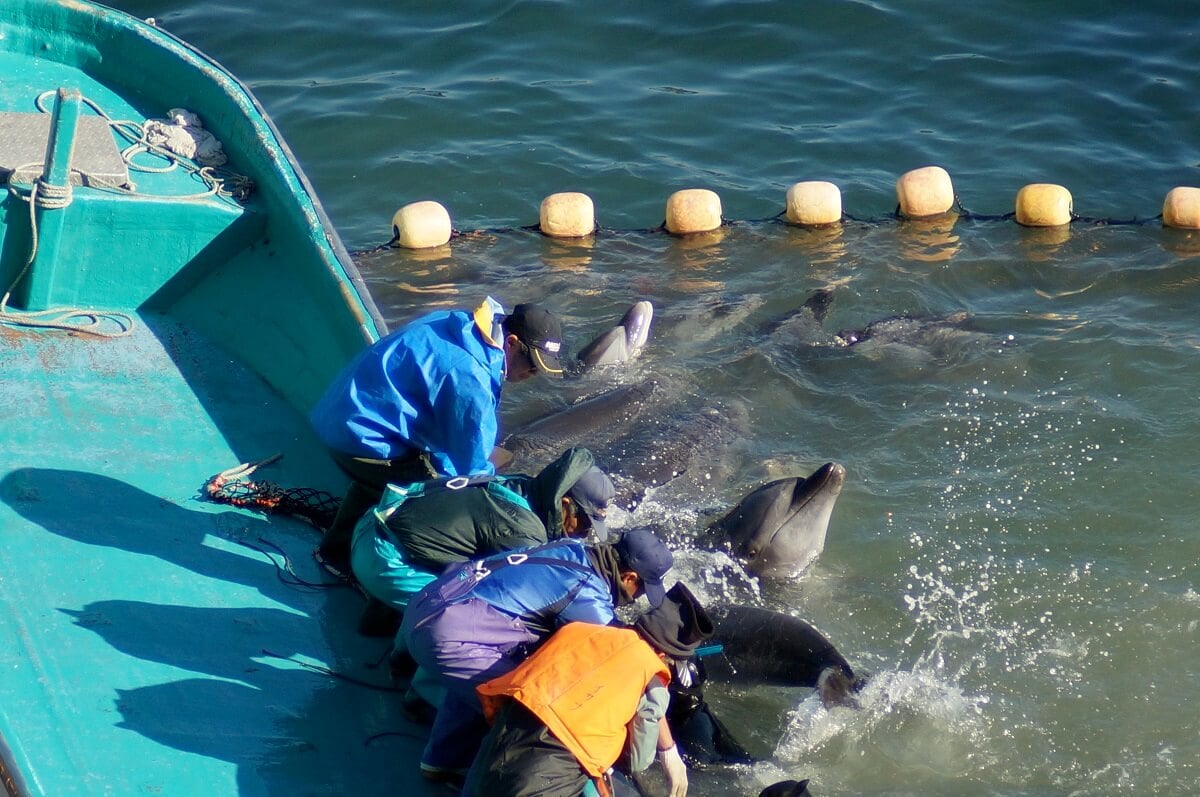
On the first day of September every year, the Taiji dolphin slaughter begins. For six months, dolphin-hunting vessels sail out of Taiji, Japan; hunt down pods of wild dolphins; surround them; and drive them back toward land to the infamous killing cove.

Taiji Dolphin Slaughter and Capture

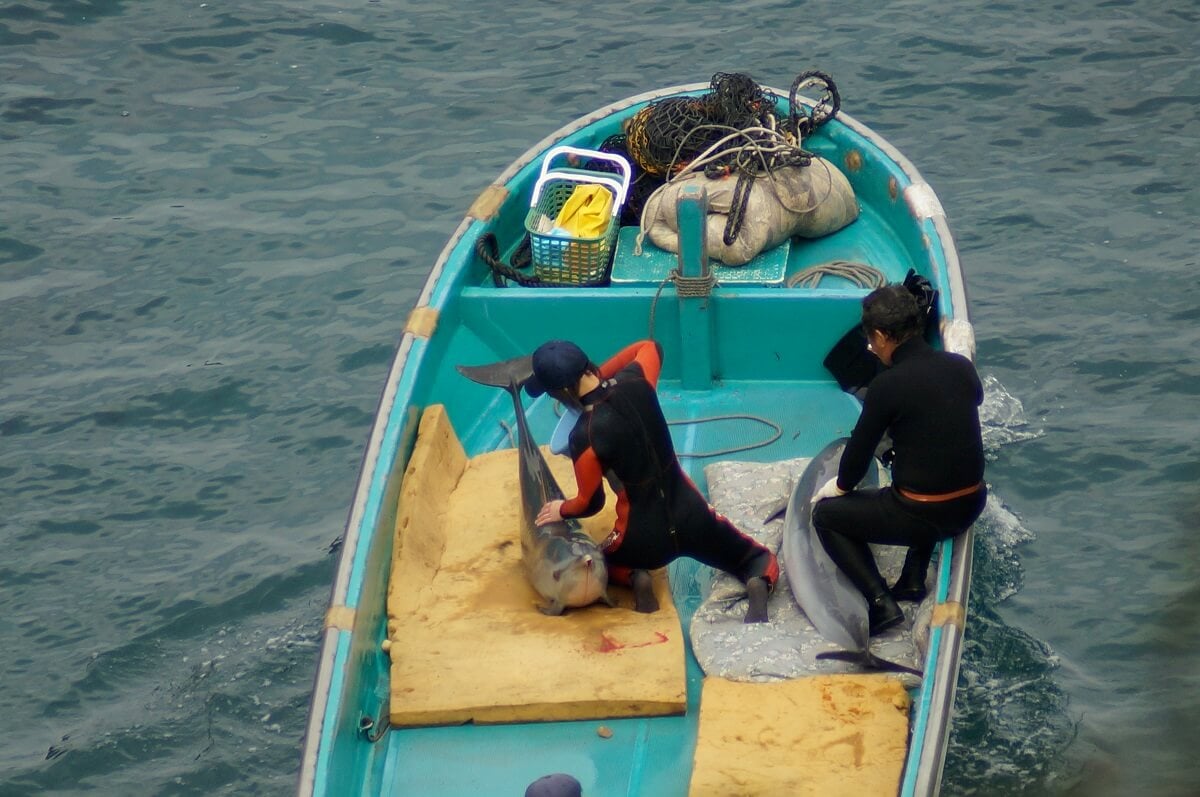
Once in the cove, dolphin hunters snare the animals with nets and drag them to shore for the selection process. Dolphin trainers work with the hunters to choose the youngest and most attractive—the ones who will be sold to marine parks and “swim with dolphins” encounters. Pod members try to fight them off and protect one another, but their efforts are in vain. This mother was unable to save her baby:

Those who aren’t chosen also face a cruel fate. Hunters—and sometimes even trainers—kill them by hammering metal rods into their spinal cords just below the blowhole. They then remove the rods and replace them with corks to keep the water in the killing cove from turning bright red. Dolphins die slowly and painfully of hemorrhaging or suffocation while watching their family members and podmates die around them. Their flesh is then sold as meat.

Taiji Dolphin Slaughter and Capture

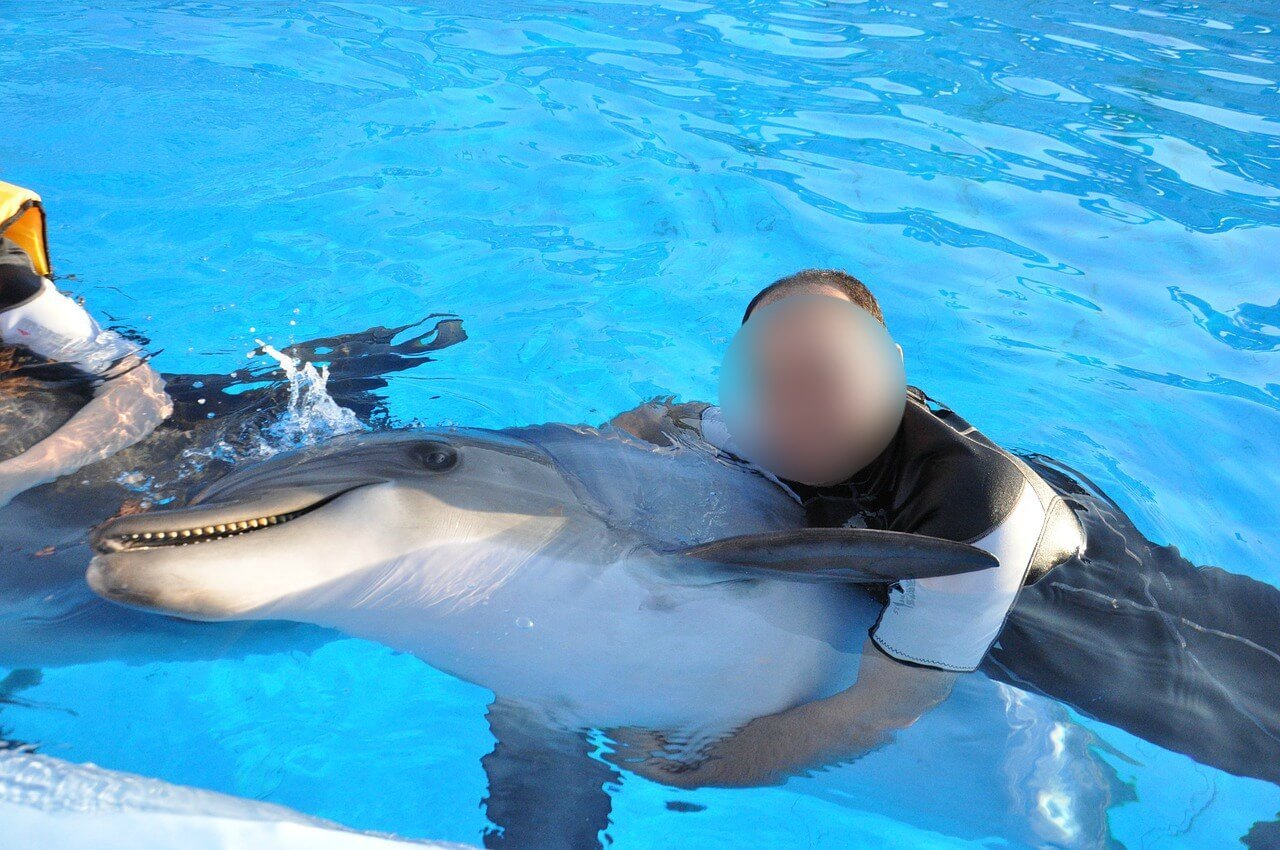
This deadly spectacle takes place only because tourists want to pet dolphins and take pictures with them.

The captive-dolphin industry directly funds the Taiji dolphin slaughter. A single dolphin can sell for as much as $152,000. Even in countries that no longer allow the importation of dolphins caught during the gruesome slaughter, marine parks and “swim with dolphins” facilities can still display animals purchased before the ban. Animals can also be moved through other countries to disguise their origin. And exhibitors that claim not to purchase from Taiji often still have hidden connections to the slaughter.

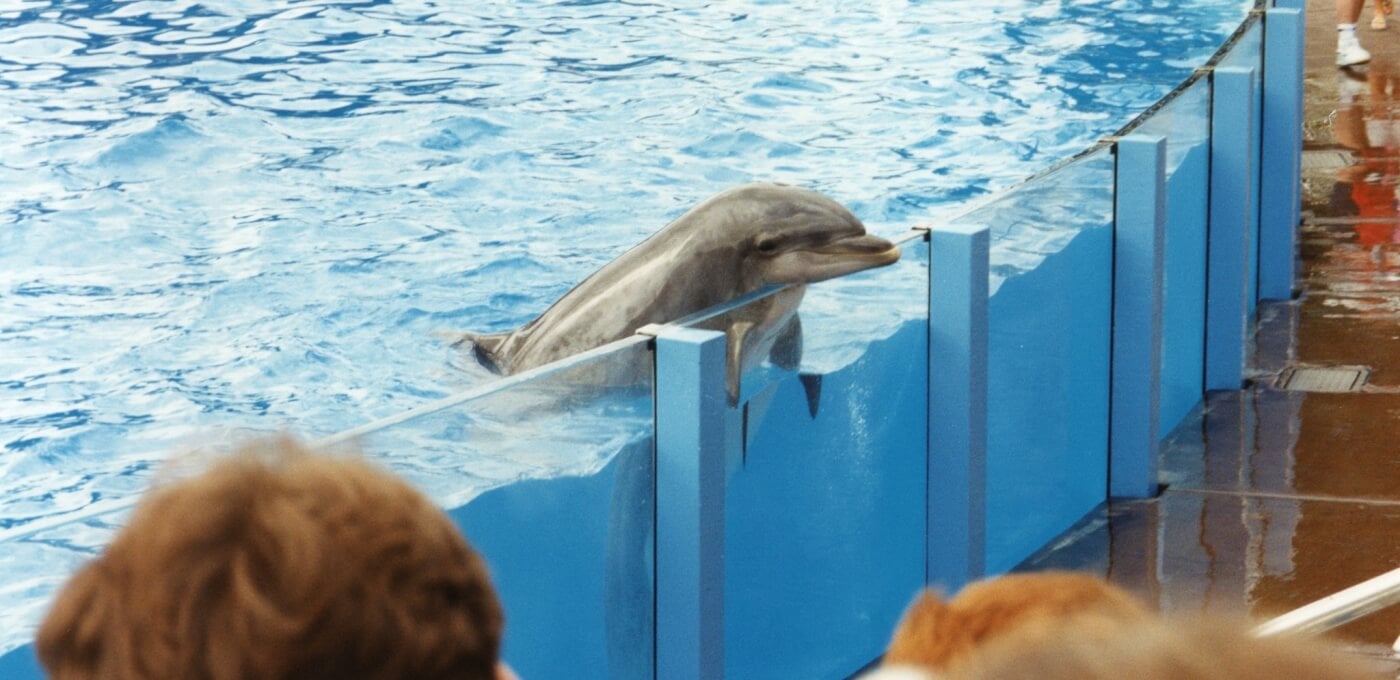
When humans stop paying to see suffering dolphins performing stupid tricks, swimming in circles in cramped tanks, or hauling tourists around on their dorsal fins, the slaughter will no longer be profitable.

man riding sad dolphin face blurred

Dolphins deserve better.

Dolphins’ brains are much larger than those of humans. (Many would argue their hearts are, too.) These brilliant animals use complex echolocation to navigate the vast ocean, swimming up to 60 miles a day. They have highly developed communication skills, and it’s believed that individuals respond to the sound of a signature whistle the same way humans respond to the sound of their names. Forcing these emotionally complex animals to live in tanks for our entertainment is morally bankrupt.

Let’s end the dolphin slaughter.

What You Can Do

The post This Is Why the Taiji Dolphin Slaughter Exists—and How We Stop It appeared first on PETA.