Orders are pouring in for PETA Kids’ first-ever bilingual coloring and activity book, All About Animals/Todo Sobre los Animales, and free copies—along with packs of colored pencils—are on their way to newly arrived immigrant children in New York City and Washington, D.C., in cooperation with the Young Center for Immigrant Children’s Rights, Team TLC NYC, and other immigrant assistance programs.
All About Animals is full of sweet illustrations for kids to color, interesting facts about wildlife (such as that elephants live in close-knit families), and age-appropriate lessons about kindness to animals (such as “Dogs don’t use words like we do, but one way that they communicate with each other is through body language”).
“The reading exercises and coloring activities in All About Animals are designed to build kids’ language skills and empathy for animals in a fun, familiar way,” says PETA Kids Senior Director of Youth Programs Marta Holmberg. “PETA Kids is pleased to help immigrant support organizations bring some comfort to children in a stressful situation.”
PETA Kids—whose motto reads, in part, that “animals are not ours to abuse in any way” and which opposes speciesism, a human-supremacist worldview—notes that children are less likely than adults to see a moral hierarchy among humans and other animals, according to a recent study.
All About Animals can be downloaded for free on PETA Kids’ website. PETA Kids is also sending copies of the book to the Young Center for Immigrant Children’s Rights’ offices in Chicago; Harlingen, Houston, and San Antonio, Texas; Pasadena, California; Phoenix; and other cities. For more information, please visit PETAKids.com or follow the group on Facebook or Instagram.
PETA Latino has achieved major victories for animals in the years since its launch in 2013. As PETA’s outreach division for Spanish-speaking communities in the U.S. and Latin America, the group’s focus is on putting animal rights on the Latino community’s map. PETA Latino’s outreach and its work to champion animal rights have made a huge difference by sharing information with people and encouraging them to have empathy and compassion for animals.
Here are just a few examples of the work PETA Latino has done for animals:
PETA Latino Helps End Public Wildlife Exhibitions in Quintana Roo, Mexico
Thanks to PETA Latino’s work with local animal rights group Animal Heroes, letters from celebrities and experts, and 50,000 petition signatures, the Mexican state of Quintana Roo banned wildlife exhibitions in public areas. The victory garnered tons of media coverage, bringing worldwide attention to the issues that come with using wildlife for entertainment.
PETA Latino’s Supporters Stand Up for Sheep on Retailer’s Mexico Instagram Account
As part of a PETA-wide campaign to persuade Forever 21 to drop wool, PETA Latino has given the company’s Mexico Instagram account a run for its money. The group and its supporters inundated the account’s posts with #DropTheWool comments, forcing the brand to disable comments for several years.
Millions Take Action for Lolita the Orca, Thanks to PETA Latino’s Efforts
PETA Latino gathered over half a million signatures, worked with important Latine celebrities, and hosted countless demonstrations in behalf of Lolita, an orca who has been held captive at the Miami Seaquarium for more than five decades. As a result of persistent action, she is no longer forced to perform, and the group will continue working to have her released into a reputable sanctuary.
First PETA Latino Demonstrations Take Place in Colombia
PETA Latino’s first-ever demonstrations in Colombia were a tremendous success. In addition to receiving local media coverage, the group reached 3.5 million people in the country on Facebook—7% of the population—following the demonstrations.
Amid the War in Ukraine, PETA Latino Helps Mexican Citizens Return Home With Their Animal Companions
After reading in the news that the Mexican government wouldn’t include animal companions in its evacuation plans from Ukraine, PETA Latino sent a letter to Foreign Relations Secretary Marcelo Luis Ebrard Casaubón asking that the government reconsider. Not long after the letter was published in several well-respected media outlets, the government announced that Mexican citizens could bring their animal companions with them.
Thousands Sign PETA Latino’s Petition for Dogs Confined to Roofs
PETA Latino’s campaign for dogs confined to rooftops has given community members guidance on what actions to take if they witness this scenario as well as information on the dangers of leaving dogs outside and how important it is for them to be taken inside and cared for as a member of the family. Thousands have pledged never to leave their dogs outdoors.
Quintana Roo Leads The Way For Animal Rights
Thanks to lobbying on the ground by Animal Heroes and other local animal protection groups as well as a petition signed by many of PETA Latino’s supporters, the governor of Quintana Roo signed into law a ban on cockfights and bullfights in 2019. As a result of this legislation, bulls, dogs, roosters, and other animals will no longer be chained, caged, beaten, drugged, or fought to the death in the state.
¡Victoria! 🎉 Después de estar 152 días congelada, #QuintanaRoo ha publicado la Ley de Bienestar Animal. Por lo que a partir de mañana entrará en vigor, quedando ILEGALIZADAS las corridas de toros en dicho estado. Gracias @CarlosJoaquin por dar este paso. https://t.co/NvYOhVPmyQpic.twitter.com/pyJvNpXZmn
Cancún Spay-a-Thon Clinics Help Sterilize More Than 1,500 Dogs and Cats
PETA Latino has hosted two annual spay-a-thons in Cancún. The event held in 2022 was the group’s largest to date, with 644 local dogs and cats spayed or neutered over the course of five days. Attendees were also provided with complimentary meat-free meals, goodies, and vegan starter kits.
PETA Latino’s Celebrity Campaigns Make an Impact
PETA Latino has worked with many celebrities to promote animal rights campaigns, including Andrea Meza, Ana Bárbara, Sherlyn, Kate del Castillo, Jesse & Joy, George Lopez, and Miguel Bernardeau. They’ve all attracted attention from the media and had a major impact on animals’ lives by reaching thousands of their followers and teaching them about having empathy and compassion for animals.
PETA Latino Supporters Take to the Streets for Sheep Used for Their Wool
In 2019, PETA Latino and its supporters took to the streets in Mexico City and Bogotá, Colombia, to urge Forever 21 to stop selling wool. The campaign and its related demonstrations attracted tons of media coverage, helping to make many aware of how sheep are exploited for their wool.
For several years, PETA Latino has hosted vegan Nochebuena giveaways on the biggest Latine holiday of the year on the streets of major cities such as Bogotá, Chicago, Guadalajara, Mexico City, Miami, and Phoenix. Passersby enjoyed a gift of delicious vegan meats and were encouraged to choose animal-friendly options for their Nochebuena dinner table, and thousands of signatures were collected.
#FrasesProhibidasPorPETA Is a Top Trending Topic on Twitter
On Twitter, #FrasesProhibidasPorPETA was a top trending topic in Mexico. PETA Latino encouraged Spanish speakers to ditch speciesist phrases that normalize violence in favor of kinder language.
Las palabras son importantes y a medida que nuestra comprensión de la justicia social evoluciona, nuestro lenguaje evoluciona junto con ella. Aquí explicamos cómo eliminar el especismo de tus conversaciones diarias. pic.twitter.com/rbObw3iDsJ
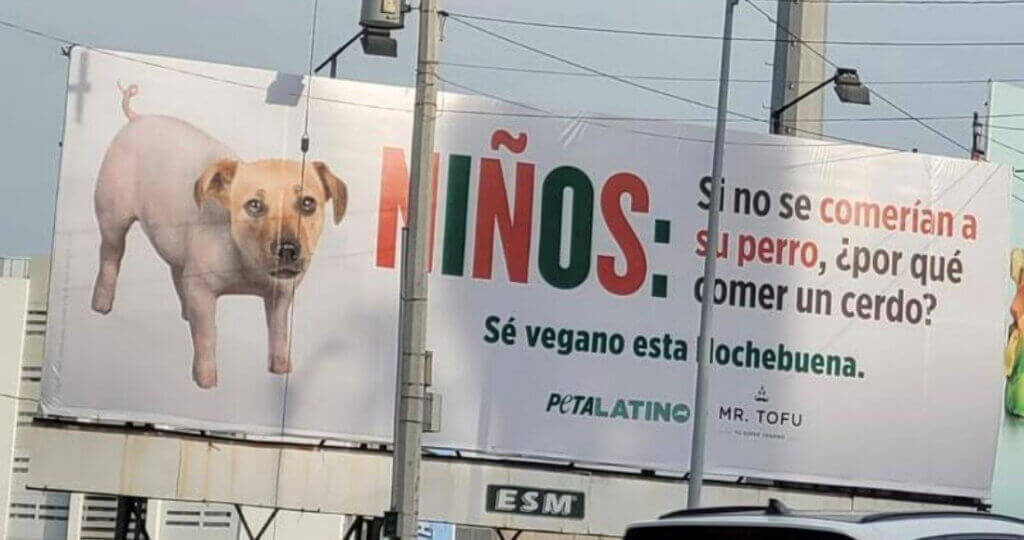
PETA Latino put up a billboard in Monterrey, the most industrial city in Mexico, asking kids not to eat pigs for Christmas, just as they wouldn’t eat their dogs. The ad generated massive discussion after some people asked the governor of the state to take it down.
Another PETA Latino billboard in southern Mexico showed support for the Maya communities fighting against industrial farms that threaten their water and soil.
PETA Latino Recognizes Activists’ Work for Animals
Recognizing the actions of activists and others who make a difference for animals is an important part of PETA Latino’s work. Awards have been given to individuals such as Hilario Aguilar, who rescued a dog from a mountaintop, and Andrea Padilla, a Colombian senator dedicated to animal rights.
Mexican Federal Judge Temporarily Bans Bullfighting in Mexico City
A Mexican federal judge issued an injunction temporarily banning barbaric and bloody bullfighting in Mexico City, where the world’s largest bullfighting arena is located—another step toward a total ban throughout the country.
Want to keep up with PETA Latino’s vital work as well as help animals? Join the PETA Latino Activist Network and E-News list to receive information about how to get involved in your community, along with breaking news, alerts for urgent action, and more:
Following a recent court ruling establishing that Shore Transit could not selectively sell ad space on buses by refusing to run ads from PETA but accepting others, the agency has taken the extreme step of ending all paid advertising on its buses—a move that will also eliminate its ad revenue.
Just-released published Shore Transit board meeting minutes reveal that following PETA’s legal win, the advertising company will only run internal and government public service messages on its buses. The move comes after PETA’s attempts to run pro-vegan ads on its buses back in May 2020 and July 2021. In light of the new advertising guidelines, PETA is now dismissing the lawsuit against Tri-County Council of the Lower Eastern Shore of Maryland and its Shore Transit division.
“The Eastern Shore is awash in chicken sheds and processing plants, and Shore Transit would rather shoot itself in the foot than run the honest message that no one needs to kill in order to eat and that slaughterhouses spread disease,” says PETA Foundation Director of Litigation Asher Smith. “If agencies want to remain beholden to local animal exploiters rather than run PETA’s ads, they’re going to pay the price in lost revenue for refusing to talk about healthy and humane eating.”
Each person who goes vegan spares nearly 200 animals every year a terrifying death and helps prevent pandemics. The National Academy of Sciences has also found that slaughterhouses pose “a particular public health risk extending far beyond meatpacking companies and their employees.” The contribution of slaughterhouses to human deaths and the many of COVID-19 infections on the Eastern Shore has been confirmed by Maryland health officials.
PETA was represented in the lawsuit by Brian Hauss of the American Civil Liberties Union’s Speech, Privacy, & Technology Project and Robin Cockey of Cockey, Brennan & Maloney P.C.
PETA—whose motto reads, in part, that “animals are not ours to eat”—opposes speciesism, a human-supremacist worldview. For more information on PETA’s investigative newsgathering and reporting, please visit PETA.org or follow the group on Twitter, Facebook, or Instagram.
New eyewitness reports, including from a private investigator hired by PETA, allege that local outfit Zootastic Park is receiving shipments of animals from a South Carolina roadside zoo that faces a PETA lawsuit over its alleged failure to provide animals with adequate care—leading to animal deaths, among other issues. Because the secret transfers from Waccatee Zoological Farm hinder PETA’s ability to collect evidence about the animals’ conditions and push for any needed treatment, PETA has filed an emergency motion with the U.S. District Court for the District of South Carolina, seeking a court order that prohibits further transfers to Zootastic.
PETA notes that Zootastic has a history of poor treatment of animals as documented by the U.S. Department of Agriculture (USDA), including a “critical citation” it received after allowing several animals to suffer from frostbite—leading to amputations of parts of two monkeys’ tails. Last year, the USDA cited Zootastic for failing to provide animals with adequate veterinary care, noting that the tails of two squirrels at the facility had been amputated because of apparent “self-trauma.”
“Shipping animals from one shabby outfit to the next prolongs their pain, and in this case, it blocks PETA from gathering evidence about these animals’ suffering,” says PETA Foundation General Counsel for Captive Animal Law Enforcement Brittany Peet. “This is a shady stunt designed to prevent abused animals from receiving the care they desperately need.”
PETA’s lawsuit under the federal Endangered Species Act and South Carolina’s public nuisance law alleges that Waccatee confines and exhibits more than 460 animals in conditions in which they’re deprived of appropriate veterinary care and other necessities. The group’s motion also asks the court to consider sanctions against Waccatee and asks for the notorious roadside zoo to account for the whereabouts and ownership history of the animals. In addition to PETA Foundation counsel, the plaintiffs are represented by Jonathan Brightbill, Kyllan Gilmore, Stacie Knight, and Sharon Lin with Winston & Strawn LLP.
PETA—whose motto reads, in part, that “animals are not ours to use for entertainment”—opposes speciesism, a human-supremacist worldview. For more information on PETA’s investigative newsgathering and reporting, please visit PETA.org or follow the group on Twitter, Facebook, or Instagram.