PETA Asia’s scantily clad “lettuce ladies” headed to the United Nations Climate Change Conference (COP27) today to bare their skin and lay bare the summit’s hypocrisy of serving meat, dairy, and other planet-killing foods. According to the UN’s own recommendations, going vegan is necessary if we are to avoid the worst effects of the climate catastrophe, since animal agriculture is responsible for nearly one-fifth of human-induced greenhouse gas emissions. Photos are available here.
“Would an oncologist take puffs of a cigarette while administering chemotherapy? Because that’s exactly how leaders look when they talk about saving the planet in between bites of meat,” says PETA Director of Outreach Ashley Byrne, who traveled to Egypt to volunteer as a lettuce lady (pictured above, left). “Double standards are on full display at COP27, and PETA is calling on the UN to go vegan or go home.”
By some estimates, animal agriculture is responsible for more greenhouse gas emissions than all the world’s transportation systems combined. The meat, egg, and dairy industries also use an enormous amount of water—it takes more than 2,400 gallons to produce just 1 pound of beef—while polluting waterways with manure runoff, and more than 90% of all Amazon rainforest land cleared since 1970 is used for grazing livestock, exacerbating the climate catastrophe. In addition to helping save the planet, each individual who goes vegan saves nearly 200 animals every year from daily misery inside a dark shed or on a squalid feedlot and a terrifying death under the slaughterhouse knife.
PETA—whose motto reads, in part, that “animals are not ours to eat”—opposes speciesism, a human-supremacist worldview. For more information, please visit PETA.org or follow the group on Twitter, Facebook, or Instagram.
Below, please find a statement from PETA Executive Vice President Tracy Reiman in response to news that for the first time, the U.S. Food and Drug Administration has given a company—UPSIDE Foods—the green light to sell cultured meat in the U.S.:
Years ago, PETA funded the very first foray into cultured meat research at two U.S. universities, offered a $1 million prize for the first laboratory that could create commercially viable lab-grown chicken meat, and even patented the findings of a scientist who eventually joined UPSIDE Foods before selling the patent to the startup at a very low cost, so we’re over the moon to see “slaughter-less meat” becoming a reality. But as billions of animals are still killed every year for food, animal agriculture is fueling the climate catastrophe, and delicious vegan meats are already widely available, there’s no reason to wait on government greenlights; everyone can and should go vegan now.
PETA—whose motto reads, in part, that “animals are not ours to eat” and which opposes speciesism, a human-supremacist worldview—offers a free vegan starter kit on its website. For more information, please visit PETA.org or follow the group on Twitter, Facebook, or Instagram.
Earlier today, PETA supporters were detained by police and banned from campus after invading the University of Michigan’s (U-M) Pharmacology Seminar Series, where they confronted University of Massachusetts–Amherst (UMass) experimenter Agnès Lacreuse, interrupting her seminar in order to expose UMass’ horrific menopause experiments on marmoset monkeys. Video footage is available here.
A protester took the mic, and activists shouted out information about the tests, including that Lacreuse drills into marmosets’ skulls, cuts open their necks to expose muscle, and threads electrode leads from the scalp and neck to the abdomen. To crudely mimic hot flashes in the small monkeys—who do not experience menopause—experimenters cut out their ovaries, administer hormone-manipulating drugs, and heat the animals with hand warmers like those placed in mittens. In these and other tests, sensitive and social monkeys are kept in solitary confinement—like Anakin, a marmoset who was eventually killed by UMass experimenters.
“U-M faculty and students should know that Lacreuse torments tiny monkeys in cruel and deadly menopause experiments that will not help women,” says PETA Vice President Dr. Alka Chandna. “In an age when superior, human-based research can so effectively study the effects of hormone fluctuations in humans, it defies ethics and logic to condemn vulnerable marmosets to lives of misery and distress.”
PETA has been contacted by numerous UMass alumni and donors concerned about the school’s animal welfare violations. The U.S. Department of Agriculture cited the university for severely burning a marmoset with hand warmers as he was recovering from surgery, failing to alert an attending veterinarian to sick animals, and permitting a monkey to escape and then injuring the animal’s tail during recapture.
PETA—whose motto reads, in part, that “animals are not ours to experiment on”—opposes speciesism, a human-supremacist worldview. For more information on PETA’s investigative newsgathering and reporting, please visit PETA.org or follow the group on Twitter, Facebook, or Instagram.
Have you ever taken a turkey’s perspective into consideration when whistling your way through the holidays or the rest of the year? Known for being affectionate, intelligent, and charismatic, these birds so frequently used for food deserve freedom and compassion. Consider with us the many reasons to give thanks for turkeys and to keep them off your plate.
Caring and Courageous
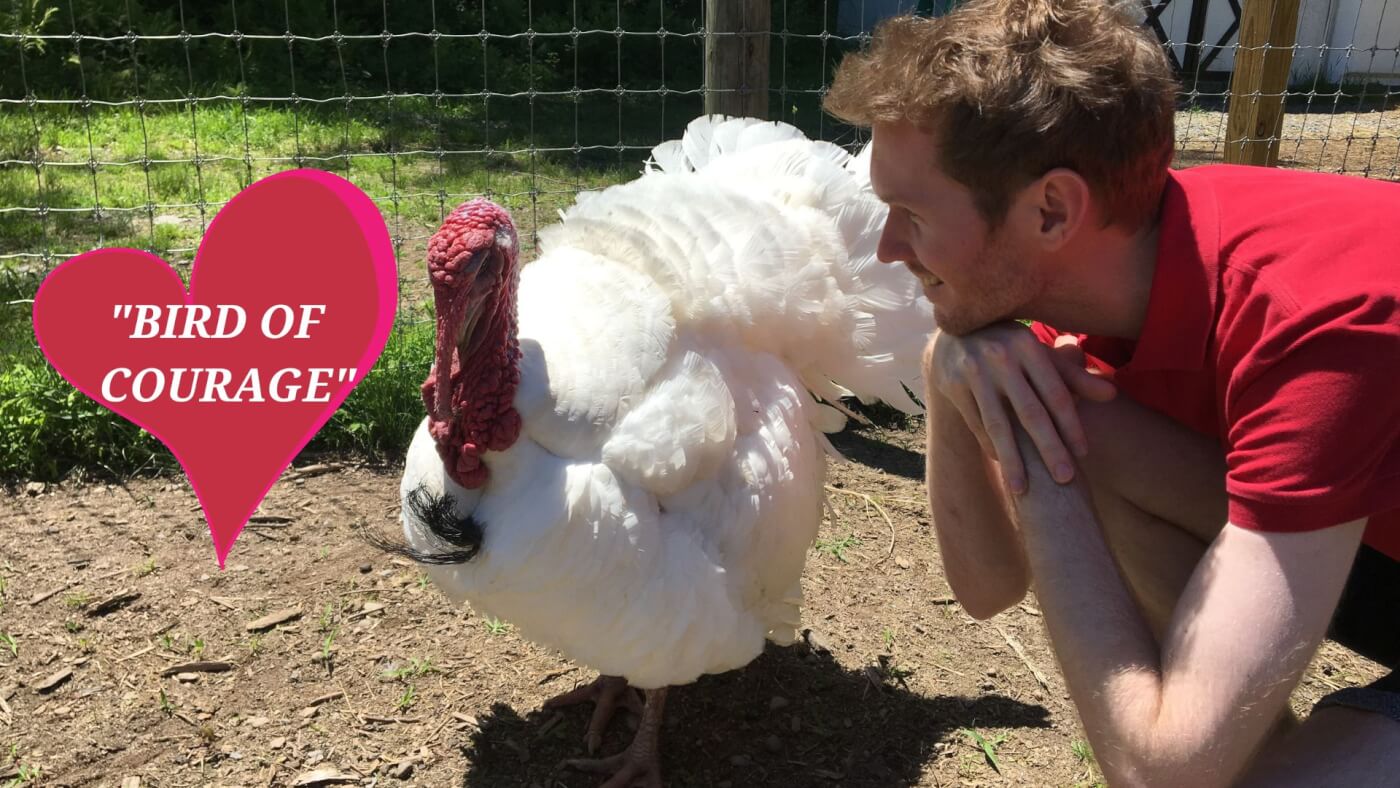
Perhaps the most striking characteristic of turkeys is courage, especially in caring for their young. In nature, mother turkeys bravely defend their babies from predators, prizing that bond even over their own life. Turkeys also prioritize the safety of their peers. Benjamin Franklin famously wrote of this virtue, bringing it to light for future admirers of the birds:
[I]n Truth the Turk’y is in comparison a much more respectable bird [than the Bald Eagle], and withal a true original native of America … a Bird of Courage.
It’s the opposite of courage to support confining, killing, and eating these benevolent birds.
Curious and Aware
Sanctuary caregivers have termed turkeys “natural detectives.” Spending even a short time with them reveals how observant and aware they are of the sights and sounds of their surroundings. Likely the avian answer to Sherlock Holmes, they often display exploratory behavior, ever keen to investigate undiscovered corners and forage for fresh food sources. Their sight is three times as clear as that of a human with 20/20 vision. They can see the full color spectrum and have a 270-degree field of vision.
Sensitive and Musical
Notable, too, is turkeys’ sensitivity, sometimes expressed through blushing as they become excited, agitated, or ill. This causes the skin on their head and neck to change hues, reflecting evolving emotional states. Whenever they have the good fortune to get their feathers stroked, they soak it up as a calming massage. Like cats, they even purr while being caressed and cuddled. Turkeys are also musically inclined and sensitive to melodies. They revel in listening to specific tunes and cherish clucking and chirping loudly along to favorite songs.
Interaction and Relationships
Playful and happy to see familiar faces, turkeys are sociable animals capable of forming meaningful friendships. Feeling close to others is fundamental to them.
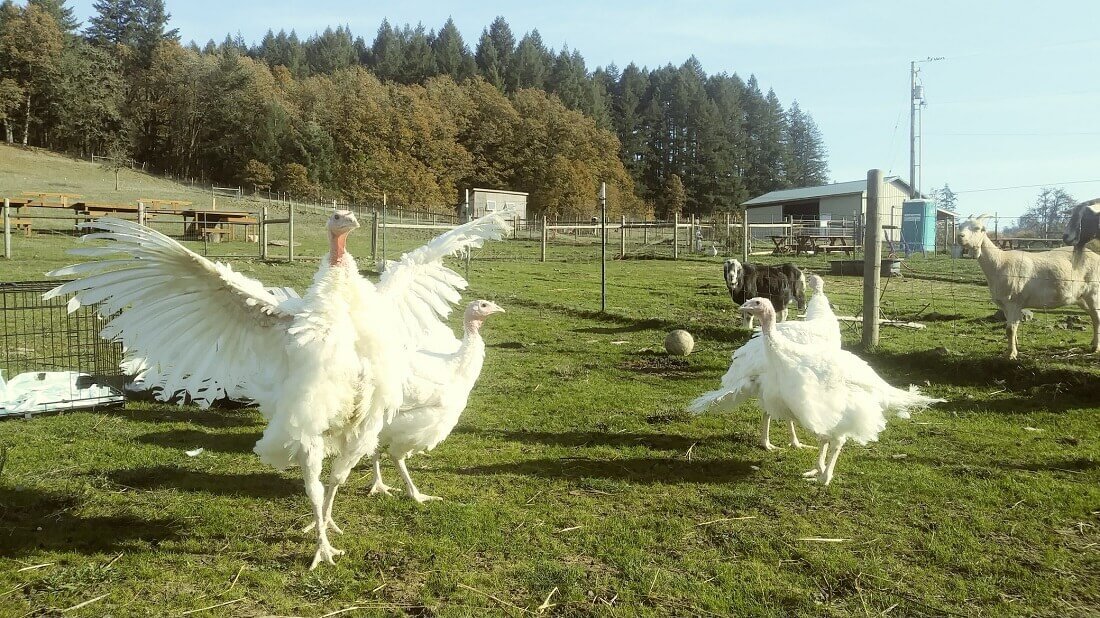
Each turkey has a distinct personality, and they love to interact and play games together. If an apple is tossed into their midst, a flock is likely to bounce it about like a soccer ball.
Flirting and courting games occur regularly, too. The longer a male turkey’s snood (the dangling appendage on his face), the healthier and more desirable to potential mates he is. Males also allure females with colorful flaps of skin on their necks called wattles as well as with tufts of beard-like hair that extend from their chests.
In their natural habitat, these birds sleep in trees as a group for protection. Then in the morning, they conduct roll calls via quiet yelps to ensure that everyone is safe.
Activity and Routine
Although turkeys used for food have been genetically manipulated to weigh far more than is natural, those in nature prosper by staying active: running at rates of up to 35 mph, flying at up to 55 mph, gobbling up fruits and vegetables, preening themselves, stretching their wings, taking dust baths, tending to their young, building nests, and climbing high up into trees to roost. They thrive on these routines of motion and deserve the natural liberty to do so.
Appreciating their array of unique qualities prevents people from thinking of turkeys as food.
Specifics of Speciesism
Every year in the U.S. alone, a staggering 300 million turkeys are raised and killed for their flesh. Of those, more than 45 million are slaughtered for Thanksgiving and more than 22 million for Christmas. The natural life expectancy of a turkey is 10 years, but most used for food don’t make it past 5 months. That means nearly all those used for food are infants.
Since they can no longer mate naturally due to their size, turkeys are held down by workers and forcibly inseminated. After the chicks hatch, the ends of their beaks and toes are cut off without painkillers. Then they are crammed into filthy sheds, often become crippled by their own weight, and likely punched, kicked, stomped on, and thrown. Those who become too sick or injured to live through transport are slammed against walls or strangled until dead. The rest are shoved into crates on trucks bound for a slaughterhouse. The ride takes hours, often in extreme weather, and the birds are given no food or water. At the slaughterhouse, the survivors are hung by their weak or broken legs, dragged through electrified “stunning tanks” that immobilize them, cut through the neck, and dumped into a large vat used for feather removal, sometimes while still alive. These horrors are nothing to be thankful for.
The fortunate few rescued from the massive machine of speciesism may find their way to a loving sanctuary where humans help turkeys heal and live peacefully. Among other animals restored to a more natural state, the birds begin to flourish and form social groups meaningful to them. Their personalities can emerge and blossom, and any visitor patient enough to observe and appreciate them for a bit will wonder how turkeys are ever viewed as food.
What You Can Do for Turkeys
As many of us gather to express gratitude for the blessings in our lives, we ought to consider turkeys’ lives, too. Rather than making them centerpieces of your table, try centering turkeys in a new, compassionate light within your heart this holiday season and all year round. Visit a nearby, reputable farmed-animal sanctuary that genuinely cares for them if you can, and connect with these remarkable birds. Then when planning upcoming meals, it will be a breeze to make vegan choices using our free vegan starter kit: