Breathing-Impaired Breeds Need Extra Care in Cold Temperatures

No dog should be outside in extreme weather for an extended period of time, but it’s more dangerous for some. Bulldogs, boxers, pugs, Cavalier King Charles spaniels, and most other flat-faced dogs are breathing-impaired breeds (BIB) who struggle to breathe even in comfortable weather conditions as a result of the physical characteristics they’ve been bred to have. When the weather is particularly hot or cold, just being outdoors can put their lives at risk.

sad pug on harness

Why Does the Cold Make It Harder to Breathe?

If you’ve ever found yourself huffing and puffing after just a few minutes of shoveling snow, it may not be a sign that you’re out of shape. Cold air causes airway constriction, making breathing more difficult for everyone. When BIBs are outside in the cold, they experience the same constriction—but through their already- tightened airways. Imagine running a mile while breathing through a straw and you may have a glimpse of what it’s like for breathing-impaired breeds to play and continue breathing.
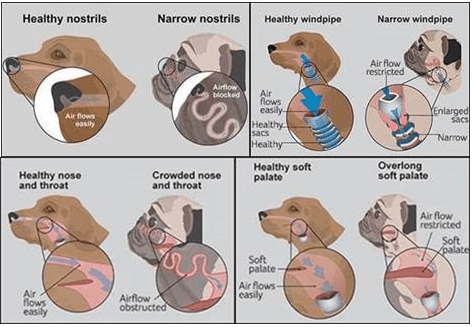
©PDSA

All dogs suffer when they’re left outside in the cold for extended periods of time, but BIBs are likely to be affected more quickly than others. In addition to their struggle to breathe, many BIBs—like boxers, pugs, and bulldogs—have very short fur and no undercoat, so they can’t keep warm by themselves for very long. If your dog has to be outside in the cold for short periods of time, invest in well-fitting winter wear, like boots, coats, or sweaters to keep them comfortable and safe.

Individual dogs have their own levels of tolerance for cold weather, but if you’re cold, your dog likely is, too. When the temperature dips below freezing, dogs are at risk for hypothermia—especially BIBs and short-haired dogs. If you’re worried about missing the warning signs that your dog is too cold, learn the signs of hypothermia in dogs.

What Are the Signs of Hypothermia in Dogs?

  • Squinting
  • Hunched posture
  • Lifting the paws to keep them off the cold ground
  • Shivering
  • Body parts that are cold to the touch (Ears, tail, and paws are particularly sensitive.)
  • Clumsy movements, stiffness, difficulty walking
  • Pale gums
  • Rapid and then slow breathing
  • Lethargy and confusion

If your dog suddenly stops shivering while still outdoors, that doesn’t mean they’re warming up or adapting—it’s a sign of severe hypothermia, and it’s imperative that you immediately bring them inside and seek veterinary assistance.

How You Can Help Breathing-Impaired Breeds and Other Dogs

BIBs are bred to have certain physical traits to the detriment of their quality of life. Breeders and sellers know that flat-faced dogs suffer but still exploit them for profit.

The solution is simple: Stop breeding and buying bulldogs, other breathing-impaired breeds, and all other dogs. All “purebreds” (flat-faced or not) suffer from congenital and often painful conditions. If you have the time, money, patience, and love to care for an animal for life (which could be more than 15 years), please adopt one from an animal shelter. If you already have a breathing-impaired dog, please commit to making their life as fulfilling, healthy, and comfortable as you can—and pledge never to buy another one.

Has Your Purebred Dog Developed Health Issues?

The post Breathing-Impaired Breeds Need Extra Care in Cold Temperatures appeared first on PETA.
What Does 2023 Have in Store for Vegan Food? Here Are Our Trend Predictions

In 2022, we saw many of our food trend predictions come true, so we know we’ll be seeing more exciting vegan food news this year, too! Of course, we can expect new vegan products to hit shelves, new cookbooks to be filled with inspiring recipes, and more options to be added to fast-food menus—but what else? We’ve looked into our crystal ball to make a few predictions for the year ahead:

Caffeine Alternatives

While we’ll still be sipping on coffee, we can see caffeine alternatives becoming more popular this year, since they can be enjoyed all day and generally have other health benefits as well. FigBrew is one option—it’s made from figs and similar to coffee, but it won’t make you jittery. Other options might be made with chicory, maca, or even mushrooms.

Tinned Marinated Beans

Flavorful options like the Giant Baked Beans in Tomato Sauce and Greek Chickpeas with Cumin and Parsley from Trader Joe’s are examples that have been around for a while, but we think tinned marinated beans will become extremely popular this year. They’re easy to prepare for a quick lunch or for entertaining guests and full of protein, but they aren’t made from the bodies of intelligent individuals.

Cultivated Meat—for Our Animal Companions

Lab-grown meat is sure to make animal agriculture obsolete soon, and one place you’ll start to see it this year is in companion animal food. The companies Because, Animals and Wild Earth are both working on high-quality cultivated meat options for dog and cat food.

Mocktails Galore

Canned mocktails and other nonalcoholic liquor alternatives have been on the rise for years, but we think 2023 will bring a boom for these products. We’re especially excited about options like Kin Euphorics, which use adaptogens and botanicals that relax you without a buzz or a hangover. Booze-free bottle shops and bars are even popping up in cities across the country, and we’re sure more will be on the way soon.

Vegan Versions of Classic Snacks

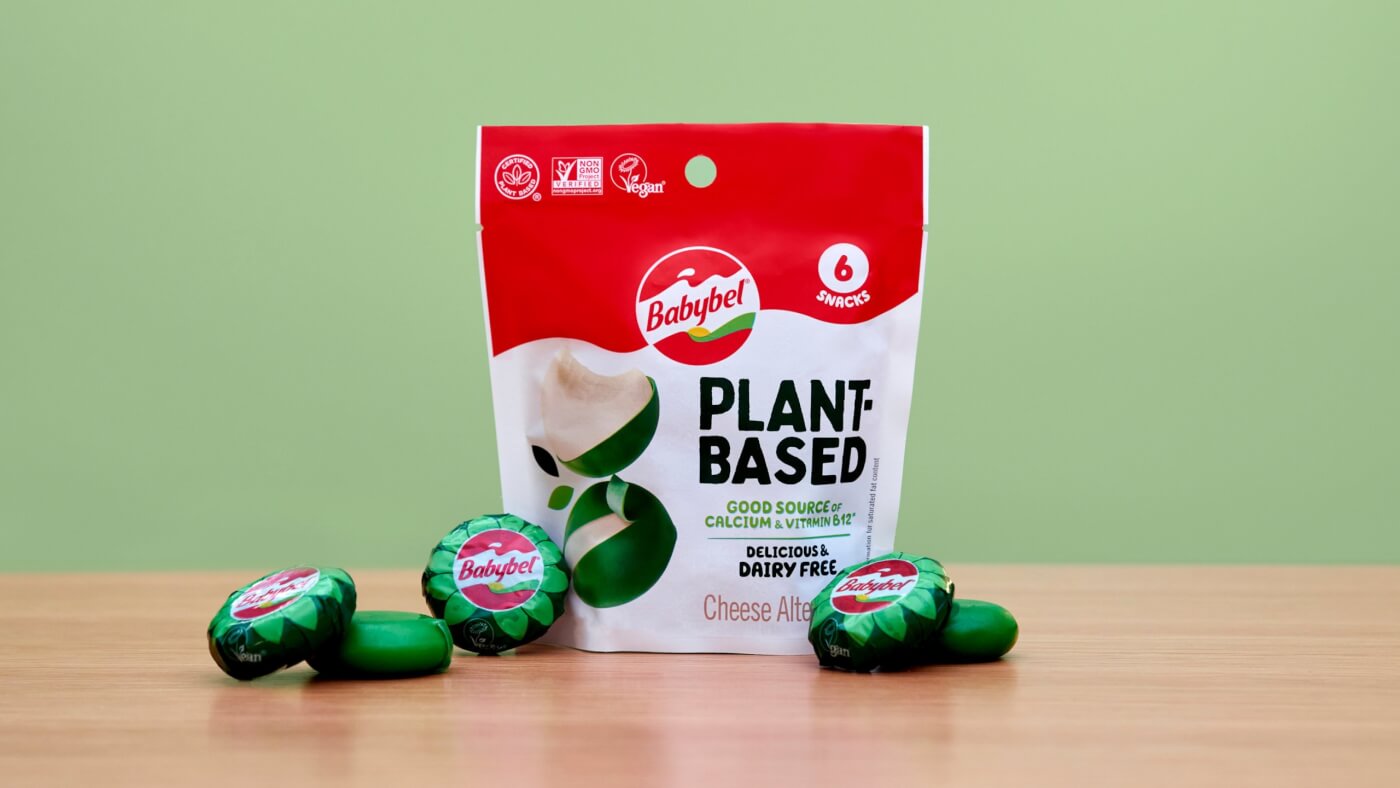
This year, it’ll become even easier to satisfy your craving for nostalgic snacks. Vegan Babybel is already in stores, meat- and dairy-free “lunchables” kits are coming soon, and the grocery store aisles are already filled with cruelty-free options along these lines. Which veganized snack are you most hoping to see?

vegan babybel cheese© Bel Brands

Frozen Breakfast Foods

Convenience will always be trendy, but so is having a satisfying breakfast. Brands like MorningStar, Alpha Foods, and Field Roast have recently launched tasty frozen vegan breakfast items, and we’re sure even more options will be on the market this year.

Vegan Steak

These days, there’s a vegan version of almost anything you can think of, including steak. Juicy Marbles’ and eat meati’s options cook up just like meat, but they aren’t made from the flesh of a playful cow. Beyond Steak is already hitting stores and should be popping up on more Taco Bell menus soon.

More Celebrity-Backed Vegan Brands

Celebrities are getting behind vegan brands in a big way, and we’re sure we’ll see more collaborations in the coming year. Tabitha Brown’s Target collection is already proof that big things are in store for 2023!


Ready to help make 2023 the best year ever for animals, the planet, and your own health? Go vegan! Order our free vegan starter kit to learn more:

Send Me a Free Vegan Starter Kit Today

The post What Does 2023 Have in Store for Vegan Food? Here Are Our Trend Predictions appeared first on PETA.

5 Iditarod Facts: Do You Know What STILL Happens to Dogs Used in the Death Race?

Did you think our species had finally evolved to treat all dogs kindly? Think again. Speciesism persists in the various ways animals are exploited for entertainment. The Iditarod, an annual dog-sled race in Alaska notorious for forcing dogs to run through extreme snowstorms and grueling terrain, is the opposite of compassionate fun. Even if you thought you’d heard everything about this cruel event, here are five Iditarod facts—we bet you’ll be shocked to learn they’re still true—that will inspire you to take action.

1. Up to half the dogs who start the race never make it across the finish line due to exhaustion, illness, injury, or other causes.

Many dogs develop stomach ulcers, sustain stress fractures, or suffer from dehydration or diarrhea during the race. In 2022 alone, nearly 250 dogs were pulled off the trail, forcing those remaining to toil even harder to pull heavy sleds. Notorious musher Dallas Seavey admitted that during the first half of the race, the dogs he was forcing to run were suffering from diarrhea and several had been pulled off the trail because of injuries. And Iditarod winner Brent Sass abandoned three dogs who could go no further.

2. Dogs die on and off the Iditarod trail. Death is even listed in the official rules for the race as an “unpreventable hazard” for dogs.

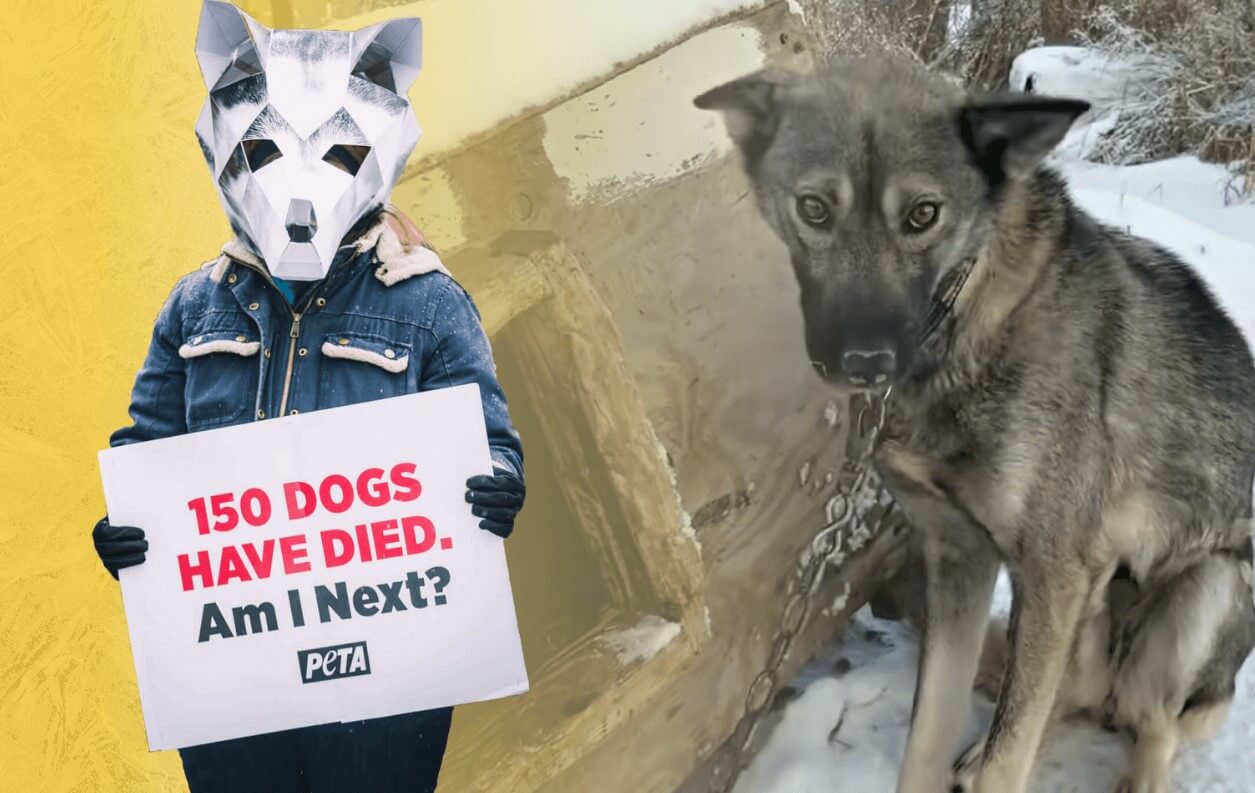
The leading cause of death for dogs during the race is aspiration pneumonia, caused by inhaling their own vomit. Many more have died in other horrific ways, including asphyxiation, heart attacks, trauma from being struck by a vehicle, freezing to death, and excess fluid in the lungs. In total, over 150 dogs have died during the Iditarod. Before the 2022 race even started, dogs were attacked and one was killed during training. A PETA investigation into former Iditarod winners revealed that in one incident, a dog was dragged to death after a team broke free from a sled while training.

iditarod "dog" masked protester and chained dog

Breeders of dogs used for sledding have admitted that “surplus” dogs are killed if they’re not fast or fit enough for competition or if they don’t meet certain aesthetic standards. Dogs who finish the race but are deemed no longer useful to the industry have been shot, drowned, or abandoned to starve.

Veteran musher Zoya DeNure alleged that some trainers have killed “hundreds on top of hundreds or more dogs” because they didn’t make the cut. She called out musher Dallas Seavey’s kennels, among others, for killing dogs who aren’t fast or fit enough and wrote, “Sadly, this has been going on in the family ‘dynasty’ for decades.”

3. Even “champion” dogs may be dumped or forgotten like used sporting equipment once they’re no longer considered useful.

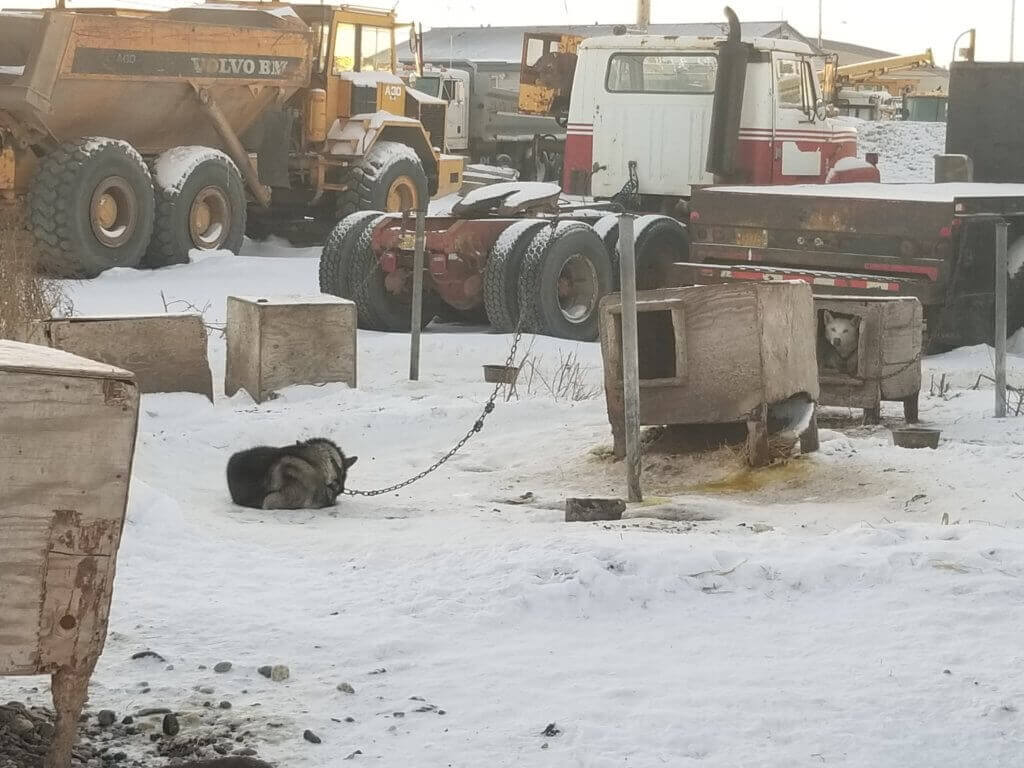
Iditarod facts with chained dog left alone in snow by broken box and old equipment

During PETA’s investigation into former champions’ kennels, musher John Baker let Snickers—a lead dog when Baker won the Iditarod—suffer in the freezing cold. Rather than providing this elderly dog with the veterinary care and comfort she desperately needed, he chained her beside the frozen sea—alone and unable to escape the Arctic cold.

She had no shelter until PETA’s eyewitness built one for her, as the wooden box next to her area was only accessible from an adjacent pen. Baker said Snickers suffered from arthritis even when she ran the Iditarod. He admitted that she had been “in a lot of pain” for years and that he needed to “put her out of her misery.” He stated that he planned to shoot her but hadn’t yet done it because “I just don’t have a good place to bury her.”

4. Dogs love to run, but those used for the Iditarod go from being forced to run about 1,000 miles in under two weeks to spending the off-season chained up outside without the opportunity to explore their surroundings, exercise and play in a meaningful way, or even socialize.

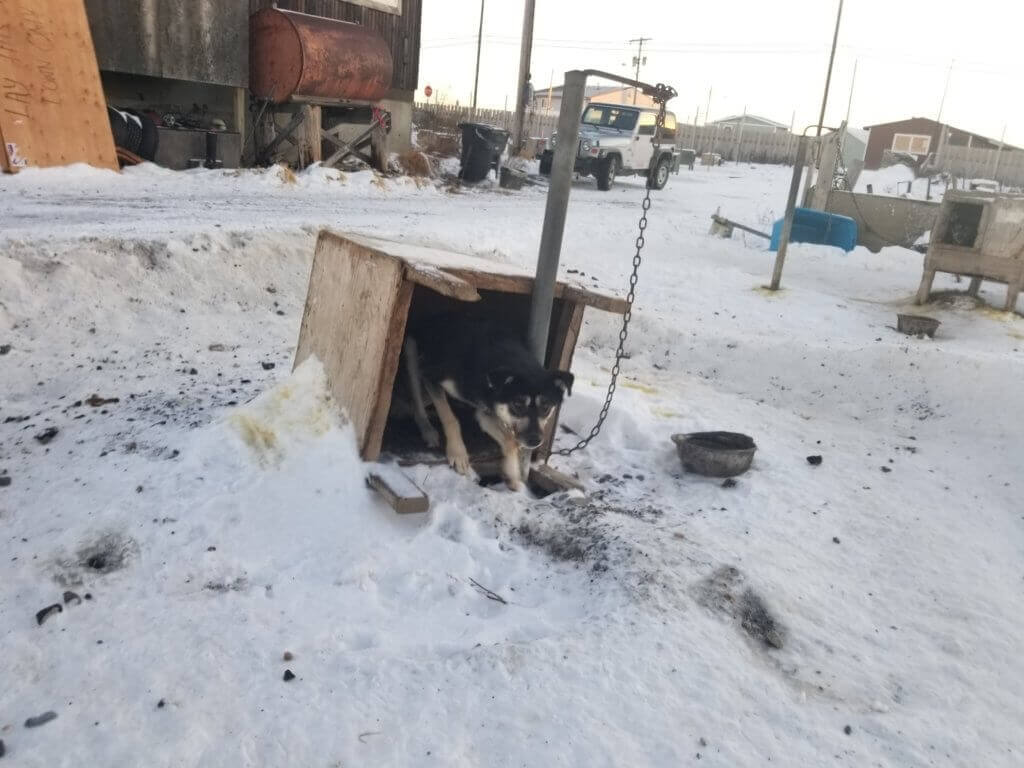
Iditarod facts with dog chained in neglectful kennel in freezing snow

Most kennels keep dozens of dogs on short chains with little or no shelter. Between races, their world extends no farther than the end of a 6-foot tether. They’re deprived of everything dogs thrive on: exercise, play, mental stimulation, and companionship. PETA’s investigator found that dogs were denied veterinary care for painful injuries, kept constantly chained next to dilapidated boxes and plastic barrels in the bitter cold, and forced to run even when they were exhausted or dehydrated.

5. Dogs are prohibited from taking shelter during the race, even in potentially deadly weather, except for during medical exams or treatment.

In 2022, the Iditarod was hit by a massive storm with winds around 70 mph and freezing temperatures. Multiple mushers said they feared for dogs’ lives and broke the rule that prohibits sheltering the animals during the race by bringing their dogs inside cabins to protect them. The race ended in controversy over officials’ shameful decision to fine these mushers for protecting the dogs during this dangerous storm, which could have caused them to freeze to death. Meanwhile, Brent Sass, the 2022 winner, shared a disturbing video of dogs covered with snow and ice in the blistering wind and with their eyes frozen shut during the race.

Get Active to Help Dogs and End This Horrendous Event

These five current facts about the vile Iditarod prove how badly action is still needed. Last year, PETA and its supporters achieved a victory by persuading Millennium Hotels and Resorts—one of the event’s last major sponsors—to declare 2022 its final year of support. Most major companies have ditched the death race, but Liberty Media is stalling. Please help suffering dogs now:

Urge Liberty Media and Others to Stop Sponsoring the Iditarod

The post 5 Iditarod Facts: Do You Know What STILL Happens to Dogs Used in the Death Race? appeared first on PETA.

PETA Sings the Praises of Lisa Marie Presley’s Animal Advocacy

Please see the statement below from PETA Senior Vice President Lisa Lange on the death of Lisa Marie Presley:

Lisa Marie Presley was not only a talented singer-songwriter, loving wife, and mother but also a friend to animals. After learning that an Elvis impersonator had named a chimpanzee after her and was exploiting her for profit, she successfully teamed up with PETA to achieve the release of her namesake to a sanctuary. And she didn’t stop there. Early in the COVID-19 pandemic, when shelters were in desperate need of foster families, Lisa Marie and her twin daughters set a wonderful example by opening their home and hearts to two dogs. Though the “Lights Out” singer has passed away, her bright vision for animals will continue to inspire all of us at PETA.

PETA—whose motto reads, in part, that “animals are not ours to abuse in any way”—opposes speciesism, a human-supremacist worldview. For more information, please visit PETA.org or follow the group on Twitter, Facebook, or Instagram.

The post PETA Sings the Praises of Lisa Marie Presley’s Animal Advocacy appeared first on PETA.

UGA Win Prompts PETA Call for Benevolence to Breathing-Impaired Bulldog, End to Use of Live Mascots

In the wake of the University of Georgia’s (UGA) decisive national championship win over Texas Christian University, PETA sent a letter this morning to UGA President Jere W. Morehead urging him to make the school a winner not only in football but also in its treatment of others by retiring the school’s English bulldog mascot, Uga. The group notes that the school’s use of Uga drives demand for breathing-impaired breeds (BIB), such as pugs, boxers, and English and French bulldogs, whose breeding is being banned in other countries, as their purposely bred, grotesquely flattened faces leave them struggling to walk, play, and even breathe.

“As the back-to-back national champion, can’t UGA find it in its heart to honestly examine the impact of its promotion of deformed dogs and call time on its outdated, live-animal mascot program?” asks PETA Executive Vice President Tracy Reiman. “PETA is calling on Jere Morehead to be a peach and replace poor Uga with a human mascot who can support the team in a winning way.”

PETA—whose motto reads, in part, that “animals are not ours to use for entertainment” and which opposes speciesism, a human-supremacist worldview—notes that Uga is a living, feeling being, not a toy to be carted to chaotic football stadiums across the country and trotted out in front of scores of screaming fans.

For more information, please visit PETA.org or follow the group on Twitter, Facebook, or Instagram.

PETA’s letter to Morehead follows.

January 12, 2023

Jere W. Morehead

President

University of Georgia

Dear President Morehead:

Hello again. I wrote in 2019 on behalf of People for the Ethical Treatment of Animals (PETA) to urge you to stop subjecting dogs to the stress and dangers of being used as the University of Georgia’s “Uga” mascot. In light of a new PETA investigation—as well as calls from veterinarians to end the promotion of bulldogs and other flat-faced dog breeds—I’m hoping you will take steps to retire Uga. Please consider the following information with an open mind and heart.

As the New York Post recently reported, PETA’s investigation revealed a disturbing industry practice: Pet stores that sell English bulldogs—as well as other dogs bred to have grotesquely flattened faces—refuse to offer a “lifetime warranty” on them because of the serious health issues that these dogs inevitably suffer from. English bulldogs, pugs, Boston terriers, boxers, French bulldogs, and other breathing-impaired breeds (BIB) are afflicted with brachycephalic syndrome, which leaves them struggling just to breathe and is the leading cause of death for bulldogs.

Solely for the sake of appearances, BIB dogs are bred to have deformities that cause labored breathing, snorting, coughing, gagging, retching, vomiting, tiring easily, collapsing, and fainting. Many can’t even go for a walk or chase a ball—the things that dogs love to do—without gasping for air. In one study, a fifth of BIB dog guardians reported that their dog had undergone at least one surgery related to having distorted physical features.

Veterinarians around the world are sounding the alarm: In 2018, the British Veterinary Association called on companies to stop using BIBs in products and advertisements. The mounting evidence of flat-faced dogs’ suffering is so clear that in 2022, Norway completely banned the breeding of bulldogs. Meanwhile, the prominence of your university’s mascot is driving up the demand for breeding these dogs and perpetuating their suffering.

Please be a champion not just in football but also for dogs. We hope you’ll consider replacing Uga with a willing human mascot, like the ones at many other universities. May I please have your assurance that the University of Georgia will make this change? Thank you for your consideration.

Sincerely,

Emily R. Trunnell, Ph.D.

UGA College of Family and Consumer Sciences, Class of 2010

UGA Biomedical & Health Sciences Institute, Neuroscience, Class of 2016

Senior Scientist, Science Advancement and Outreach

PETA

The post UGA Win Prompts PETA Call for Benevolence to Breathing-Impaired Bulldog, End to Use of Live Mascots appeared first on PETA.