Responding to the 20-year sentence handed to Hong Kong pro-democracy activist Jimmy Lai for ‘national security’ offences, Amnesty International’s Deputy Regional Director Sarah Brooks said:
“This sentencing marks another grim milestone in Hong Kong’s transformation from a city governed by the rule of law to one ruled by fear. Imprisoning a 78-year-old man for doing nothing more than exercising his rights shows a complete disregard for human dignity. Every day he spends in behind bars is a grave injustice.
“With this ruling we see yet again how Hong Kong’s National Security Law is being used to distort fundamental freedoms into criminal acts. Jimmy Lai’s imprisonment is a cold-blooded attack of freedom of expression that epitomizes the systematic dismantling of rights that once defined Hong Kong.
“Jimmy Lai is a prisoner of conscience who should never have spent a single day behind bars. The Hong Kong authorities must immediately and unconditionally release him.”
Background
Hong Kong’s High Court today sentenced pro-democracy activist Jimmy Lai to 20 years in prison for conspiracy to commit collusion with foreign forces and conspiracy to commit sedition. The sentence follows his conviction, in December 2025.
Lai was charged with “collusion with a foreign country or external elements” under the Beijing-imposed National Security Law (NSL) on 11 December 2020. He has been continuously detained since 31 December 2020. He was later charged with two more counts of “conspiracy to collude with a foreign country or external elements” under the NSL, and one more count of “conspiracy to publish seditious publications” under the Crimes Ordinance.
Hong Kong authorities said the charges related to the publication of articles in Apple Daily, a newspaper owned by Lai, that called on foreign countries to impose sanctions. Authorities also cited Lai’s meetings with US politicians and interviews with overseas media, his Twitter (now X) posts and his list of followers on the platform which included prominent foreign politicians and NGOs supportive of the pro-democracy movement in Hong Kong.
Lai, a British national, was denied bail in February 2021 when Hong Kong’s highest court ruled that national security cases were an exception to the presumption in favour of bail. Amnesty International research published in June 2025 found that this was the case in 89% of national security cases. The Hong Kong government also prohibited Lai’s British lawyer Timothy Owen from representing him.
Jimmy Lai founded the outspoken Apple Daily in 1995. Shortly after the National Security Law was introduced on 30 June 2020, nearly 200 police raided the newspaper’s headquarters. It was the first time the law was invoked to search a media outlet’s premises, and Lai was arrested along with his two sons and several newspaper executives.
Apple Daily closed in June 2021 following another police raid and the freezing of its assets, in what Amnesty at the time called a “brazen attack on press freedom”.
Prior to today’s sentencing, Hong Kong courts have convicted Lai in four separate cases involving “unauthorized assemblies” and fraud and handed down prison sentences totalling over seven years.
In 2024, Amnesty International recognized Lai as a prisoner of conscience alongside human rights lawyers Chow Hang-tung and Ding Jiaxi.
Responding to the European Commission’s preliminary findings that TikTok’s design is addictive and in breach of the Digital Services Act (DSA), a landmark EU law meant to create a safer digital space, Lisa Dittmer, Amnesty International Researcher on Children and Young People’s Digital Rights said:
“For years now, TikTok has been the forefront of Big Tech’s race to capture children’s time and attention at all costs. This announcement is an overdue but welcome acknowledgement of TikTok’s addictive design.
“The European Commission must now urgently show that it is willing and capable of enforcing theDigital Services Act to stop this abuse and provide children, young people and adults alike with a safer online environment.
Lisa Dittmer, Amnesty International Researcher on Children and Young People’s Digital Rights
“Amidst current discussions of restrictions on children’s access to social media platforms, governments must remember they also have a duty to protect children’s right to participate in the digital world. To do so, their focus must be on tackling the toxic design of leading social media platforms, including through effectively enforcing laws like the Digital Services Act, as opposed to restricting children’s rights.”
Background:
In its preliminary assessment published today, the European Commission said TikTok did not adequately assess how its addictive design features could harm the physical and mental wellbeing of its users.
It pointed to certain design features which it said keeps users scrolling and shift their brains into ‘auto pilot mode’ and called for a change in the platform’s design.
Responding to yesterday’s attempted murder of journalist Carlitos Candangue by armed men reportedly wearing police uniforms, Amnesty International’s Regional Director for East and Southern Africa, Tigere Chagutah, said:
“The attempted murder of Carlitos Cadangue, who has been actively reporting on the illegal mining of gold in the province of Manica, is gravely concerning and shows the growing attacks on the country’s journalists simply for doing their job. Authorities must promptly, thoroughly, independently, impartially, effectively and transparently investigate the attempt on Carlitos Cadangue’s life and bring to justice in fair trial anyone suspected to be responsible. This was a brazen act designed to silence a journalist who has shone a spotlight on the misdeeds of the powerful and to intimidate others from doing the same.
The attempted murder of Carlitos Cadangue, who has been actively reporting on the illegal mining of gold in the province of Manica, is gravely concerning and shows the growing attacks on the country’s journalists simply for doing their job.
Tigere Chagutah, Amnesty International’s Regional Director for East and Southern Africa
“Authorities must also take urgent steps to effectively uphold the human rights of everyone in the country and protect journalists from harassment, intimidation and threats to their lives, whether from state actors or private individuals. They must ensure the safety and security of journalists, human rights defenders and activists in the country and end the prevailing culture of impunity which continues to fuel these attacks.”
This was a brazen act designed to silence a journalist who has shone a spotlight on the misdeeds of the powerful and to intimidate others from doing the same.
Tigere Chagutah
Background
On 4 February, unknown armed men, whom the journalist said were dressed in the uniform of national police fired dozens of bullets at the vehicle of the SOICO Television (STV) journalist Carlitos Cadangue in Chimoio city, Manica province, at around 6pm. At the time, Carlitos Cadangue was driving home with his son. Before the attempted murder, Carlitos Cadangue received death threats following his reports on illegal mining in the province of Manica, leading to the suspension of all mining companies operating in the province, including those involved in illegal mining.
Amnesty International has reported on other journalists who have been murdered or forcibly disappeared. João Chamusse, the editor of the journal Ponto por Ponto was found dead in his home on 14 December 2023. Arlindo Chissale has not been seen since 7 January 2025. Witnesses who spoke with his family revealed that on the day of his enforced disappearance, they saw him being removed from a public minibus and beaten before being driven away by alleged members of the defence and security forces.
HelpAge International survey reveals toll on physical and mental health of older people
Severe shortages of nutritious food, medicine and shelter contributing to inhumane conditions
“The rights and needs of older people in Gaza must not be ignored” – Erika Guevara-Rosas
Older people in Gaza are suffering an overlooked physical and mental health crisis amid Israel’s ongoing blockade of aid and essential medicines and the recent ban on humanitarian organizations, new research by HelpAge International and Amnesty International has revealed.
In a health survey by HelpAge International, older people said that food scarcity had caused them to skip meals, including to ensure other family members could eat, while others said they had to ration medications for serious health conditions because of lack of access.
Internally displaced older people also described to Amnesty International how their lack of access to nutritious food, adequate shelter and healthcare was causing extreme harm due to the continuing blockade imposed by Israeli authorities. Interviewees had been displaced multiple times since October 2023.
“During armed conflict, older people’s needs are often overlooked. In Gaza, older people are enduring an unprecedented physical and mental health collapse as a direct result of Israel’s deliberate infliction of conditions of life calculated to bring about the physical destruction of Palestinians in Gaza” said Erika Guevara-Rosas, Amnesty International’s Senior Director of Research, Advocacy, Policy and Campaigns.
“HelpAge International’s survey reveals how Israel’s ongoing unlawful, cruel and inhumane restrictions on the entry of life-saving aid have impacted older people’s ability to access critical healthcare and medications and has limited their access to nutritious food and to adequate shelter.
“The rights and needs of older people in Gaza must not be ignored. Many continue to endure degrading living conditions and desperate humanitarian situation following the destruction of their homes and repeated displacements. Israeli authorities must immediately and unconditionally lift their blockade, and allow the unhindered entry of essential supplies, including medicine and shelter materials.”
During the winter months, Palestinians in Gaza – most of whom live in dilapidated tents or makeshift shelters – have also had to endure overflowing sewage and floodwaters, and have been exposed to heavy winds. Israel has also suspended the registration of 37 NGOs operating in Gaza and the West Bank as of 1 January. and they have been ordered to cease their operations within 60 days.
HelpAge International’s survey findings
HelpAge International surveyed 416 older people in Gaza, and published its findings in a new report Pushed Beyond Their Limits: The survival of older people in Gaza, today. Amid severe food deprivation and the collapse of essential services, older people face distinct and often overlooked risks. Their needs remain largely invisible. Key findings from the HelpAge International survey include:
Older people are living in extreme shelter deprivation: 76% of those surveyed live in tents, which are often severely overcrowded; 84% said their current living conditions harm their health and privacy.
Displacement has been constant and destabilizing: 79% have been displaced more than three times since October 2023, disrupting family support and increasing isolation.
Health conditions are widespread and largely unmanaged: Despite high prevalence of chronic pain and disease, access to medication is extremely limited, with 42% able to obtain it only “sometimes” and 18% “rarely”. 68% of respondents reduced or stopped treatment due to lack of stock. Overall access to healthcare remains low, with just 17% reporting full healthcare availability, and treatment for chronic conditions identified as the most frequently missed service at 31%.
Food insecurity is acute and can be life-threatening: While half of respondents said accessing assistance was easier since the ceasefire, 11% still had eaten no meals in the previous 24 hours; 48% had reduced their own intake to ensure others could eat.
Mental health strain is severe and directly affects nutrition: 77% said that sadness, anxiety, loneliness, or insomnia had reduced their appetite and impacted their wellbeing.
“Life has become even more miserable”
These findings were corroborated by Amnesty International’s research, which included interviews with 12 older people from all regions of the occupied Gaza Strip who remain in tents in internally displaced persons (IDP) camps in the Zawayda area, where living conditions are extremely challenging. In most cases, a relative facilitated communication with the older person, many of whom had a disability or needed assistance using a smartphone.
Interviewees said they were forced to stop or ration medications for existing chronic illnesses, which were either unavailable or had increased by three or four times in price. According to the World Health Organization, as of October 2025 fewer than 14 of Gaza’s 36 hospitals were partially functioning, while less than one-third of rehabilitation services were operational, severely limiting older people’s access to care.
Some older people had lost significant amounts of weight, and most relied on community kitchens that did not always provide adequately nutritious food. The terrain in the IDP camps, often uneven and sandy, prevented those who used wheelchairs or walkers from moving freely, rendering them fully dependent on relatives.
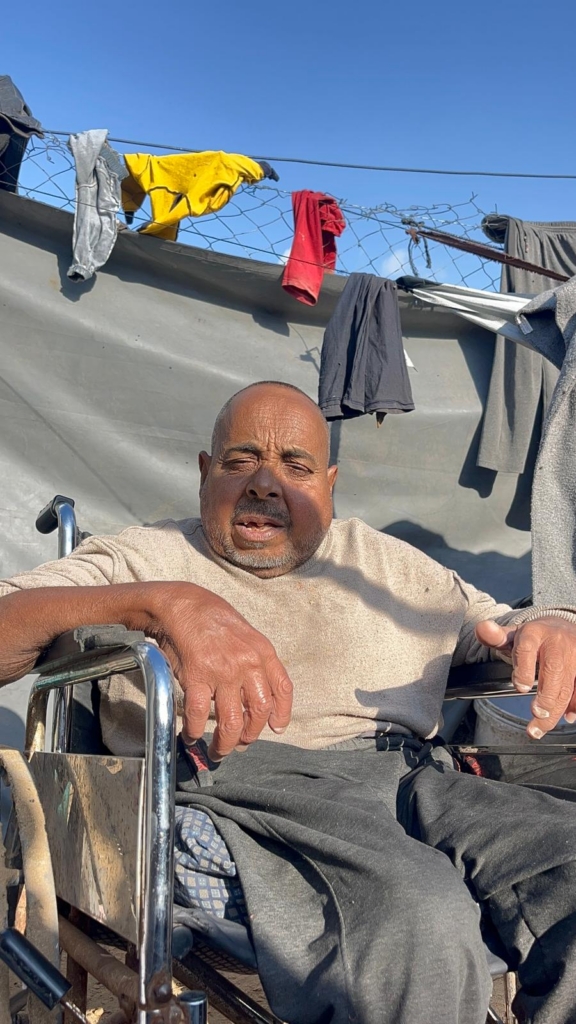
Mohammed Bili, 61, has been displaced seven times since October 2023. He requires dialysis three times a week. However, the facility he previously visited has been destroyed, and he now gets dialysis only twice a week for shorter sessions. He struggles to use his wheelchair in the camp’s terrain, and has lost nearly 20kg.
Amnesty International
Mohammed Bili, 61, struggles to use his wheelchair in the camp’s terrain.
He told Amnesty International’s researchers: “I struggle with extreme stiffness in my arms and weakness in my muscles due to the fact that I can’t access dialysis as frequently as I need.”
Samira Al-Shawa, 88, had used a walker to move about independently. Now she is living in an IDP camp, where the sandy terrain means she is unable to walk at all. She spends most of her time lying on a makeshift bed in her tent. Charity kitchens provide her family with food, but it is insufficient and lacks adequate nutrition. She has lost about 20kg since October 2023.
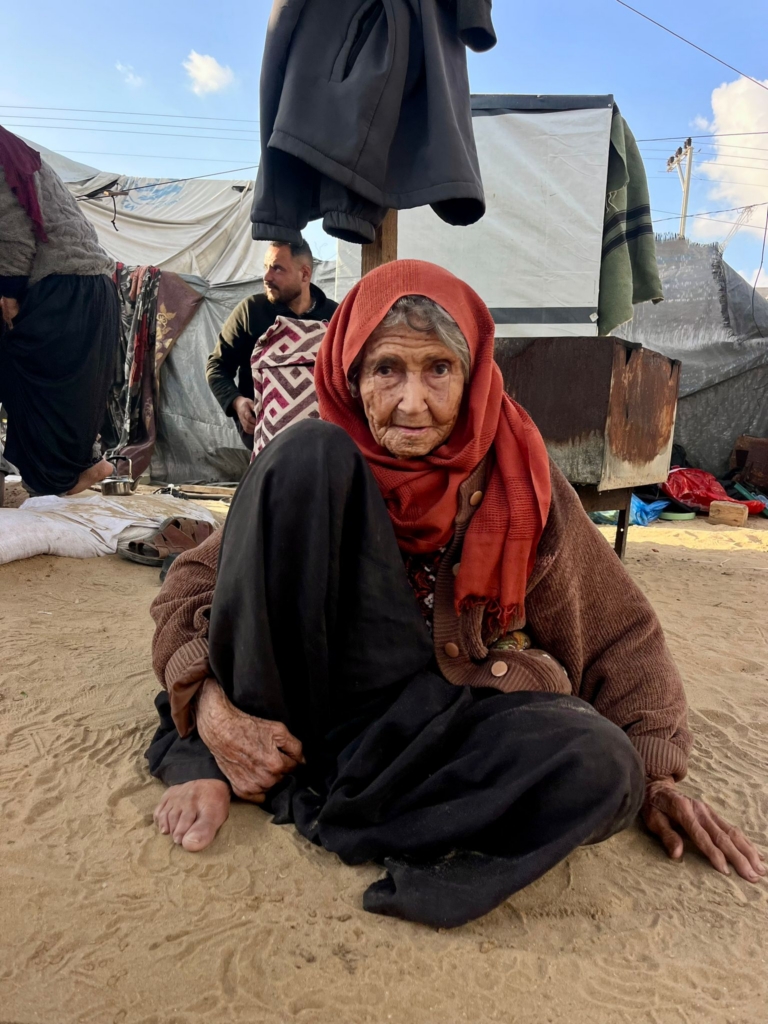
Sadiqa Al-Barrawi, aged approximately 90, has been displaced three times since October 2023. She is currently living in a tent in Salam IDP camp with her son, his wife and their four children. While going to use the toilet one night in January 2025, she fell and injured herself, and now cannot stand or walk. She told Amnesty International: “Since then life has become even more miserable.”
Sadiqa has diabetes and high blood pressure. She has lost about 25kg and relies on food from charity kitchens. She added: “We are farmers. At home in the village, we have land and the best fresh food – and now we have nothing.”
Amnesty International
Sadiqa Al-Barrawi, aged approximately 90, has been displaced three times since October 2023.
Background
People over 60 make up about 5% of Gaza’s population. According to the Palestinian Ministry of Health, as of early December 2025, 4,813 older people had been killed in Gaza since October 2023, although this figure did not include indirect deaths due to destroyed health infrastructure, for example. According to a report by UNWRA, many older people lose connection to caregivers due to the hostilities or the upheaval of displacement. Amnesty International has documented how older people are at heightened risk in situations of armed conflict, and their humanitarian needs systemically ignored.
In December 2024, Amnesty International concluded that Israel is committing genocide in Gaza, arguing that it had carried out acts prohibited under the Genocide Convention with the specific intent to destroy Palestinians in Gaza, including killings, causing serious bodily or mental harm, and deliberately inflicting on Palestinians in Gaza conditions of life calculated to bring about their physical destruction.
The heavy prison sentences imposed on Rached Ghannouchi and four other Ennahda party leaders mark is the latest blow in the Tunisian authorities’ campaign to crush the opposition party ousted from power by President Kais Said in 2021 as part of their broader crackdown on dissent, Amnesty International said today.
On 2 February, a Tunis appeals court convicted at least 20 individuals including opposition figures handing down prison sentences ranging from three to 35 years in the case known as “Conspiracy against State Security 2”.
The prison term for Rached Ghanouchi, the 84-year-old former Ennahda leader detained on various charges since April 2023, was increased from 14 to 20 years bringing the total prison terms issued against him in multiple cases to 56 years. The court also upheld 35-year sentences in absentia against former intelligence chief Kamel Guizani, former foreign minister Rafik Abdessalem, Lotfi Zitoun and Mouadh Ghannouchi, Rached Ghannouchi’s son.
Tunisian authorities should immediately quash the unjust convictions and sentences of all defendants. Authorities must respect and ensure the human rights of everyone and uphold the rule of law in the country.
Sara Hashash, Deputy Regional Director for the Middle East and North Africa at Amnesty International.
“Tunisian authorities should immediately quash the unjust convictions and sentences of all defendants. Authorities must respect and ensure the human rights of everyone and uphold the rule of law in the country.”
“The multiple persecutions of the members of Ennnahda show how Tunisa’s justice system is being instrumentalized by the authorities to crush all forms of political opposition and silence peaceful dissent. In Tunisia today, the majority of opposition leaders from different political backgrounds/groups/affiliation are already behind bars. The latest Conspiracy 2 case verdict sends a chilling message: peaceful opposition of the authorities is now punished with decade-long prison sentences,” said Sara Hashash, Deputy Regional Director for the Middle East and North Africa at Amnesty International.
“In recent years the human rights situation in Tunisia has sharply deteriorated, with authorities escalating their repression against the political opposition, carrying out a systematic purge targeting the Ennahdha party. This travesty of justice and attack on the rule of law must end.”
Since the dissolution of the Tunisian parliament in March 2022, in which the Ennahda party held a strong majority, leaders, former members of parliament, staff and members of the Ennahdha party have been systematically targeted. Its leaders, volunteers, and grassroots members have faced judicial harassment, arrest, detention and prosecutions in relation to terrorism-related accusations or alleged conspiracies against state security, often without credible evidence. At least 26 Ennahdha party leaders, employees and members are currently detained and being investigated or prosecuted. Many others have left the country.
The First Instance trial in the Conspiracy 2 case had concluded on 8 July 2025 with mass conviction of 21 out of 24 individuals including senior political leaders from Ennahdha Party like Habib Ellouz, Lotfi Zitoun, former members of parliament, former government and security officials. Sentences ranged from 12 to 35 years. The trial was marred by fair trial violations with defendants held in pre-trial detention compelled to participate in hearings remotely via video link from prison, a measure that according to their lawyers hampered their ability to communicate with legal counsel and engage effectively with the court.
The Ennahda leaders stand accused of running a covert network led by Ghannouchi aimed at “changing the structure of the state” with the help of former Ministry of Interior official Kamel Ben El Bedoui. The charges were based on allegations of “conspiracy against state security”, largely relying on anonymous witness testimony, intercepted communications, and documents seized during police raids.
Much of the material consisted of political criticism and private communications critical of President Saied dating back to between 2011 and 2022, but with no concrete evidence of a recognizable offense under international law. The authorities’ central claim that certain opposition politicians operated a clandestine “security apparatus” remains unsubstantiated by any independently verifiable evidence.
Systematic targeting of Ennahda
In recent years Tunisian authorities have increasingly turned to counterterrorism laws and state security charges to arbitrarily prosecute and detain opposition figures including leading figures amongst the Ennahdha Party leadership. Courts have conducted mass trials based on insufficient evidence or unfounded accusations, resulting in repeated violations of fair trial guarantees.
In addition to his most recent sentence in the Conspiracy 2 case, Rached Ghannouchi had already been sentenced in multiple other cases. Since his arrest in April 2023, he has been investigated or prosecuted in at least 11 different cases. In May 2023, Tunisia’s anti-terrorism court sentenced him to a year in prison and a fine in connection with public remarks at a funeral in which he praised the deceased as a “courageous man” who did not fear “a ruler or tyrant”.
In April 2023, shortly after Rached Ghannouchi’s arrest, security forces shut down all offices of the Ennahda party across the country.
Mondher Ouinissi who replaced Rached Ghannouchi as head of the party was also arrested and detained a few months later on 7 September 2023 and is being prosecuted in a separate case for conspiracy charges. Ajmi Ouirimi who followed as Secretary General of the party, was also arrested and detained since July 2024.
Even members and supporters of Ennahda have been targeted. In September 2024, security forces arrested at least 97 people for their activism within Ennahda party groups in different regions, as part of a pre-electoral crackdown ahead of the presidential elections. Most of them were released over the following weeks.