
Chile: Amnistía Internacional envió un llamado a mandatarios europeos por su encuentro con el presidente Piñera

Ahead of the visit of Chilean president Sebastián Piñera to Spain, France, Italy and the United Kingdom, Amnesty International has sent a letter to each of the leaders of these European countries expressing its concern about the serious human rights violations and impunity that continue to put all people in Chile at risk and involve a continued failure to meet the state’s obligations in relation to justice, reparation for victims and their families, and guarantees of non-repetition.

“Almost two years on from the protests that began in October 2019 and the widespread attacks against the protestors by the Chilean Carabineros, investigations into serious human rights violations and possible crimes against humanity are making little progress,” said Erika Guevara-Rosas, Americas director at Amnesty International.

“No strategic commander has been prosecuted to date, and in many cases the same officials who are alleged to have committed human rights violations are still in their posts in charge of controlling the protests. The international community cannot be complicit in this impunity by remaining silent.”

Investigations into serious human rights violations and possible crimes against humanity are making little progress.

Erika Guevara-Rosas, Americas director at Amnesty International

Amnesty International has called on the authorities in Spain, France, Italy and the United Kingdom, in their exchanges with President Sebastián Piñera, to express how important it is that the Chilean authorities: 

  • Ensure that the National Prosecutor’s Office and the Judiciary have all the information and resources necessary to carry out prompt, thorough, impartial, and independent investigations into each of the responsibilities within the Carabineros’ line of command that were key in allowing the right to physical integrity to be widely violated in the context of the social demonstrations that began in October 2019.
  • Adopt all necessary measures to provide reparation to the victims and their families, including adequate rehabilitation, care and reparation for victims of ocular trauma, respecting all international standards of integral reparation applicable. In particular, the current Comprehensive Eye Reparation Programme (PIRO) should be strengthened, in response to the many criticisms raised by the victims themselves who are beneficiaries of this programme.
  • Promote the structural reform of the police institution Carabineros de Chile so as to effectively ensure that law enforcement agencies strictly follow international standards on the use of force, respect the life and physical integrity of all people and have effective mechanisms of accountability, both to civilian authorities and to the public.
  • Take all other necessary measures to protect freedom of expression and peaceful assembly and prevent the recurrence of events such as those documented by Amnesty International.

Amnesty International hopes that the meeting between the Chilean President and his European counterparts will be an opportunity to advance the protection and promotion of human rights in Chile.

Additional information:

Amnesty International has documented the widespread violation of the right to physical integrity by Carabineros officers during the protests that began in October 2019, which have undoubtedly marked a milestone in Chile’s recent history, due to the massive scale of the social demands and multiple repercussions at the social and political level. According to updated figures from the Public Prosecutor’s Office and the National Institute of Human Rights, there are more than 8,000 victims of state violence and more than 400 cases of eye trauma.

Amnesty International found sufficient evidence to argue that the widespread violations demonstrate a pattern of conduct that reveals an intention to harm demonstrators in order to silence protest, or accept such harm as a necessary evil. The scale and consistency of the human rights violations and possible crimes under international law committed could have been avoided, but the strategic and operational commanders of the police institution deliberately failed to implement certain measures within their power. They also deliberately allowed impunity within the institution and obstructed the Prosecutor’s Office’s access to information.

For more information or to arrange an interview, please contact:

Duncan Tucker (Amnesty International Americas): duncan.tucker@amnesty.org;

Ilsen Jara (Amnesty International Chile): ilsen.jara@amnistia.cl

The post Chile: Amnistía Internacional envió un llamado a mandatarios europeos por su encuentro con el presidente Piñera appeared first on Amnesty International.

Angelina Jolie and Amnesty International remind the world of its commitment to children’s rights with a book some adults won’t want children to read

Angelina Jolie and Amnesty International have joined forces to create a resource for children and young people to learn about their rights, with the publication of a new book which empowers teenagers to speak out against injustice.

Know Your Rights and Claim Them explains what child rights are, equips young people with the knowledge they need to protect themselves and others, and shows how governments are failing to uphold their commitment to child rights. It was written in collaboration with Professor Geraldine Van Bueren QC, one of the original drafters of the UN Convention on the Rights of the Child.

Angelina Jolie said:

“If governments kept their word, and if all adults respected children’s rights, there would be no need for this book. Children have rights just as adults do and they should have the power and agency to claim them.

“Know Your Rights and Claim Them is the book some adults don’t want children to read, as it will arm them with the knowledge to defend their rights and those of others.

“Governments signed up to protect children’s rights in 1989, yet many of them are still failing to listen to the voices of children. In some countries, girls as young as nine are forced into marriage. Globally, more than 61 million children don’t attend primary schools and, in 2019, one in six children were living in extreme poverty – a number that rose significantly during the pandemic. It’s time to remind the world of its commitment to children’s rights.”

Angelina Jolie and Amnesty International have joined forces to create a resource for children.

The book is available in bookshops in the UK from today, and available for pre-order in USA, Australia, New Zealand and Greece. With other countries including South Korea, Denmark and Germany following close behind. The authors’ goal is for the book to be published in all languages and countries, empowering many millions of young people to know and claim their rights.

The social and economic effects of the COVID-19 pandemic provide a stark reminder that many human rights issues have a disproportionate impact on young people and when it comes to issues that directly affect them, their voices are rarely heard or listened to. Know Your Rights and Claim Them aims to equip young people with the knowledge they need to stand up and have their say.

The book sets out how the concept of children’s rights came into being through the UN Convention on the Rights of the Child, which was designed to give children the right to a voice and to participate in all decisions that affect them. It also features how-to guides, along with the stories of a number of incredible young activists who are at the forefront of human rights change around the world. Whether campaigning on climate change, demanding access to education, or speaking out against racial discrimination and gun violence, these inspirational young people demonstrate the power of standing up for what we believe in.

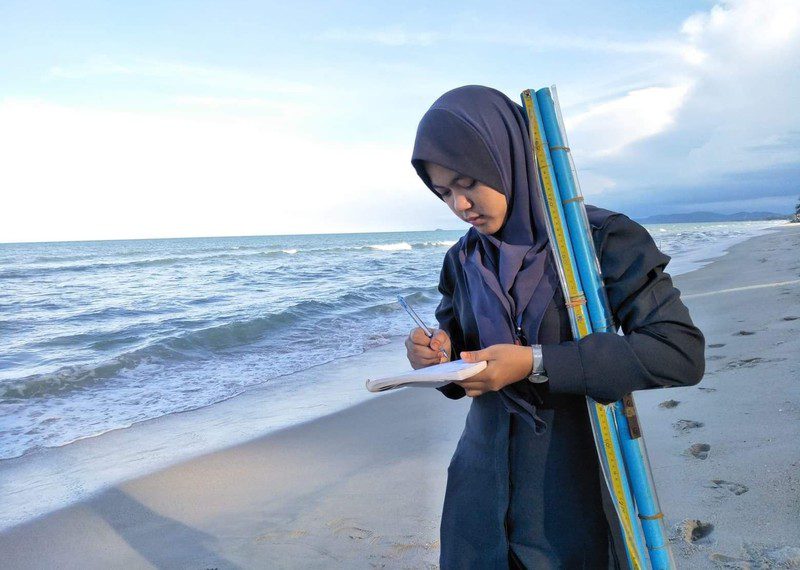
Khairiyah Rahmanyah, 19, was born to a fishing family who live close to the sea in southern Thailand. The sea near her home is a rich source of seafood and home to endangered marine species, such as sea turtles and rare pink dolphins. In 2020, when she was 17, Khairiyah launched a campaign against the Thai government’s plan to develop her village, Chana, into an industrial estate. As a result, the government decided to postpone their decision. However, the project has not been dropped, and the fight for her community continues.

Khairiyah Rahmanyah, 19, from Thailand.

“Words cannot explain how I feel to be part of this book,” said Khairiyah, who spent hours picketing, and travelled 1,000 kilometres to Government House in Bangkok to deliver a letter to the prime minister begging him to stop the development.

“I am really proud to be representing the stories of my community. I was born into activism and I have been fighting to protect my community since I was little. It has been painful to live this reality and I want life to be different for the next generation. As children, we must be allowed to learn about our rights and it’s up to adults to encourage, empower and support us.”

Children have a right to life, dignity and health; identity; equality and non-discrimination; a safe place to live; protection from harm; participation (including the right to be heard); bodily integrity; protection from armed violence; justice and liberty; privacy; minority and Indigenous rights; education; play; freedom of thought; and voice and peaceful protest. 

There are about 2.3 billion children in the world, nearly a third of the total human population. Given the devastating impact of the global pandemic on children and young people, it’s never been more crucial to arm them with the knowledge they deserve. This is their right – and it’s time for the world to listen and act.   

Agnès Callamard, Amnesty International’s Secretary General, said:

“We must all tackle the human rights issues of today, with an eye on the future, knowing we are accountable to the world of 2030. Not only must we ask ourselves – ‘how are our actions impacting the children of tomorrow?’ – we need to make sure that children are setting the agenda for the years to come. That can only happen if they know their rights and how to claim them.

“When children don’t, they’re at risk of abuse, discrimination, and exploitation, often at the hands of adults. They’re also at risk of being overlooked, unable to participate in important decisions about the world they live in and the problems they will inherit. Amnesty International is campaigning to ensure children’s rights are a priority for governments across the world.

“That’s why, alongside the book, we have launched an online human rights education course featuring young activists, which will serve as a powerful tool to empower young people and others to claim their rights across the world. When young people are educated about their rights, they are empowered to defend them, to stand up against injustice against themselves and others. Knowledge is key. We will all benefit from a world in which child rights are upheld.”

Know Your Rights and Claim Them will be released in the UK on 2 September 2021, with publication in Australia, Greece, New Zealand and USA to follow in October. The book will be available online and from all good bookshops. Amnesty International’s online human rights education course will be available on 2 September.

Join Angelina Jolie in conversation with some of these young people over Zoom tonight at 1830 BST/10:30 AM PST.

The post Angelina Jolie and Amnesty International remind the world of its commitment to children’s rights with a book some adults won’t want children to read appeared first on Amnesty International.

Egypt: Chance to end seven-year sham case against brave NGOs

Responding to the news that an Egyptian judge has dropped an investigation into at least six human rights defenders and NGO workers, lifted travel bans against them and stopped asset freezes targeting a number of them in Case 173/2011, including Azza Soliman, Esraa Abdelfattah and Negad el Bor’ei, Amnesty International’s Deputy Director for the Middle East and North Africa, Lynn Maalouf said:

“The decision to lift the travel bans and drop the investigations against these six human rights defenders is the first good news since this investigation against human rights and civil society organizations first started in 2014. It has long been a form of reprisal for defenders of brave human rights work, and they should not have been targeted with these punitive measures in the first place.    

“The Egyptian authorities must drop Case 173 once and for all and lift all travel bans and asset freezes against at least 20 other human rights defenders still subject to these measures. This infamous decade-long case has been nothing but a desperate attempt to dismantle Egypt’s human rights movement and silence dissent through intimidation, harassment and politically motivated legal action.

“Separately to this case, at least 13 human rights defenders and NGO workers remain behind bars on unfounded terrorism charges, while dozens more face unlawful travel bans and abusive trials over charges of spreading false news. If the Egyptian authorities are serious about ending the crackdown against human rights defenders, then they must immediately release those arbitrarily detained, remove travel bans, quash verdicts and end unjust prosecutions of human rights defenders.”

Background

On 30 August, a press release by the investigative judge in Case 173/2011 sent to the Egyptian media announced that he had closed the investigation and removed the travel bans and asset freezes against four human rights organizations and their staff members, including Azza Soliman, Esraa Abdelfattah, Negad El Bor’ei, Hossam Ali and Magdy Abdelhamid. It is unclear whether the Ministry of Interior has now officially removed their names from the travel bans list. 

However, Case 173 investigations continue into other prominent human rights defenders, including: Gamal Eid, director of the Arab Network for Human Rights Information; Hossam Bahgat, founder and director of the Egyptian Initiative for Personal Rights; Mozn Hassan, head of Nazra for Feminist Studies. Others named in the case include Mohamed Zaree, the Egypt Programme director at the Cairo Institute for Human Rights Studies; and Aida Seif al-Dawla, Magda Adly and Suzan Fayad, the founders and directors of El-Nadeem Centre for Rehabilitation of Victims of Torture.

Since 2014, investigative judges have conducted a criminal investigation into the work and sources of foreign funding of Egyptian NGOs and have issued asset freezes against seven organizations and 10 human rights defenders. Egyptian authorities banned at least 31 human rights defenders and NGO staff from travel abroad for six years. Different courts have rejected several appeals by human rights defenders against the punitive restrictive measures against them.

The post Egypt: Chance to end seven-year sham case against brave NGOs appeared first on Amnesty International.

European Court’s judgment on Natalia Estemirova’s abduction and killing highlights unabated impunity in Russia

In a judgment issued today, the European Court of Human Rights (ECtHR) ruled that Russian authorities have failed to properly investigate the murder of Natalia Estemirova, a prominent human rights defender who was abducted and killed in Chechnya in 2009.

Denis Krivosheev, Amnesty International’s Eastern Europe and Central Asia Acting Director, said:

“This judgment exposes the impunity surrounding the murder of Natalia Estemirova and the cynical inaction of the Russian authorities. In the twelve years since Natalia was killed, not only have they failed to identify and bring the perpetrators to account, but they have also remained silent and complacent as other human rights defenders in Chechnya were exposed to the same perils, attacked, threatened, and prosecuted.”

“Since 2009 the assault on human rights in Chechnya has intensified and civil society has been methodically extinguished by the Chechen authorities. To this day, Natalia’s colleagues at the NGO Memorial face death threats, arbitrary arrests and jail, and many journalists and activists have been forced into exile. Scores of people have been forcibly disappeared. The inaction of Russian authorities has effectively given the Chechen leadership a carte-blanche to continue to commit abuses, and to silence anyone who dares to speak out.

The inaction of Russian authorities has effectively given the Chechen leadership a carte-blanche to continue to commit abuses, and to silence anyone who dares to speak out

Denis Krivosheev, Amnesty International’s Eastern Europe and Central Asia Acting Director

“Natalia Estemirova lost her life because she worked relentlessly to document and expose egregious human rights violations committed in Chechnya. This heinous, cowardly murder must be fully, effectively, and impartially investigated and all those behind it found and brought to justice. Until this happens, the Council of Europe Committee of Ministers, the European Union and Russia’s bilateral partners should take every opportunity to compel Russia to fully implement this binding judgment. Until then, this binding judgment will be a step short of the justice and truth that Natalia Estemirova and her family are entitled to.”

Background

Natalia Estemirova was a prominent human rights defender who worked for the Russian NGO Memorial in Chechnya. She was known for investigating gross human rights violations, including enforced disappearances, extrajudicial executions, and torture committed by the Russian State agents during the second 1999-2009 Chechen conflict. She repeatedly drew criticism and threats from the Chechen authorities, including the Kremlin-appointed Chechen leader Ramzan Kadyrov. On 15 July 2009, Natalia Estemirova was abducted by unidentified armed men in the Chechen capital Grozny and was found dead on the same day in the neighboring Ingushetia. No one has been brought to justice for her killing.

Since Natalia’s murder, journalists, human rights defenders and civil society activists in Chechnya continue to be harassed, intimidated, attacked, jailed under trumped up charges and even killed like human rights defender Zarema Sadulaeva along with her husband Alik Dzhabrailov. Numerous abductions and killings have been reported in Chechnya since. Many public critics of the Chechen authorities have faced torture, enforced disappearance or extrajudicial execution. The perpetrators of these and other crimes, including the so-called ‘gay purge’ and of mass extrajudicial executions committed in 2017, have enjoyed complete impunity.

The post European Court’s judgment on Natalia Estemirova’s abduction and killing highlights unabated impunity in Russia appeared first on Amnesty International.

Pakistan: Authorities must deliver on pledge to end cruelty of enforced disappearances

Pakistan’s authorities must deliver long-promised reform to end state-sanctioned enforced disappearances and finally bring the country in line with international human rights law and standards, said Amnesty International, on the UN’s International Day for Victims of Enforced Disappearance. 

A proposed amendment bill to the Pakistan Criminal Penal Code to outlaw the practice – in which the state denies holding an individual or refuses to provide information on their fate or whereabouts, has remained pending for more than two and a half years. Enforced disappearances have been routinely used as a tool by Pakistan’s intelligence services since the inception of the so-called “War on Terror” in 2001, to target human rights defenders, political activists, students, and journalists, with the fate of hundreds of victims still unknown, according to victim groups and families.  

Enforced disappearances have long been a stain on Pakistan’s human rights record, causing untold anguish to hundreds of families.  

Dinushika Dissanayake, Deputy Director for South Asia

The most recent amendment bill, which is currently under parliamentary review, contains fundamental flaws and falls short of meeting the minimum requirements of international law, which strictly prohibits enforced disappearances. 

“Enforced disappearances have long been a stain on Pakistan’s human rights record, causing untold anguish to hundreds of families. Despite this fact being acknowledged repeatedly by the current government, the continuation of the practice sends mixed signals to the groups desperate to learn the fate and whereabouts of their loved ones. That no one has been held accountable despite all these moves, is also cause for concern,” said Dinushika Dissanayake, Amnesty International’s Deputy Director for South Asia. 

“When it was announced in January 2019, the proposed reform offered hope that the political will to finally outlaw enforced disappearances might exist. Two and a half years on, we have a watered-down proposal that falls short of what was promised.” 

The current amendment bill falls short of standards set by international law in a number of areas, particularly with regard to the scope of the law identifying who the perpetrator can be. It only prohibits enforced disappearances committed against a Pakistani national or in Pakistan, disregarding instances of Pakistanis who could be responsible for an enforced disappearance abroad, potential foreign victims, and those cases when the alleged offender is present in any territory under the jurisdiction of Pakistan, as provided by international law. The bill also only applies to cases when ‘an unlawful or illegal deprivation of liberty’ has taken place, failing to recognize that enforced disappearances may be committed even after a lawful detention or arrest. Similarly, the bill also does not recognize that state knowledge, acquiescence, or support of a disappearance is not necessarily required for the act to be criminal.  

Likewise, the amendment bill does not clearly define its mandate and does not specify under which legal structure victim families will be able to file a complaint, how compensation will be determined, and what retrospective effect the amendment will have, if any. 

The amendment bill was presented before parliament by the Ministry of Human Rights on 7 June. It currently sits with the Standing Committee on Interior in the National Assembly, which has yet to provide any feedback almost three months on. Just weeks after the reform was presented, on 26 June, political activist Seengar Noonari was abducted by the authorities. 

Amnesty International is also calling on the Pakistani authorities to promptly adhere to the International Convention for the Protection of All of Persons from Enforced Disappearance, without making any reservation to its text, and immediately disclose the whereabouts and fate of those still missing. 

“Enforced disappearances have left an indelible and painful legacy in Pakistan. To move forward from this past, the authorities need to not only expedite these reforms, but also be completely transparent about the fate of all those abducted by state agents and other groups, and start holding perpetrators accountable,” said Dinushika Dissanayake. 

Background 

Pakistan has made some limited progress towards proscribing enforced disappearances. Recent verdicts by the Islamabad High Court have set precedents for compensation for families of victims of enforced disappearances and fines for law enforcement agencies. However, it is not clear if these have been implemented. 

Seengar Noonari was returned to his family five weeks after being subject to enforced disappearance. 

For more information about enforced disappearances in Pakistan, see here. 

The post Pakistan: Authorities must deliver on pledge to end cruelty of enforced disappearances appeared first on Amnesty International.