Cambodia: Conviction of Prey Lang activist marks further repression of environmental defenders

Responding to the conviction of Prey Lang Community Network (PLCN) activist Chan Thoeun for “intentional violence with aggravating circumstances”, Ming Yu Hah, Amnesty International’s Deputy Regional Director for Campaigns, said:

“Chan Thoeun and the PLCN have been standing up against powerful illegal logging interests for years. They have defended the Prey Lang forest while the Cambodian authorities have turned a blind eye to the rampant destruction of this vital ecosystem, which is an essential part of the culture of Indigenous Kuy communities.”

“While Chan Thouen will not face a prison term, this remains an unjust conviction. He never should have been charged or tried in the first place. This conviction fits the pattern of previous attempts to silence and intimidate environmental activists in Prey Lang and across Cambodia, where bogus charges and suspended sentences are frequently used to suppress peaceful activism.”

“Time and time again, the Cambodian courts fail to deliver genuine justice in cases involving human rights defenders and environmental activists. Meanwhile, the Cambodian government continues to trample on Indigenous Peoples’ rights and allows logging companies to pursue their illegal activities with impunity.”

“Cambodia cannot be a responsible climate actor while marginalizing, harassing and convicting Indigenous and environmental activists in unfair trials. Amnesty International calls on the Cambodian authorities to overturn this verdict and to allow independent environmental groups to undertake unrestricted monitoring of illegal deforestation.”

Background

Today, Cambodian environmental activist Chan Thoeun, an activist with the Prey Lang Community Network (PLCN) was convicted of “intentional violence with aggravating circumstances” under Articles 217 and 218 of the Criminal Code and given a two-year suspended sentence. He was initially tried in absentia for “attempted murder” by the Kampong Thom Provincial Court of First Instance on 16 September, and the charges against him changed today during the verdict announcement.

The alleged incident occurred in July 2020 in Kampong Thom’s Sandan district after Chan Thoeun had taken photos of trucks illegally transporting timber from the Prey Lang Wildlife Sanctuary. According to Chan Thoeun’s lawyer, after the confrontation, the alleged victim filed a complaint with district military police accusing Chan Thoeun of attempted murder.

Chan Thoeun has vehemently denied the allegations against him. PLCN have stated that the complainant is a timber trader who was engaged in illegal logging at the time of the confrontation with Chan Thoeun.

Prey Lang is mainland Southeast Asia’s largest lowland evergreen forest, covering approximately 500,000 hectares across four provinces. In 2016, much of the forest was designated as a wildlife sanctuary. More than 250,000 people live in and around Prey Lang, most of whom identify as Indigenous Kuy. Prey Lang is a crucial part of the Kuy people’s livelihood, culture and spirituality.

Widespread illegal logging and the repression of environmental activism are among the grave threats to Cambodia’s Prey Lang rainforest. In February 2020, the Cambodian authorities banned environmental defenders from entering the Prey Lang wildlife sanctuary and PLCN have been barred from conducting their forest patrols ever since.

Throughout 2021, Cambodian authorities have unleashed a relentless assault on environmental activists, while the government claims to be a responsible actor on climate and promotes the country as a suitable market for carbon credits ahead of the 2021 United Nations Climate Change Conference, also known as COP26.

In early February 2021, Ministry of Environment officers arrested and arbitrarily detained five environmental defenders while they were investigating illegal logging in Prey Lang. They were only released three days later, after signing a document committing them to refrain from entering Prey Lang without permission from the Ministry of Environment.

Several grassroots environmental groups, including PLCN, have been threatened based on accusations they are operating illegally because they are not registered under Cambodia’s widely-criticized Law on Associations and Non-Governmental Organizations.

In June 2021, four environmental activists affiliated with Mother Nature Cambodia, a prominent campaign group that has won several major environmental victories, were charged variously with “plotting” and “insulting the King” (lèse majesté) after investigating river pollution in the Tonle Sap River in Phnom Penh. In May 2021, the Phnom Penh Municipal Court convicted and sentenced five Mother Nature Cambodia activists to between 18 and 20 months in prison for seeking to protest government plans to fill and privatize a major lake in the capital.

The post Cambodia: Conviction of Prey Lang activist marks further repression of environmental defenders appeared first on Amnesty International.

China: UN must act on Xinjiang atrocities after petition shows mass global outrage

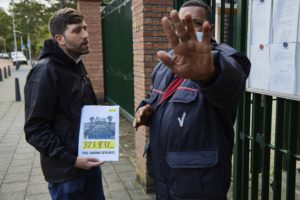
  • More than 323,000 people worldwide sign Amnesty International’s ‘Free Xinjiang Detainees’ petition
  • Open letter urges UN to investigate human rights violations against Uyghurs, Kazakhs and other Muslim minorities
  • New testimonies reveal impact on detainees’ family members

The international community must strongly condemn the ongoing serious human rights violations in China’s Xinjiang Uyghur Autonomous Region (Xinjiang) and pave the way for justice and accountability, Amnesty International said today in an open letter to UN member states.

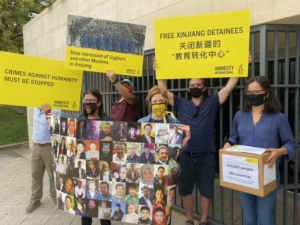
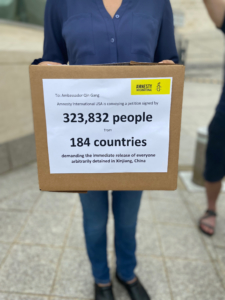
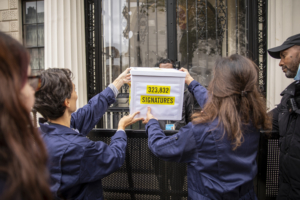
The call comes after 323,832 people from 184 countries and territories signed the organization’s petition calling on the Chinese authorities to release the hundreds of thousands of Muslim minority men and women arbitrarily detained and subjected to mass internment, torture and persecution in Xinjiang.

Around the world, hundreds of thousands of people have signed our petition to express their outrage at evidence of crimes against humanity and other serious human rights violations being inflicted on Muslims in Xinjiang

Agnès Callamard, Amnesty International’s Secretary General.

“Around the world, hundreds of thousands of people have signed our petition to express their outrage at evidence of crimes against humanity and other serious human rights violations being inflicted on Muslims in Xinjiang,” said Agnès Callamard, Amnesty International’s Secretary General.

“It’s a clear sign that people around the world see through China’s efforts to silence critics and lash out in response to credible reporting on its atrocities in Xinjiang. Every signature is a direct call on China to immediately stop this systematic persecution.

“The Chinese government must immediately release all people arbitrarily detained in the camps and in prisons, dismantle the internment camp system, and end the systematic attacks against predominantly Muslim ethnic groups in Xinjiang.”

Petitions delivered at Chinese embassies

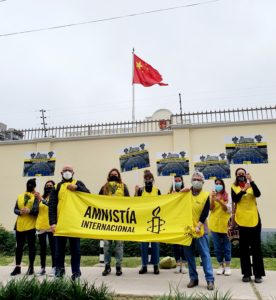
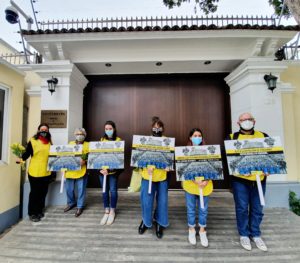
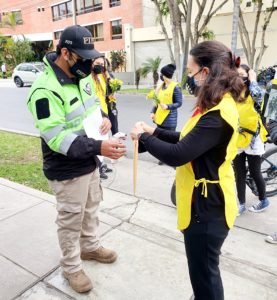
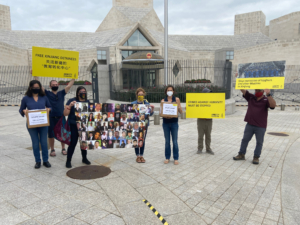
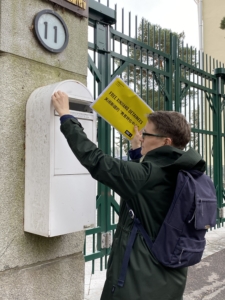
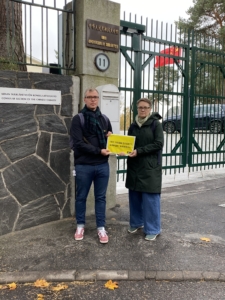
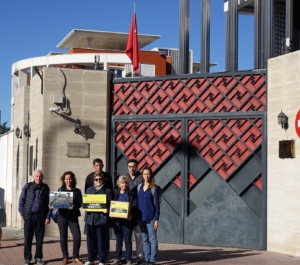
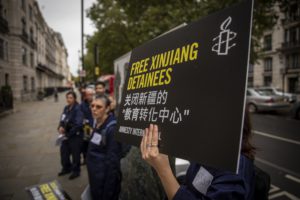
In recent days, Amnesty International supporters in 10 cities around the world have held public events to hand over their Free Xinjiang detainees petitions.

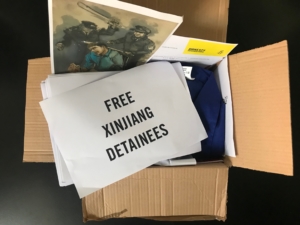
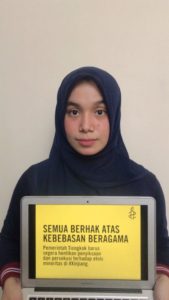
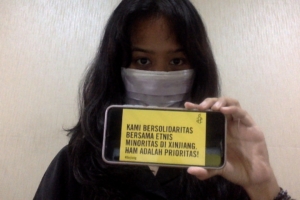
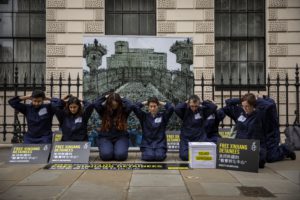
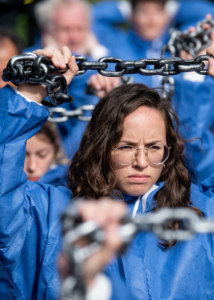
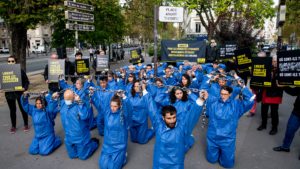
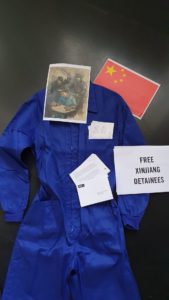
On 7 October, activists gathered at the Chinese embassy in London, UK, to hand over their petition while dressed in the distinctive blue uniforms that camp detainees are forced to wear. Amnesty International activists planned similar events at Chinese embassies in: Dakar, Senegal; Helsinki, Finland; Lima, Peru; Lisbon, Portugal; Madrid, Spain; Paris, France; The Hague, the Netherlands; and Washington DC, USA. Amnesty International Indonesia hosted an online seminar and led a digital action encouraging activists to dress in blue uniforms and post selfies. 

The global petition is part of an ongoing Amnesty International campaign, launched in June 2021, to demand an end to the arbitrary detention and other serious human rights violations suffered by predominantly Muslim ethnic groups in Xinjiang.

The campaign highlights more than 60 cases of individuals arbitrarily detained in “transformation-through-education” centres – actually, internment camps – or sentenced to prison for years. These represent only a small fraction of the hundreds of thousands of men and women – possibly up to one million or more – whom the Chinese authorities have detained under the guise of fighting “terrorism”. 

New family testimonies

Amnesty International interviewed dozens of family members of those arbitrarily detained in Xinjiang and recently released new videos sharing some of their experiences.

Memeteli’s sister, Hayrigul Niyaz, was detained after she returned from studying abroad, and he has no information about her whereabouts in Xinjiang. Memeteli told Amnesty International: “If I met her again, I will say: ‘Sorry, my sister, that I couldn’t save you from the camps.’”

Adila’s father, Sadir Ali, was arrested in 2018 and sentenced to 20 years in prison, allegedly because he was fasting during Ramadan. Adila said: “Deep [in my] heart I will never be happy because my father is in the jail or in the camp. Why is the Chinese government doing this to us?” She said she had been unable to visit her hometown for 11 years and has lost contact with her relatives in Xinjiang.

Abduweli Ayup, a well-known Uyghur activist now living in Norway, told Amnesty International about his sister, Sajidugul Ayup and brother Erkin Ayup, who are serving 12 and 14 year prison sentences, respectively, in Xinjiang for “inciting terrorism”: “I feel every time I do something, it will be dangerous for my family. No one can protect my family members from the punishment. I know that maybe my words will make the Chinese government very angry, but at least I will make the Chinese government know that I will not just watch them torture my sister. I’m not afraid to speak out anymore.”

Accountability for Xinjiang violations

In June 2021 Amnesty International launched a report documenting how Uyghurs, Kazakhs and other predominantly Muslim ethnic minorities in Xinjiang face systematic state-organized mass imprisonment, torture and persecution amounting to crimes against humanity.

The Chinese government has shown a total unwillingness to acknowledge the reality of the situation in Xinjiang, to halt the human rights violations, or to conduct impartial and thorough investigations and prosecute those suspected to be responsible in fair trials without recourse to the death penalty.

Meanwhile, UN bodies and member states have been slow to respond to the violations. Indeed, another UN Human Rights Council session ended last week without any formal action being taken to address abuses in Xinjiang.

Amnesty International is urging UN member states to stand together to strongly condemn China’s serious human rights violations in Xinjiang and to launch a robust, independent, international investigative mechanism to ensure accountability.

“Despite mounting evidence of serious human rights violations and crimes under international law over the past four years, the United Nations and its member states have failed to live up to their responsibility to hold China to account for its actions,” said Agnès Callamard.

The international community must stop pretending that the dystopian reality for Muslims in Xinjiang will somehow remedy itself. Too much time has already been wasted. Now more than ever, UN member states have a duty to protect the human rights of all people in Xinjiang, launch an investigation into the suspected crimes under international law, and ensure accountability.

Agnès Callamard

“The international community must stop pretending that the dystopian reality for Muslims in Xinjiang will somehow remedy itself. Too much time has already been wasted. Now more than ever, UN member states have a duty to protect the human rights of all people in Xinjiang, launch an investigation into the suspected crimes under international law, and ensure accountability.”

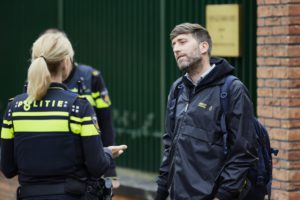
Gallery – images from Amnesty International petition handover events.

The post China: UN must act on Xinjiang atrocities after petition shows mass global outrage appeared first on Amnesty International.
Curaçao: Authorities continue to deny protection to people fleeing the crisis in Venezuela

The Curaçaoan and Dutch authorities have violated the rights of Venezuelans seeking international protection in Curaçao, Amnesty International said today in the new report, Still no Safety: Venezuelans denied protection in Curaçao. The organization documented 22 cases of Venezuelans, including children, who have been subjected to human rights violations such as automatic detention under inhumane conditions, ill-treatment, family separations and the denial of their right to seek asylum.

Almost 5.7 million Venezuelans have fled the human rights crisis in their country, making it one of the largest forced displacement crises in the world. Curaçao, a nearby Caribbean island that is part of the Kingdom of the Netherlands, is one of the destination countries. It is estimated that 17,000 Venezuelans live with irregular migratory status on the island.

“It’s unacceptable that the Kingdom of the Netherlands has supported the Curaçaoan authorities in rounding up, detaining and deporting people who fled Venezuela in search of safety. Instead of turning a blind eye while people’s human rights are being violated, the Dutch authorities should ensure that they receive the international protection they need,” said Erika Guevara-Rosas, Americas director at Amnesty International.

Still no protection

Amnesty International has found that the situation of Venezuelans seeking protection in Curaçao has not improved since it published the report Detained and Deported in 2018. Although Curaçao introduced a new international protection procedure, it still does not meet international human rights law and standards. For example, Venezuelans fleeing the crisis are still automatically detained for undefined periods of time, in which they are pressured to sign forms consenting to deportation and have very limited access to legal assistance. The protection assessment interviews are carried out by government officials who are also in charge of arresting foreigners with irregular migratory status. So far, the new procedure has only led to rejection of applications for protected status. The organization is deeply concerned that Curaçao consequently sends people back to Venezuela where they are at great risk of serious human rights violations, in breach of the international principle of non-refoulement.

The conditions in the “Foreigners Barracks”, the detention center in the Sentro di Detenshon i Korekshon Korsou (SDKK) prison, remain inhumane, with detainees subjected to sensory deprivation, overcrowding, being locked up among convicted prisoners, and a lack of privacy. Venezuelans told Amnesty International that prison guards subjected them to degrading and inhuman treatment, such as physical and verbal abuse and being forced to leap like frogs while naked. In 2019, police shot a group of Venezuelans who were in the Foreigners Barracks with rubber bullets. The intentional and disproportionate force the police used against them, and the severity of the injuries, may amount to ill-treatment or torture.

Miguel, who was among those shot with rubber bullets, recalls how the guards punished him and his group for seeking protection: “Then the craziness started: the guards didn’t let us sleep. They made noise at every moment with hammers. I was sleeping on the ground and poorly fed. I lost thirty-five kilos in five months. They damaged us psychologically to make sure we left the island.”

Detention of children and family separation

Curaçao has violated the rights of Venezuelan children by detaining them and separating them from their parent(s) who live on the island. Amnesty International has found eight cases of children who were or had been detained amongst adults in the Foreigners Barracks or in juvenile institutions. They were not reunited with their parent(s), neither were the parent(s) allowed to visit them. Instead, the Curaçaoan authorities deported them or were planning to deport them without their parents’ knowledge or authorization. The intentional and severe mental suffering that government officials have inflicted by deporting children and separating them from their parent(s) may in some cases amount to torture.

“It’s unacceptable that the Kingdom of the Netherlands has supported the Curaçaoan authorities in detaining and deporting people who fled Venezuela in search of safety

Erika Guevara-Rosas, Americas director at Amnesty International

In the case of Yusmari, her two sons, aged 15 and 16 at the time, were automatically detained in the Foreigners Barracks after the Coastguard had intercepted them and handed them over to the Curaçaoan immigration police. Yusmari, who already lived with an irregular migratory status on the island, recalls when they were put in the Foreigners Barracks: “Every time we called, we would cry.” Her youngest son, who is now back in Venezuela, told Amnesty International: “I felt bad. I was not used to being locked up.” After two days, Yusmari’s sons were detained in a youth institution where she was not allowed to contact or visit them. When she finally got permission and arrived at the youth institution, she learnt that the Curaçaoan authorities had already deported her children.

The Netherlands’ contribution to human rights violations

Despite various alarming signals about serious refugee and migrant rights violations committed in recent years, the Dutch authorities have intensified their active cooperation and support to Curaçao, principally in the field of detection, detention and deportation of irregular migrants and people seeking protection.

In November 2019 the Dutch military assisted in the guarding of a group of unlawfully detained Venezuelans, who appear to have been collectively deported in breach of international law. The Netherlands has also provided the Dutch Caribbean Coastguard with equipment and personnel to intercept people arriving by boat in an irregular manner, regardless of the high risk they run of being subjected to human rights violations on land.

The Dutch authorities have not created any binding human rights safeguards, independent monitoring mechanisms, or investigated alleged violations while supporting the Curaçaoan authorities. The responsible State Secretary has repeatedly stated that the Dutch authorities have no obligations to do so, because the Dutch government regards migration policy and possible violations as Curaçao’s responsibility.

However, Amnesty International takes the position that international obligations to respect and protect human rights also apply to the Netherlands when it supports the Curaçaoan authorities. The Dutch authorities have obviously failed to do so and have therefore contributed to a system of violations.

Amnesty International calls on the Curaçaoan authorities to guarantee the rights of Venezuelans seeking protection by creating an asylum procedure that meets international standards. They should stop the detention of children, and the separation of families; and only use detention of adults as a last resort. They must conduct prompt, thorough, independent and impartial investigations into all allegations of human rights violations committed during arrests or in custody.

The government of the Netherlands should assess human rights risks and create binding human rights safeguards applicable to the support it provides the Curaçaoan authorities. Moreover, the Netherlands should establish an independent inquiry to investigate its responsibilities in the assistance and other forms of cooperation between the Netherlands and Curaçao in the field of migration and international protection, in particular the guarding of Venezuelans in the sports hall in 2019 and the actions of the Coastguard.

For more information or to request an interview, contact:

Katy Sherriff (Amnesty International Netherlands): k.sherriff@amnesty.nl  

Carlos Mendoza (Amnesty International Americas): carlos.mendoza@amnesty.org

The post Curaçao: Authorities continue to deny protection to people fleeing the crisis in Venezuela appeared first on Amnesty International.

Libya: Unlawful lethal force and mass arrests in unprecedented migrant crackdown

Libyan security forces and militias in Tripoli have used unlawful lethal force and other violence in an unprecedented roundup of over 5,000 men, women and children from Sub-Saharan Africa and are holding them in horrid conditions where torture and sexual abuse are rampant, said Amnesty International. 

On 1 October, armed men from militias and security forces affiliated with Libya’s Interior Ministry violently broke into homes and temporary shelters in the Gargaresh area in Tripoli, home to a sizable population of refugees and migrants, firing rounds of live ammunition, damaging belongings and stealing valuables. Terrified migrants and refugees, including several registered with the United Nations High Commissioner for Refugees (UNHCR), were then transferred to detention centres in Tripoli, where they are denied regular and confidential access to UNHCR and other humanitarian agencies and subjected to torture and other ill-treatment. 

“Libyan forces have a harrowing record of subjecting refugees and migrants to unimaginable horrors with impunity. Using unlawful lethal force to capture thousands of unarmed men, women and children solely on the basis of their race is a new low and lays bare the authorities’ utter disregard for the lives and dignity of refugees and migrants,” said Diana Eltahawy, Deputy Director for the Middle East and North Africa at Amnesty International.

“We urge the Libyan authorities to immediately release all those arbitrarily detained solely on the basis of their migration status and to launch investigations into all incidents of unlawful use of force, torture and sexual violence. In the interim, authorities should ensure that those in detention are treated humanely, held in conditions that meet international standards and granted unimpeded access to UNHCR and other humanitarian actors without delay.”

To document the raid and its aftermath, Amnesty International spoke to witnesses, victims and family members, and examined dozens of videos and photographs shared by witnesses and published online of the raid and detention centres. While Amnesty International was unable to independently geolocate the videos, the location of interviewed witnesses was verified.

Violent raids, unlawful use of lethal force, xenophobic arrests 

According to eyewitnesses and video analysis, in the early hours of 1 October, armed men wearing uniforms with logos of the Interior Ministry and two affiliated militias, the Security Directorate’s Support Force and the Public Security Agency, whose role in violations against migrants and refugees has previously been documented by Amnesty International, arrived in Gargaresh. Some were riding in armoured vehicles with mounted weapons and fired live rounds at unarmed refugees and migrants as they began to arbitrarily arrest thousands of Sub-Saharan Africans. 

Witnesses told Amnesty International that they saw at least three men being shot and falling to the ground lifeless.  According to a statement by Georgette Gagnon, United Nations Assistant Secretary-General Resident and Humanitarian Coordinator for Libya, at least one man was killed, while 15 sustained gunshot wounds. Using live ammunition against unarmed people posing no imminent threat to life or injury is a gross human rights violation and can constitute an arbitrary deprivation of the right to life.

Witnesses said the armed men targeted people on the basis of their race. One man who managed to escape told Amnesty International: “They arrested anyone who is black.” A woman told Amnesty International that when she attempted to show her UNHCR registration, an armed man tore it before arresting her and taking her to a detention centre run by the Directorate of Combatting Illegal Migration (DCIM), a department of the interior ministry responsible for policing migration.

Migrants and refugees told Amnesty International that armed men beat and kicked them, ransacked houses and stole money and belongings. Women reported that armed men groped them during the raid. 

The Interior Ministry issued a statement claiming that the raid was part of a “plan to attack criminal hideouts” used for “distributing drugs and alcohol and shelter undocumented migrants” and announced plans to deport the captured “irregular migrants.” 

Prime Minister of the Government of National Unity Abdelhamid al-Debiba visited Gargaresh following the raid claiming that the goal of the operation had been to “clean the area of alcohol, drugs and prostitution.” He made no mention of casualties or plans to investigate. 

Since the raid, security forces and militias have been carrying out further arrests of refugees and migrants from across Tripoli. 

Inhumane detention conditions

The United Nations estimated that as many as 5,000 migrants and refugees have been arrested since the raid, further exacerbating already dire conditions in DCIM detention centres.

DCIM guards and militiamen, nominally under control of the Interior Ministry, have subjected those detained since the 1 October raid to abuse, ill-treatment and sexual assault. Detainees and family members reported being beaten and kicked with sticks and backs of rifles.  A video received on 3 October from a detention centre, analysed by Amnesty International, shows men in camouflage beating detainees and forcing them to run and squat.

A woman detainee in al-Mabani DCIM detention centre told Amnesty International that male guards had sexually assaulted several girls and women. Another woman detainee in Shara’ al-Zawiya detention centre said she was forced to strip naked in front of male guards, who then searched and groped her.

Videos from both the al-Mabani and Share’ al-Zawiya detention centres showed extremely overcrowded and filthy hangers. In one video, a detainee appears to have collapsed while others are seen banging on the door for guards to save him. 

Detainees also said DCIM guards did not provide them with sufficient food or clean water, and they were forced to urinate and defecate inside the hangers where they were held. One woman detainee in al-Mabani told Amnesty International that she and her children were drinking toilet water. 

Amnesty International has previously documented how DCIM guards and militia members routinely subject migrants and refugees to torture and other ill-treatment, cruel and inhuman detention conditions, extortion and forced labour in al-Mabani and Shara’ al-Zawiya detention centres.

Living in fear

As a result of the raids, many migrants and refugees in Tripoli went into hiding or became homeless, as they are unable to return to their homes for fear of arrest or because their homes were destroyed during the attack. The Tripoli Security Directorate of the Interior Ministry issued a statement on 4 October calling on employers and landlords to register foreign workers. The social media page of the Hay Al-Andalus municipality, which encompasses Gargaresh, said that authorities had evicted around 7,000 “illegal migrants.” 

Following the raid, dozens of migrants and refugees went to the Tripoli Community Day Centre of UNHCR calling for protection and shelter. Two told Amnesty International that on 5 October men in military clothes ordered them to leave and beat them. Amnesty International examined a video consistent with these allegations. A woman who went into hiding after the raid told Amnesty International: “all we want is security, we cannot even go out to buy food or work, our babies are starving.”

Refugees and migrants are trapped in Libya with no safe ways out. Libyan authorities have suspended a number of evacuation flights out of Libya in 2021. This year, only 1,311 migrants returned to their countries of origin through programmes by the International Organization for Migration, while only 212 refugees were resettled elsewhere. Amnesty is aware that at least one woman and two children, among those arrested during the raid, were scheduled for evacuation out of Libya, but their flight was indefinitely postponed. 

EU cooperation

Despite overwhelming evidence of the harrowing violations against refugees and migrants in Libya, the European Union and its member states, in particular Italy, have, for years, financed and trained Libya’s coast guards to stop migrants and refugees from crossing the Mediterranean to Europe and bring them back to indefinite arbitrary detention in life-threatening conditions.  Since the Gargaresh raid, at least 645 people were intercepted at sea by the Libyan coast guards and brought back DCIM detention. 

We have called time and time again on the European Union and its member states to look at the deadly consequences of their containment policies and stop enabling Libyan authorities to intercept people at sea and forcibly return them to a vicious cycle of abuse. People seeking security are paying the price for the EU-sponsored system, built with the aim of keeping refugees and migrants out of Europe at all costs.

Diana Eltahawy, Amnesty International

Amnesty International urges the EU and member states to urgently suspend any co-operation with Libya on migration and border control. They must ensure that any future cooperation is contingent upon Libyan authorities ending the policy of arbitrary detention of migrants and refugees and effectively investigating abuses against them. The EU and its member states must also open additional safe and legal routes into Europe, through the offer of a meaningful number of places for resettlement and alternative pathways for protection for the thousands of people in need of protection stranded in Libya.

The post Libya: Unlawful lethal force and mass arrests in unprecedented migrant crackdown appeared first on Amnesty International.
Maria Ressa and Dmitry Muratov’s Nobel Peace Prize win is a victory for press freedom globally

Responding to journalists Maria Ressa and Dmitry Muratov winning the 2021 Nobel Peace Prize in recognition of their fight for freedom of expression in the Philippines and Russia respectively, Agnès Callamard, Secretary General of Amnesty International, said:  

“Maria Ressa and Dmitry Muratov’s Nobel Peace Prize win is a victory not only for independent, critical journalism in The Philippines and Russia, but for the fight for justice, accountability and freedom of expression all over the world. 

“For more than three decades, Maria Ressa has worked tirelessly as a journalist in the Philippines, carrying out vital investigative reporting on corruption, abuses of power, and human rights violations in President Rodrigo Duterte’s deadly so-called war on drugs. As the co-founder of Rappler, a highly lauded and uncompromising online news site, she’s opened the world’s eyes to the brutality and pervasive impunity in the Philippines. Put simply, she is a global icon for press freedom. 

“Dmitry Muratov has been a rock for free media in Russia, his newspaper producing hard-hitting, fearless journalism in the face of mortal danger in the country’s increasingly perilous press environment. He is one of the few who continue to hold power to account. We salute the indefatigable professionalism and courage not only of Mr Muratov, but of all those Russian journalists who have suffered while carrying out their professional duties.  

“The Russian and Philippines authorities must take note of Dmitry Muratov’s and Maria Ressa’s Nobel Peace Prize win and end their relentless attack on press freedom.” 

Background 

In January 2012, Maria Ressa co-founded Rappler, an online news website critical of Philippine President Rodrigo Duterte and his administration’s murderous “war on drugs”. She also serves as the publication’s CEO.  

Under the Duterte administration, Maria Ressa, former journalist Reynaldo Santos and Rappler’s directors have collectively faced threats and multiple lawsuits and investigations, including alleged tax violations and violations of the prohibition against foreign control over mass media. 

In June 2020, Maria Ressa was found guilty of “cyber libel” after being convicted under the controversial Philippines Anti-Cybercrime law. For this conviction and if she is found guilty under a myriad of other charges she faces up to sixty years in prison. Amnesty International was among numerous rights groups around the world that condemned her conviction as an attack on press freedom.   

Dmitry Muratov co-founded Novaya Gazeta in 1993 and has been its editor ever since. According to the Committee to Protect Journalists, at least six of its journalists, including Anna Politkovskaya, have been murdered during the course of their professional duties.  

Dmitry Muratov and his Novaya Gazeta colleagues have over the decades provided essential public interest information to Russia society, in the continuing face of attacks, threats and imprisonment.  

In recent months an increasing number of media organizations and journalists have been designated “undesirable organizations” or “foreign agents”, either halting their work or imposing severe administrative and financial constraints. 

The post Maria Ressa and Dmitry Muratov’s Nobel Peace Prize win is a victory for press freedom globally appeared first on Amnesty International.