Where do you go when nowhere will welcome you?

States must protect thousands of Haitians on the move. This is how.

Two deadly earthquakes a decade apart. Political turmoil. The assassination of a President. Rampant insecurity. Kidnappings. Multiple massacres allegedly with state involvement. Food insecurity. Fuel shortages. A rise in gender-based violence.

The list goes on.

These are just some of the reasons why Haitians have, for years, made the decision that life was unsafe or untenable in their home countries and left in search of safety and stability for their families.

The state has, for years, failed to address the violence and instability throughout the country, and with natural disasters further destabilizing Haiti, many people have been left with few choices but to leave if they wished to survive. The international community’s efforts have also failed to address the most pressing human rights issues in the country.

Yet states within the Americas have also failed to protect them.

A few weeks ago, an Amnesty International and Haitian Bridge Alliance delegation travelled to Tapachula, Mexico, on the border with Guatemala, where we had the opportunity to interview more than 60 Haitians, all stuck in the city, which Mexican authorities have converted into a kind of “roofless prison,” while they await their asylum claims to be processed.

Haitians are not safe or secure anywhere. This was particularly clear after hearing dozens of people describe in detail how in multiple countries in the region, they had experienced human rights violations including detention and unlawful pushbacks, extortion, anti-Black racism, abuses including gender-based violence by armed groups, and destitution.

The majority of people we interviewed had left Haiti some years ago, and many went to live and work in Chile. However, they felt compelled to leave because of racism and the inability to regularize their immigration status under the Piñera administration. This left them with the uncertainty of knowing if their families were going to be safe. But although the people we spoke to could not stay in Chile, they told us they cannot return to Haiti.

All those we spoke with in Tapachula expressed fear of being deported to Haiti. One man told us he had fled Haiti months after unidentified men killed a relative who belonged to a political party. No one was ever prosecuted for the killing. A woman said she left after armed men went from house to house in her neighbourhood, burglarizing, beating and raping her family and her neighbours. She told us that reporting to the police was futile because they could not protect her, and she feared retaliation.

But that is just one part of the story.

While Mexico, the United States, and other countries in the region have the duty to ensure Haitians on the move are safe, as set out in a resolution recently published by the Inter-American Commission on Human Rights, they are not doing so.

According to the International Organisation of Migration, since mid-September, countries across the Americas have deported some 12,000 Haitians back to Haiti, the majority from the US.

In a public statement which Amnesty International, and seven other organizations, published today, we set out how the US continues to violate the rights of Haitian migrants and asylum seekers by expelling them under a Title 42 policy –an order under the guise of public health whose misuse to conduct mass expulsions has been widely condemned by the UN and health experts, among others — largely without providing access to the US asylum system or protection screenings mandated under the Convention against Torture.

But Mexican authorities are not doing much better. According to our research, Mexico’s immigration officials continue to pushback Haitians into Guatemala, often at night, without individualised assessments of people’s protection needs, and without giving them information about their right to claim asylum, in violation of international human rights standards.

As of November, more than 47,000 Haitians had claimed asylum in Mexico, but only 37% had received refugee status or complimentary protection, according to data from the Mexican Commission for Refugee Assistance (COMAR). This is compared with a success rate of 97% for Venezuelans or 84% for Hondurans. One of the reasons for this is Mexico is failing to consider Haitians refugees as defined under the Cartagena Declaration, something Mexico is already doing for other nationalities who are fleeing “massive human rights violations” or “generalized violence”, as defined in the Convention, and which clearly applies to Haiti. It is also failing to provide other forms of legal residency to Haitians, something Mexican law allows for.

But the story continues.

To arrive in Mexico, Haitians must travel overland through six to nine Latin American countries, always passing through the gruelling Darien Gap, a stretch of jungle and mountains filled with multiple dangers, including criminal armed groups.

Some of the people we interviewed teared up as they told us they had witnessed armed groups raping women migrants they had travelled through the jungle with or described the risks of the journey for their families. Even for researchers accustomed to documenting human rights violations, these stories are hard to listen to.

So too are the stories of constant microagressions to overtly racist acts that Haitians told us they experienced in many of the countries they travelled through.

“Wherever we go, they (people) look at us like ‘children of poor people’”, one man told us. Another woman said that on the bus in Chile she sometimes felt white people would move to another seat to avoid sitting next to her. Others said they experienced racial discrimination at work and were paid less and required to do more.

Another man told us that en route to Mexico, police officials in four separate countries stopped the bus he was travelling on, requested passports and then extorted everyone onboard, forcing them to pay between $20 and 30 for them to continue. On one occasion in Honduras, he said, the police made all the white people get off the bus, and then extorted all the black people who they kept inside. He was unsure if they also extorted the lighter skinned migrants, but felt Haitians were racially profiled and discriminated against.

For all these reasons, for many Haitians, nowhere is safe.

But it doesn’t have to be like this.

States across the region have in place the legal frameworks to provide Haitians with international protection in this situation, through granting asylum, or alternative forms of legal residency with appropriate safeguards, as also recommended by the UN.

In any research, you always remember the emotions people transmit. During this research trip, we will remember the dignity and determination of the Haitians we interviewed, and their strong need for stability after enduring so much trauma. They have travelled far in search of the things all humans work to secure – access to shelter, food, schools, and other basic needs. Governments across the region seem to forget that these protections are also protections governments have the obligation to provide, but which they are shamefully failing to fulfil.

This article was originally published in El Diario

The post Where do you go when nowhere will welcome you? appeared first on Amnesty International.

Lebanon: Government recklessness in medication subsidy reform violates right to health and life

The Lebanese authorities are failing to safeguard the rights to health and life for the country’s population amid an ongoing crisis that has left patients unable to afford or access essential medication, Amnesty International said today.

Since the November lifting of subsidies, medication prices in Lebanon shot up four times as compared to 2019 when the economic crisis first started, and medication remains in severe shortage. Despite knowing for the past year at least that lifting subsidies might become necessary, the government failed to put in place a social protection plan to ensure continued access to essential medication. Amnesty International spoke to 13 pharmacists, doctors, hospital directors and patients with chronic or other diseases who consistently said that even when they do manage to obtain the funds, they regularly struggle to obtain essential medication.

“Since 2019, the people of Lebanon have been hit by round after round of crisis and today they have been left to muddle through a health crisis created by the government. Lifting subsidies on medication without ensuring that there is a social protection framework in place to guarantee their access to essential medication is an act of deep recklessness,” said Lynn Maalouf, Amnesty International’s Deputy Regional Director for the Middle East and North Africa.

“Government inaction on the medication crisis is inexcusable. The government has not met since mid-October at a time when they should be rushing to put in place urgent measures to address the medication crisis and its impact on people. These could include reintroducing targeted subsidies on essential medications and working with pharmaceutical companies and international donors to guarantee a reliable supply of essential medication.”

Lifting subsidies on medication without ensuring that there is a social protection framework in place to guarantee their access to essential medication is an act of deep recklessness.

Lynn Maalouf, Amnesty International

On 9 November, following months of statements by the Central Bank (BDL) announcing its inability to provide the US Dollars needed to sustain the subsidy scheme which covers up to 95% of drug consumption in Lebanon, the government announced it was lifting pricing subsidies on most medicines. This led to a further spike in the price of essential medication, even as the shortages continued. While this move was entirely foreseeable since the BDL had been warning of it for months, the government failed to accompany the subsidy removal with a social protection plan that would enable people’s access to essential drugs. A government cash card programme, for which registration was launched on 1 December, is not expected to issue payments until March 2022 and it remains unclear how the government plans to fund the scheme.  

Residents saw their medication bills shoot up exponentially after the November decision, according to pharmacists and patients interviewed by Amnesty International. As a result, at least 70% of the population is today unable to afford the medication that is still available, according to Assem Araji, chair of the Parliamentary Health Committee.

Pharmacies began reporting shortage of many essential drugs from June 2020 onwards. Several hospitals, including Rafic Hariri University Hospital (RHUH), Tripoli Governmental Hospital and Al-Makassed General Hospital, told Amnesty International that they were only able to function thanks to limited foreign donations.

BDL, drug importers and the Ministry of Public Health (MoPH) blamed the shortage on the smuggling of subsidized products, the stockpiling and hoarding of chronic medicines, and delays in processing import requests. Yet the government has taken little action to address these obstacles. In June, BDL largely stopped supplying dollars to banks to extend lines of credit to importers of infant baby formula and medicine, saying it could no longer afford the drain on its reserves and in November, MoPH announced the lift of subsidies on pharmaceuticals for chronic diseases, while subsidies on drugs used in cancer treatment, dialysis and the management of mental health illnesses would remain in force. However, even while maintaining subsidies on these categories of drugs, patients and hospitals have been struggling to find them on the market.

Unavailable or unaffordable medication

According to hospital workers in Beirut, Tripoli and Nabatiyeh Amnesty International spoke to, the lack of available medication is having a severe, life-threatening, impact on patients. The head of the pharmacy at RHUH told Amnesty International for example, that the impact is clear in emergency rooms (ERs): “A patient came with a failing heartbeat because he couldn’t find the med that organizes his heartbeats. And another patient had a seizure because he couldn’t find the med for blood pressure… […] Even my husband’s brother, he couldn’t find his blood pressure medication for two days, he was rushed here to the ER, but he passed away.”

Amnesty International spoke to patients suffering from cancer, diabetes and mental health issues who said that they could not find their prescribed medications, despite some looking in up to 12 different pharmacies across Lebanon. They were also rarely able to find suitable alternatives. A patient with bipolar disorder who couldn’t find her medication in Lebanon explained: “I asked friends to get me a drug called Manicarb from abroad. It is a very delicate drug. Something was different in its composition, so I suffered a severe manic episode. My doctor then checked the composition and ordered me to stop it.”

Meanwhile, hospitals are running low on supplies including donations they have received from international organizations. Doctors and patients told Amnesty International that they can barely source enough medication to cover their treatments for the rest of December. These shortages are particularly afflicting those suffering from conditions such as cancer, heart disease or mental health as they are likely to experience extremely serious health consequences if they are unable to access medication.

Government inaction on the medication crisis is inexcusable.

Lynn Maalouf, Amnesty International

Dr. Issam Chehade, Head of Hematology-Oncology Department at RHUH, said several of his patients had been deprived of medication and chemotherapy treatments for a period of three or four months, with a potential serious impact on their health and chances of recovery. “The psychological state of our patients is very bad, especially [those] who are diagnosed early with curable cancers and some types of blood cancers. Then suddenly you tell them that their meds are not available,” he said.

“Mahmoud”, a 60-year-old man with underlying heart, blood pressure and central nervous system issues, says he can barely find any medication and the ones he can find, he cannot afford. “How much worse can things get? And still, they [the state] are not even planning any kind of rescue,” he said.

To support patients, staff in Al Makassed Hospital launched a fund. “We cannot see our patients unable to buy their life-saving drugs and do nothing. But we are aware that the situation is too bad for our initiative to have an impact,” said Dr. Mohammed Badr, the director of Al Makassed. 

Although some doctors say the pressure has eased somewhat over the last weeks after some companies resumed importing medications, limited and costly supplies mean only a small number of patients are able to access the drugs.  

Dr. Rania Sultan, who runs the pharmacy at Tripoli Governmental Hospital, says they do not have the essentials a hospital needs to function. “I don’t have the shots required to resuscitate a patient rushed in with a heart attack… And I only have 10 adrenaline shots, while one patient in the intensive care unit needs up to 30 shots! I can’t speak about sustainable planning when I don’t even have the essentials needed to save lives today.” And as fears mount over another outbreak of Covid-19, Dr, Raida Bitar, director of RHUH pharmacy, told Amnesty International that “we do not have the necessary medication to treat the disease’s symptoms”.  

Background 

According to the International Trade Organisation, Lebanon imports approximately 95% of its pharmaceutical products, spending more than $1 billion annually. 

In November 2019, BDL reduced its subsidizing of the import of medicines to 85% of the foreign currency needed for pharmaceutical products at the official peg of LBP1,507.50. This meant that importers were forced to buy the remaining 15% of foreign currency on the black market at the unofficial exchange rate, thereby driving up medication prices. However, with the Lebanese pound losing over 95% of its value and the depletion of foreign-currency reserves, the BDL warned it had to remove subsidies from most medicines. MP Araji explained on 22 November that medical subsidies were reduced from $120 million per month to about $35 million.

The post Lebanon: Government recklessness in medication subsidy reform violates right to health and life appeared first on Amnesty International.

Ethiopia: New wave of atrocities in Western Tigray

International investigations, access to detainees key to deter further abuses

Amhara security forces are responsible for a surge of mass detentions, killings and forced expulsions of ethnic Tigrayans in the Western Tigray territory of northern Ethiopia, Amnesty International and Human Rights Watch said today.

Tigrayan civilians attempting to escape the new wave of violence have been attacked and killed. Scores in detention face life-threatening conditions including torture, starvation, and denial of medical care.

The new onslaught of abuses by Amhara forces against Tigrayan civilians remaining in several towns in Western Tigray should ring alarm bells.

Joanne Mariner, Amnesty International’s Director of Crisis Response

“The new onslaught of abuses by Amhara forces against Tigrayan civilians remaining in several towns in Western Tigray should ring alarm bells,” said Joanne Mariner, Amnesty International’s Director of Crisis Response.

“Without urgent international action to prevent further atrocities, Tigrayans, particularly those in detention, are at grave risk.”

Since armed conflict began in November 2020, Western Tigray, a disputed administrative territory, has been the site of some of the worst atrocities, including massacres, indiscriminate shelling, and large-scale forced displacement of the Tigrayan population.

On 2 December, 2021, the United Nations Office for the Coordination of Humanitarian Affairs (OCHA) reported that 1.2 million people have been displaced from Western Tigray since the beginning of the conflict. A 9 December OCHA report found that between 25 November and 1 December, over 10,000 Tigrayans were newly displaced from Western Tigray. It also stated that Western Tigray remained inaccessible to aid agencies due to security concerns.

In November and December, Amnesty International and Human Rights Watch conducted phone interviews with 31 people, including 25 witnesses and survivors as well as relatives of those detained and expelled, about abuses by Amhara militias and regional security forces against Tigrayan civilians in the towns of Adebai, Humera, and Rawyan.

Since early November, Amhara regional police forces and militias, including militia groups known as Fanos, have systematically rounded up Tigrayans in Adebai, Humera, and Rawyan. These forces separated families, arrested teenagers age 15 and older and men and women civilians. They have forcibly expelled women and younger children, as well as sick and older people from the area. Some of those expelled have since arrived in Central Tigray, while others remain unaccounted for.

“Tigrayans, regardless of [their] sex and age, were taken to a school,” said one man in Rawyan who witnessed the house-to-house roundups of Tigrayans by Fano militia. “They separated the old from the young, took their money and other possessions. … Older people, parents were loaded on big trucks [going] east. They let them go with nothing, while the young remained behind.”

Following roundups in Humera on 20 and 21 November, two witnesses described seeing as many as 20 trucks full of people leaving on those days toward Central Tigray.

They started shooting whoever was in range running. When the people tried to escape… [the Fano] attacked them with machetes and axes so no one could escape…We were passing bodies and we were all in shock… After we calmed down, we noticed that there were more bodies there too. Everywhere you turned, there would be five, 10 bodies.

A 34-year-old farmer from Adebai.

Six witnesses said Amhara forces shot at Tigrayans seeking to flee the roundups in Adebai and attacked them with sticks and sharp objects. An unknown number were killed. “They started shooting whoever was in range running,” said a 34-year-old farmer from Adebai, who ran to nearby fields from Fano militias attacking him and others. “When the people tried to escape… [the Fano] attacked them with machetes and axes so no one could escape…We were passing bodies and we were all in shock… After we calmed down, we noticed that there were more bodies there too. Everywhere you turned, there would be five, 10 bodies.” Four witnesses said armed elements also shot at Tigrayans crossing into Sudan.

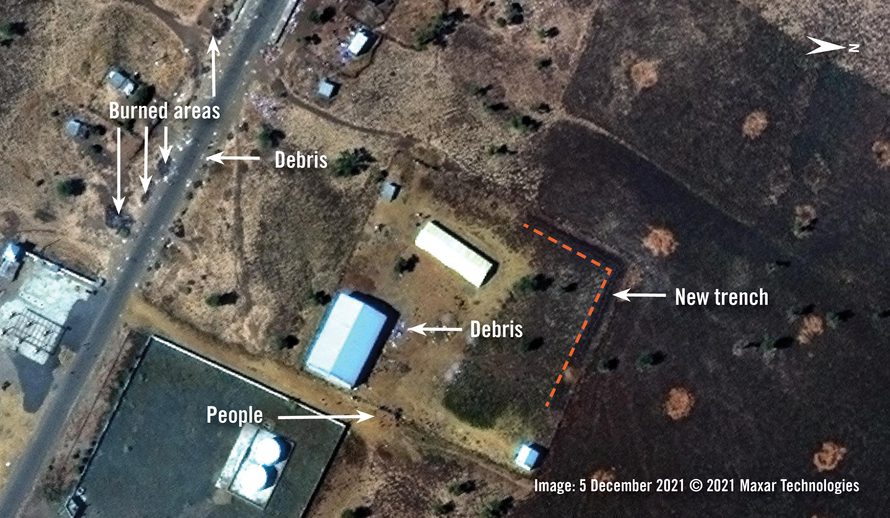
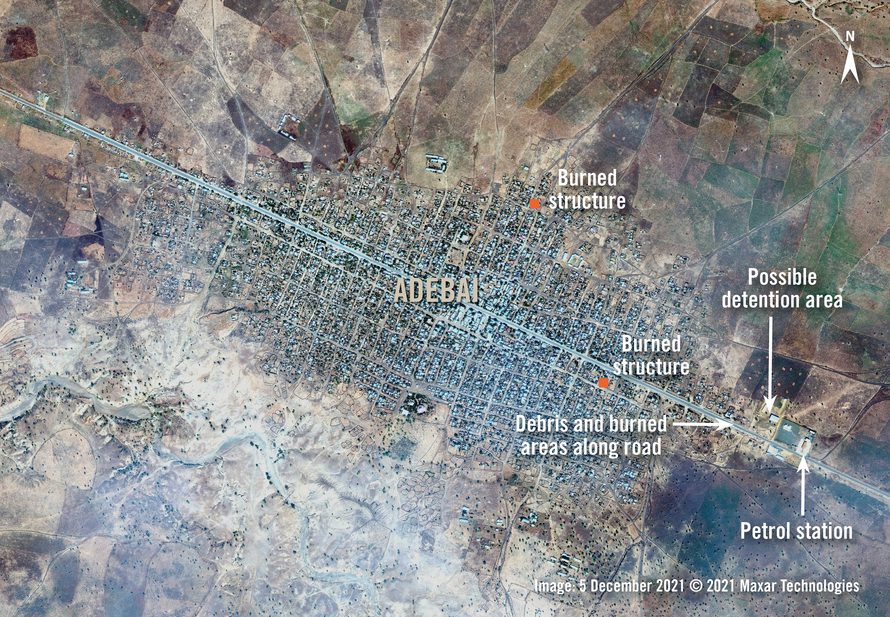
Satellite imagery captured between 19 November and 5 December shows significant activity in Adebai, including moving vehicles, groups of people around a makeshift detention site, large amounts of debris on the main road, and burned structures. Imagery taken on 5 December in Humera shows 16 open-back trucks near the town’s central roundabout.

Satellite image overview of Adebai, Western Tigray
Satellite image collected of the town of Adebai, in northern Ethiopia’s Western Tigray administrative zone, showing overview of locations of damage and a possible detention site. Analysis by Amnesty International, Image: © 2021 Maxar Technologies<br><br>
Analysis of satellite image collected on 5 December 2021 of the eastern outskirts of Adebai town. People and debris are visible around a large warehouse, near the Enda Roto petrol station. Burned areas and debris are visible by the main road. Analysis by Amnesty International, Image: © 2021 Maxar Technologies

Three former detainees held in Humera prison, some of whom had been held for as long as five months before they escaped in November, said that Amhara authorities kept them in extremely overcrowded cells for extended periods. Guards denied them food and medical treatment and tortured and beat detainees whose hands and feet had been tied with sticks and rifles. One former detainee arrested on 19 July escaped around 13 November while loading corpses of fellow detainees onto a tractor. He said he knew of 30 people who died while he was held there, including seven of the 200 men in his cell: ““All of us have gone through it [the beatings] but the most vulnerable ones were the [older men],” he said. “They couldn’t handle the torture, that’s why they were dying.” He said that the Fano militia members beating them threatened all Tigrayans with death.

The roundups, abusive detentions, and forced expulsions separated families and left communities from the three towns desperate for news about the safety and whereabouts of their loved ones, many of whom were put on trucks and remain unaccounted for. One man who fled Adebai in late November said: “My wife and my mother called me four days ago, told me they had put them in vehicles, and they don’t know where they are taking them. After that I have never heard from them.”

 The Ethiopian authorities should immediately cease attacks on civilians, secure the release of those arbitrarily detained, and urgently provide unimpeded access to Western Tigray for aid agencies and organizations with a mandate to visit detention sites, Amnesty International and Human Rights Watch said.

Given the gravity of the ongoing abuses, the UN Human Rights Council should urgently establish an independent international mechanism to investigate abuses in the Tigray conflict, including serious violations of international humanitarian law (the laws of war), identify those responsible at all levels, and preserve evidence for future accountability.

Forced displacement and deliberate attacks on the civilian population violate the laws of war. Everyone in custody has the right to be treated humanely and with respect for their inherent dignity, including having access to adequate food and medical care. Ordering civilians displaced for reasons not required for their security or imperative military necessity, attacking civilians who are not directly participating in hostilities, and torturing or otherwise mistreating detainees, are war crimes.

“The global paralysis on Ethiopia’s armed conflict has emboldened human rights abusers to act with impunity and left communities at risk feeling abandoned,” said Laetitia Bader, Horn of Africa director at Human Rights Watch.

“As evidence of atrocities mounts, world leaders should support the creation of an international investigative mechanism and the UN Security Council should put Ethiopia on its formal agenda.”

As evidence of atrocities mounts, world leaders should support the creation of an international investigative mechanism and the UN Security Council should put Ethiopia on its formal agenda.

Laetitia Bader, Horn of Africa director at Human Rights Watch

ADDITIONAL BACKGROUND AND ACCOUNTS

Roundups, Killings, and Mistreatment in Custody

In the early morning hours of 3 November, as Adebai residents headed to Abune Teklai church in town to pray, local security forces at the church ordered the men to congregate for a meeting while telling the women to leave, four residents said. “I was… metres away from the church when I met a group of three Tigrayan women that told me I better go home because Fanos were collecting Tigrayan men and had ordered the women to leave,” a 20-year-old student said.

As word of the roundup spread, six Tigrayan men interviewed were among the many who ran in panic, some home or to neighbouring fields to evade arrest. Four witnesses said Amhara militia members shot or attacked those trying to flee with machetes, axes, knives, or sticks. A 26-year-old man fleeing to the fields saw armed men on motorbikes shooting at people including his 70-year-old uncle. He later saw his uncle’s body, and those of two other men, including an older man he knew. “They were shooting at anyone who was behind,” he said. “[My uncle] wasn’t even running…they still shot him. I saw the guy shooting at him and him falling.”

Four witnesses said the Fano militia proceeded to go house-to-house searching for Tigrayans. A farmer hiding at home watched as a group of 30 to 40 armed men attacked his neighbour, a mechanic in his mid-twenties: “They told him to come… He had his hands up and they hit him on his shoulder with an axe. As he screamed, they dragged him and took him with them.”

Amhara forces took those captured to detention sites: some to the town’s police station, others to a former sorghum mill used as a makeshift detention site near the Enda Roto petrol station, on the town’s eastern outskirts.

In the following days, the men who had escaped survived by hiding on farmland, but continued to come under attack, three residents said. The 20-year-old student heard gunshots on 7 November and later saw bodies near a reservoir three kilometres northeast of Adebai:

“The Fanos and [armed individuals] just came… and started killing whomever they found in the bushes. … We were further [away]… but we were hearing a lot of gunshots. So when it got quiet and it was dark, we went to the [reservoir] and saw a lot of bodies. We didn’t count because we were afraid and shocked… I would say [I saw] about 20 [bodies].”

Bodies remained unburied, so that “the whole town smelled and was filled with dead bodies,” said one man. Four other residents said they saw dead bodies on the outskirts of town.

Roundups, beatings, and detentions of Tigrayan civilians also occurred in the towns of Humera and Rawyan. A 37-year-old farmer from Humera said he witnessed roundups and the killing of an older man with a physical disability nicknamed “Lingo” on 5 November. On his way home the farmer saw militias telling Lingo “to stand up and, when he couldn’t, they started beating him… with machetes, axes, and stones.” Two days later, the farmer learned that Lingo was beaten so badly that he died.

Four people who made it to Sudan said that armed forces on the Ethiopian border shot at them as they tried to cross. A 14-year-old boy who crossed on November 23 said that as his group arrived in Dima, the last Ethiopian village before the border, forces in military clothing “started shooting and telling us to stop, and when we kept running, they captured one of us and killed another one.” He said a third person was missing following the incident.

Roundups, Expulsions of Older People, Women, and Children.


During the roundups in Adebai, Humera, and Rawyan, Amhara forces separated and eventually expelled younger children, women, and older and vulnerable Tigrayans towards Central Tigray.

In Humera, two witnesses and three family members who spoke to people there at the time said that Amhara forces put people in about 20 trucks that left town on 20 November. The expulsions continued the following day, including of children and young mothers, said one witness. A similar number of vehicles left that second day, said one resident.

The roundups of Tigrayans similarly began in Rawyan on 20 November. Four witnesses and two family members said that Amhara militias and Fanos in coordination with the town’s administrators rounded up Tigrayans. They went house to house and “collected all Tigrayans at the school,” said one driver, who was among those held. He noted that town administrators issued instructions to militias:

“Militia were beating the youth, 17 and 18-year-olds, searching for money, and collecting their possessions. The [administrators] gave instructions, who can be released, and who can stay…. “Catch this one! Release this one!” They loaded the older people, parents… onto the open trucks, Isuzu trucks… and took them away from Rawyan.”

One boy said that the militias registered him and other youth and released them. Men and older teenagers remained detained in the village ward offices and flour mill.

In Adebai, militias loaded some of the Tigrayan men they arrested on 3 November onto Isuzu and other pickup trucks and took them away, four residents said. The roundups continued in the weeks that followed, when women and older people were also arrested and taken away.

Family members of those expelled soon lost touch with loved ones. A student said he last received a phone call from his sister on 28 or 29 November as armed forces were putting her and their mother on a truck in Adebai and taken away:

“She told me that they were being forced to leave everything behind, that they didn’t even let them grab their clothes or any belongings… that they [the forces] started looting the house while they were there, [and] that they didn’t even have food or water to drink… She… told me that there were 13 vehicles [and] that they had already boarded six vehicles.”

A farmer described the last phone call he had with his two daughters and niece on 23 November: “When the Fanos were taking them, they took everything they carried in their hands, the jewelry, the clothes that they had, even the kids’ clothes and the biscuits that they had for them. And for two days… they were burning clothes.”

Satellite imagery collected between 19 November and 5 December confirmed that there were open-back vehicles along the main road that crosses Adebai and burned spots and large amounts of debris along the road.

Mistreatment in Mass Detention Sites

Thousands of Tigrayan detainees are estimated to be held in overcrowded detention sites in Western Tigray. Three former detainees held in Bet Hintset prison in Humera, one of several detention sites in the town, described appalling conditions with frequent beatings, torture, insults, and the denial of food and medicine by Amhara regional special police. A daily labourer arrested in July and held in Bet Hintset prison, also controlled by Amhara regional police, until his escape in mid-November described being kept in a 3-by-4-metre room with up to 200 people:

“Forget showers, we couldn’t use toilets. They didn’t give us food or water, even [at times] when our family brought us food, they wouldn’t let us… a lot of people were falling ill… dying… I’m talking daily, daily… I’m very sure of 30 bodies… only from our room, seven people died, all of them were above the age of 70.”

He described a regular schedule of severe beatings, in which Fanos would torture groups of detainees by beating their hands, heads, chests, and genitals using sticks or the butt or the muzzle of a rifle. Another detainee, also arrested in mid-July and held at Bet Hintset, said: “They used electric wires and for the ages from 12 to 30, they hit us on the soles of our feet… the others that are older, they lay them down on their stomachs and hit them from their necks to their feet.”

With the expulsion of some relatives in November on whom detainees had relied for food, survivors and relatives were concerned about those still detained. One 55-year-old man said, “I’m so worried about what they are eating in the prisons, because I know they won’t give them food and all the family members that they had who used to bring them food were taken. I’m sure a lot of people are dying.” Another resident said: “I fear those detained will all be killed.”

The post Ethiopia: New wave of atrocities in Western Tigray appeared first on Amnesty International.

Äthiopien: Neue Gräueltaten in West-Tigray

Sicherheitskräfte aus der Region Amhara sind für Masseninhaftierungen, Massaker und Vertreibungen von Menschen tigrayischer Herkunft im Westen des Bundesstaates Tigray im Norden Äthiopiens verantwortlich.

Haiti: The US must stop deportations and abuse against Haitians

Deportations to Haiti from the United States, including Title 42 flights, have violated Haitians’ human rights and were followed by an increase in deportations of Haitians from across the Americas as Haiti continues to face a human rights and humanitarian crisis, reported by Amnesty International, the Center for Gender & Refugee Studies, Haitian Bridge Alliance, the Global Justice Clinic at NYU School of Law, the Groupe d’Appui aux Rapatriés et Réfugiés (GARR), Refugees International, Rezo Fwotalye Jano Siksè and Service Jésuite aux Migrants Haiti.

In the joint document released today, the signatory organizations highlight the main aspects of the human rights and humanitarian crisis in Haiti and evidence that the US is violating its legal obligations to individually assess the claims of asylum seekers and to ensure that individuals are not returned to persecution or torture. Many expelled Haitians have disembarked US deportation flights sick, handcuffed, hungry, traumatized, and disoriented only to find themselves in a “humanitarian nightmare,” including widespread gang violence, an ongoing political crisis following assassination of Haiti’s President Jovenel Moïse, food insecurity, a health system “on the brink of collapse,” devastation following a recent earthquake, and at risk for Covid-19 in a country where vaccination rates are reportedly around 0.4%.

Under the guise of public health, the US has made regular misuse of the Title 42 order to conduct mass expulsions and block Haitians and others from seeking asylum. This practice, widely criticized by the United Nations, health experts, human rights organizations and even US officials, has put people at increased risk for Covid-19 and has contributed to further racism, xenophobia, and discrimination in US border policies. The excessive force against Haitian migrants and asylum seekers by border agents on horseback in Del Rio, Texas in September reflected experiences of systemic racism inherent in the policing system throughout the country.

The organizations are calling on the US government to immediately stop all deportations to Haiti, including Title 42 expulsions; end the discriminatory mistreatment of Haitian asylum seekers and migrants; and provide them access to the asylum system.

For more information or to arrange an interview, contact Duncan Tucker: duncan.tucker@amnesty.org and Taisha Saintil: tsaintil@haitianbridge.org

The post Haiti: The US must stop deportations and abuse against Haitians appeared first on Amnesty International.