
Don’t let Big Tech fool you: Small businesses don’t want surveillance advertising.

by Claudia Prettner (Legal/Policy Advisor, Amnesty Tech), Alia Al Ghussain (Campaigns and Communications Officer, Amnesty Tech) and Nienke Palstra (Senior Campaigner, Global Witness)

Tracking-based advertising has become all pervasive in the digital world. Our new research shows that small businesses know very well how harmful these practices are to human rights but have little alternative.

Big Tech companies claim that regulating tracking-based advertising would harm small and medium-sized enterprises (SMEs). Google and Facebook (Meta) often style their lobbying efforts as being on behalf of the interests of SMEs, claiming they are simply looking out for the small businesses and consumers who use their advertising tools.

To micro-target people, this kind of advertising is based on monitoring people on and offline to develop hyper-specific profiles and provide them with advertisements tailored to match their inferred interests and traits.

Many SMEs use tracking-based advertising to reach new audiences. But pervasive tracking of people’s lives is having adverse effects on people’s rights – including privacy, freedom of expression, and non-discrimination. Furthermore, this toxic practice has allowed Facebook and Google to dominate the internet. This means that many SMEs have no choice but to use these companies’ services, as there is no meaningful alternative.

We wanted to find out from SMEs themselves – are they happy with the tracking-based advertising offered by Big Tech platforms?

The answer is overwhelming: SMEs don’t like tracking-based ads. That is what a YouGov survey of 617 SME leaders in Germany and France has shown.

The poll commissioned by Amnesty International and Global Witness found that three out of four SME leaders believe that tracking-based ads undermine people’s right to privacy and other human rights.

More than two thirds of the businesses questioned feel that the dominance of Google and Facebook over the digital advertising market means they have no choice but to advertise with them.

Additionally, almost eight out of ten SME leaders believe Big Tech platforms like Google and Facebook should face stricter regulation when it comes to the use of personal data for targeting ads to people.
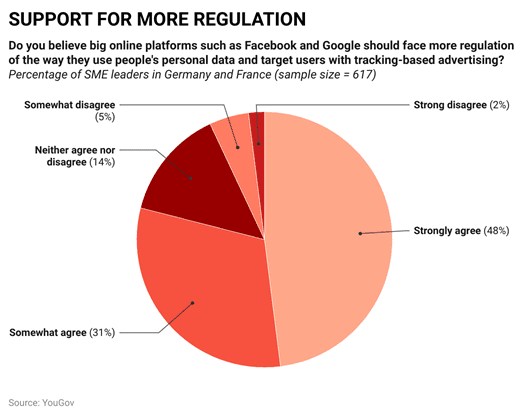
These results clearly counter the lobby narrative of Big Tech, which defends their business model by claiming that it supports small businesses. On the contrary, the polling shows small business leaders in France and Germany are deeply wary of their ad tech practices – but don’t see an alternative.

Furthermore, the French and German business owners think their own customers are uncomfortable being targeted with ads based on the use of their personal data. Their discomfort is consistent across many data categories: the SME leaders believe their customers to be uncomfortable being targeted using information about their health (67%), their sexual orientation (66%), their race or ethnicity (62%) or personal events in their life (62%).

This reinforces previous polling conducted by Global Witness, which found that the majority of people in France and Germany were opposed to their personal information being used to target them with ads online.

Tech companies should serve the communities who use their platform, rather than using their dominance to force them to choose between access to the digital world, and the enjoyment of their rights. The EU has a unique opportunity to reshape the rules of the internet by bringing in strong regulation on tracking-based advertising in the Digital Services Act (DSA).

Our poll should give legislators pause over any assumption that businesses want tracking-based advertising at any cost. MEPs are voting in plenary on the DSA this week. This vote gives them the opportunity to include stronger rules on tracking-based ads in this piece of legislation. We therefore urge legislators to listen to the voices of civil society and small businesses and end online advertising practices that rely on intrusive surveillance in the DSA.

The post <strong>Don’t let Big Tech fool you: Small businesses don’t want surveillance advertising.</strong> appeared first on Amnesty International.

France/Germany: Small businesses want EU to get tough on Google and Facebook’s invasive advertising – new research

  • YouGov poll reveals small business leaders are uncomfortable with Facebook and Google’s tracking-based advertising 

Small business leaders in France and Germany want alternatives to Facebook and Google’s dominant tracking-based advertising, new research commissioned by Amnesty International and Global Witness has shown.

Ahead of a key EU vote this week aimed at imposing stricter rules on tracking-based digital advertising, a poll of leaders of small and medium-sized businesses in the two countries revealed 75% believed tracking-based advertising undermines peoples’ privacy and other human rights.

A total of 69% of business owners surveyed said that while they were uncomfortable with Facebook and Google’s influence, they felt they had no option but to advertise with them due to their dominance of the industry.

The constant and invasive monitoring of our lives to target people with ads is unacceptable

Claudia Prettner, Legal and Policy Adviser at Amnesty Tech

The survey results, from a poll of more than 600 people conducted by YouGov, come ahead of this week’s plenary vote by the European Parliament on the Digital Services Act, with MEPs considering stricter rules for tracking-based advertising. 

“The constant and invasive monitoring of our lives to target people with ads is unacceptable, annihilates our right to privacy, and fuels discrimination,” said Claudia Prettner, Legal and Policy Adviser at Amnesty Tech.

“These results show that business owners are extremely uncomfortable with the approach to tracking-based advertising that their customers currently experience.

“This week’s plenary vote on the Digital Services Act represents a vital opportunity for MEPs to stand up for human rights, and to take action to address advertising practices that rely on intrusive surveillance.” 

Alternative solutions now needed

Ahead of this week’s vote, Facebook and other industry leaders have emphasized their belief that targeted advertising is necessary for the survival of European small and mid-sized enterprises.

But the survey showed that 79% of respondents felt that large online platforms – such as Facebook and Google – should face increased regulation of how they use personal data to target users while advertising online.

The survey also showed that business owners believed their customers were not comfortable being targeted with online ads based on their race or ethnicity (62%), their sexual orientation (66%), information about their health (67%), their religious views (65%), their political views (65%), or personal events in their life (62%).

“It’s been part of Facebook and Google’s lobbying playbook to use small business’ reliance on their services as a fig leaf to justify their invasive profiling and targeting of users for advertising,” said Nienke Palstra, Senior Campaigner on Digital Threats to Democracy at Global Witness.

“In fact, our polling shows small business leaders in France and Germany are deeply wary of their ad tech practices – but don’t see an alternative. Given the overwhelming support from small business to regulate ad tech giants, there is every reason for MEPs to go further in the Digital Services Act and protect individuals from surveillance advertising.”

The latest findings support previous Global Witness polling conducted in February 2021 that investigated French and German social media users’ attitudes to targeted advertising. Those results showed overwhelmingly that people were deeply uncomfortable about the ways they are targeted by advertisers every day, from being categorized by income and religious views to life events such as pregnancy, bereavement, or illness.

The post France/Germany: Small businesses want EU to get tough on Google and Facebook’s invasive advertising – new research appeared first on Amnesty International.

Russia: One year after jailing, Aleksei Navalny and his associates in a “living hell”

Over the course of the last 12 months, the Russian authorities have unleashed an unprecedented campaign of repression and reprisals against wrongfully imprisoned opposition leader Aleksei Navalny and his supporters, destroying all remnants of the rights to freedom of expression and association, Amnesty International said today on the first anniversary of the politician’s arrest.

“In the year since Aleksei Navalny’s detention at a Moscow airport, the politician, his supporters and Russian civil society organizations have suffered a relentless onslaught of repression. Dozens of Navalny’s associates and supporters are facing prosecutions on bogus charges, while a growing number of them are already in prison. Meanwhile, the authorities have labelled his organizations as ‘extremist’ and blocked their websites,” said Marie Struthers, Amnesty International’s Eastern Europe and Central Asia Director.

In the year since Aleksei Navalny’s detention at a Moscow airport, the politician, his supporters and Russian civil society organizations have suffered a relentless onslaught of repression

Marie Struthers, Amnesty International’s Eastern Europe and Central Asia Director

“Some of Aleksei Navalny’s associates were able to flee the country, yet they now fear their relatives in Russia will suffer a similar fate of unfounded prosecution and imprisonment. On the anniversary of his detention, Navalny and the political activists associated with him are in a living hell.”

On 2 February 2021, a court in Moscow replaced Navalny’s non-custodial sentence with a jail term of two years and eight months, later shortened by two months. Soon thereafter, the Russian authorities began dismantling the Anti-Corruption Foundation and the Citizens’ Rights Protection Foundation, which Navalny founded, and closed his offices. On 9 June 2021, the two organizations were officially labelled as “extremist” and arbitrarily banned.

The activities of the two organizations have since been criminalized. On 28 September 2021, the authorities opened a criminal case against Navalny and his associates under the trumped-up charge of creating an “extremist association”. On 9 November, Lilia Chanysheva, the former coordinator of Navalny’s offices in Ufa, was placed in pre-trial detention.

Dozens of Navalny’s team and regional coordinators from his wider political movement have now left Russia fearing political persecution. Yuri Zhdanov, the father of Ivan Zhdanov, the director of the Anti-Corruption Foundation, was arrested on spurious charges of “forgery” and “large-scale fraud” in March 2021.

Aleksei Navalny faces further bogus charges and up to 15 additional years in prison on top of his current sentence. He stands accused of “contempt of court”, “fraud on an especially large scale” and “money laundering” in relation to alleged misappropriation of donations to his NGOs. He has also been charged with creating an organization that “infringes on the personality and rights of citizens.”

“The callous actions of the Kremlin, who remain hellbent on silencing and vilifying Aleksei Navalny and his supporters, must end now. More than 360,000 people around the world have signed a petition set up by Amnesty International that calls for the Russian authorities to immediately and unconditionally release Aleksei Navalny,” said Marie Struthers.

More than 360,000 people around the world have signed a petition set up by Amnesty International that calls for the Russian authorities to immediately and unconditionally release Aleksei Navalny

Marie Struthers, Amnesty International’s Eastern Europe and Central Asia Director

“We call on world leaders, international organizations and people across the world to add their voices not only to the call for Aleksei Navalny’s immediate release, but also for the end of brutal reprisals against his supporters. The people of Russia should not have to suffer from the relentless suppression of their human rights. They deserve to have their voices heard without fear of reprisals.”

Background

Aleksei Navalny, an outspoken Kremlin critic, author of groundbreaking investigations into high-level corruption in Russia and founder of several civil society organizations, was arbitrarily detained on 17 January 2021 in Moscow’s Sheremetyevo airport upon his arrival from Berlin, where he had been recovering after being poisoned in Siberia in August 2020.

He was placed in pre-trial detention for allegedly failing to report regularly to his probation officer in person while recovering from his near-fatal poisoning.

The European Court of Human Rights found Aleksei Navalny’s conviction in 2014 and subsequent prison sentence to be “arbitrary and manifestly unreasonable.”

On 14 January 2022, Leonid Volkov and Ivan Zhdanov, two associates of Navalny, were added to a list of “extremists” by the Russian finance regulator. Their assets in Russia are now blocked.

The post Russia: One year after jailing, Aleksei Navalny and his associates in a “living hell” appeared first on Amnesty International.

Tunisia: Amend excessive Covid-19 restrictions banning all public gatherings

New Covid-19 restrictions in Tunisia banning all public gatherings effectively impose a blanket ban on public demonstrations, and thus impede people’s rights to free expression and peaceful assembly, Amnesty International said today. The restrictions came into force on 13 January, amid signs of growing intolerance for dissent and one day before planned demonstrations against President Kais Saied on the 11-year anniversary of the ouster of former president Zine El Abidine Ben Ali.

“Every January, Tunisians have commemorated Tunisia’s revolution by taking to the streets to voice their grievances. It is imperative that the Covid-19 health crisis not be used as a pretext to suppress rights in general or the rights to freedom of expression and peaceful assembly in particular,” said Amna Guellali, Amnesty International’s Deputy Regional Director for the Middle East and North Africa.

“Under the new restrictions, there is a risk that authorities’ response to demonstrations could lead to unnecessary use of force or arbitrary arrests, a shameful feature of security forces’ policing of many public demonstrations in recent years. We call on Tunisian authorities to amend the new rules to bring them in line with Tunisia’s international obligations.”

Tunisia’s government says the new restrictions, announced on the head of government’s Facebook page, are intended to combat the spread of Covid-19. They will remain in force for two weeks and may be renewed on the advice of the Health Ministry. Daily Covid-19 cases and the positive test rate have both risen sharply in recent days, according to the Health Ministry. However, the ban on public gatherings goes too far. While states may restrict the right to peaceful assembly to protect public health, restrictions must be necessary, proportional, and not imposed in a blanket fashion. Authorities should instead assess each assembly case by case.

Moves since 25 July 2021 by Saied to concentrate power in his own hands – including suspending parliament and most of Tunisia’s constitution, and granting himself supreme executive authority and the right to legislate by decree – have polarised Tunisian society and triggered vigorous public debate over the country’s future.

It is imperative that the Covid-19 health crisis not be used as a pretext to suppress rights in general or the rights to freedom of expression and peaceful assembly in particular.

Amna Guellali, Amnesty International

Supporters and opponents of Saied have staged public demonstrations since 25 July, which authorities have allowed to proceed largely unhindered. However, judicial authorities including military courts have increasingly investigated and prosecuted people for publicly criticising the president.

In January 2021, security services used unlawful force in response to wide-spread protests over socio-economic grievances, including beating protestors and firing tear-gas indiscriminately in residential areas.

Article 21 of the International Covenant on Civil and Political Rights, which Tunisia has ratified, guarantees the right to peaceful assembly.

The United Nations Basic Principles on the Use of Force and Firearms by Law Enforcement Officials provide that law enforcement officials may only use force when strictly necessary, provided for by law, and where the harm caused by the use of force remains proportionate to the objective they are seeking. This is echoed by The United Nations Code of Conduct for Law Enforcement Officials.

“Over the past five months we’ve been seeing worrying indications of authorities’ increasing intolerance for dissent. President Kais Saied must rescind all restrictions that may implicitly violate human rights and publicly commit to respecting international law and standards,” said Amna Guellali.

The post Tunisia: Amend excessive Covid-19 restrictions banning all public gatherings appeared first on Amnesty International.