Thailand: Amnesty committed to continuing its work despite calls for expulsion

Amnesty International has had a longstanding presence in Thailand and is committed to continuing to promote and protect human rights for people in the country despite calls for it to be expelled, the organization said today.

“As a global movement with operations in more than 70 countries and members in 150 countries and territories, no matter where we operate, our job remains the same: to prevent, monitor and hold states, corporations and others accountable for abuses of human rights under international law,” said Kyle Ward, Amnesty International’s Deputy Secretary General.

“We offer constructive recommendations to authorities on steps they can take to uphold their international human rights obligations. We will continue to do this independently and impartially on the basis of facts. In response to the anti-Amnesty campaign and related investigation, we continue to answer any questions the Thai government may have about our work in the country.

“While we recognize that the Royal Thai Government has a duty to protect public order and national security, we continue to highlight that authorities must do so in a manner that is in accordance with international human rights law, and that is proportionate, necessary and fulfils the government’s obligations to ensure and facilitate respect for human rights, including the rights to freedom of expression and peaceful assembly.

“Amnesty International’s constructive recommendations for authorities to fulfil their human rights obligations derive from internationally agreed human rights standards that Thailand has committed to uphold.

“The anti-Amnesty campaign comes at a time when authorities are separately trying to pass a controversial law regulating non-profit organizations in the country. This NPO law could have severe consequences for all civil society in Thailand, and Amnesty has repeatedly called on the government to withdraw the bill and seek further consultation. The targeting of Amnesty is taking place against a backdrop of a growing intolerance for human rights discourse among Thai authorities.”

Background:

In November, a vice minister in the Prime Minister’s office made public calls for Amnesty International to be expelled from Thailand. The official has started an online petition, helped organize calls on social media and staged small protests.

The Prime Minister responded by announcing an investigation into Amnesty International Thailand on 26 November.

The global Amnesty International movement is made up of the International Secretariat and a network of international members and national membership entities, including Amnesty International Thailand. Whilst Amnesty International Thailand and the International Secretariat are separate legal entities, they work closely together under the same Statute.

The post Thailand: Amnesty committed to continuing its work despite calls for expulsion appeared first on Amnesty International.

Ethiopia: Tigrayan forces murder, rape and pillage in attacks on civilians in Amhara towns

Fighters affiliated with the Tigrayan People’s Liberation Front (TPLF) deliberately killed dozens of people, gang-raped dozens of women and girls – some as young as 14 – and looted private and public property in two areas of northern Ethiopia’s Amhara region, Amnesty International said in a new report released today. 

The atrocities were perpetrated in and around Chenna and Kobo in late August and early September 2021, shortly after Tigrayan forces took control of the areas in July. The attacks were often characterized by additional acts of violence and brutality, death threats, and the use of ethnic slurs and derogatory remarks. In Kobo, Tigrayan forces were apparently lashing out at the civilian population in retaliation for increased resistance from local militias and armed residents.

“Tigrayan forces have shown utter disregard for fundamental rules of international humanitarian law which all warring parties must follow. Evidence is mounting of a pattern of Tigrayan forces committing war crimes and possible crimes against humanity in areas under their control in the Amhara region from July 2021 onwards. This includes repeated incidents of widespread rape, summary killings and looting, including from hospitals,” said Sarah Jackson, Deputy Regional Director for East Africa, the Horn and the Great Lakes at Amnesty International.

“The TPLF leadership must put an immediate end to the atrocities we have documented and remove from its forces anyone suspected of involvement in such crimes.”

Tigrayan forces have shown utter disregard for fundamental rules of international humanitarian law which all warring parties must follow. This includes repeated incidents of widespread rape, summary killings and looting, including from hospitals.

Sarah Jackson, Deputy Regional Director for East Africa, the Horn and the Great Lakes at Amnesty International

Summary killings in Kobo

In Kobo, a town in the north-east of the Amhara region, Tigrayan fighters deliberately killed unarmed civilians, seemingly in revenge for losses among their ranks at the hands of Amhara militias and armed farmers. Amnesty International interviewed 27 witnesses and survivors, including some who helped to collect and bury the bodies.

Ten Kobo residents told Amnesty International that in the afternoon of 9 September 2021, Tigrayan fighters summarily killed their relatives and neighbours outside their homes.

“First they shot my brother Taddese… He died on the spot. My other brother and my brother-in-law tried to move away and were both shot in the back and killed… they shot me in my left shoulder… I stayed down, pretending to be dead,” a survivor told Amnesty International.

Twelve other Kobo residents said that they found the bodies of local residents and labourers who had been killed execution-style – shot in the head, chest or back, some with their hands tied behind their backs.

“The first dead bodies we saw were by the school fence. There were 20 bodies lying in their underwear and facing the fence and three more bodies in the school compound. Most were shot at the back of their heads and some in the back. Those who were shot at the back of their heads could not be recognized because their faces were partially blown off,” one male resident said.

The first dead bodies we saw were by the school fence. There were 20 bodies lying in their underwear and facing the fence and three more bodies in the school compound. Most were shot at the back of their heads and some in the back. Those who were shot at the back of their heads could not be recognized because their faces were partially blown off

A male resident of Kobo

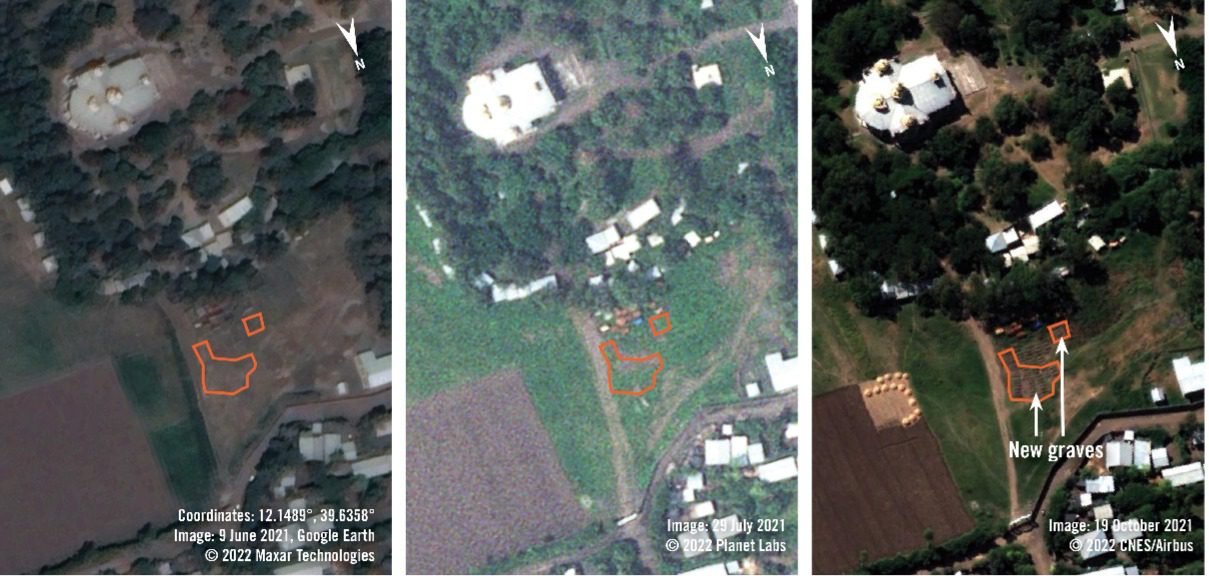
Satellite imagery analysis by Amnesty International’s Crisis Evidence Lab shows evidence of new burial sites on the grounds of St. George’s Church and St. Michael’s Church, where residents said they had buried those killed on 9 September.

Deliberate killings of civilians – or of captured, surrendered, or wounded fighters – constitute war crimes and possibly crimes against humanity.

New burial sites near St. Georges Church in Kobo
A time series of satellite imagery shows the increase in graves at St. Michael’s church graveyard, where witnesses told Amnesty International some of those summarily killed on 9 September were buried. © 2022 Maxar Technologies (L); © 2022 Planet Labs (C); Image: 19 December 2021 © 2022 CNES/Airbus (R).

Sexual violence in Chenna

From July 2021 onwards, in and around Chenna, a village north of Bahir Dar, the capital of the Amhara region, Tigrayan forces raped dozens of women and girls as young as 14, often in the victims’ own homes after having forced them to provide food and cook for them.

The sexual violence was accompanied by shocking levels of brutality, including beatings, death threats, and ethnic slurs. Fourteen of the 30 survivors interviewed by Amnesty International said that they were gang-raped by multiple Tigrayan fighters, and some were raped in front of their children. Seven of the survivors were girls under the age of 18.

Lucy, a 14-year-old seventh-grade student, and her mother were both raped by Tigrayan fighters in their home in Did-Bahr. She told Amnesty International: “I was at home with my mother and my grandmother when two young men with rifles came to our home in the morning at about 11. One of them wore military clothes and the other wore civilian clothes. They spoke a mix of Tigrinya and some Amharic. They said ‘Our families were raped and now it is our turn to rape you.’ One of them raped me in the courtyard and the other raped my mother inside the house. My mother is very sick now, she is very depressed and desperate. We don’t speak about what happened; it is impossible.”

I was at home with my mother and my grandmother when two young men with rifles came to our home in the morning at about 11. One of them wore military clothes and the other wore civilian clothes. They spoke a mix of Tigrinya and some Amharic. They said ‘Our families were raped and now it is our turn to rape you.’

Lucy, a 14-year-old girl from Did-Bahr

Salam, a 29-year-old woman, described how four Tigrayan fighters locked her older parents in a separate room and then gang-raped her over a 15-hour period.

Many of the survivors suffered severe and long-term physical and psychological damage, including 10 who remained hospitalized three months after they were raped. Doctors who provided medical care to rape survivors told Amnesty International that two rape survivors had to be treated for lacerations likely caused by having the bayonets of rifles inserted into their genitals.

Amnesty International has previously documented similar patterns of Tigrayan fighters raping Amhara women and girls in Nifas Mewcha, and has received credible reports of rape from other areas of the Amhara region. Such atrocities constitute war crimes and, potentially, crimes against humanity.  

Looting of civilian property

In both Kobo and the Chenna area, residents told Amnesty International that Tigrayan fighters stole possessions from their homes and shops and looted and vandalized public properties, including medical clinics and schools.

The looting and damage to medical facilities made it impossible for rape survivors and other residents in need of medical care to obtain treatment locally, forcing them to wait until they could reach hospitals in Debark, Gondar and Bahir Dar weeks later. For rape survivors, this was far too late to receive crucial post-rape care, some of which needs to be administered within 72 hours. 

“These atrocities yet again drive home the need for swift action by the international community to investigate abuses by all sides, bring those responsible to account and ensure that survivors can realise their rights,” said Sarah Jackson.

“For too long, the international community has been failing victims and survivors of crimes under international law in Ethiopia. The United Nations and African Union must deploy relevant investigation teams to the region. The international commission of human rights experts on Ethiopia, established by the UN Human Rights Council in December, must also be permitted to start its work and be granted access to the country as soon as possible.”

Background

The conflict in Tigray broke out in November 2020 and spread to other regions of northern Ethiopia from July 2021. Amnesty International has documented a range of violations by all parties to the conflict, including massacres, extrajudicial executions and other unlawful killings, sexual and other gender-based violence and arbitrary detentions by Ethiopian government forces and allied militias and by Eritrean forces acting alongside them.

The post Ethiopia: Tigrayan forces murder, rape and pillage in attacks on civilians in Amhara towns appeared first on Amnesty International.

EU/Egypt: At EU-AU Summit, Europe’s leaders risk legitimizing al-Sisi government’s repression

  • Amnesty spokespeople available
  • Activists including Egyptian rights defenders will protest at Place du Trône, Brussels (near to the statue of Léopold II) on Wednesday 16 February at 14h as Egyptian President visits the Belgian King

EU leaders must press Egyptian President Abdel Fattah al-Sisi to tackle Egypt’s human rights crisis and end the unrelenting assault on human rights defenders when they meet on the sidelines of the European Union – African Union (EU-AU) summit, Amnesty International said today ahead of the event this week.

“EU leaders meeting with President al-Sisi this week should use this opportunity to denounce his government’s crackdown on human rights. Despite his attempts at window dressing, the reality is that gross human rights violations continue unabated in Egypt. EU leaders must not offer him an opportunity to whitewash Egypt’s deeply repressive policies,” said Eve Geddie, Director of Amnesty International’s EU Office.

“The Egyptian authorities are cracking down on any form of dissent. People currently behind bars for peacefully exercising their human rights in the country expect EU leaders to speak out for them and press for change. Failing to do so would send a harmful message that the EU values deepening ties with the authorities over the human rights of people in Egypt.”

Al-Sisi’s visit to Belgium for the EU-AU summit comes against the background of wider concerns about the authorities’ recent efforts to eradicate independent human rights NGOs in the country. In January 2022, the Arab Network for Human Rights Information, a prominent human rights NGO, announced its closure after 18 years due to its inability to continue its human rights work in the repressive climate.  

Human rights defenders and other civil society actors continue to be subjected to politically motivated criminal investigations, travel bans, asset freezes, extrajudicial probation measures, and other forms of harassment.

Over  recent months, the Egyptian authorities have also referred at least 28 human rights defenders and peaceful opposition politicians to trials by emergency courts over bogus “false news” or “terrorism” charges. At least seven of them were sentenced following grossly unfair trials in 2021 to between three and five years’ imprisonment for criticizing Egypt’s human rights record, economic policy and living standards.

Despite their self-proclaimed efforts to combat discrimination against women, the Egyptian authorities continue to crack down on women, including survivors of sexual violence, on absurd “morality” or “indecency” charges. They have also punished women’s rights defenders for speaking out against sexual harassment.

President al-Sisi’s visit to Brussels comes shortly after it was revealed that the EU is jointly bidding with Egypt to co-chair the Global Counterterrorism Forum, an influential international counter-terrorism organization. This decision was criticized by 16 NGOs given Egypt’s appalling record of misusing counterterrorism laws to silence dissent, erode due process rights, and keep thousands in indefinite pre-trial detention.   

Amnesty International is calling on EU and AU member states to deliver on their human rights commitments and explicitly support the role of civil society and human rights defenders.

“By continuing to pursue business-as-usual relations with Egypt, the EU risks undermining its own credibility.  The upcoming meeting with al-Sisi must not offer Egypt an opportunity to conceal its horrendous human rights abuses. The harassment, intimidation, and arbitrary detention of human rights defenders in Egypt must end,” said Eve Geddie.

Background

See Amnesty International’s public statement on the EU-AU summit here.

Amnesty International Belgium is organizing a demonstration at Place du Trône on 16 February from 14:00 to 16:00. Ramy Shaath, a recently released prisoner of conscience,  and Souheila Yildiz, the partner of Ahmed Samir, a Master’s student who was sentenced to four years prison in June 2021, will attend the protest.

For more information or to arrange an interview, please contact:    

Alison Abrahams on alison.abrahams@amnesty.org or +32 483 680 812    

Out of hours contact details    

+44 20 7413 5566    

email: press@amnesty.org     

twitter: @amnestypress  

The post EU/Egypt: At EU-AU Summit, Europe’s leaders risk legitimizing al-Sisi government’s repression appeared first on Amnesty International.

Singapore: Stop resumption of hangings after two years of no executions

Responding to reports that the Singapore government plans to resume executions as early as Wednesday, 16 February, Rachel Chhoa-Howard, Amnesty International’s Singapore researcher, said: 

“Following more than two years of no executions in 2020 and 2021, it is appalling that the Singapore government is planning to resume this cruel practice imminently. Executing individuals who have been sentenced for drug related offences and to the mandatory death penalty is in breach of restrictions under international law. 

“It is high time for Singapore to re-establish a moratorium on the death penalty as a first step towards full abolition. The global trend towards abolition continues unabated, with the majority of the world’s governments having abolished the cruel punishment in law or in practice. Among other examples, Singapore’s neighbour  Malaysia has observed an official moratorium on executions since July 2018 and is poised to consider alternatives to the death penalty as soon as the end of the month.” 

Background 

The last known execution in Singapore was carried out in November 2019. Amnesty International received information that at least two executions are scheduled to take place on Wednesday, 16 February. 

More than two-thirds of countries all over the world have abolished the death penalty in law or practice. Singapore’s close neighbour Malaysia has observed an official moratorium on executions since 2018 and is considering fresh reforms as soon as this month. 

In a separate case at the end of 2021, Singapore authorities set the execution of Malaysian national Nagaenthran K Dharmalingam for drug related offences.  

Several medical experts have found him to have borderline intellectual functioning and cognitive deficits, which might have impacted his ability to assess risks and his accounts of the circumstances of the offence.  

Amid international outcry, his last minute appeal hearing was postponed several times, and is currently set to take place in March. Amnesty International opposes the death penalty unconditionally, in all cases and under any circumstances. 

The post Singapore: Stop resumption of hangings after two years of no executions appeared first on Amnesty International.