Repression in the spotlight


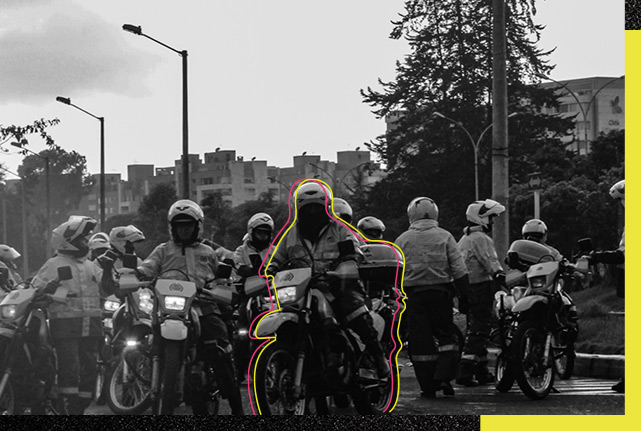
Police officers at the 2021 National Strike in Colombia
Police officers at the 2021 National Strike in Colombia / © Santiago Sanchez

Introduction

Throughout the 2021 National Strike, Colombia witnessed mass demonstrations across the country. The protests made visible the historical claims of marginalized populations in the country.  Inequality, racism, violence and the consequences of the internal armed conflict were key structural causes of the social explosion.

The demands of protesters reflect broad social grievances based on the state’s failure to guarantee basic economic and social rights such as education and health, as well as failure of the state to implement measures to mitigate the effects of the pandemic, in one of the most unequal countries in the region.

Instead of listening to the demands of the thousands of people who demonstrated, the government of Iván Duque responded with repression and violence to discourage the peaceful protests and ultimately to punish those who were demanding change in the country.

STOP THE REPRESSION

Help stop the repression and human rights violations by signing the petition

Agents of the Mobile Anti-Riot Squadron (ESMAD) 
© SOS Colombia Canción Paro Nacional

Who was punished for speaking up?

Repression and Violence in the city of Cali: Kevin Agudelo 

The gravest violations committed by the security forces during this period were concentrated in the city of Cali. In collaboration with SITU Research, Amnesty International reconstructed the violent incursion called “Operation Siloé” that took place on May 3rd, when National Police officers, in conjunction with agents of the Mobile Anti-Riot Squad (ESMAD) and the Special Operations Group of the Colombian National Police (GOES), used lethal weapons, such as Tavor 5.56 mm rifles, against peaceful protestors.

At least three people were killed that night from gunshot wounds, including Kevin Agudelo, a young amateur football player with Siloé FC, hundreds of people were injured and many were arbitrarily detained. The reconstruction uses more than 200 audiovisual assets analysed by Amnesty International’s Crisis Evidence Lab and SITU Research, as well as witness testimony to verify and illustrate the details of the incursion and the events leading to Kevin’s death.

Reconstruction of Operation Siloé

Based on the analysis of audiovisual evidence and numerous witness testimonies, Amnesty International concludes that the evidence indicates there was no imminent threat of violence that could not reasonably have been addressed by more proportionate measures on the part of the security forces. The use of force and lethal weapons against peaceful protestors by ESMAD and GOES was unjustified and violated the human rights of the protestors on May 3rd, in Siloé, a neighborhood in the city of Cali.

Losing your eyes to raise your voice

Gareth Sella & Leidy Cadena

We documented 13 cases of eye injuries, including the case of Gareth Sella and Leidy Cardenas and analysed more than 300 audio-visual pieces. Amnesty’s Crisis Evidence Lab and the Digital Verification Corps (DVC) verified that that there were disproportionate and repressive actions committed by the mobile anti-riot Squad (ESMAD) from 28 April to 20 October 2021; and concluded that, in the context of the national strike, agents of the mobile anti-riot Squad (ESMAD) violated the human rights of the demonstrators by inflicting eye injuries as a result of the disproportionate use of potentially lethal weapons.

© Alexa Rochi / Amnesty International

Arm yourself with your dreams so you don’t lose your sight

Gareth Sella: The consequences of the stigmatization of protest.

Gareth Sella is a young 24-year-old filmmaker who is recognized for his human rights activism and his critical stance on police violence, which he transmits through his work in the production company La Resistencia.

On 24 February 2021, within the framework of the National Week against Police Brutality, convened by victims’ organizations, in which dozens of demonstrators called for the dissolution of the ESMAD and protested against repression and impunity, Gareth along with his colleagues “Escudos Azules” a collective that aims to ensure that social protest is carried out in a peaceful manner and to that end, they act as mediators between protesters and the police, went out to march peacefully, days before senior public officials had made stigmatizing statements of those who demonstrated.

On 22 February 2021, the Criminal Analysis Center of the Criminal Investigation Directorate (DIJIN) of the National Police, issued an alert entitled “Call for violent social mobilization 24 February-24F” and the convening groups were classified as “radical”, including the Blue Shields collective.

On 24 February, Gareth was hit in the face by an artifact that, according to his statement and that of several witnesses, was launched at close range by an agent of the mobile anti-riot Squad, the consequence of this impact was the partial loss of sight. Despite facing the wounds and damage caused, his desire to fight impunity is stronger. His public statements are powerful and reflect the story of a young artist who was injured by ESMAD agents, in retaliation for his activism and with the intention of inflicting pain and silencing his voice
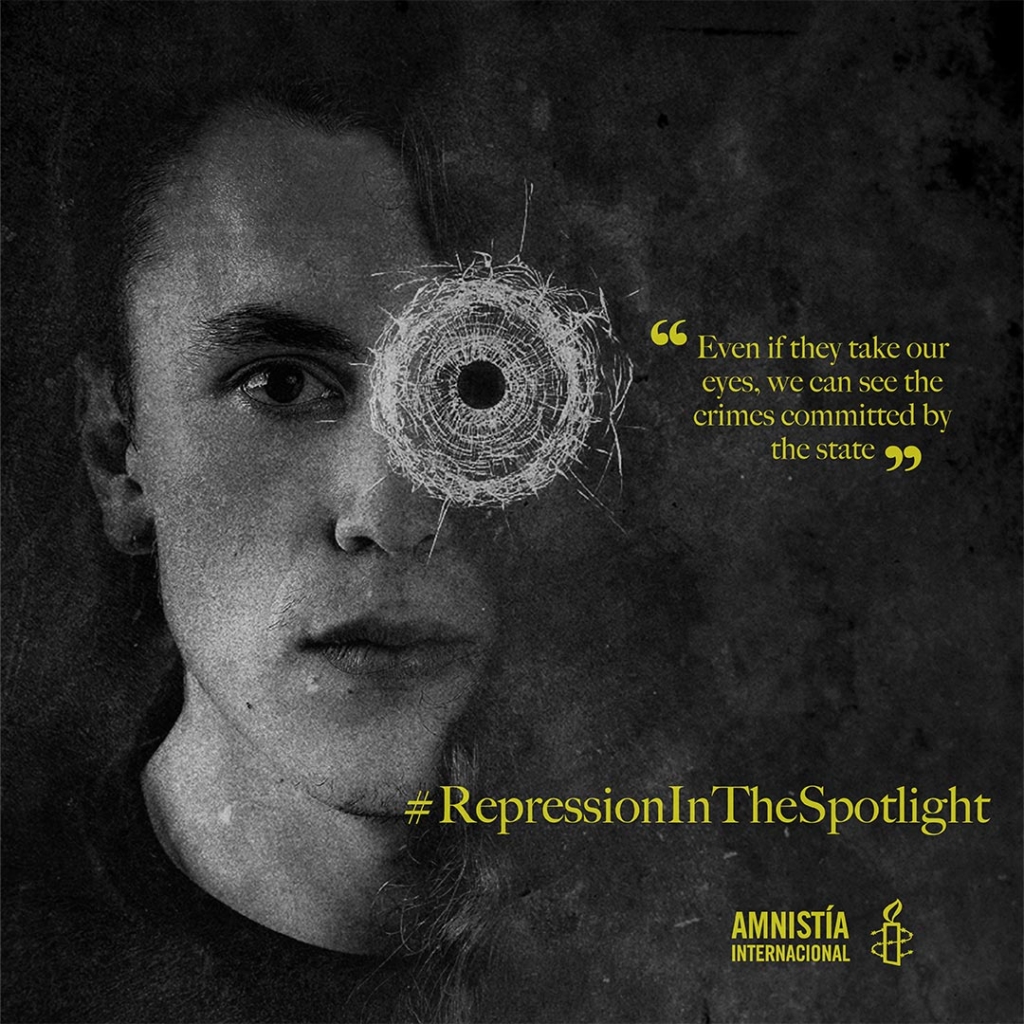
Gareth Sella, Victim of eye trauma in the context of pacific demonstration in Bogotá Colombia. 

© vmly&r / Amnesty International

Leidy Cadena: The price of being a young woman and raising your voice.

Leidy is a young student of political science, passionate about human rights and photography. Together with her partner and hundreds of Colombian people who wanted a change in the country, she went out to march. Once the protest turned violent due to the presence of the ESMAD, Leidy and others tried to return home. While they were going for their bicycles, an ESMAD agent shot Leidy directly and she  lost the sight of her right eye.

“I lost my eye but I swear I feel like I have ten thousand out there, let’s keep fighting that this doesn’t end here (…) I think it is very nice to be able to tell people that yes we can, that we can get out of these things and that, although it is very sad and painful, we have to go ahead and show the country that we are still here ready to fight”.

Due to her fight against impunity and her search for justice, Leidy received death threats, as a result of which she had to leave Colombia and seek asylum abroad.
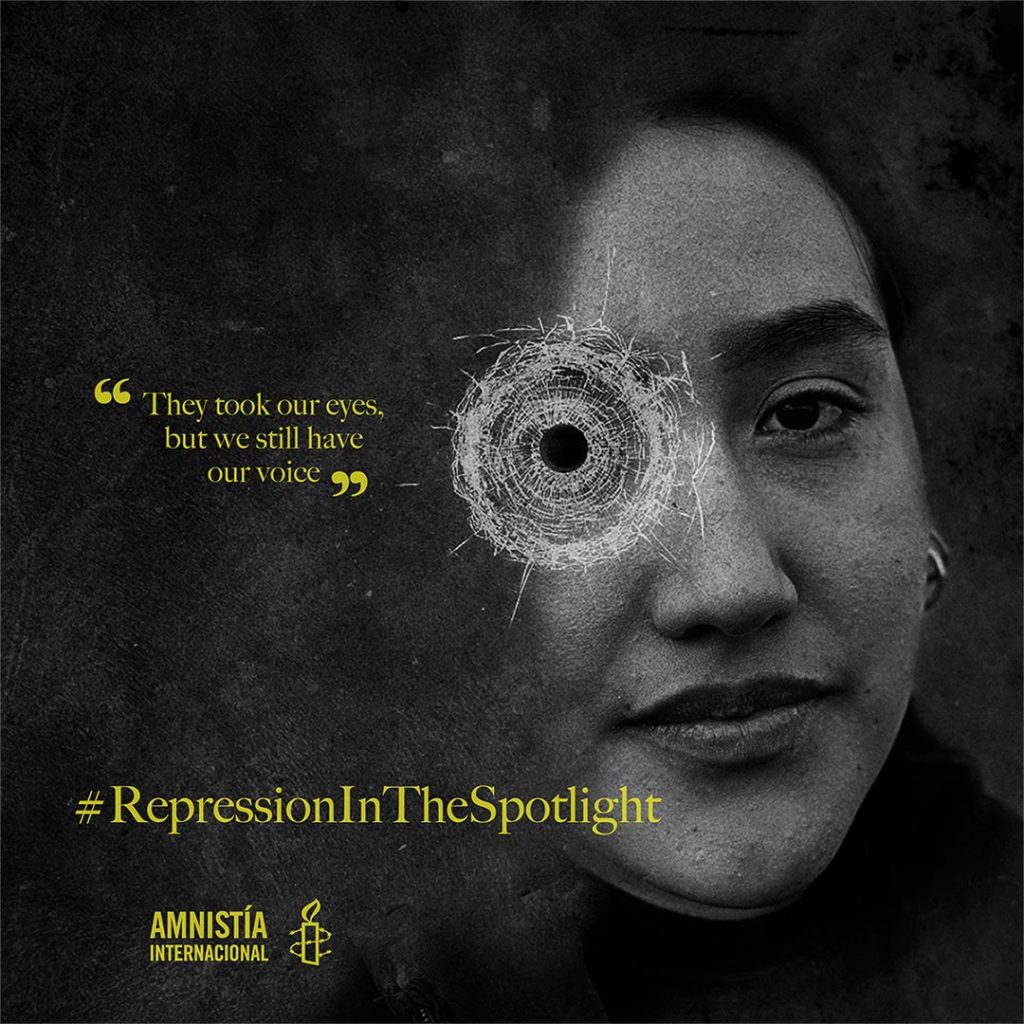
Leidy Cadena. Victim of Eye Trauma on the 28th of Abril 2021, in the context of the national Strike. Bogotá Colombia.

They took away an eye, but we still have our voice

© vmly&r / Amnesty International

What human rights violations occurred? 

Throughout the national strike Amnesty International verified excessive use of force, disappearances, sexual abuse and targeting of Indigenous Peoples, urban paramilitarism, illegal detentions and torture against peaceful demonstrators in Cali, among other human right violations
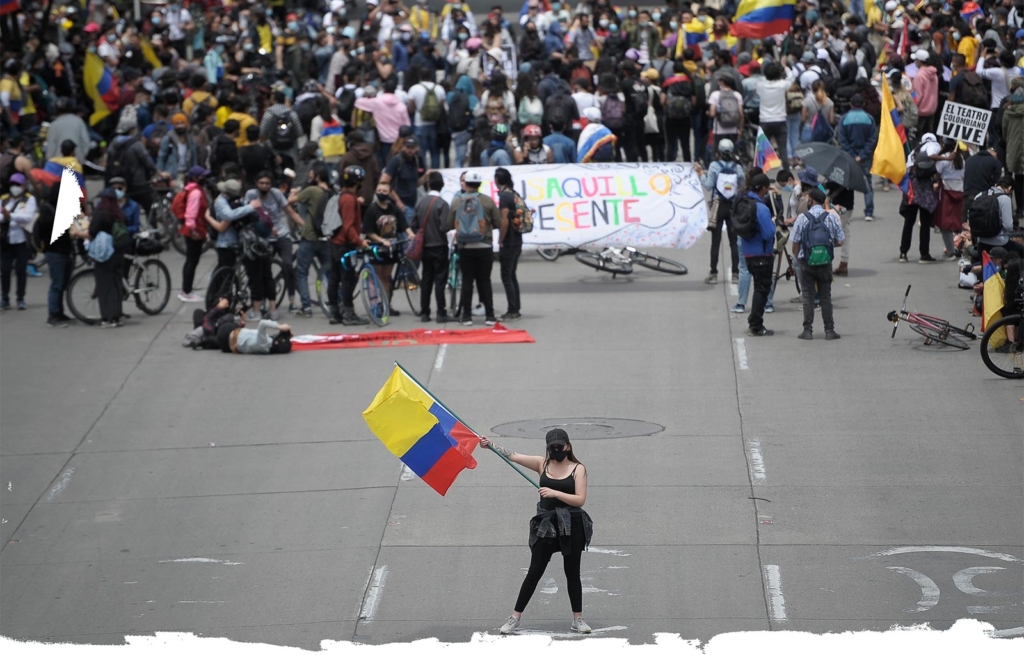
Protesters demonstrate in a peaceful manner at the 2021 National Strike in Colombia
Protesters demonstrate in a peaceful manner at the 2021 National Strike in Colombia / © Natalia Pedraza Bravo / Amnesty International

Repression and violence against those who hope for a better future in Colombia MUST stop!

  • The Colombian president and congress must take action to prevent the excessive use of force against peaceful protesters, initiating the process of police reform. 
  • The mayors of the cities of Bogotá, Popayán, Cali, Manizales and Medellín must put forward clear plans of actions for victims of illegal repression and violence that include prevention, treatment, rehabilitation and pyscho-social care.
  • Ordinary civilian courts must investigate agents suspected of criminal responsibility in fair proceedings. The investigation must include all chain of command responsibilities within the state authorities.
  • The prosecutor's office should refrain from referring cases of possible human rights violations in the context of social protest to the military justice system. All cases should be handled by a specialized human rights unit and prosecutors with the proper training.

WHAT CAN I DO TO STOP THE REPRESSION?

Help stop the repression and human rights violations by signing the petition

Download our reports

In the epicenter of repression: Human rights violations during the 2021 national strike in Cali, Colombia.

DOWNLOAD REPORT

Colombia: Shoots on sight: eye trauma in the context of the National Strike.

DOWNLOAD REPORT

The post Repression in the spotlight appeared first on Amnesty International.

EU: Ombudsman finds Commission failed to ensure rights at Croatian border

An investigation by the EU’s independent oversight body has found that the European Commission (EC) failed to ensure that fundamental human rights were respected in EU-funded border operations by Croatian authorities since 2018. During that time, widespread abuses against migrants and asylum seekers by Croatian border guards have been documented, including people being bound, brutally beaten and tortured.

“The European Commission financed Croatia’s border operations, including the salaries of border guards who are notorious for violent treatment of migrants and asylum-seekers, and yet it turned a blind eye to abuses. The Ombudsman has made it clear that the Commission must ensure that EU funds do not support operations that violate human rights” said Eve Geddie, Director of Amnesty International’s EU Office.

The Ombudsman found that the fact that a mechanism for monitoring human rights in Croatia was only established in the summer of 2021, while the European Commission funded ‘emergency’ border control operations since 2018 created confusion and was “regrettable”.

“As Amnesty and other warned, the mechanism for monitoring rights violations in Croatia is not independent nor effective and cannot serve as a credible watchdog without significant improvements. Its first report, issued in December, which found that Croatian police ‘acted illegally by returning migrants from Croatia to Bosnia and Herzegovina outside of the framework of international or national law’, was quickly retracted and replaced with a new version which scrubbed all references pointing to any wrongdoing by the Croatian authorities,” said Eve Geddie.

“Too many people have borne the brunt of the Croatian authorities’ border violence, and the European Commission’s lamentable failure to prevent and ensure accountability for it. We expect the Commission to ensure that the mechanism put in place in Croatia with EU assistance is given a broader mandate to effectively monitor and investigate the violations and freed from undue political influence.”

Eve Geddie

In her conclusion, the Ombudsman requested that the EC take a more active role in overseeing the work of the monitoring mechanism to ensure its independence and efficacy and demand from Croatia concrete and verifiable information on steps taken to investigate the reports of collective expulsions and mistreatment of migrants and asylum-seekers. 

“The Commission must ensure that EU-funded border-related operations comply with EU law, not just in Croatia, but at all EU borders,” said Eve Geddie.

For more information or to arrange an interview, please contact:      

Alison Abrahams on alison.abrahams@amnesty.org or +32 483 680 812      

Out of hours contact details      

+44 20 7413 5566      

email: press@amnesty.org       

twitter: @amnestypress     

Background 

Croatia is a beneficiary of more than 108 million EURO under EU’s Asylum Migration and International Fund (AMIF) and has received an additional 46 million EURO in emergency assistance for migration and border management since 2017.

In December, the Council of Europe’s Committee against Torture confirmed that Croatian authorities have assaulted refugees and migrants and denied them access to asylum. They also criticised the authorities for failing to conduct thorough and timely investigations into complaints of police misconduct.

The post EU: Ombudsman finds Commission failed to ensure rights at Croatian border appeared first on Amnesty International.

Pakistan: Zahir Jaffar conviction significant, but death penalty won’t end violence against women

In response to the conviction of Zahir Jaffar, the main accused in the gruesome murder of Noor Mukkadam in July 2021, Amnesty International’s South Asia campaigner Rimmel Mohydin said:

“The murder of Noor Mukkadam was a horrific crime and those responsible must receive punishment consistent with the gravity of the crime, but without resorting to the death penalty. Convictions have been dismally low for victims of gender-based violence in Pakistan, making today’s guilty verdict all the more significant. This conviction underscores the importance of ensuring that the criminal justice system responds effectively at all levels.  

“However, far-reaching procedural and institutional reform, and not the death penalty, is needed to tackle the endemic problem of violence against women in Pakistan – like everywhere else. If authorities want to take meaningful steps to ensure justice for women and girls, they must avoid using the death penalty as a ‘quick fix’ and commit to ensuring the criminal justice system prevents and responds to such crimes effectively at every stage.” 

Background

Noor Mukkadam, 27, was murdered and beheaded at the residence of Zahir Jaffar on 20 July 2021. Zahir, his parents and their staff members were arrested shortly after.  After a seven-month trial, a local court found Zahir guilty and sentenced him to death. The staff members, who were present at the scene of the crime, were given 10-year jail sentences. His parents, alleged to have aided Zahir with getting rid of the body, were acquitted.

The death penalty is the ultimate cruel, inhuman and degrading punishment. Amnesty opposes the death penalty in all cases without exception – regardless of who is accused, the nature or circumstances of the crime, guilt or innocence or method of execution.

The post Pakistan: Zahir Jaffar conviction significant, but death penalty won’t end violence against women appeared first on Amnesty International.

EU: Due diligence proposal ‘a missed opportunity’

Responding to the publication of the European Commission’s proposal for a Directive on corporate sustainability due diligence, Patrick Wilcken, Head of Business and Human Rights at Amnesty International said:

“The EU Commission’s decision to develop a directive marks a milestone on the road to greater corporate accountability across the EU. However, the narrow scope of the draft means that this is a missed opportunity, as in its current form only 1% of all EU companies would be required to check that their business complies with human rights and environmental standards.”

Patrick Wilcken, Head of Business and Human Rights at Amnesty International

The UN Guiding Principles on Business and Human Rights, on which this proposed legislation is modelled, explicitly states that due diligence responsibilities apply to “all business enterprises, both transnational and others, regardless of their size, sector, location, ownership and structure.” 

The proposal also threatens to restrict access to remedy for victims of corporate human rights abuses by allowing companies to shift their responsibilities on to business partners using contractual assurances.

The draft nevertheless represents an important first step towards establishing key principles in law: that companies must conduct human rights and environmental due diligence across their global value chains; and that they can be taken to court for harms resulting from a failure to meet these due diligence obligations.

“EU co-legislators must strengthen this proposal, extending it to as broad a range of businesses as possible and eliminating loopholes for avoiding liability. Only then will we see businesses across the EU held to account for the human rights and environmental impact of what they do.”

For more information or to arrange an interview, please contact:      

Alison Abrahams on alison.abrahams@amnesty.org or +32 483 680 812      

Out of hours contact details      

+44 20 7413 5566      

email: press@amnesty.org       

twitter: @amnestypress     

Background

The EU Commission proposal on corporate due diligence will only impact businesses with more than 500 employees and €50 million net turnover and companies in “high-impact” sectors with more than 250 employees and €40 million turnover. Small and medium-sized enterprises (SMEs) would be entirely excluded.

Amnesty International has joined calls for the EU to establish clear, robust and enforceable cross-sectoral requirements on business enterprises to respect human rights and the environment and to carry out due diligence.

The post EU: Due diligence proposal ‘a missed opportunity’ appeared first on Amnesty International.