EU: Batteries will need to comply with new human rights and green rules

T&E and Amnesty International welcome MEPs’ support for landmark batteries legislation

Batteries produced or sold in the EU would need to comply with new environmental standards and checks to see if their raw materials are responsibly sourced, according to a draft law backed by the European Parliament. But the rules still need to be signed off by EU governments which want to delay the introduction of recycling targets and due diligence checks by battery-makers.

Alex Keynes, clean vehicles manager at Transport & Environment (T&E), said: “This puts Europe firmly on the path to a sustainable zero-emissions future. The batteries that replace the burning of oil will need to be produced with green energy, made from responsibly sourced metals and fully recycled at the end of their life. Europe’s battery factories are being set up today, so any delays to recycling targets and checks on responsibly sourced materials are indefensible.”

Under the draft law, battery-makers will face checks on their supply chains to ensure any environmental or human rights abuses are identified and addressed. Limits on the carbon emissions caused by battery production will reduce their climate impact even further and boost the climate advantage of electric vehicles over combustion engine cars. 

From 2026, key raw materials will need to be recycled at the end of each battery’s life: 90% of nickel, copper and cobalt used and 70% of lithium (up from the paltry 35% proposed by the Commission). This will help secure a critical domestic supply of battery metals and offset the need for new mining.

“This is an encouraging step in the right direction by the European Parliament. Batteries are central to the energy transition, and ensuring they are free from human rights abuse and environmental harm must be a top priority for lawmakers in the EU. Respecting frontline and indigenous communities’ rights and livelihoods must be respected at all costs. Having strict due diligence requirements on the extraction and processing of key battery metals can help safeguard these rights, and will set a strong precedent for regulation elsewhere,” said Richard Kent, Researcher on Human Rights and the Energy Transition at Amnesty International.

Respecting frontline and indigenous communities’ rights and livelihoods must be respected at all costs. Having strict due diligence requirements on the extraction and processing of key battery metals can help safeguard these rights, and will set a strong precedent for regulation elsewhere.”

Richard Kent, Researcher on Human Rights and the Energy Transition at Amnesty International

T&E and Amnesty International called on EU Environment Ministers to drop all proposals to delay the due diligence checks and recycling targets when they meet on 17 March. The Parliament and EU governments are expected to finalise the law by the end of June.

The post EU: Batteries will need to comply with new human rights and green rules appeared first on Amnesty International.

Russia: Kremlin’s ruthless crackdown stifles independent journalism and anti-war movement

  • Independent media blocked, more than 150 journalists have fled the country
  • Facebook and Twitter banned
  • New legislation punishes independent reporting on the war with up to 15 years’ behind bars; the term “war” and calls for “peace” are effectively banned
  • More than 13,800 arbitrarily arrested at anti-war rallies since 24 February

The Russian authorities have unleashed an unprecedented, nationwide crackdown on independent journalism, anti-war protests and dissenting voices following Russia’s invasion of Ukraine, Amnesty International said today.

By blocking the most popular critical media outlets, closing independent radio stations and forcing dozens of journalists to halt their work or leave the country, the authorities have almost completely deprived people in Russia of access to objective, unbiased and trustworthy information. Roskomnadzor, Russia’s media regulator, has also blocked access to Facebook and Twitter.

“For two decades, the Russian authorities have waged a covert war against dissenting voices by arresting journalists, cracking down on independent newsrooms and forcing media owners to impose self-censorship. Yet, after Russian tanks entered Ukraine, the authorities switched to a scorched-earth strategy that has turned Russia’s media landscape into a wasteland,” said Marie Struthers, Amnesty International’s Director for Eastern Europe and Central Asia.

After Russian tanks entered Ukraine, the authorities switched to a scorched-earth strategy that has turned Russia’s media landscape into a wasteland

Marie Struthers, Amnesty International’s Director for Eastern Europe and Central Asia

Critical reporting and social media silenced

Since the start of the invasion, Roskomnadzor began to establish war-like censorship to silence dissent. On 24 February, the regulator ordered all media outlets to only use official, state-sanctioned sources of information or else face severe punishments for spreading “fake news”. The words ‘war’, ‘invasion’ and ‘attack’ were all banned from use when describing Russia’s military actions in Ukraine.  

On 28 February, Roskomnadzor blocked Nastoyashchee Vremya (Current Times), a subsidiary of Radio Free Europe/Radio Liberty, for spreading “unreliable” information about the invasion. On 1 March, almost all Ukrainian news outlets were inaccessible to internet users in Russia.

Over the days that followed, the Kremlin ruthlessly censored a swathe of independent media, including broadcaster TV Rain, the Echo of Moscow radio station, Latvia-based Meduza, critical Russian news outlets Mediazona, Republic and Sobesednik, grassroots activism portal Activatica and the Russian-language services of the BBC, Voice of America and Deutsche Welle.

The blocking of news sites and the threat of criminal prosecutions has also led to an exodus of journalists from Russia. According to Agentstvo, an investigative journalism site now inaccessible in Russia, at least 150 journalists have fled the country since the beginning of the war.

TV Rain chose to suspend broadcasting amidst fears of reprisals. Znak.com, a significant regional news channel, halted its operations citing censorship fears. The Echo of Moscow radio station was taken off the air; shortly after, its state-aligned owners decided to liquidate the company. Even Novaya Gazeta, a beacon of independent journalism led by Nobel Peace Prize laureate Dmitry Muratov, announced on 4 March that it would remove articles on Russia’s invasion of Ukraine.

From 1 March, Roskomnadzor began to slow traffic on Twitter and Facebook to a crawl, before accusing the two companies of disseminating “inaccurate” information about the conflict in Ukraine. On 4 March, both social media platforms were blocked.

“The free press in Russia has not died despite the authorities’ relentless efforts. The brave journalists continue their crucial work, not in newsrooms but as exiled reporters scattered around the world. One may not see their reports on TV or hear them on the radio, yet their truth is livestreamed on YouTube. Their words do not grace the pages of newspapers, but are spread to the world through Telegram-channels. Vital updates from all of these correspondents must be shared and valued,” said Marie Struthers.

The free press in Russia has not died despite the authorities’ relentless efforts. The brave journalists continue their crucial work, not in newsrooms but as exiled reporters scattered around the world

Marie Struthers, Amnesty International’s Director for Eastern Europe and Central Asia

Weaponizing of “foreign agents” and “undesirable organizations” laws

The Russian authorities also used notorious repressive legislation to crackdown on media and dissenting voices. On 5 March, two investigative reporting outlets, Vazhnye Istorii (Important Stories) and the Organized Crime and Corruption Reporting Project (OCCRP), were designated as “undesirable organizations”, which criminalized their operations and barred them from working in Russia.

On 9 March, a new bill was introduced in the State Duma creating a “unified register” of all current and former employees or members of NGOs, public associations and media entities labelled as “foreign agents” and persons labelled as such individually.

Crackdown on anti-war protests

Despite the introduction of draconian restrictions and a ferocious police response to peaceful protests, Russia’s anti-war movement continues to fill the streets with rallies even though the authorities immediately and brutally disperse them.

According to OVD-Info, a police watchdog NGO, around 13,800 peaceful protesters have been arbitrarily detained after anti-war rallies across Russia since 24 February. This figure includes more than 5,000 peaceful protesters who were detained across 70 cities on 6 March alone.

People deprived of their liberty in Russia are routinely subjected to beatings, humiliation and other forms of ill-treatment. Many people have also said they were denied access to lawyers and deprived of food, water or bedding.

In one particular case, at Brateyevo police station in Moscow on 6 March, a protester recorded a policeman telling her: “It’s over. Putin is on our side. You are the enemies of Russia. You are the enemies of the people.” He then said “we’re gonna kill you all here and that’s it. We’ll get another reward for it” as they dragged her by her hair and smashed her in the face with a plastic water bottle.

“The courageous people in Russia who oppose the war face serious personal risk. When they take to the streets, which is already a crime in the eyes of the authorities, and demand an end to the war, their message represents such a glaring contrast with state propaganda that it places them firmly in the crosshairs of the security forces. Yet these people should be celebrated for daring to raise their voices against the injustice of the invasion,” said Marie Struthers.

The courageous people in Russia who oppose the war face serious personal risk. […] Their message represents such a glaring contrast with state propaganda that it places them firmly in the crosshairs of the security forces

Marie Struthers, Amnesty International’s Director for Eastern Europe and Central Asia

Criminalization of “fake news”

On 4 March, Russia’s parliament introduced legislation that further criminalizes sharing “false information” about the activities of the Russian Armed Forces or “discrediting” Russian troops. Anyone accused of committing these “crimes” could face extortionate fines or a prison sentence of up to 15 years. Over the following three days, more than 140 people were detained under the new law effectively banning the word “war” and calls for “peace”.

“In dark times like these, only solidarity and goodwill can challenge the onslaught of state violence and rampant lawlessness. We call on the Russian authorities to end their relentless assault against civil society organizations and journalists. And we ask the international community to provide all possible support to Russian reporters, human rights defenders and activists who continue to deliver the truth and stand up against injustice despite suffering terribly for their cause,” said Marie Struthers.

STOP THE AGGRESSION AND PROTECT CIVILIANS IN UKRAINE

Right now, people in Ukraine are facing a catastrophic human rights crisis. People are dying, including children, and many thousands of lives are at risk. Take action to demand that the Russian authorities stop this act of aggression and protect civilians now.

The post Russia: Kremlin’s ruthless crackdown stifles independent journalism and anti-war movement appeared first on Amnesty International.

Ukraine: Russian ‘dumb bomb’ air strike killed civilians in Chernihiv – new investigation and testimony

  • Attack on March 3 killed people as they queued for bread
  • Lethal air strike may constitute a war crime

A Russian air strike that reportedly killed 47 civilians in the Ukrainian city of Chernihiv may constitute a war crime, Amnesty International said today following an investigation into the attack.

At approximately 12.15pm on Thursday 3 March, the small public square formed by Chernihiv’s Viacheslava Chornovola and Kruhova streets was hit by multiple bombs, killing civilians and severely damaging nearby buildings.

Based on new interviews and the verification and analysis of video evidence, Amnesty International’s Crisis Response team has concluded the attack was mostly likely a Russian air strike in which at least eight unguided aerial bombs – known as ‘dumb bombs’ – were used.

This was a merciless, indiscriminate attack on people as they went about their daily business in their homes, streets and shops

Joanne Mariner, Amnesty International’s Crisis Response Director

“The air strike that hit the streets of Chernihiv shocks the conscience. This was a merciless, indiscriminate attack on people as they went about their daily business in their homes, streets and shops,” said Joanne Mariner, Amnesty International’s Crisis Response Director.

“This shocking attack is one of the deadliest that the people of Ukraine have endured yet. The Prosecutor of the International Criminal Court should investigate this air strike as a war crime. Those responsible for such crimes must be brought to justice, and victims and their families must receive full reparation.”

The Chernihiv Regional Administration reported that 47 people (38 men and nine women) were killed in the strike. Verified footage of the strike shows eight munitions being dropped in close succession and falling in a line, as is typical in a bombing run. 

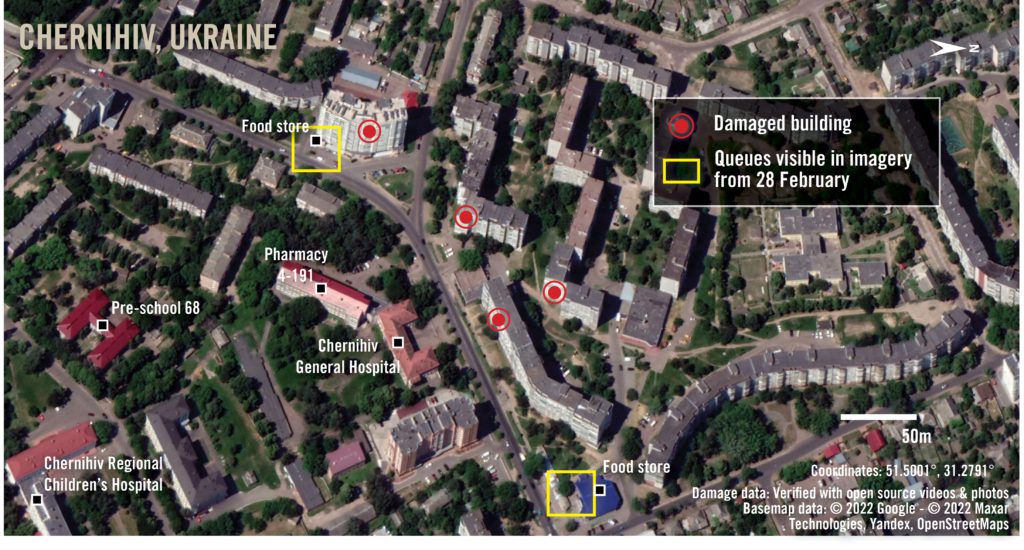
Amnesty International was not able to identify a legitimate military target at, or close to, the scene of the strike. Satellite imagery from 28 February shows a queue of people outside the building that was impacted by the strike. Based on this imagery and testimony gathered from witnesses, Amnesty International believes the majority of victims were queuing for food when the missiles struck.

‘Everything was destroyed’ 

When the bombs struck, Alina, a 21-year-old student, was in her home on nearby Ivana Bohuna Street with her family.

She told Amnesty International: “I heard a very, very loud buzzing, and I felt our building shaking. It was as if our flat was inflating… And then after two seconds, I heard the windows get blown out into the courtyard. Our building shook a lot; I thought there would be no walls left.

“When I heard the buzz, I called my grandma into the corridor with me. We laid on the ground and that’s likely what saved us.”

Alina’s parents were in the street when the blast happened, and they survived the attack. She added: “At [a nearby] yellow building, there had been a line for bread, and that’s where they had wanted to go… I don’t remember whether it was my mother or my father, one of them said, ‘No the line is too long, let’s go.’ And so they left. The people who were in that line are no more.”

An overview map shows the areas of damage – verified with open-source photos and videos – from strikes on 3 March 2022 in Chernihiv, Ukraine. 

Yulia Matvienko, a 33-year-old mother-of-three, was at home with her children, also on Ivana Bohuna Street, when the attack happened.

She suffered a head injury, telling Amnesty International: “I was walking along the corridor and hadn’t even made it into the kitchen when I was suddenly deafened – I didn’t understand what was happening.

“Everything started to suddenly crumble and fall. The children screamed. For several seconds, it was like there was silence and time stood still. Then I dragged my children out from under the rubble. Blood was flowing down me, and I dragged my children out.

“Everything was destroyed, and the door [to their building] was knocked off. Not a single window was left, and some balconies were totally torn off. There is not a scratch on the children. It’s a miracle… [there was] only my blood on them.”

In dashcam footage of the strike, falling munitions are visible and the sound of what is likely a low quick-passing aircraft can be heard, consistent with the tactics of conducting a strike of this type. Dropping unguided bombs in populated areas violates the prohibition of carrying out indiscriminate attacks. Such bombs have wide-area effects and are far less accurate than precision-guided munitions.

Crisis Evidence Lab verification

Amnesty International’s Crisis Evidence Lab verified footage of the aftermath of the strike that showed damage to buildings and bodies in the street. Footage from the State Emergency Service of Ukraine also showed damage and the rescue effort.

Other verified videos of the aftermath show widespread destruction and at least one distinctive bomb crater, of a size consistent with surface impacted munitions of approximately 500kg.

Other verified content from another air strike location in Ukraine shows an unguided dud FAB-500 M62 bomb being removed by civil defence forces. In addition, an official video released by the Russian military on 6 March shows the sortie launch of Su-34 Fullback aircraft loaded with eight FAB-500 bombs, an indicator of the typical combat load in current Russian operations. 

“All states should cooperate with the ICC and the new Commission of Inquiry established by the UN Human Rights Council to help ensure accountability for grave violations and crimes such as this attack. Victims of this conflict must have justice,” said Joanne Mariner.

Amnesty International has previously called for international humanitarian and human rights law to be respected by all parties as the conflict in Ukraine continues.

STOP THE AGGRESSION AND PROTECT CIVILIANS IN UKRAINE

Right now, people in Ukraine are facing a catastrophic human rights crisis. People are dying, including children, and many thousands of lives are at risk. Take action to demand that the Russian authorities stop this act of aggression and protect civilians now.

The post Ukraine: Russian ‘dumb bomb’ air strike killed civilians in Chernihiv – new investigation and testimony appeared first on Amnesty International.

Morocco/Western Sahara: Activist targeted with Pegasus spyware in recent months – new evidence

A prominent human rights activist in Morocco has been targeted with NSO Group’s Pegasus spyware in recent months, Amnesty International can reveal.

Analysis by Amnesty International’s Security Lab found that two phones belonging to Sahraoui human rights defender Aminatou Haidar were targeted and infected as recently as November 2021, just months after the Pegasus Project revelations shocked the world.

“The fact that Aminatou Haidar was targeted with Pegasus spyware mere months ago is further proof that companies like NSO Group will continue to facilitate human rights violations unless they are properly regulated,” said Danna Ingleton, Deputy Director of Amnesty Tech.

“This latest revelation shows NSO Group’s human rights policies are meaningless in practice. Amnesty International has repeatedly shown forensic evidence of Pegasus misuse since 2019 in Morocco, as well as in over a dozen countries in the Pegasus Project investigation, yet NSO Group has taken no action to prevent the ongoing human rights violations caused by its tools in Morocco.

“NSO Group must be held accountable for its role in the targeting of Aminatou Haidar, and other fearless activists from Morocco and Western Sahara.”

Aminatou Haidar is a human rights defender from Western Sahara, who has won multiple awards for her peaceful activism, including the Robert F. Kennedy Human Rights Award in 2008, the 2009 Civil Courage Prize, and the Right Livelihood Award in 2019.

After receiving security alerts by email from Apple saying her phones may have been targeted by state-sponsored attackers, Aminatou Haidar contacted the Right Livelihood Foundation, who referred her to Amnesty International’s Security Lab for forensic analysis. The Security Lab then confirmed the targeting and infection with NSO Group’s Pegasus spyware.

Amnesty International’s analysis showed that one of Haidar’s phones contained traces of Pegasus targeting dating back to September 2018, and further traces of infection as recently as October and November 2021 on the other. Amnesty International shared forensic records from Haidar’s phone with Citizen Lab researchers at the University of Toronto, who independently confirmed the Pegasus infections from October and November 2021.

This clearly indicates that civil society in Morocco and Western Sahara is still being unlawfully targeted with the Pegasus spyware, despite Amnesty International documenting an extensive history of misuse.

These attacks on human rights defenders are part of an intensifying clampdown of peaceful dissent in Morocco. The continued abuse of NSO Group’s tools in the country indicates Moroccan authorities are failing to respect and protect the rights to freedom of expression, association, and peaceful assembly.

In addition, NSO Group’s repeated failure to act on the misuse of its tools indicates that it has failed in its human rights responsibilities to not contribute to human rights violations and failed to conduct adequate human rights due diligence in order to mitigate harm.

Amnesty International provided detailed evidence of these abuses to NSO Group on multiple occasions, first in October 2019 with the cases of Maati Monjib and Abdessadak El Bouchattaoui; in June 2020 with the case of journalist Omar Radi; and in July 2021 with the Pegasus Project revelations including the case of Moroccan journalist in exile Hicham Mansouri and Claude Mangin, the partner of Naama Asfari, a Sahraoui activist who is imprisoned in Morocco.

The Moroccan authorities disputed the latest findings, citing a “lack of material evidence”. NSO Group did not respond by time of publication, but has previously refused to confirm or deny whether the Moroccan authorities use its technologies

Since the first revelations of the Pegasus Project, targets from countries including Palestine, El Salvador, Poland and Belgium, have been uncovered, highlighting the wide range of abuses and violations committed using NSO Group’s Pegasus spyware.

“Spyware companies like NSO Group cannot be trusted to regulate themselves, and we are again calling for an immediate moratorium on the sale, transfer, and use of spyware technology until a human rights regulatory framework is in place,” said Danna Ingleton.

Background

Western Sahara is the subject of a territorial dispute between Morocco, which annexed the territory in 1975 and claims sovereignty over it, and the Polisario Front, which calls for an independent state in the territory and has set up a self-proclaimed government-in-exile in the refugee camps in Tindouf, south-west Algeria.

A UN settlement in 1991, which ended fighting between Morocco and the Polisario Front, called for a referendum for people of Western Sahara to choose independence or integration into Morocco. The referendum has not yet been held. In recent years, access to Western Sahara has grown increasingly difficult for external monitors as the human rights situation continues to deteriorate.

The post Morocco/Western Sahara: Activist targeted with Pegasus spyware in recent months – new evidence appeared first on Amnesty International.