
Saudi Arabia: Mass demolitions and forced evictions marred by violations and discrimination

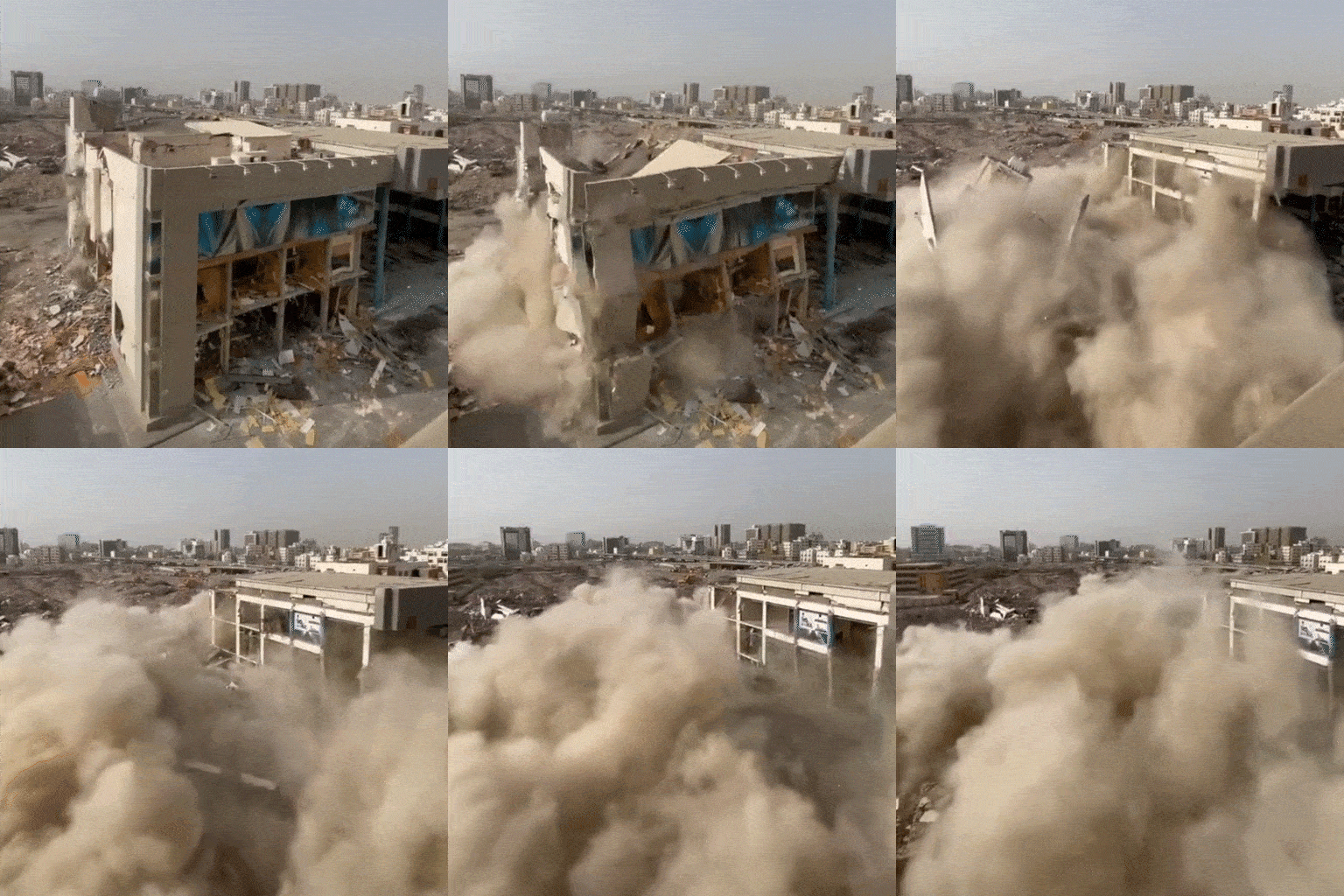
An ongoing large-scale demolition and eviction plan, part of the Crown Prince Mohammad bin Salman’s strategy to achieve Vision 2030, which impacts half a million people in over 60 neighbourhoods in the coastal city of Jeddah, violates international human rights standards and discriminates against foreign nationals, Amnesty International said today calling on the authorities to end forced evictions.

According to the organization’s review of a Jeddah Municipality document, with a timeline of development plans dating back to 2019, the demolitions affect more than 558,000 residents. The demolitions began in October 2021 and have continued intermittently since then.

The Saudi Gazette announced on 31 January 2022 a compensation scheme for citizens excluding foreign nationals who make up 47% of those evicted. According to the authorities, the value of compensation will only be appraised after the demolition of buildings.

“Beneath the progressive, glitzy image that Saudi Arabia is trying to present to the world, lie horrid stories of abuses and violations. The world will not be fooled by sham fanfare. A Jeddah Municipality document shows that project plans were finalized almost three years ago, yet the Saudi authorities failed to engage in a process of genuine consultation with residents, provide adequate notice and announce the amount of compensation and provide it to residents prior to the demolitions,” said Diana Semaan, Amnesty International’s Acting Deputy Director for the Middle East and North Africa.

“The authorities are building this project at any cost to the people living in the area. Not only did they callously kick residents out of their homes without giving them adequate time or compensation to find an alternative home, but they also discriminated against hundreds of thousands of foreign nationals by excluding them from the compensation scheme.”

Amnesty International interviewed one resident, three activists and three journalists with knowledge of the situation on the ground, two of whom were in Jeddah between February 2022 and May 2022. The organization also verified satellite images that showed at least 20 neighbourhoods across Jeddah demolished between October 2021 and May 2022, and 13 videos that showed the destruction of buildings in multiple neighbourhoods.

In April 2022, Amnesty International wrote to the Saudi Arabian Human Rights Commission raising questions and concerns about the demolition and due process requirements in the context of evictions but has not received a response.

Beneath the progressive, glitzy image that Saudi Arabia is trying to present to the world, lie horrid stories of abuses and violations.

Diana Semaan, Amnesty International

According to a public official document reviewed by Amnesty International, residents were given a notice period ranging between 24 hours in one neighbourhood and between one and six weeks in others. For example, in the Al Ghaleel neighbourhood, one of the impacted neighbourhoods, electricity was cut off one day after residents saw “evacuate” painted on their buildings. In other neighbourhoods, schedules for evictions and demolitions were posted on billboards or through state-aligned media.

“I only found out about the eviction through spray paint on our building on 22 January and a paper posted on our ground floor stating that we had to leave before the end of the month. I never saw or spoke to any municipality or government officials.” said a foreign national who had been living in one of the neighbourhoods for three years before he was forced to leave in February 2022.
In line with the UN Basic Principles and Guidelines on Development-Based Evictions and Displacement, the authorities must offer compensation and resettlement to all those affected without discrimination, ensuring that no one is left homeless as a result of an eviction, including citizens and non-citizens, those with or without ownership documents, and tenants. In addition, they must involve all affected individuals, provide appropriate notice, release information in advance and provide all affected residents reasonable time to publicly review or object to the proposed plan, including plans to protect vulnerable groups.

Stigmatized and intimidated

State-aligned media channels have unleashed a sweeping stigmatizing narrative about people living in the affected areas, claiming that the majority of people in some areas are undocumented and the neighbourhoods are “rife with diseases, crime, drugs and theft” as the inhabitants are “violators of the residence and work system.”

One community activist told Amnesty International: “Entire communities are being destroyed. What will happen to those most vulnerable? Both documented and undocumented migrants cannot afford alternative housing in higher cost areas. Those who are undocumented are smeared as criminals. There is no empathy for them.”

There is a climate of fear around the sharing of information and the reporting of violations in the eviction process. According to an Amnesty International source who has direct contact with residents in Jeddah, people fear reprisals by the authorities if they demand their rights and are therefore afraid to speak out. One resident said he feared he would face the same fate as Abdul Raheem al-Huwaiti, who was killed by security forces in April 2020 after leading the community organizing against land acquisitions related to NEOM, a megacity project being built in Tabuk province in the north-west of Saudi Arabia.

Many people using pseudonyms have taken to Twitter to protest the destruction of their neighbourhoods and homes, as well as the difficulties they face in finding affordable alternative housing. They are also protesting the high cost of living and housing for those evicted, the delay in compensation, and the increased prices of rent and home relocation services in Jeddah.

Background

In 2017, Saudi Arabia launched Vision 2030, a plan to diversify the economy and create more opportunities for women and young people.

Saudi Arabia’s Crown Prince launched the Jeddah Central Project in December 2021, a SR75 billion (approximately USD 20 billion) to develop 5.7 million square meters of land. The first demolitions in relation to this project started in October 2021 followed by another round in January 2022, when videos of the destruction began surfacing on social media.

The post Saudi Arabia: Mass demolitions and forced evictions marred by violations and discrimination appeared first on Amnesty International.

DRC: Military escalation with Rwanda devastating for civilians 

Warring parties must ensure that civilians are protected amid the fighting between the Movement of 23 May (M23) and the Congolese army supported by UN peacekeepers in North Kivu province, said Amnesty International today.

The military escalation in eastern DRC during M23’s resurgence is having devastating consequences for the civilians caught in the middle. All parties to the conflict must strictly respect rules of international humanitarian law, including doing everything to ensure the safety of the civilians

Deprose Muchena, Amnesty International's Director for East and Southern Africa

“The military escalation in eastern DRC during M23’s resurgence is having devastating consequences for the civilians caught in the middle. All parties to the conflict must strictly respect rules of international humanitarian law, including doing everything to ensure the safety of the civilians”, said Deprose Muchena, Amnesty International’s Director for East and Southern Africa.

Fighting between the Congolese army and M23 has resulted in 23 civilian deaths since May 2022, including three children according to the UN.  

“Civilians have already suffered in this latest round of this conflict, with more than 80,000 people fleeing their homes since the fighting resumed in April 2022. Some have left for Uganda and others have been displaced internally. The Congolese authorities and all regional and international stakeholders must swiftly and durably address the worsening human rights situation in accordance with international law.”

Since the resurgence of M23 in November 2021, tension has risen between the governments of DRC and Rwanda. In recent days, verbal and physical attacks targeting people designated as “Rwandans” or “Tutsi” have spread online in the DRC.

The Congolese authorities and all regional and international stakeholders must swiftly and durably address the worsening human rights situation in accordance with international law.”

Deprose Muchena

The Congolese authorities, the UN and several institutions in the DRC and abroad have strongly denounced the advocacy of hatred.

“We welcome Congolese authorities’ clear position against hatred and violence. They must be followed by concrete steps to effectively protect all people without discrimination, and to hold anyone involved in advocacy of hatred and violence to account. The likes of Twitter, Facebook and TikTok should take swift steps to stop the spread of advocacy of hatred on their platforms,” said Deprose Muchena.

Background

Eastern DRC has suffered from armed conflict since the 1990s. The violence has intensified in recent years, with more than 7,380 civilians killed between 2017 and April 2022, according to the Kivu Security Tracker.

President Félix Tshisekedi has imposed a state of siege — similar to a state of emergency — in North Kivu since May 2021 in an attempt to reduce violence. Instead, insecurity has escalated and Amnesty International found that authorities have used the state of siege to restrict the exercise of freedoms of expression and peaceful assembly, and carry out other human rights violations with impunity.

The M23 movement’s attacks in North Kivu resumed in November 2021, eight years after the group was militarily defeated by the Armed Forces of the Democratic Republic of the Congo and the UN Force Intervention Brigade. Its recent demands include implementation by the DRC government of the 2013 Nairobi Agreement, which provided amnesty to M23 members and included their repatriation to the DRC.

The DRC government accuses Rwanda of aggression using M23 as a proxy, and the speaker of DRC’s National Assembly was quoted in the media as accusing Uganda as having sided with M23 and Rwanda during the battle for Bunagana in North Kivu on 13 June 2022. Conversely, Rwanda accuses the DRC of aggression and colluding with members of the Rwandan Hutu rebellion of the Democratic Forces for the Liberation of Rwanda (FDLR) operating in eastern DRC, which contains remnants of the Interahamwe militia and former Rwandan soldiers responsible for the 1994 Rwandan genocide, as well as fighters not involved in the genocide, including many too young to have participated.

At a summit held in Nairobi on 20 June, Heads of State of the East African Community including DRC’s Félix Tshisekedi called on all armed groups in eastern DRC to cease hostilities and directed an immediate ceasefire. They approved the dispatch of a regional force whose mission would be to disarm local and foreign armed groups that fail to disarm voluntary.

The post DRC: Military escalation with Rwanda devastating for civilians  appeared first on Amnesty International.

Bangladesh: “Engage with us to find a durable solution”

Since 2021 big fire incidents have been rife in the Rohingya refugee camps in Bangladesh. Many of us lost livelihood opportunities such as shops, as well as belongings which we brought from Myanmar. On top of that, Bangladesh’s government put further restrictions on our livelihood options, access to education and the right to freedom of movement and association.

Any form of financial transaction is forbidden in the camps. As a result, security officials often accuse Rohingya refugees of operating criminal gangs for having mobile phones with internet access and mobile financial systems installed on their phones. Some Rohingya refugees avoid detention by paying money to the officials.

We refugees are living in limbo in Bangladesh with neither the opportunity to return to our homes in Myanmar nor have a way to live life peacefully in Bangladesh.

At this current state, we have lost the expectation that  the international community will do anything to truly help. We face enormous hardship in the refugee camps. Nearly half a million Rohingya children hang in the balance with limited primary level access to education. We have no security for our lives, no means for livelihood. To move anywhere outside the refugee camps, we need written order from the camp authority. We are just a monsoon’s landslide away from perishing under the muds.

On the top of it, we do not know how we can ever return to our homes. We are neither safe in the refugee camps nor in Arakan [in Myanmar]. Our people are losing their lives to gang violence in the refugee camps, in environmental calamity, or by taking dangerous attempts to migrate to other countries through the deadly seas and other means.

Sadly, our options are so limited. Yet, there would be some hope if we had access to education. At least we can strive to improve the fate of our children by doing something better for them. Here, too, in the refugee camps there is so much restriction. We are detained by the police for operating community schools.

Our people deserve to have a better life. Bangladesh has given us a second chance to survive , but what happens after this? Are we supposed to live in a standstill in the camps with nowhere to go and nothing to do? Being stuck in one place with no qualitative change in our lives for five years is no less cruel than the discrimination we faced in Myanmar.

We are a people who have been denied and deprived of our rights at home for decades. The way out of this situation is not by looking away from us or pushing us away to a remote island but by engaging with us to find a durable solution.

San thai Shin is a researcher and a volunteer teacher and prefers to write under his Burmese name in order to speak freely. The views expressed in this blog are entirely his own.

rohingya refugees need protection of their rights now more than ever

The post Bangladesh: “Engage with us to find a durable solution” appeared first on Amnesty International.

Japan: ‘Discriminatory’ ruling on same-sex marriage a crushing blow to equality

In response to today’s court ruling in Japan that upheld the government ban on same-sex marriage, Amnesty International’s East Asia Researcher Boram Jang said:

“The court’s endorsement of the Japanese government’s discriminatory ban on same-sex marriage is a deeply damaging setback to equal rights in the country.

“This ruling highlights the prejudice faced by LGBTI people in Japan, and the government’s failure to address it.

“Last year’s ruling by the Sapporo District Court, which held that Japan’s marriage ban was unconstitutional, offered hope of progress on this issue, but today’s verdict is a crushing blow to same-sex couples who will feel they are back to  square one.

“We urge the Japanese government to undertake a thorough review of all laws, policies and practices that discriminate against same-sex couples in all walks of life. Japan’s repressive ban on same-sex marriage must be consigned to history.”

Background

Osaka District Court today rejected the claims of three same-sex couples – two male, one female – who argued that Japan’s ban on same-sex marriage was unconstitutional.

It is only the second such case to be heard on this issue in Japan after the Sapporo District Court ruled in favour of three same-sex couples in a similar case last year.

That ruling, on 17 March 2021, said the Japanese government violated Article 14 of the Japanese constitution that ensures the right to equality. However, the court today ruled that Article 14 had not been violated. 

Despite long-running efforts by campaigners, Japan has failed to introduce national legislation to eliminate discrimination based on sexual orientation, gender identity, expression and sex characteristics. 

Amnesty International continues to call on the Japanese government to prioritize LGBTI rights and introduce national legislation that is comprehensive, and specifically prohibits discrimination on the grounds of sexual orientation, gender identity, expression and sex characteristics. 

The post Japan: ‘Discriminatory’ ruling on same-sex marriage a crushing blow to equality appeared first on Amnesty International.

End violence and serious human rights violations against Afghan refugees

To mark World Refugee Day, members of the Alliance for Human Rights in Afghanistan stand together to honour Afghan refugees around the globe. We honour their strength and courage as they have been forced to flee their home countries to escape conflict and persecution. We acknowledge the profound hardships they have endured and reaffirm our commitment to carry their voices and defend their rights. The Alliance for Human Rights reminds the international community of its obligations to uphold and protect the right to seek asylum, the right to life and other fundamental human rights of Afghan refugees under the international human rights law regime.

The Afghan refugee crisis is one of the largest protracted refugee situations in the world. Today, over 6 million Afghans have been driven out of their homes and their country by conflict, violence and poverty. Of those, 3.5 million are displaced within Afghanistan, with 2.6 million Afghan refugees living in other countries. These numbers have been exacerbated by the Taliban´s seizure of power in Afghanistan in August 2021 and the critical humanitarian crisis Afghanistan is facing today. The impact of the situation has been particularly devastating for women and children, who account for 80 percent of newly displaced Afghans, as they face increased protection risks such as family separation, psychosocial stress and trauma, exploitation and gender-based violence.

Refugee rights are fundamental human rights. The 1951 Refugee Convention and its 1967 Protocol protect the rights of refugees. This includes the right not to be expelled except under certain strictly defined conditions; the right not to be punished for illegal entry into a state; the rights to work, housing, education, public relief assistance, freedom of religion, access to the court system, freedom of movement within the territory and receiving identity and travel documents.

Regrettably, many Afghan refugees, including in Iran, Pakistan, Uzbekistan, Tajikistan, Malaysia and Turkey do not enjoy their rights under international law. They continue to face brutality, violence, ill-treatment and pushbacks. They face discrimination and struggle to access basic services, education, work, identity and travel documents. In the worst cases, they face arbitrary detentions, penalties and forced deportation.

We are appalled by the increasing number of incidents of violence and serious human rights violations against Afghan refugees. In the face of such egregious abuses, many governments are ignoring the great suffering of individuals in need of international protection, particularly women and children.

States must uphold their commitments and respect fundamental human rights, including the right to life and the right to seek asylum. We call on states to:

  • Ratify the 1951 Refugee Convention and its 1967 Protocol
  • Take all necessary measures to ensure the safe passage out of Afghanistan for all those targeted by the Taliban and other parties. This includes ensuring that border crossings remain open, visas are expedited, support for evacuations is delivered, and relocation and resettlement support is provided;
  • Immediately end forcible return of Afghan refugees and heed the call of the United Nations High Commissioner for Refugees (UNHCR) to suspend the forced return of nationals and former habitual residents, including anyone whose asylum claims have been rejected, until the situation in the country has stabilized sufficiently as determined by an independent human rights assessment, and the security, rule of law and human rights situation in Afghanistan has significantly improved to permit returns in safety and dignity;
  •  Allow all Afghan seekers to access a clear, transparent and functioning asylum system, lodge a claim for international protection and apply for resettlement
  • Provide individuals at particular risk including human rights defenders, journalists, women leaders and activists, and LGBTIQ+ persons, immediate practical support at all levels, including through diplomatic and political channels, with specific and enhanced protection measures for women human rights defenders and women journalists. Use their influence, including in economic, political, or religious realms, to ensure compliance with the above demands.

We stand in solidarity with Afghans – both at home and in exile.

Amnesty International

Human Rights Watch

Freedom House

Freedom Now

International Federation for Human Rights (FIDH)

MADRE

World Organisation Against Torture (OMCT)

The post End violence and serious human rights violations against Afghan refugees appeared first on Amnesty International.