EU/Lithuania: In milestone judgement, EU Court slams automatic detention and denial of asylum

Responding to the Court of Justice of the European Union’s finding today that Lithuanian national law, which orders the automatic detention of people who cross irregularly into the country and effectively denies them the right to asylum, is incompatible with EU laws, Nils Muižnieks, Europe Regional Director of Amnesty International, said:

“The Court of Justice of the European Union today confirmed the conclusions in our latest report on Lithuania, which details the authorities’ flagrant violation of European and international law by not only denying the right to asylum for irregular arrivals in the country, but also arbitrarily detaining them.”

“Lithuania is duty bound by its international obligations to offer access to international protection to asylum seekers. Following today’s finding by the Court of Justice of the EU, the authorities should immediately repeal this repressive legislation. It is essential that Lithuania offers access to fair asylum procedures to all who express a need to gain international protection.

“The Lithuanian authorities must also end their cruel practice of automatically detaining refugees and migrants. Today’s judgment confirmed that depicting detention as ‘temporary accommodation’ or even an ‘alternative to detention’ does not allow any derogation from the obligation to respect refugees and migrants’ rights against arbitrary detention.”

The Lithuanian authorities must also end their cruel practice of automatically detaining refugees and migrants

Nils Muižnieks, Europe Regional Director of Amnesty International

Background

In today’s decision, the Court of Justice of the European Union found that Lithuanian national law, which allows an applicant for international protection to be denied the right to asylum and placed in automatic detention solely on the grounds that they have irregularly crossed the border, is not compatible with EU legislation.

The Court found the practice of denying the right to asylum to be in violation of EU law, including the EU Charter of Fundamental Rights, and debunked the Lithuanian claims that the country has the right to derogate European law in “extraordinary situations” or during the “mass influx of foreigners.”

Moreover, the Court confirmed Amnesty International’s conclusion that the measures applied in Lithuania are at all effects detention, irrespective of the authorities depicting it as “temporary accommodation” or even an “alternative to detention.”

In July 2021, as the number of people arriving at the Lithuania-Belarus border increased, lawmakers adopted new legislation that deviates from international and EU legal safeguards on the right to asylum and arbitrary detention.

The post EU/Lithuania: In milestone judgement, EU Court slams automatic detention and denial of asylum appeared first on Amnesty International.

Algeria: Over 260 Hirak detainees languishing in prison must be released

The Algerian authorities must immediately and unconditionally release at least 266 activists and protesters imprisoned for participating in the Hirak protest movement, criticising the authorities, denouncing state corruption or expressing solidarity with detainees, Amnesty International said today as Algeria prepares to celebrate 60 years of independence on 5 July.

In May 2022, local watchdogs reported that at least 266 activists and protesters are languishing in Algerian prisons solely for exercising their rights to freedom of expression and assembly; the authorities must urgently drop all charges against them.

Many protesters are being held in pretrial detention for excessively long periods of time. Others have been handed sentences of up to five years on overly broad, trumped-up charges such as “harming” national security, “undermining national unity”, “offending” public officials, “inciting unarmed gatherings”, spreading fake news, and terrorism.

“Sixty years after Algeria was recognized as an independent nation, basic freedoms and human rights are still being overlooked, trampled upon or actively curtailed,” said Amna Guellali, Amnesty International’s Deputy Director for the Middle East and North Africa.

“The unjustified detention of activists and protestors must end. It is shameful that the Algerian authorities continue to the use of overly broad and repressive laws to prosecute individuals solely for peacefully exercising their rights to freedom of expression and assembly.”

On 24 April 2022, Hakim Debbazi, a Hirak detainee, died in custody under unclear circumstances. Debbazi is a 55-year-old father of three children. He had been held in pretrial detention since February 2022 after sharing a Facebook post from another page that called for a protest to mark the third anniversary of the Hirak movement. He was prosecuted for “inciting an unarmed gathering”, “offending public officials” and publishing content that might “harm the national interest”. The court rejected a request for his provisional release from his lawyers, but offered no explanation for the refusal. 

Zakiya Sadeg, Debbazi’s aunt and lawyer, told Amnesty International that he had informed his wife during a visit in April that he was suffering from chest pains and breathing difficulties. He also said he was being held in a small, smoke-filled room that lacked ventilation. Almost one month after Debbazi’s death, Algeria’s Minister of Justice said, citing an autopsy report, that he had died of natural causes.

The unjustified detention of activists and protestors must end.

Amna Guellali, Amnesty International

Out of all cases documented by Amnesty International, at least four detainees have faced additional trials while in prison over charges related to expressing state criticism either online or offline. On 8 June 2020, environmental activist Mohad Gasmi was arrested and later sentenced to five years in prison over a Facebook post that was deemed by the authorities as “glorifying terrorism.” While in prison, he was prosecuted on additional charges related to his participation in environmental activism abroad and communicating with activists online. He was handed an additional three-year sentence.

Journalist Merzoug Touati was also handed an additional prison term while serving his initial one-year sentence for “inciting an unarmed gathering” and publishing content that “undermines national unity”. On 29 May 2022, he was sentenced to one more year in prison and fined $350 USD in a separate case under the same charges. Touati was eventually released on 20 June following a presidential pardon. Charges against him have not been dropped. He received yet another sentence of a year in prison and a fine of $342 USD on 28 June 2022. The latest sentence is the fourth against him in 2022.

After the Hirak protest movement was halted due to Covid-19 in 2020, the Algerian authorities escalated their repression of peaceful dissent. The growing suppression of state critics was not limited to Algerians within the country, but also targeted several individuals residing abroad or seeking refuge overseas.

Earlier this year, one refugee was abducted in Tunisia before being forcibly returned to Algeria and prosecuted on at least 10 charges including “participation in a terrorist organization” for his alleged links to the Movement for the self-determination of Kabylie. 

Also, at least two asylum seekers were deported over their alleged links with unauthorized organizations, while at least three dual nationals residing in Canada were arbitrarily arrested or interrogated upon arrival in Algeria, and then prevented from exiting the country for several weeks or months.

The post Algeria: Over 260 Hirak detainees languishing in prison must be released appeared first on Amnesty International.
Ukraine: Deadly Mariupol theatre strike ‘a clear war crime’ by Russian forces – new investigation

An extensive investigation by Amnesty International has concluded that Russian military forces committed a war crime when they struck the Mariupol drama theatre in Ukraine in March, killing at least dozen people and likely many more.

In a new report, ‘Children’: The Attack on the Donetsk Regional Academic Drama Theatre in Mariupol, Ukraine, the organization documents how the Russian military likely deliberately targeted the theatre despite knowing hundreds of civilians were sheltering there on 16 March, making the attack a clear war crime.

Amnesty International’s Crisis Response team interviewed numerous survivors and collected extensive digital evidence, concluding that the attack was almost certainly carried out by Russian fighter aircraft, which dropped two 500kg bombs that struck close to each other and detonated simultaneously.

“After months of rigorous investigation, analysis of satellite imagery and interviews with dozens of witnesses, we concluded that the strike was a clear war crime committed by Russian forces,” said Agnès Callamard, Amnesty International’s Secretary General.

“Many people were injured and killed in this merciless attack. Their deaths were likely caused by Russian forces deliberately targeting Ukrainian civilians.

“The International Criminal Court, and all others with jurisdiction over crimes committed during this conflict, must investigate this attack as a war crime. All those responsible must be held accountable for causing such death and destruction.”

Amnesty International commissioned a physicist to build a mathematical model of the detonation, to determine the net explosive weight (NEW) of the blast which would be required to cause the level of destruction seen at the theatre. The conclusion was that the bombs had a NEW of 400-800kg. Based on available evidence regarding the aerial bombs in Russia’s arsenal, Amnesty International believes the weapons were most likely two 500kg bombs of the same model, which would yield a total NEW of 440-600kg.

The most likely Russian aircraft to have conducted the strike are multi-role fighters – such as the Su-25, Su-30, or Su-34 – which were based at nearby Russian airfields, and frequently seen operating over southern Ukraine.

Amnesty International examined several alternative theories about who was responsible for the attack, and what weapons may have been used. Based on the available credible evidence, the investigation ultimately found that a deliberate air strike targeted at a civilian object was the most plausible explanation.

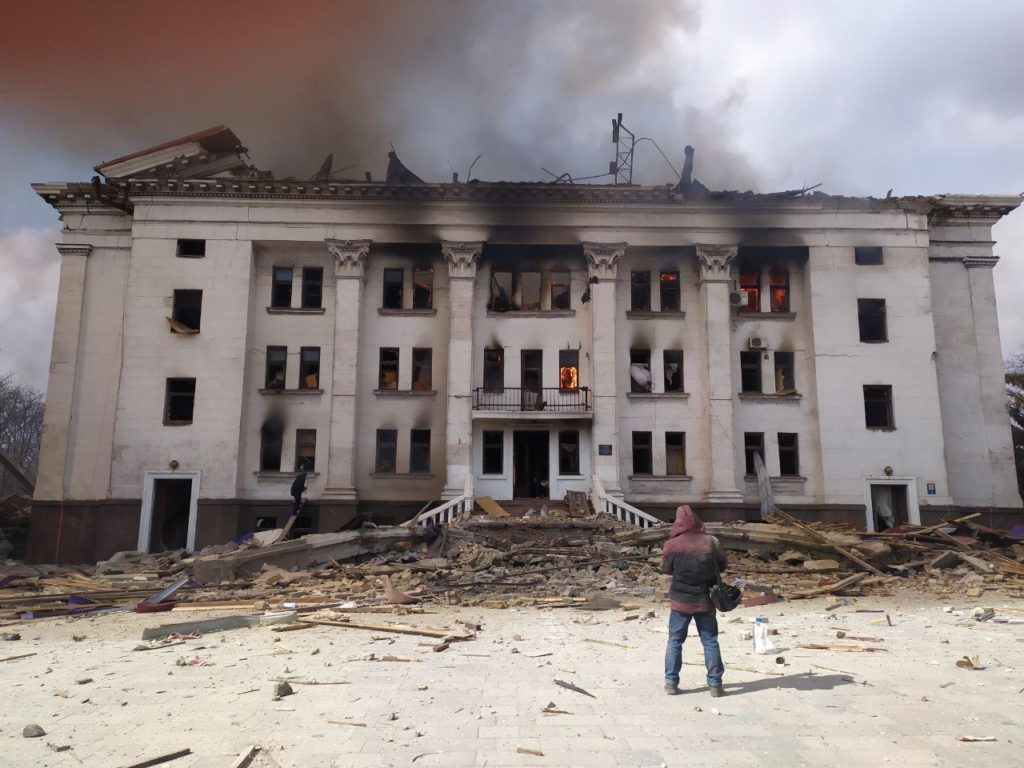
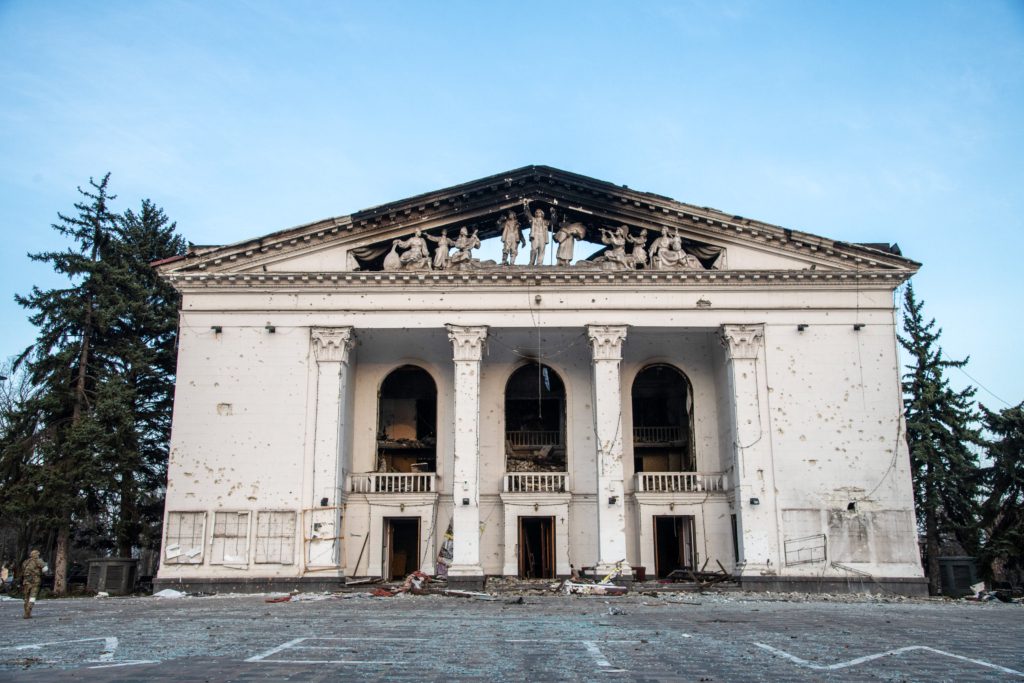
The heavily- damaged Mariupol Drama Theatre in Mariupol, with “children” written clearly on the ground.

The International Criminal Court, and all others with jurisdiction over crimes committed during this conflict, must investigate this attack as a war crime.

Agnès Callamard, Amnesty International’s Secretary General

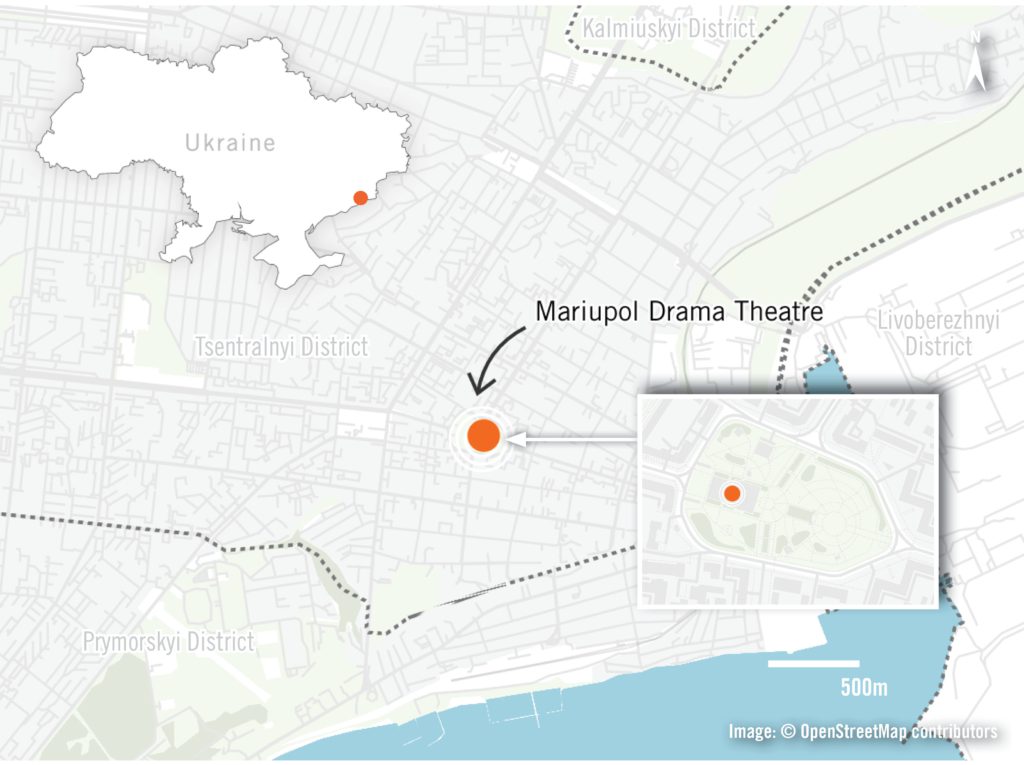
 A map showing the location of the Mariupol Drama Theatre in Mariupol along with a map of Ukraine depicting the location of Mariupol.
A map showing the location of the Drama Theatre in Mariupol, along with a map of Ukraine depicting the location of Mariupol.

‘I couldn’t believe my eyes’

Following the Russian invasion of Ukraine in late February 2022, civilians began fleeing their homes as cities and towns were targeted by military attacks. In besieged Mariupol in the Donetsk region, the theatre became a safe haven for civilians seeking shelter from fighting.

The theatre, in the city’s Tsentralnyi district, was a hub for the distribution of medicine, food and water, and a designated gathering point for people hoping to be evacuated via humanitarian corridors. The building was clearly recognizable as a civilian object, perhaps more so than any other location in the city.

Locals had also written the giant Cyrillic letters “Дети” – Russian for “children” – on forecourts on either side of the building, which would have been clearly visible to Russian pilots and also on satellite imagery.

Nevertheless, Russian bombs struck the theatre shortly after 10am on 16 March, producing a large explosion which caused the roof and huge portions of two main walls to collapse. At the time of the attack, hundreds of civilians were in and around the theatre.

Amnesty International believes that at least a dozen people were killed by the strike and likely many more, and that many others were seriously injured. This estimate is lower than previous counts, reflecting the fact that large numbers of people had left the theatre during the two days prior to the attack, and most of those who remained were in the theatre’s basement and other areas that were protected from the full brunt of the blast.

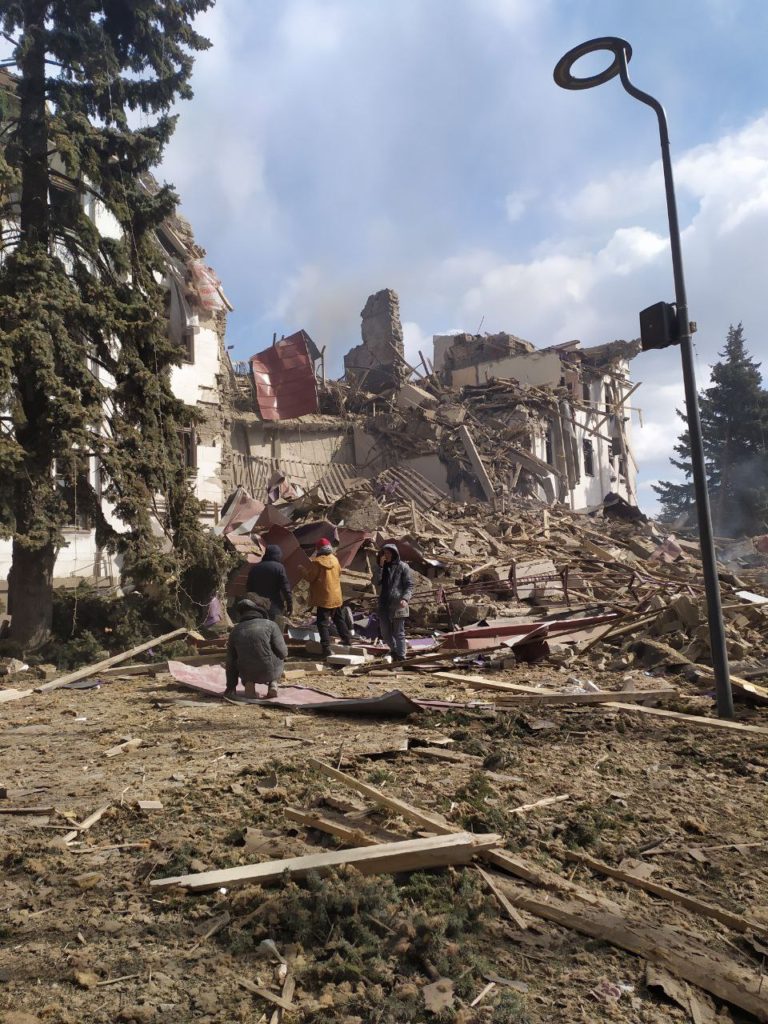
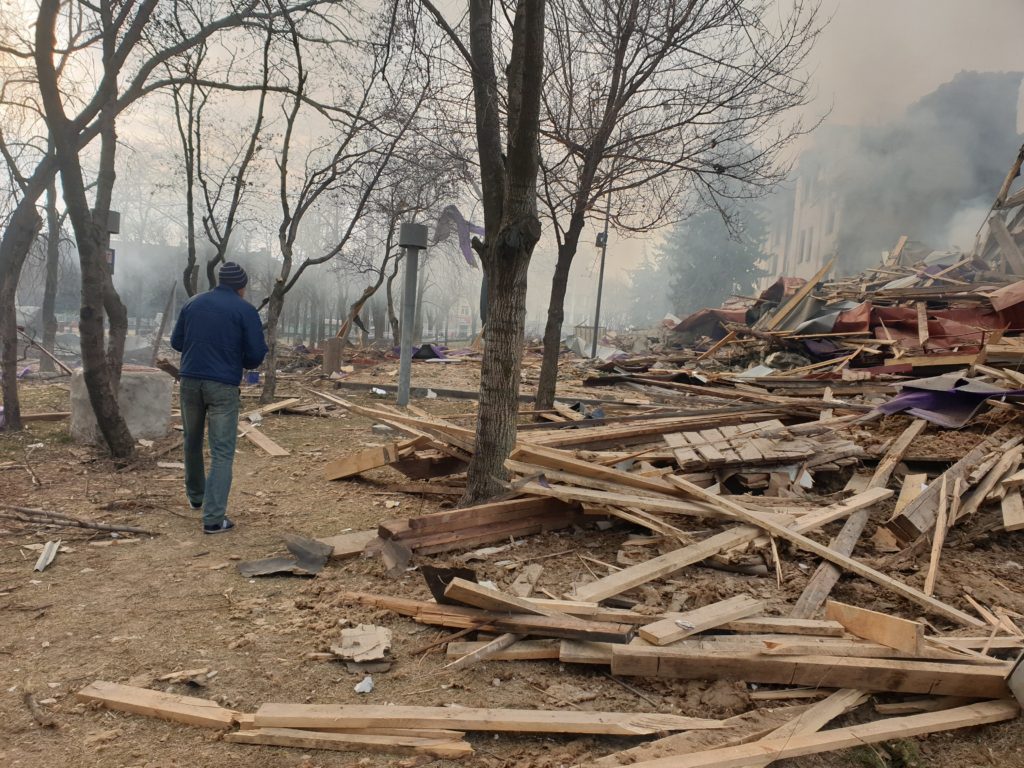
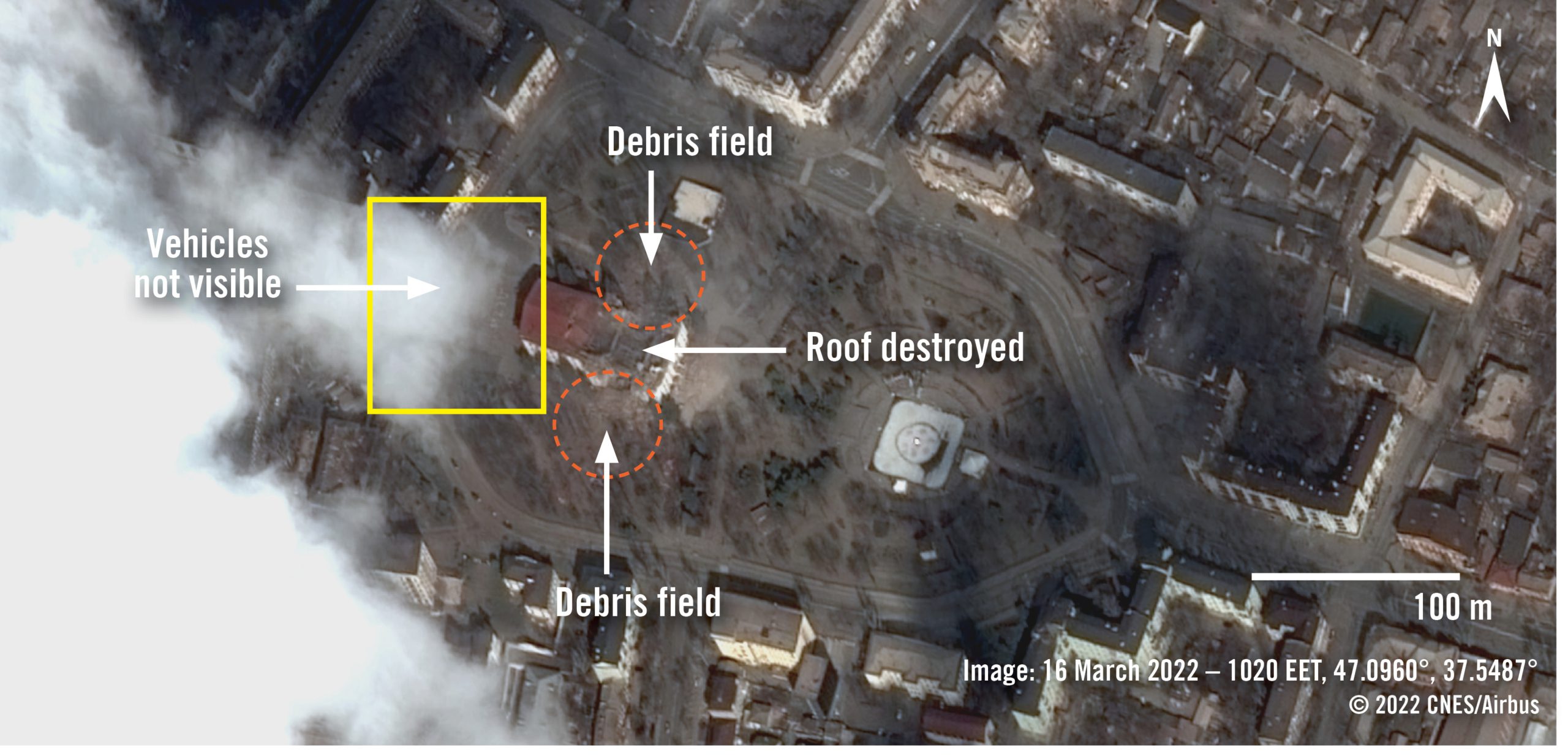
When the bombs detonated, they destroyed the adjacent interior walls along the sides of the performance space, and then breached the exterior load-bearing walls, creating two main debris fields on the north-eastern and south-western sides of the building. Both debris fields are visible on satellite imagery taken just minutes after the strike.

Ihor Moroz, a 50-year-old architect, was nearby when the theatre was hit. He told Amnesty International: “It all happened in front of our eyes. We were 200 or 300 metres away [when] the explosion happened… I could hear a plane and the sound of bombs dropping. Then we saw the roof [of the theatre] rise up.”

Grigoriy Golovniov, a 51-year-old entrepreneur, said: “I was walking down the street leading to the drama theatre… I could hear the noise of a plane… but at that time I didn’t really pay attention because [planes] were constantly flying around… I saw the roof of the building explode… It jumped 20 metres and then collapsed… then I saw a lot of smoke and rubble… I couldn’t believe my eyes because the theatre was a sanctuary. There were two big ‘children’ signs.”

Vitaliy Kontarov, a 48-year-old truck driver, was also close to the theatre at the time of the attack. He told Amnesty International: “We heard planes… I saw two missiles fire from one plane towards the theatre.”

Serhii Zabohonskyi, stands outside the rear of the theatre moments after the explosion.
The rear of the theatre showing significant damage, shortly after the explosion.

I couldn’t believe my eyes because the theatre was a sanctuary. There were two big ‘children’ signs.

Grigoriy Golovniov, a 51-year-old entrepreneur

‘In a second, everything changed’

In total, interviewees provided Amnesty International with the full names of four people who were killed: Mykhailo Hrebenetskyi, Lubov Svyrydova, Olena Kuznetsova, and Ihor Chystiakov. They also gave the forenames of three other people they believe were killed. Several survivors and other witnesses reported seeing dead bodies of people they could not identify, and it is likely that many fatalities remain unreported.

A woman in her late teens was sheltering in the basement with her boyfriend and her mother when the bombs struck. She told Amnesty International: “In a second, everything changed. Everything jumped up… People started screaming. It was full of dust. … I saw people bleeding. We grabbed our documents and left… Some people were not as lucky.”

Yevhen Hrebenetskyi found the body of his father Mykhailo inside the concert hall. Yevhen told Amnesty International: “There were many injured people… There were police trying to pull people out of the rubble… At first, I saw his [Mykhailo’s] arm. First, I saw a familiar hand. You know the hand of your loved ones. His face was covered with blood. His body was covered with bricks… I didn’t want my mom to see.”

Dmytro Symonenko was with Lubov Svyrydova moments before she died from her injuries. He told Amnesty International: “She was severely injured. She managed to crawl from the rubble… she asked us to remember her name, because she felt she was dying.”

Many other interviewees told Amnesty International they had seen bloodied bodies and dismembered body parts, including legs and hands, in the rubble of the devastated building following the strike.

A debris field covers the area where the field kitchen was located.
Debris pictured in the area outside the theatre where the field kitchen was located.

Deliberate targeting of civilians

International humanitarian law (IHL) is the body of law which principally governs armed conflict. A core principle of IHL is that parties to an armed conflict must at all times distinguish between civilians and civilian objects, and members of the military and military objects. Military objects can be targeted; it is unlawful to target civilians or civilian objects. Prior to any attack, members of the military are required to take steps to ensure that they are reasonably certain they are not targeting civilians and civilian objects.

None of the 28 survivors Amnesty International interviewed, nor any of the other witnesses around the theatre on the day of the attack, provided any information to indicate that the Ukrainian military was using the theatre as a base for operations, a place to store weapons, or a place from which to launch attacks.

The civilian character of the theatre and the presence of numerous civilians was evident in the weeks prior to the attack. The nature of the attack – the strike’s location inside the building, as well as the likely weapon used – and the absence of any potentially legitimate military objective nearby, strongly suggests that the theatre was the intended target. As a result, the attack likely constitutes a deliberate attack on a civilian object, and is a war crime.

“Through the air and on the ground, Russian forces have been on a well-documented and deliberate killing spree of civilians in Ukraine,” said Agnès Callamard.

“Thorough investigations are urgently needed in order to hold perpetrators accountable for the serious injury and loss of civilian life they caused, as well as for the extensive damage to civilian infrastructure.”

 A man walks by a debris field to the side of the theatre shortly after the attack.
A man walks by a debris field to the side of the theatre shortly after the attack.

Methodology

Between 16 March and 21 June, Amnesty International gathered and analysed available credible evidence related to the attack on the theatre. This included 53 first-hand testimonies from survivors and witnesses of the attack and its aftermath, 28 of whom were inside or adjacent to the theatre at the time. Amnesty International also analysed satellite imagery and radar data from immediately before and shortly after the attack; authenticated photographic and video material provided by survivors and witnesses; and two sets of architectural plans of the theatre.

This was supported by an open-source investigation by Amnesty International’s Crisis Evidence Lab, who examined and verified 46 photos and videos of the strike that were shared on social media, as well as an additional 143 photos and videos that were privately shared with researchers.

Amnesty International’s ongoing documentation of violations of human rights and international humanitarian law committed during the war in Ukraine is available here.

 Satellite image from 16 March shows the theatre after the strike.
Satellite image from 16 March shows the damage caused to the theatre shortly after the strike.

STOP THE AGGRESSION AND PROTECT CIVILIANS IN UKRAINE

Right now, people in Ukraine are facing a catastrophic human rights crisis. People are dying, including children, and many thousands of lives are at risk. Take action to demand that the Russian authorities stop this act of aggression and protect civilians now.

The post Ukraine: Deadly Mariupol theatre strike ‘a clear war crime’ by Russian forces – new investigation appeared first on Amnesty International.
Senegal: Prohibitions, violence, arbitrary arrests: the right to protest is under threat

Repeated bans on demonstrations, together with the deaths of people during such protests, represent a real threat to the right to protest in Senegal, Amnesty International has said. Amnesty International is calling on the Senegalese authorities to guarantee the right to peaceful assembly, conduct independent and impartial investigations into the deaths of previous demonstrators, and prohibit the excessive use of force by the security and defence forces.

The last planned demonstration organized on 17 June at the initiative of the opposition coalition, Yewwi Askan Wi (YAW), was banned by order of the Dakar Prefect, citing a risk of disturbing public order. Yet nine days previously, a demonstration by this same coalition had been held peacefully.

The Senegalese authorities must guarantee the right to peaceful assembly, as enshrined in the Senegalese constitution and in international law and, in particular, repeal the Ministerial Order No. 7580 of 20 July 2011 prohibiting “political demonstrations” in central Dakar, in accordance with the ruling of the ECOWAS Court of Justice on 31 March 2022.

During the 17 June protests, violence broke out in Dakar – when demonstrators tried to accede to the Place de la Nation, which was barricaded by security forces – and in Bignona and Ziguinchor. Three people lost their lives.

We are calling on the judicial authorities to launch an investigation into the incidents of 17 June without delay, and to conduct it independently and impartially. If there is evidence of unlawful violence and killings by members of the security forces, those individuals must be brought to justice and tried, 

Seydi Gassama, Executive Director of Amnesty Senegal

More deaths

Idrissa Goudiaby, 43, died in the context of the protests in Ziguinchor in the south of the country. The autopsy certificate establishing how he died has not yet been issued to his family, nor his body returned, 10 days after the event.

Amnesty International spoke to several of Idrissa Goudiaby’s brothers as well as his father about the circumstances of his death. According to his brother, Mamadou Goudiaby, “Idrissa was not at the demonstration but had gone out to return the children home. He is a taxi driver and, when there is a protest in Ziguinchor, he stops working at noon and does not work during the afternoon. The children were scattered around the neighbourhood, and he was trying to get them all back in.”

Reporting the testimonies of those who took his brother’s body to the hospital, he says: “The bullet hit him in the neck, and he fell near Nema Pharmacy in the Grand-Dakar neighbourhood. It was the people of that area who took him to the hospital because he was losing blood and the emergency services were taking a long time.”

Albert “Abdoulaye” Diatta died during the demonstration in Bignona. His family, who also state that he was fatally wounded by gunfire, are still not in possession of the body, which was taken to the regional hospital in Ziguinchor for an autopsy. 

Another individual, still unidentified, died in the Bopp neighbourhood of Dakar, near the Massalikoul Jinane mosque, during the 17 June protests. While demonstrators interviewed by the media note that the individual died as a result of the police firing tear gas canisters, which are believed to have caught mattresses and started a fire, a public statement issued by the police on 18 June states that the deceased inadvertently caused the accident while preparing to burn a tyre.

Amnesty International notes that the use of force by the security forces during demonstrations must be necessary and proportional to the legitimate aim of maintaining law and order, and that the use of firearms is unlawful except in cases of imminent threat of death or serious injury to self or others. 

Arbitrary arrests

A number of people were also arrested during the 17 June demonstration in Dakar, including well-known figures and leaders of the YAW coalition together with dozens of demonstrators. Such was the case of Mame Diarra Fam and Dethié Fall, both Members of Parliament, and Ahmed Aidara, Mayor of Guédiawaye [city]. This latter was tried on 27 June and given a one-month suspended prison sentence plus a fine of FCFA 50,000 for “participating in an unarmed gathering”. Dethié Fall was arrested outside his party’s headquarters on the VDN major road, in Dakar, while Mame Diarra Fam was arrested outside the house of the Mayor of Dakar, Barthélémy Dias. Dethié Fall received a six-month suspended sentence for participating in an unauthorized demonstration, while Mame Diarra Fam and 82 other defendants were acquitted of the same charges. These people were arbitrarily arrested for participating or calling for participation in these demonstrations.

On 18 June, Guy-Marius Sagna, a parliamentary candidate for Ziguinchor department, was also arbitrarily arrested for “participating in an unauthorized demonstration” while visiting 33 demonstrators being detained at the Ziguinchor gendarmerie. A decision is due to be made in their case on 28 June 2022 in Ziguinchor. These individuals should not be detained or prosecuted simply for exercising their right to peaceful assembly and Amnesty International is calling for their immediate and unconditional release and for the charges against them to be dropped.

Abusive administrative decisions, such as blanket bans on demonstrations that are not time-bound or justified by a legitimate purpose, undermine the enjoyment of freedom of peaceful assembly, 

Samira Daoud, Amnesty International's Regional Director for West and Central Africa.

Further information

The protests were planned on 17 June in Dakar and elsewhere in the country, at the initiative of the opposition parties, to denounce the Constitutional Council’s decision to reject the national opposition’s list for the upcoming legislative elections.

Last year, on 3 March 2021, spontaneous demonstrations broke out in several towns around Senegal following the arrest of political opponent, Ousmane Sonko, while on his way to a court summons in connection with a rape complaint. Fourteen people were killed during the five days of protests and nearly 600 more were injured, according to the Senegalese Red Cross. 

As part of its campaign “Justice for the victims of the violent repression of demonstrations in Senegal”, Amnesty is calling for the opening of independent and rapid investigations and, if necessary, the prosecution of members of the security forces accused of using excessive force.

The post Senegal: Prohibitions, violence, arbitrary arrests: the right to protest is under threat appeared first on Amnesty International.