
Die Taliban müssen dieses grausame Muster der gezielten Tötungen sofort beenden.
Afghanistan: Taliban torture and execute Hazaras in targeted attack – new investigation
- Six people killed during a night raid on a family home in Ghor province, including a 12-year-old girl
- Ongoing Taliban killings indicate a pattern of attacks on ethnic minorities and members of the former security forces
Taliban fighters killed six Hazara people in a deliberate attack on the ethnic minority group in Afghanistan’s Ghor province, Amnesty International said today following a new investigation.
On 26 June 2022, the Taliban detained and unlawfully executed four men during a night raid operation in search of a former security official. The body of at least one of those executed showed signs of torture. A woman and a 12-year-old girl were also killed during the raid.
The attack is part of a wider pattern of unlawful targeted killings of people whom the Taliban perceives as adversaries, in this case being both members of the Hazara community and those who were associated with the former Afghan government.
These violent deaths are further shocking proof that the Taliban continue to persecute, torture and extrajudicially execute Hazara people.
Agnès Callamard, Amnesty International’s Secretary General
“The Taliban must immediately end this cruel pattern of targeted killings and, as the de facto authorities, ensure the protection of all Afghans,” said Agnès Callamard, Amnesty International’s Secretary General.
“The Taliban must investigate these killings and ensure that those responsible are prosecuted in accordance with international human rights obligations and standards. If the de facto authorities cannot provide justice, the Prosecutor of the International Criminal Court should immediately open full investigations into all cases of extrajudicial executions. In addition, along with the UN Special Rapporteur on the situation in Afghanistan, Amnesty International calls for an independent accountability mechanism in and for Afghanistan.”
Amnesty International documented similar extrajudicial executions of Hazara people in Ghazni province in July 2021, and Daykundi province in August 2021. Despite publicly promising not to target former government officials, the Taliban have still not investigated or prosecuted anyone for the killings.
Amnesty International conducted eight remote interviews, including with witnesses to the June 2022 attack, analyzed 38 photos and three videos that were taken in the aftermath of the attack, consulted a forensic pathologist to review the images of the bodies, and reviewed satellite imagery of the area to confirm the location of one of the killings. Several of the photos analyzed were published online by Taliban media, including the Ghor Province Governor Media Office, which deleted the post soon after publication.
Family members killed
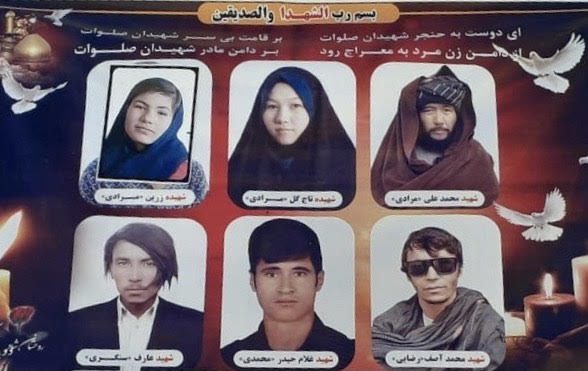
On the night of 26 June 2022, Taliban forces raided the home of Mohamad Muradi, a Hazara man and security official under the former government who had also previously led a People’s Uprising Program force – a local militia – against the Taliban in 2020 and 2021.
Muradi had recently returned to his home in Chahar Asyab, in the Lal wa Sarjangal district in Ghor province, after failing in an attempt to flee to Iran, and then hiding in other cities around the country. Like many who had been involved in Taliban opposition, Muradi had not taken up the offer of a personalized ‘amnesty letter’ – often issued to former security and government officials, offering permission to return home in exchange for a promise to lay down arms – due to the fear of reprisal attacks by the Taliban.
Witnesses told Amnesty International that, on the night of the attack, Taliban forces fired rifles and rocket-propelled grenades at Muradi’s home, killing Taj Gul Muradi, his 22-year-old daughter, who had studied medicine and had been providing health care in the community. The attack wounded Muradi and two of Muradi’s other children, a son and his 12-year-old daughter. The girl suffered severe stomach injuries and died the next day.
Muradi’s left leg was injured, and he surrendered to Taliban forces through the intervention of local elders. However, the Taliban then dragged him outside of the house and shot him dead. An analysis of photos of Muradi’s body shows damage to the front of his shirt, indicating a likely chest wound, and an exit wound in his forehead.
Amnesty International reviewed photos and videos that show damage to Muradi’s home consistent with witness testimony. The images were also geolocated by analyzing visible features – including vegetation, nearby pavements and the buildings’ layout – and satellite imagery.
Tortured and extrajudicially executed
Three other men who had been staying at Muradi’s home were detained and then extrajudicially executed. Two of them, like Muradi, had previously been members of the People’s Uprising Program force, though none had taken part in fighting with the militia for some time.
Ghulam Haider Mohammadi, Muradi’s nephew, had been visiting relatives. Photos of Mohammadi’s body indicate that he was executed with at least one gunshot to head, while kneeling and with his hands bound behind him. Locals found his body approximately 50 meters from Muradi’s home, left between some rocks in a tree-covered area.
Witnesses told Amnesty International that the other two victims – named Asif Rezayee and Arif Sangaree – were put in a vehicle and driven away to be killed in a separate location. The bodies of the two men were later discovered in an uninhabited part of Takeghal, more than 30 minutes’ drive from where they were initially detained.
Asif Rezayee had been living in Kabul but had returned to his home village a few days prior to visit family members. Rezayee was executed by gunfire while his hands were cuffed behind his back. Photos and a video of his body show four distinct gunshot wounds, to the head, chest, right thigh, and left hand. Based upon the nature of the wounds, apparent bullet trajectory, and gun powder stains, the wounds to the leg and hand were done at close range prior to execution. Such intentional infliction of pain on a bound detainee constitutes torture, a crime under international law.
Photos indicate that Arif Sangaree was also executed while bound and detained, with at least one close range shot to the head. One of the photos posted by the Taliban to Facebook, claiming credit for the successful operation, shows Sangaree with a significant facial wound surrounded by fresh bright red arterial blood, indicating the Taliban took the photo immediately after his death. In contrast, photos provided by people who discovered the body show Sangaree with the identical wound, but the blood dark and dried, meaning time had passed.
The Taliban news sources that posted the image of Arif Sangeree’s body described the night raid as a “targeted operation” that culminated in a fight between “rebels” and “Mujahideen”, or the Taliban. The account claimed seven rebels had been killed, detained and wounded, and that one Taliban member was killed, with two others wounded.
To justify the deaths, the statement went on to say that the raid had occurred after fighters associated with Mawlavi Mahadi, the Hazara leader of a Taliban defector group, had attacked the Taliban in Balkhab district of Sar-e-Pul province, and then fled and established themselves in the village of Chahar Asyab. This Taliban statement is incorrect. While this fighting has been documented by the UN Special Rapporteur on the situation in Afghanistan in his 6 September 2022 report, which includes cases of Taliban executions of fighters hors de combat, Muradi and his family members were not members of Mahadi’s group or taking part in this round of attacks. Rather, Amnesty International believes the Taliban justification is a pretext for targeting ethnic minorities and soldiers associated with the former government.
Background
The Taliban seized power in Afghanistan following the collapse of the government in mid-August 2021. Amnesty International has called for the protection of thousands of Afghans at serious risk of Taliban reprisals. There have been numerous cases of raids and extrajudicial executions targeting those the Taliban perceives as adversaries – those affiliated with the former government particularly Hazaras/Shias or those fighting with the National Resistance Front (NRF).
Read previous investigations by Amnesty International into unlawful killings by Taliban:
The post Afghanistan: Taliban torture and execute Hazaras in targeted attack – new investigation appeared first on Amnesty International.
UNGA: A chance to restore trust in a besieged international system
Amnesty International’s Secretary General Agnès Callamard will be attending the 77th Session of the UN General Assembly (UNGA) in New York between 19 and 23 September. Ahead of her visit, Agnès Callamard said:
“Armed conflict, food shortages, deepening inequalities and the mounting climate emergency are testing the effectiveness of the international community like never before. Everywhere we turn today lies evidence of failings of the past: civilians from Ukraine to Ethiopia dying in their thousands while the perpetrators of war crimes walk free, huge swathes of Pakistan underwater, and millions of people worldwide on the brink of famine.
Armed conflict, food shortages, deepening inequalities and the mounting climate emergency are testing the effectiveness of the international community like never before.
Agnès Callamard
“Instead of alleviating the suffering caused by conflicts, members of the UN Security Council have allowed rampant abuse of the veto power to exacerbate it. This tragic betrayal of the Security Council’s mandate is but one example of the UN’s failures to rise above politics and national self-interest. This week we need bold, coordinated action from UN member states, who must show global leadership and live up to the principles on which the UN is founded. Global problems of the scale we are now confronting can only be addressed through global solutions.”
During her time in New York, Agnès Callamard will call on UN member states to seek pathways to accountability for violations including:
- Violations of international humanitarian law and war crimes committed by Russian forces in Ukraine;
- Crimes against humanity, ethnic cleansing and war crimes committed by Amhara regional security forces and civilian authorities in Ethiopia’s Western Tigray Zone;
- The ongoing campaign of atrocities unleashed by the Myanmar military in Rakhine state, and the military’s brutal crackdown on opposition to the 2021 coup.
She will also call on member states to:
- Resist efforts to stifle attempts to hold Israeli authorities accountable for the apartheid regime they have inflicted on Palestinians;
- Address the dire humanitarian situations in Yemen, Myanmar and Syria;
- Take coordinated action to assist countries most impacted by the mounting effects of the climate emergency;
- Address structural inequality through rights-based, inclusive and fair policies and actions, including strengthening cooperation on global tax reform, and providing urgent and sustainable debt relief for the lowest-income countries.
Earlier this month, Volker Türk was appointed as the new UN High Commissioner for Human Rights. Ahead of UNGA 77, Amnesty International reiterated its call on High Commissioner Türk to fulfil his mandate by being a vocal champion of human rights, with the courage and principles to stand up to powerful states and withstand political pressure. He must also support civil society’s role in informing and shaping human rights positions and responses by the international community.
The 77th session of the UN General Assembly (UNGA 77) opened on Tuesday, 13 September 2022. The first day of the high-level General Debate will be Tuesday, 20 September 2022.
The post UNGA: A chance to restore trust in a besieged international system appeared first on Amnesty International.
Zimbabwe: Authorities launch crackdown against students protesting high fees
Authorities must drop sinister charges against University of Zimbabwe students who have been peacefully protesting high fees and affirm their right to freedom of assembly and expression, Amnesty International said today.
“It is such a travesty of justice that these students are having to spend time in detention and courtrooms for simply asking for affordable education
Lucia Masuka, Executive Director of Amnesty International Zimbabwe
Police arrested 14 students at the University of Zimbabwe on 12 September 2022 after they embarked on peaceful #FeesMustFall demonstrations against high tuition fee hikes by the university. While five more students were arrested on 14 September, and taken to Avondale police station and face charges of “disorderly conduct”, some of those who were arrested on 12 September appeared in court on yesterday.
“It is such a travesty of justice that these students are having to spend time in detention and courtrooms for simply asking for affordable education so that they can remain in lecture rooms. The arrests of these students, who were protesting peacefully, are a violation of their right to protest. Authorities must respect students’ right to peaceful protest and drop all charges against them,” said Lucia Masuka, Executive Director of Amnesty International Zimbabwe.
“We consider the arrests to be arbitrary and call on the Zimbabwe Republic Police to respect the freedom to petition and demonstrate as guaranteed by the constitution.”
The university recently announced a staggering increase in tuition fees of up to 1000% requiring undergraduate students to pay up to ZWD500 000 from around ZWD50 000 depending on their faculty, which is equivalent to about $900USD at the interbank rate of 12 September. Students have described the increase in fees as unaffordable and beyond the reach of their parents and guardians and vowed to boycott lectures until the university reverses its decision.
Authorities must respect students’ right to peaceful protest and drop all charges against them
Lucia Masuka
12 of the 14 students were released late on Tuesday 13 September after paying fines of ZWD2000 or $3.31USD each at the interbank rate of 14 September. The remaining appeared in court on 14 September and were released on free bail and are set to return to court on 29 September. The students are represented by Zimbabwe Lawyers for Human Rights (ZLHR).
Background
The 14 students who were arrested on 12 September were detained at Avondale police station and charged with disorderly conduct. They were identified as Thelma Nzero, Mufaro Vhutuza, Owen Mashaya, Tinashe Zana, Tinotenda Mwenje, Fletcher Katehwe, Havana Mtetwa, Natasha Dhliwayo, Ropafadzo Mutangadura, Fatima Ajida, Tsungai Chitodha, Beyond Wendy Siwela, David Musasa, and Godknows Zabhura.
The five other students who were arrested on 14 September have been identified as Tivimba Musengi, Tinotenda Mangana, Hazel Gwande, Tanyaradzwa Nzvimbo, and Charles Moyo.
#FeesMustFall protests broke out at the University of Zimbabwe on Monday 12 September 2022 as students demonstrated against the university tuition fee hikes. The university increased fees for both undergraduate and postgraduate study by up to a staggering 1000%. Under the new fee structure, undergraduate students are required to pay up to ZWD500 000 from around ZWD50 000 depending on their faculty, which is equivalent to about $900USD at the interbank rate of 12 September. While students pursuing a Master’s degree will have to fork out up to ZWD1 million or $1800USD.
The university has also increased accommodation fees from ZWD71,000 to $616USD or the equivalent in local currency for the August to December semester.
The hike in fees risks forcing many students to abandon their studies thus potentially violating their right to education.
The post Zimbabwe: Authorities launch crackdown against students protesting high fees appeared first on Amnesty International.