Brazil: Police massacre in Rio de Janeiro is evidence yet again of systemic and racist violence    

Amnesty International urges a prompt, independent, impartial and internationally supervised investigation into the deadliest police operation in the state’s history.

Amnesty International strongly condemns the massacre that occurred during “Operation Containment” carried out on 28 October in the Alemão and Penha favelas in Rio de Janeiro – the deadliest in the state’s history – which left at least 121 people dead, including four police officers, and multiple reports of extrajudicial executions by civilian and military police.

“What took place in Rio de Janeiro was not a security operation, it was a massacre. Over a hundred people, most of them black and living in poverty, were killed in an operation planned and carried out by the state itself. The authorities must urgently conduct a prompt, independent and impartial investigation, and request international oversight to ensure its effectiveness,” said Ana Piquer, Americas director at Amnesty International. “The government of Cláudio Castro in Rio de Janeiro has turned its security policy into a policy of death. This must cease immediately,” she added.

What took place in Rio de Janeiro was not a security operation, it was a massacre. Over a hundred people, most of them black and living in poverty, were killed in an operation planned and carried out by the state itself.  

Ana Piquer, Americas director at Amnesty International. 

Extrajudicial killings and systematic repression

According to local organizations and statements from residents, the operation, in which more than 2,500  civil and military police officers were involved, allegedly saw shots being fired from helicopters, raids being carried out without a warrant, and assistance to injured persons being prevented. Testimonies and local reports claim that several bodies were found with signs of possible extrajudicial execution, including shots from behind or to the back of the head and bound hands. Under international human rights law, lethal force may be used only when strictly necessary to protect life or prevent serious injury in the face of an imminent threat. 

However, public statements made by the governor of Rio de Janeiro have attempted to legitimize the illegal use of police force, claiming that “only police officers were victims” and that the state can “exceed its powers” in the so-called “war on crime”. This rhetoric seeks to legitimize a lethal and failed policy to guarantee impunity for human rights violations committed by the security forces, thereby perpetuating them. 

“People in the favelas live under a constant state of alert and threat. Police operations in Brazil have become synonymous with terror, racism and a total lack of protection,” said Jurema Werneck, executive director at Amnesty International Brazil. “There is no possible justification for this lethal use of force. The security forces must protect lives, not destroy them.”

People in the favelas live under a constant state of alert and threat. Police operations in Brazil have become synonymous with terror, racism and a total lack of protection.

Jurema Werneck, executive director at Amnesty International Brazil.

Structural racism and impunity

The pattern of police violence in Rio de Janeiro reflects the racism embedded in Brazil’s drugs and public security policies. The government of Cláudio Castro has been responsible for four of the five deadliest operations in the state’s history, including those in Jacarezinho in 2021 and Vila Cruzeiro in 2022.

Despite repeated warnings from the United Nations (UN) and the Inter-American Commission on Human Rights (IACHR) regarding the discriminatory nature of the so-called “war on drugs”, the Brazilian state continues to systematically carry out police operations that clearly violate international standards on the use of force.

Amnesty International warns that the Rio de Janeiro authorities have sought to criminalize relatives and neighbours who, in the absence of the state, recovered the bodies of the victims to guarantee their identification and dignified burial.

The criminalization of relatives, neighbours and human rights defenders constitutes an institutional practice that reflects structural police violence in Brazil, characterized by racism and impunity. Given this situation, the authorities have a duty to promptly and effectively investigate, prosecute and provide redress for the extrajudicial executions and other human rights violations that occurred during Operation Containment. They must also provide ongoing support and assistance to the victims’ families, allowing them to participate in the investigation in a formal and meaningful manner, pursuant to international protocols such as the Minnesota Protocol.

The authorities must also facilitate the creation of a verification commission of international experts to oversee investigations and inquiries into the human rights violations that occurred during this police operation.

“Silence and impunity are complicit in violence. Until such a time as the state assumes its responsibility and guarantees the right to truth, justice and reparation, this cycle of abuse will continue, disproportionately affecting black, mixed-raced and marginalized communities in Brazil,” said Ana Piquer. 

Silence and impunity are complicit in violence. Until such a time as the state assumes its responsibility and guarantees the right to truth, justice and reparation, this cycle of abuse will continue, disproportionately affecting black, mixed-raced and marginalized communities in Brazil.

Ana Piquer, Americas director at Amnesty International. 

For further information or to arrange an interview, please contact press@amnesty.org 

The post Brazil: Police massacre in Rio de Janeiro is evidence yet again of systemic and racist violence     appeared first on Amnesty International.

South Africa: Government is failing millions of people trapped in informal settlements and impacted by the climate crisis – new report

The government is putting the well-being and in many cases the lives of the more than five million people living in South Africa’s informal settlements at risk by failing to provide them with access to quality housing and essential services, Amnesty International South Africa said in a new report. 

These people, many of them living on flood-prone land, are routinely left to cope on their own especially during severe weather conditions, despite the fact that the main responsibility for preparing for and responding to these disasters lies with the government.

Informal settlements in South Africa along with other underserved areas like temporary relocation areas, are a sore reminder of the racial injustice and disenfranchisement that were hallmarks of the colonial and apartheid regimes preceding 1994. However, this does not mean that we must ignore the fact that the ongoing housing crisis and the failure of successive governments to guarantee the right to access to adequate housing among other human rights

Amnesty International South Africa, Executive Director, Shenilla Mohamed

Amnesty International South Africa’s report Flooded and Forgotten: Informal Settlements and the Right to Housing in South Africa examines the incidence and impact of floods, both large scale and seasonal caused by heavy rain, on residents of informal settlements and underserved areas in South Africa, particularly in Johannesburg, eThekwini, and Cape Town.

“Informal settlements in South Africa along with other underserved areas like temporary relocation areas, are a sore reminder of the racial injustice and disenfranchisement that were hallmarks of the colonial and apartheid regimes preceding 1994. However, this does not mean that we must ignore the fact that the ongoing housing crisis and the failure of successive governments to guarantee the right to access to adequate housing among other human rights,” Amnesty International South Africa Executive Director Shenilla Mohamed said. 

“The government is failing the millions of people trapped in these underserved areas, especially in a time when economic hardships and poverty are rife. People live in informal settlements because there is a lack of affordable and accessible formal housing and sometimes because they are the only affordable means of living close to work or work opportunities. Article 10 of South Africa’s Constitution, which is part of the Bill of Rights is clear that everyone has inherent dignity and the right to have their dignity respected and protected, no matter who they are.”

More government action urgently needed to deal with increased risk of flooding

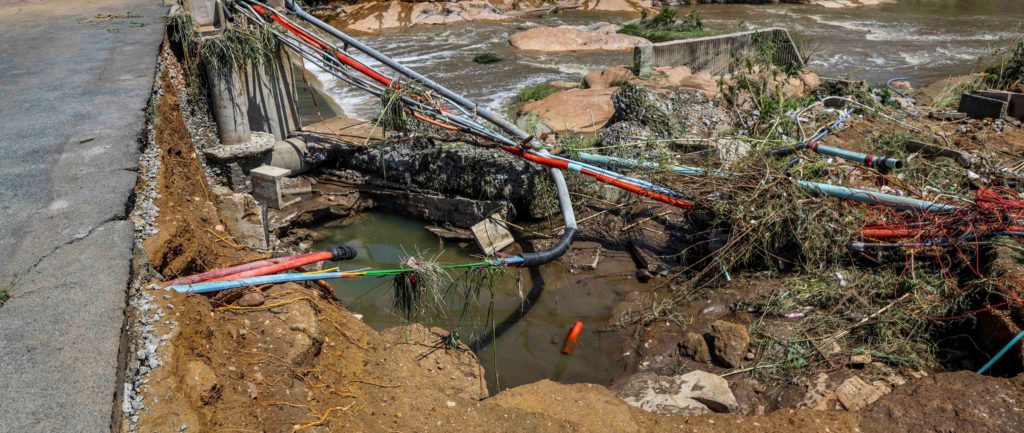
The recent floods in June 2025 in the Eastern Cape province, which caused the death of over 100 people and washed away the homes of thousands of people, was a stark reminder that urgent and long-term action by the government is needed. While South Africa’s Disaster Management Act and National Disaster Management Framework aim to reduce the risk of disaster, there is ample evidence that not enough is being done towards this end. 

Based on the experiences of people living in informal settlements documented in Amnesty International’s report, interviews with experts and practitioners in the field and a review of reports, laws and policies, evidence shows that South Africa’s response to flooding disasters – whether major or seasonal– is patchy and piecemeal, with not enough done to prepare for such events. 

For example, people displaced by KwaZulu-Natal floods in 2022 are still in temporary emergency accommodation in poor conditions nearly three years later, indicating a lack of preparedness for recovery efforts. Some of those displaced died after they were relocated to an area that was severely flooded in 2025, highlighting a serious failure to ensure that flood victims are relocated to safety. In the case of seasonal flooding, the support and assistance that many residents of informal settlements experience is alarmingly poor or absent. 

Although the KwaZulu-Natal Department of Human Settlements, in their response to Amnesty International, dated 30 October 2025, asserted that “informal settlements are not planned settlements and inherently their establishment would not be preceded by the availability of basic services”, South Africa remains bound by constitutional and international obligations to provide essential services to all residents, including those living in informal settlements. 

“The reality, as documented in Amnesty International’s report, is that millions of South Africans living in informal settlements are deprived of these rights due to central government neglect, under-resourced municipalities, and poor urban governance, not simply because their settlements are unplanned,” Shenilla Mohamed said.

“The lack of access to adequate, well-located affordable housing in South Africa has also led to the growth of informal settlements in floodplains and low-lying areas which means that people living there are increasingly impacted by flooding.”

The climate crisis is making the situation far worse

Human-induced climate change has also exacerbated the risks of flooding, already a seasonal problem in South Africa’s informal settlements and underserved areas. As elsewhere in the world, this means that people who have contributed the least to climate change due to their low consumption patterns and are least able to cope with flooding are the worst affected by the impacts of climate change. 

We have no help from anyone, we have to stay and fix it, we can’t run away… where will we go?

Victim from Freedom Park

One of the main concerns expressed to Amnesty International in all three metropolitan areas was that the regular seasonal flooding of informal settlements and underserved areas was rarely seen as warranting a disaster response by the municipalities. The residents were simply left to fend for themselves and rely on charitable organisations. 

A woman from Freedom Park in Johannesburg said: “We have no help from anyone, we have to stay and fix it, we can’t run away… where will we go?”

South Africa must meet its human rights obligations

South Africa has a plethora of laws and policies on issues around access to housing, provision of essential services such as  water and sanitation, upgrading of informal settlements, a healthy environment, and preparing for and responding to disasters. It is also a state party to all the major international and regional human rights instruments including the UN International Covenant on Economic, Social and Cultural Rights which guarantees the rights to access adequate housing, water and sanitation. 

“Despite South Africa having strong legislation and policy and clear international commitments as with so many other things in this country, implementation remains the issue. The reality points to obvious failures of the government to adequately and thoroughly realise these obligations and this comes at a huge cost to the human rights, lives and livelihoods of millions of people,” Shenilla Mohamed said. 

The South African government must provide access to adequate housing for people living in the country and commit to upgrading informal settlements with access to essential services in a manner that complies with human rights law and standards, including through budgetary and policy commitments.

It must also mobilise all the necessary human, financial and technical resources to ensure that disaster risk reduction is fully integrated into urban planning processes and these are implemented with a view to protecting residents of informal settlements from disasters, climate change related or otherwise, and protecting their human rights.

Background

This report documents the experiences of people living in informal settlements and other underserved areas in South Africa. It is based on qualitative research carried out between February and September 2025. These experiences are presented within the framework of key laws, policies and practices related to access to adequate housing, access to essential services, and disaster preparedness and response.

The post South Africa: Government is failing millions of people trapped in informal settlements and impacted by the climate crisis – new report appeared first on Amnesty International.