On 3/6/2026 9:08:19 PM, an earthquake occurred in United States potentially affecting Few people affected in MMI III. The earthquake had Magnitude 5.7M, Depth:9.339km.
Lebanon: Israeli military’s overly broad mass evacuation orders sowing panic and fuelling humanitarian suffering
Responding to Israel’s use of repeated, overly broad evacuation orders across Lebanon over the past four days, including to more than 100 villages and towns in the country’s south and east, as well as the entirety of Beirut’s southern suburbs, displacing hundreds of thousands of people, Kristine Beckerle, Deputy Regional Director for the Middle East and North Africa at Amnesty International said today:
“Civilians in Lebanon are once again being ordered to flee en masse by a military that has repeatedly shown its willingness to inflict significant civilian harm through unlawful attacks in previous rounds of fighting. The sweeping evacuation orders have sown panic and terror, displaced hundreds of thousands of people and fuelled yet another humanitarian catastrophe for a population already exhausted and reeling from multiple crises.
“The overly broad warnings covering vast areas of Lebanon do not constitute effective guarantees of protection. They provide no meaningful information about where or when the Israeli military might strike and offer civilians nowhere near the level of guidance needed to make informed decisions about whether, or for how long, to flee. Many civilians, including older people, children, people with disabilities, cannot evacuate, or may have nowhere safe to go.
The sweeping evacuation orders have sown panic and terror, displaced hundreds of thousands of people and fuelled yet another humanitarian catastrophe for a population already exhausted and reeling from multiple crises.
Kristine Beckerle, MENA Deputy Director
“Issuing mass evacuation orders does not grant the Israeli military the right to treat these areas as open-fire zones, nor does it absolve Israel of its obligations under international humanitarian law to protect civilians and to take all feasible precautions to minimize harm to civilians, wherever they are. In the 24 hours since the mass evacuation order for Beirut’s southern suburbs, for example, the Israeli military has carried out repeated air strikes, many without warnings.
“The repeated use of overly broad warnings, paired with the Israeli military’s extensive destruction of civilian property in more than two dozen municipalities along Lebanon’s border both before and after a ceasefire was in place, raises serious concerns that some of these mass evacuation orders are intended to forcibly displace civilians, which is prohibited by international humanitarian law.
“The absolute impunity that Israel has enjoyed after previous rounds of fighting has paved the way for these same violations of international law to recur, once again placing civilians at grave risk. We urge parties to the conflict to uphold their obligations under international humanitarian law, to protect civilians and to refrain from unlawful attacks.”
Background
Less than 100 hours after fighting escalated in Lebanon, according to the Norwegian Refugee Council, more than 300,000 people had been displaced across the country. As of 6 March, Lebanon’s Public Health Emergency Operations Centre, affiliated with the Ministry of Public Health, announced that 217 people had been killed and 798 injured since fighting escalated on 2 March, and that more than 110,000 of those displaced were in collective shelters.
Between 3-6 March the Israeli military issued a series of evacuation orders instructing residents of entire towns and villages in south Lebanon and areas of the Bekaa Valley to evacuate. These included one on 5 March in which Israel’s military ordered the entire population living south of the Litani River to leave “immediately” for their “safety”.
On 5 March, the Israeli military issued another blanket evacuation order, this time to all the residents of Dahieh, the densely populated southern suburbs of Beirut. As residents scrambled to flee, roads were clogged for hours, with fear-gripped residents escaping in cars or on foot carrying whatever they could.
Hezbollah and Israel engaged in cross-border hostilities after the group launched attacks into northern Israel following the outbreak of hostilities between Israel and Hamas in the occupied Gaza Strip in October 2023. Despite a ceasefire being agreed in 2024, Israel continued carrying out near-daily strikes, primarily in southern Lebanon and the Bekaa region, killing at least 127 civilians while the ceasefire was in place.
On 2 March 2026, Hezbollah launched a series of attacks into Israel in response to the killing of Iranian Supreme Leader Ali Khamenei following a US-Israeli attack on Iran. Since October 2023, Amnesty International has documented Israel’s unlawful attacks on civilians and civilian objects, use of white phosphorous and its extensive destruction in Lebanon’s border villages, as well as Hezbollah’s repeated firing of unguided rockets into civilian areas in Israel. All must be investigated as war crimes.
The post Lebanon: Israeli military’s overly broad mass evacuation orders sowing panic and fuelling humanitarian suffering appeared first on Amnesty International.
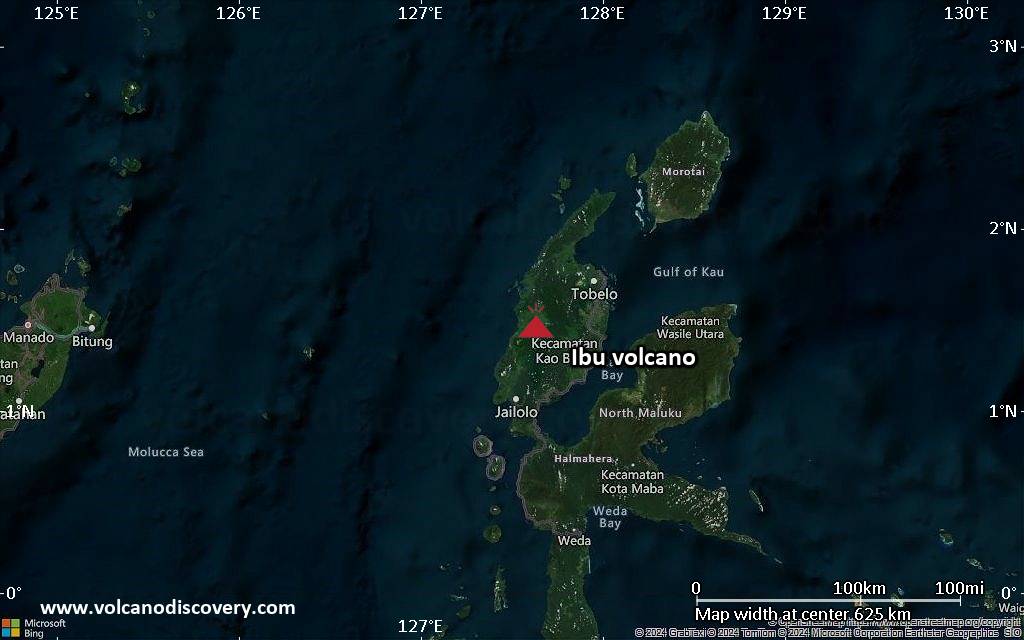
Ibu Volcano Volcanic Ash Advisory: ERUPTION LAST REPORTED AT 06/1430Z EST VA DTG: 06/1430Z
Volcanic Ash Advisory Center Darwin (VAAC) issued the following report:
FVAU01 at 14:52 UTC, 06/03/26 from ADRM
VA ADVISORY
DTG: 20260306/1500Z
VAAC: DARWIN
VOLCANO: IBU 268030
PSN: N0129 E12738
AREA: INDONESIA
SOURCE ELEV: 1325M AMSL
ADVISORY NR: 2026/266
INFO SOURCE: HIMAWARI-9, CVGHM
ERUPTION DETAILS: ERUPTION LAST REPORTED AT 06/1430Z
EST VA DTG: 06/1430Z
EST VA CLD: SFC/FL070 N0131 E12738 – N0130 E12739 – N0111
E12740 – N0113 E12728 MOV S 15KT
FCST VA CLD +6 HR: 06/2030Z SFC/FL070 N0131 E12737 – N0131
E12739 – N0111 E12740 – N0113 E12728
FCST VA CLD +12 HR: 07/0230Z SFC/FL070 N0131 E12737 – N0131
E12739 – N0113 E12745 – N0112 E12733
FCST VA CLD +18 HR: 07/0830Z SFC/FL070 N0131 E12737 – N0131
E12739 – N0113 E12745 – N0112 E12733
RMK: VA NOT IDENTIFIABLE ON LATEST SAT IMAGERY DUE TO MET
CLOUD. MULTIPLE GROUND REPORTS INDICATE INTERMITTENT
ERUPTIONS REMAIN ONGOING. VA HEIGHT AND MOVEMENT BASED ON
CVGHM GROUND REPORTS AND MODEL GUIDANCE.
NXT ADVISORY: NO LATER THAN 20260306/2100Z=
Afghanistan: New criminal regulation targets women and minority groups with ever-harsher punishments
The new Criminal Regulation recently endorsed by the Taliban leader will further entrench violence and discrimination against women, Amnesty International said in a new legal analysis documenting its wide-ranging and regressive impact on human rights.
The “Criminal Procedure Regulation of the Courts”, which lays out punishments and sentencing for a range of vague and overly broad offences, criminalizes domestic violence only in cases where a woman has suffered a broken bone or visible injuries. The decree also prescribes a three-month prison sentence for any woman who regularly visits family members without her husband’s permission and who refuses a court order to return home.
The regulation also prescribes harsh punishments for religious non-compliance, more severe punishments for people of lower social status and recognizes slavery. Other provisions authorize the destruction of property as a form of punishment, institutionalize torture and other ill-treatment through corporal punishment, and sanction the death penalty for a greater number of offences.
“The regulation makes an already repressive legal system even more draconian. Women and girls are, of course, among the most affected, with provisions that normalize domestic violence and place even greater restrictions on their movement and autonomy,” said Smriti Singh, Amnesty International’s South Asia Director.
The regulation makes an already repressive legal system even more draconian
Smriti Singh, Amnesty International’s South Asia Director
“Provisions on strict religious observance and the scaling of punishment depending on social class will entrench discrimination and target the country’s most marginalized and economically disadvantaged people.”
“We call on the Taliban to immediately revoke or revise this repressive regulation and bring it in conformity with international human rights standards. We also urge the international community to unequivocally condemn the regulation, and pressure the Taliban to end their ongoing widespread and systematic violations of human rights.”
The analysis highlights some of the central draconian provisions of the regulation and the challenges they pose, as well as how they will impact human rights in at least seven areas. The areas, and some of the key issues covered, are highlighted below:
Women’s Rights: How the changes outlined above remove essential safety mechanisms for victims and survivors of gender-based violence.
Freedom of Religion, Belief, Thought, and Expression: The impact on religious minorities of severe new penalties for deviating from the Hanifi School of Sunni Islam that the Taliban claim to adhere to, and the designation of beliefs contrary to the Sunni Branch of Islam as heretical.
Torture and other Ill-treatment: How the regulation provisions prescribe torture and other ill-treatment in the form of flagging or lashing for a wide range of offences.
Death Penalty: The prescription of the death penalty for a broad range of offences including ‘habitual sodomy’ based on a discretionary judgement from an Imam that it is in the ‘public interest’.
International Fair Trial Standards: How vague definitions of offences empower the Taliban judges and authorities to arbitrarily define and implement them, which will further undermine the justice process.
Equality Before the Law: The division of offenders into four categories with a sliding scale of punishments based on social hierarchy.
Slavery: How the wording of some provisions appears to recognize ownership over certain individuals, and expressly recognize slavery
Background
On 5 January, the Taliban leader endorsed the regulation and ordered its publication in the Official Gazette, where laws and other legislative documents are published to ensure public awareness and accessibility. On 8 January, the Taliban’s Supreme Court Secretariat (Dar -al-Insha,), circulated the regulation to the members of the Supreme Court, directorates, and courts for its implementation. Though the regulation is not yet published in the official Gazette, the Taliban stated on 23 January that it would be published soon. Amnesty International contacted the de facto Taliban authorities on 19 February seeking an official copy of the regulation and any accompanying materials for this analysis, and to determine whether the regulation has been effectively enforced, but no response was provided.
On 15 February, a media outlet reported that the implementation of the regulation had led to the prosecution of an individual in Badghis province for insulting the Taliban leader.
The post Afghanistan: New criminal regulation targets women and minority groups with ever-harsher punishments appeared first on Amnesty International.