
Damisoa: we left our drought-stricken land and found new struggles

Damisoa is from the Androy region in the very southern tip of Madagascar. In 2021, he and his family were forced to leave their home due to droughts worsened by climate change meaning there wasn’t enough food for them to survive there.

People displaced by famine and now living in northern Madagascar urgently need humanitarian assistance. But aid is currently almost exclusively concentrated in drought-stricken southern Madagascar.

Damisoa tells his story of displacement and survival and calls for the government to take urgent steps to address the hunger, homelessness and poor healthcare faced by him and others displaced by drought in Madagascar.

I should not have left my ancestral land, in southern Madagascar, but we were forced to leave. Famine had attacked our land.

I didn’t have much to sell to afford the journey: no goat or zebu (cattle), so we sold the cooking pots and the furniture from our home. That made us enough money for our family of 10 to leave. But it didn’t get us far.

We stopped in Toliaria and then again in Antananarivo. Each time, finding whatever work we could to raise the money for the next bus fare: gem mining, menial work, cleaning and laundry. The whole family, including my wife and my children, worked hard to raise money.

Eventually we made it to Ambondromamy, in the Boeny region, in northern Madagasacar. We were told we could earn a living in the forest by burning charcoal and growing corn and mung beans. Straight away, we began cultivating our crops and producing charcoal.  

Then the authorities came. As newcomers, we were afraid: when we saw their guns, we ran away. Some of us were arrested while others were left behind.

Now we have a place to stay, but we are still suffering

Eventually the local government found a solution for vulnerable people by resettling us to some small huts in Tsaramandroso, nearby. They built a place for people to stay. I did not bring my family this far for us to die, but to save our lives.  So, we accepted the offer of a place to live.

However, when we were settled, we continued to struggle. The huts do not feel like we are sleeping indoors. Especially during the rainy season (every December to April), it feels like a thunderstorm inside: the walls let the rain in, and our space is flooded.

Two rows of wooden huts.

Resettlement site in Tsaramandroso, a municipality located in the Boeny region of northwestern Madagascar.

The water around us is deadly

When the water is high, during the rainy season each year, it kills people. This water has a monster and invisible creatures in it: the river is infested with crocodiles. It is also very fast flowing, and people have died trying to cross, so we are afraid of passing through until the tide is lower.

We do not have a boat to cross the river, we use yellow jerry cans as an alternative. We attach the jerry cans with a long rope on the other side of the water and pull it across. We are never sure if it will break or not. Several people help: some know how to swim and can help others cross by carrying them on their backs.
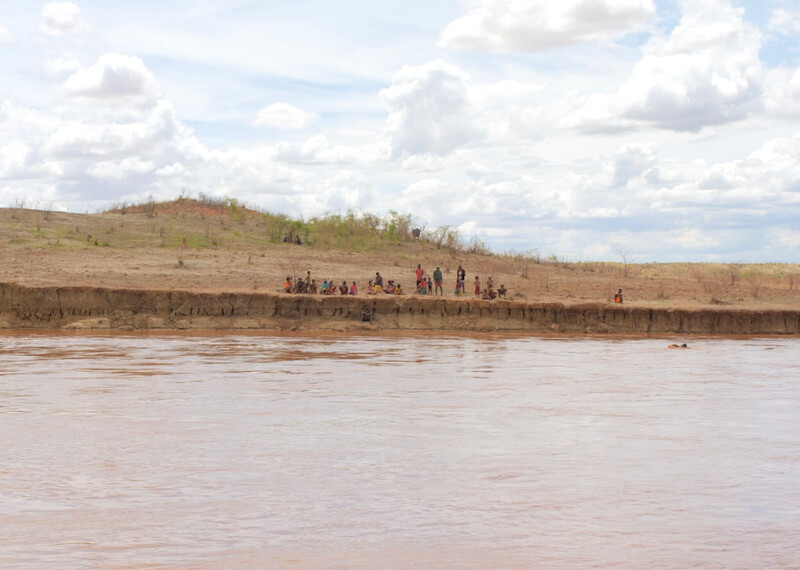
During rainy season, Damisoa’s community is very isolated due to the fast-flowing and crocodile infested seasonal river that surrounds the area where they were resettled.

When there is no more to share, we sleep hungry

We do not have any seeds or food to eat. Because of this poverty, we ignore the danger, and we try to cross the water because we need to look for food. I feel like we live in an abyss, not on earth. Where can we go when we have this water around us?

We would die if we did not help each other. Whenever one of us, from among the 33 households, has something we share it. When there is no more to share, we sleep hungry. We take lalanda leaves (wild sweet potato leaves), boil them with water and salt, and that is what we eat to survive until the next day.

We are fearful of getting sick

My sister went into labour during the rainy season, when the water was high. We did not have enough money to bring her to the doctor. Instead, we walked three hours, crossing the deadly river to see the matron.

Sadly, my newborn niece died because her mother, weakened by hunger and thirst, could no longer breastfeed.

We are fearful of falling sick because we do not have any health insurance. We are poor, so we are careful to avoid complications.

We would only struggle more if we moved elsewhere

We stay here in the North, because we struggled more when we were back in our ancestral land, in the South. And if we leave this place, we will face more struggles. If we leave again, we will be displaced again to a new place, alone, with no government support or humanitarian aid.

We would rather suffer here. It is better to stay with people you are acquainted with. And the land we are staying on is the only place the government has made available for people in our situation.

So, we prefer to stay, but we struggle. We do not have a plough to till the land, we do not have oxen. But we stay here to avoid more struggle.

I am not ashamed to demand humanity 

As the head of the village, I represent the residents here. It’s important to me that I do them justice in this role and use this position to amplify my community’s voices. We are not ashamed of our poverty which is due to the lack of government support given to us.

We are not ashamed to talk about our struggles. There is nothing to hide. If we let shame stop us from speaking out, all of our people could die.

This is where we live, this is our situation. We ask the government to consider our request for support. We look forward to their assistance.

Join Damisoa’s fight for climate-displaced people in Madagascar

Sign the petition and urge the government to act now to support Damisoa and others displaced by drought across Madagascar who are facing hunger, homelessness and poor healthcare.

The post Damisoa: we left our drought-stricken land and found new struggles appeared first on Amnesty International.

Puracé Volcano Volcanic Ash Advisory: CONT VA EMS RPRTD to 18000 ft (5500 m)

Explosive activity continues. Volcanic Ash Advisory Center (VAAC) Washington warned about a volcanic ash plume that rose up to estimated 18000 ft (5500 m) altitude or flight level 180 and is moving at 5 kts in NW direction.
The full report is as follows:

FVXX24 at 00:49 UTC, 10/12/25 from KNES
VA ADVISORY
DTG: 20251210/0047Z

VAAC: WASHINGTON

VOLCANO: PURACE 351060
PSN: N0219 W07624

AREA: COLOMBIA

SOURCE ELEV: 15256 FT AMSL

ADVISORY NR: 2025/067

INFO SOURCE: GOES-19. WEBCAM. NWP MODELS. VOLCAT.

ERUPTION DETAILS: CONT VA EMS RPRTD

OBS VA DTG: 10/0020Z

OBS VA CLD: SFC/FL180 N0230 W07629 – N0220 W07624
– N0222 W07635 – N0230 W07629 MOV NW 5KT

FCST VA CLD +6HR: 10/0630Z SFC/FL180 N0227 W07632
– N0219 W07623 – N0218 W07635 – N0227 W07632

FCST VA CLD +12HR: 10/1230Z SFC/FL180 N0226
W07634 – N0220 W07624 – N0214 W07635 – N0226
W07634

FCST VA CLD +18HR: 10/1830Z SFC/FL180 N0226
W07634 – N0220 W07623 – N0213 W07636 – N0226
W07634

RMK: CONT VA EMS RPRTD MOV TO NW OF SUMMIT. VA
NOT OBS IN STLT IMAGERY. NWP MDL GUIDANCE FCST
CONT MOV TO NW AND W THRU T+18HRS. VO ACT
MODERATE. …FISHER

NXT ADVISORY: WILL BE ISSUED BY 20251210/0645Z

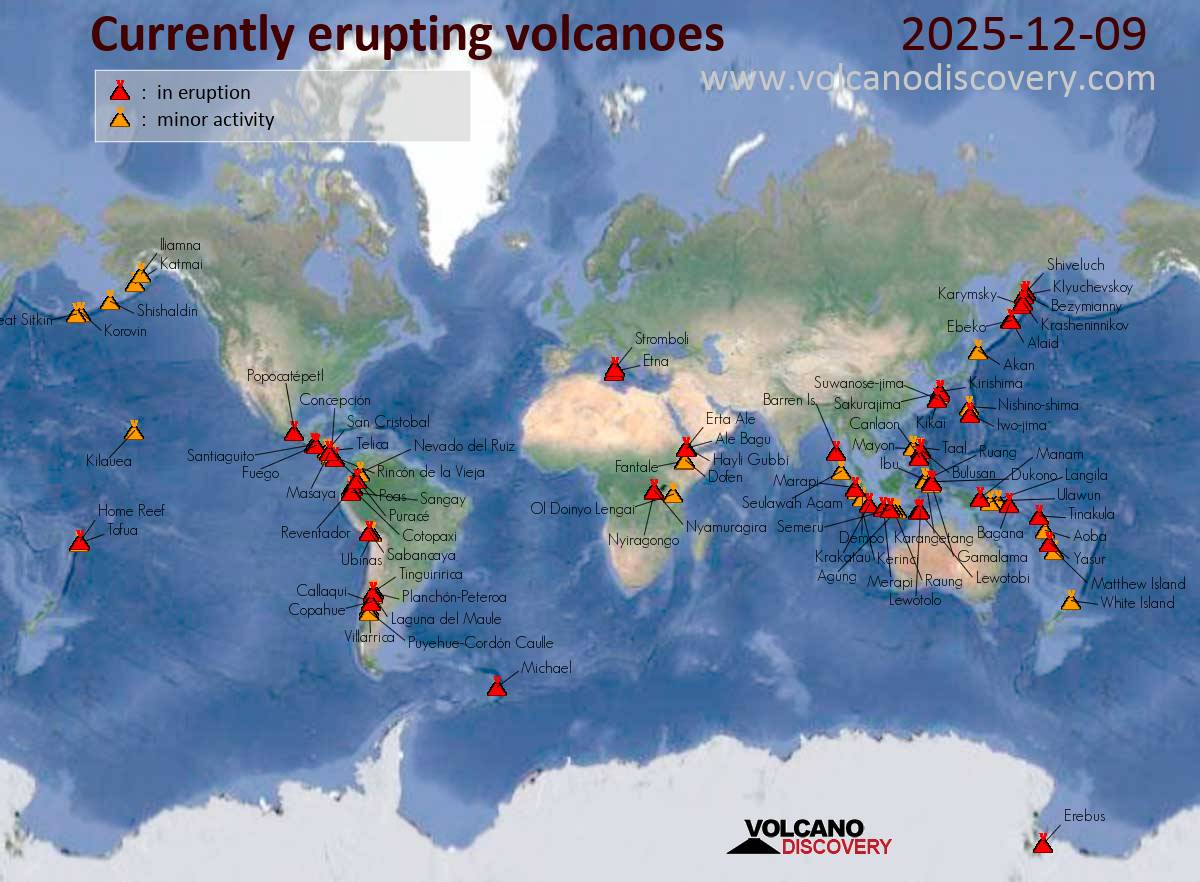
Volcanic activity worldwide 9 Dec 2025: Santiaguito volcano, Fuego, Popocatépetl, Semeru, Ibu, Duko…

Map of today's active volcanoes

Map of today’s active volcanoes

Sakurajima (Kyushu, Japan): (9 Dec) Volcanic Ash Advisory Center Tokyo (VAAC) issued the following report: ERUPTED AT 20251209/0002Z FL090 EXTD SE OBS VA DTG:09/0000Z

Ibu (Halmahera, Indonesia): Explosive activity continues. Volcanic Ash Advisory Center (VAAC) Darwin warned about a volcanic ash plume that rose up to estimated 6000 ft (1800 m) altitude or flight level 060 and is moving at 15 kts in S direction.
The full report is as follows: VA TO FL060 LAST REPORTED AT 09/1205Z EST VA DTG:09/1240Z to 6000 ft (1800 m)

Semeru (East Java, Indonesia): Volcanic Ash Advisory Center Darwin (VAAC) issued the following report: VA ERUPTION LAST REPORTED AT 09/1029Z EST VA DTG:09/1500Z

Dukono (Halmahera): (9 Dec) Explosive activity continues. Volcanic Ash Advisory Center (VAAC) Darwin warned about a volcanic ash plume that rose up to estimated 7000 ft (2100 m) altitude or flight level 070 .
The full report is as follows: VA PLUME TO FL070 OBS AT 09/0110Z MOV SE OBS VA DTG:09/0110Z to 7000 ft (2100 m)

White Island (New Zealand): (9 Dec) Since 30 October, the volcano has experienced a minor volcanic eruption. Ash emissions were mainly identified through satellite imagery and were occasionally visible on webcams. However, observations from last week’s gas flight, GeoNet cameras in the Bay of Plenty, and recent satellite data indicate that the explosive activity has now ceased, with no detectable ash emissions.
Recent views from the Whakatāne and Te Kaha cameras, together with last week’s gas measurements, show reduced activity at the active vent. No eruptions or ash emissions have been observed during the past week. Volcanic gases are still present, but the amount of sulphur dioxide (SO₂) measured has decreased compared to earlier levels. MetService has also reported no volcanic ash in the plume during this period, based on satellite monitoring.
Given the absence of further eruptive activity and ash emissions over the past week, the Volcanic Alert Level has been lowered to 2 (moderate to heightened unrest) and reduced the Aviation Colour Code to Yellow. Although the activity has paused, conditions could change rapidly. Sudden, more explosive events remain possible and could impact the crater floor and surrounding areas of the island.

Popocatépetl (Central Mexico): Explosive activity continues. Volcanic Ash Advisory Center (VAAC) Washington warned about a volcanic ash plume that rose up to estimated 18500 ft (5600 m) altitude or flight level 185 and is moving at 20 kts in E direction.
The full report is as follows: LGT VA AND GASES to 18500 ft (5600 m)

Santiaguito (Guatemala): Explosive activity continues. Volcanic Ash Advisory Center (VAAC) Washington warned about a volcanic ash plume that rose up to estimated 14000 ft (4300 m) altitude or flight level 140 .
The full report is as follows: NEW VA EMS to 14000 ft (4300 m)

Fuego (Guatemala): Explosive activity continues. Volcanic Ash Advisory Center (VAAC) Washington warned about a volcanic ash plume that rose up to estimated 14000 ft (4300 m) altitude or flight level 140 and is moving at 10 kts in W direction.
The full report is as follows: CONT VA EMS to 14000 ft (4300 m)

Puracé (Colombia): Explosive activity continues. Volcanic Ash Advisory Center (VAAC) Washington warned about a volcanic ash plume that rose up to estimated 18000 ft (5500 m) altitude or flight level 180 and is moving at 5 kts in E direction.
The full report is as follows: VONA RPRTS AND CONFIRMED IN SAT to 18000 ft (5500 m)

Sangay (Ecuador): Explosive activity continues. Volcanic Ash Advisory Center (VAAC) Washington warned about a volcanic ash plume that rose up to estimated 19000 ft (5800 m) altitude or flight level 190 .
The full report is as follows: VA SEEN IN SAT MOV NNE to 19000 ft (5800 m)

Reventador (Ecuador): Explosive activity continues. Volcanic Ash Advisory Center (VAAC) Washington warned about a volcanic ash plume that rose up to estimated 16000 ft (4900 m) altitude or flight level 160 .
The full report is as follows: CONS VA EMS SEEN IN SAT to 16000 ft (4900 m)

Sabancaya (Peru): (9 Dec) Explosive activity continues. Volcanic Ash Advisory Center (VAAC) Buenos Aires warned about a volcanic ash plume that rose up to estimated 21000 ft (6400 m) altitude or flight level 210 and is moving at 10 kts in SW direction.
The full report is as follows: PUFF EMISSION to 21000 ft (6400 m)

Ecuador: A year without justice for the four children from Las Malvinas

A year after the enforced disappearance of Steven Medina, Nehemías Arboleda, Josué Arroyo and Ismael Arroyo, their relatives continue to demand justice, truth and reparation. 

The “four children from Las Malvinas”, as they have become publicly known, were detained on8 December 2024 by members of the armed forces during a security operation in the Las Malvinas community in the city of Guayaquil. Their bodies were found on 24 December 2024 near a military base in Taura, in the province of Guayas, bearing signs of torture.

“We express our admiration and solidarity with the fight of the families of the four disappeared children from Las Malvinas. We are at a critical moment for the observance of human rights in Ecuador. These enforced disappearances not only deeply shocked the country, but also evidenced the failure of President Noboa’s security policy. The families of these children and of all the victims of enforced disappearances at the hands of the armed forces in the Ecuadorian coastal region have a right to justice, truth and comprehensive reparation,” said Ana Piquer, Americas Director at Amnesty International.

The families of these children and of all the victims of enforced disappearances at the hands of the armed forces in the Ecuadorian coastal region have a right to justice, truth and comprehensive reparation.”

Ana Piquer, Americas Director at Amnesty International.

At the beginning of this year, the Public Prosecutor’s Office filed charges within the framework of their investigation against 16 military officers for their alleged involvement in the events. These individuals are currently being held in pretrial detention. In April, additional charges were filed against a colonel. In October, the 17 suspects were brought to a trial which has held numerous hearings in the last few weeks and is currently at the stage of closing arguments. The Constitutional Court of Ecuador is also examining these crimes.

In September of this year, Amnesty International published the report “It was the military. I saw them”, detailing the enforced disappearance of 10 persons, including the “four children from Las Malvinas”. The investigation, presented in Guayaquil, concludes that the militarized security strategy driven by President Daniel Noboa has enabled serious human rights violations to be committed, including those of enforced disappearance which are crimes under international law.

According to information provided by the Public Prosecutor’s Office, there were 43 recorded disappearances in Ecuador’s coastal region as of September 2025 in the context of security operations by the armed forces during 2024. Amnesty International considers that the biggest obstacle to date for victims and their families to obtain justice is a lack of cooperation from the armed forces in the criminal investigations that are being conducted.

For more information or to arrange an interview, please contact press@amnesty.org

The post Ecuador: A year without justice for the four children from Las Malvinas appeared first on Amnesty International.

Reventador Volcano Volcanic Ash Advisory: CONS VA EMS SEEN IN SAT to 16000 ft (4900 m)

Explosive activity continues. Volcanic Ash Advisory Center (VAAC) Washington warned about a volcanic ash plume that rose up to estimated 16000 ft (4900 m) altitude or flight level 160 .
The full report is as follows:

FVXX20 at 15:17 UTC, 09/12/25 from KNES
VA ADVISORY
DTG: 20251209/1514Z

VAAC: WASHINGTON

VOLCANO: REVENTADOR 352010
PSN: S0005 W07739

AREA: ECUADOR

SOURCE ELEV: 11686 FT AMSL

ADVISORY NR: 2025/1253

INFO SOURCE: GOES-19. VONA. WEBCAM. NWP MODELS.

ERUPTION DETAILS: CONS VA EMS SEEN IN SAT

OBS VA DTG: 09/1450Z

OBS VA CLD: SFC/FL160 N0020 W07722 – N0016 W07713
– S0005 W07738 – S0004 W07740 – N0020 W07722 MOV
NE 10KT

FCST VA CLD +6HR: 09/2100Z SFC/FL160 N0020 W07714
– N0006 W07705 – S0006 W07738 – S0004 W07740 –
N0020 W07714

FCST VA CLD +12HR: 10/0300Z SFC/FL160 S0004
W07738 – S0025 W07727 – S0029 W07738 – S0005
W07740 – S0004 W07738

FCST VA CLD +18HR: 10/0900Z SFC/FL160 S0004
W07740 – S0005 W07739 – S0022 W07802 – S0016
W07810 – S0004 W07740

RMK: UPDATED VAA AS VA GETTING FARTHER OUT THAN
FCSTD. CONS VA SEEN IN SAT MOV NE AND EXTDG ARND
35 NM FM SUMMIT. FCST CONFIDENCE BEYOND T+6 HRS
IS LOW. MOV AND HGT BASED ON SAT AND GUIDANCE.
…KIBLER

NXT ADVISORY: WILL BE ISSUED BY 20251209/2115Z