Will Killing Countless Animals Actually Help Treat Alzheimer’s?

What has killing countless animals in Alzheimer’s experiments taught researchers about the disease? Honestly, not much.

Rats are tested on in Alzheimer's disease experiments © iStock.com/Caymia

After decades of wasted time and money, more than 100 unsuccessful drugs, and an untold number of animals’ lives taken, no cure for Alzheimer’s disease or method of slowing its progression in humans has been found.

Here are five things revealed by the overwhelming failure of using animal models for Alzheimer’s research:

1. Mice, rats, monkeys, dogs, and other animals don’t naturally develop Alzheimer’s disease.

Mice are quick learners and caring parents, and they even sing to their mates. They’re wonderfully complex and interesting. But just because they have thoughts and emotions just like humans doesn’t mean we share the same physiology.

Experimenters manipulate the genome of mice and other animals to force amyloid plaques to build up in their brains, just as they build up in the brains of humans with Alzheimer’s disease. While these mutilated animals may have symptoms that resemble those of Alzheimer’s, they don’t actually have the disease.

Studies have shown that trial drugs that remove toxic amyloid-beta protein from animal brains can help the animal. However, these same drugs do not help human patients with memory loss or cognitive problems.

2. Some treatments that have worked in animal trials have actually hurt human patients with Alzheimer’s.

While a compound of drugs known as BACE inhibitors tested successfully in mice who’d been genetically altered to develop a pseudo-Alzheimer’s condition, these drugs actually appeared to worsen human patients’ cognitive abilities and potentially exacerbate brain shrinkage. Three pharmaceutical companies echoed this same stunning failure.

3. The failure rate in humans for new Alzheimer’s drugs is a staggering 99%.

According to the Allen Institute, Alzheimer’s affects roughly 5.8 million Americans. It, along with other forms of dementia, costs the U.S. an estimated $290 billion every year. Despite this grave reality, no therapy exists to slow down the disease’s progression.

4. Archaic animal testing failed. Curing Alzheimer’s requires a 21st century approach.

As Allen Institute for Brain Science Senior Investigator Ed Lein stated, “We’re trying to cure a disease of a complex system we fundamentally don’t understand.”

Bradley Hyman, a professor of neurology and Alzheimer’s researcher at Harvard Medical School and Massachusetts General Hospital, furthered this point, adding that the complexity of Alzheimer’s disease makes it “very difficult to model in experimental systems.” He says,

“[D]irect examination of the human brain is without a doubt crucial to understanding the disease.”

5. We must stop killing animals and actually focus on the HUMAN brain.

More than ever, researchers must embrace non-animal research methods that are actually relevant to human physiology.

The National Institutes of Health (NIH) recently gave a $40.5 million grant to three research institutions working together to study how Alzheimer’s disease takes root in the brain. According to reports, the group will study tissue from brains donated by people who died with Alzheimer’s.

Lead investigator Lein told NPR that researchers have mistakenly been “trying to go right to the cure without really understanding the brain and what actually goes wrong that leads to dementias.”

One goal of the new consortium is to identify abnormal cells before any symptoms of Alzheimer’s start to appear. “If we can find the cells where something goes wrong, this would provide a new way to try to treat this disease,” Lein said.

What You Can Do

Support Alzheimer’s charities that actually help humans and don’t test on animals. Families and animals deserve more than death and failure from experimenters.

And urge your congressional representatives to demand that NIH stop wasting our tax dollars funding pointless animal experiments and instead focus on non-animal methods of research that save lives.

The post Will Killing Countless Animals Actually Help Treat Alzheimer’s? appeared first on PETA.
Small but Powerful—Here’s the ONE Thing You Can Do to Help Bees

Bees work hard to support their colonies and pollinate the plants that make life on Earth possible. However, many species of North American bees are threatened with extinction because of habitat loss and heavy pesticide use. Humans have used this as an excuse for intensive farming of these friendly flyers—but the unnatural intervention does nothing to support colonies.

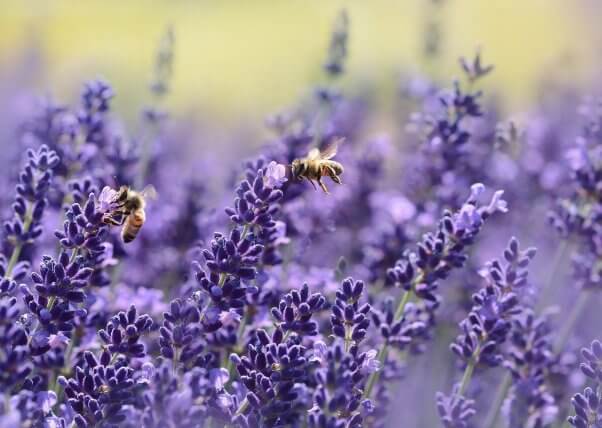
interesting bee facts bees on lavender

Here are some fascinating bee facts that will help you get to know your buzzing neighbors:

1. They work really hard at their jobs.

In a single day, a worker bee may visit up to 10,000 flowers, collecting drops of nectar that she uses to produce honey and feed the hive. After all her hard work, a single bee will produce less than a teaspoonful of honey in her lifetime. Throughout her typical life span of only six to eight weeks, she will fly about 36,000 miles—almost 1.5 times the circumference of the planet.

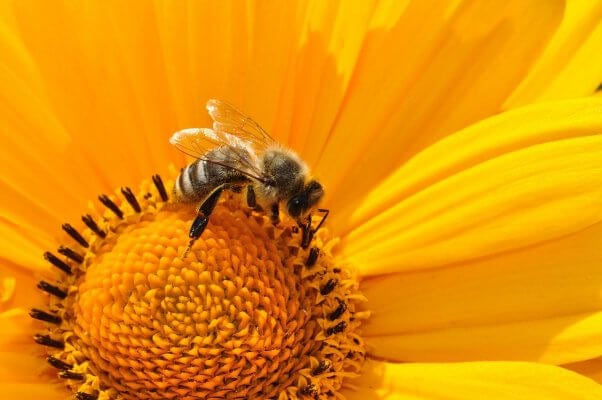
interesting bee facts bee on yellow flower

2. They dance to show each other where to find food.

Workers use the “round dance” when nectar is less than 100 meters (328 feet) from the hive and the “waggle dance” when it’s found farther away. They will dance in a particular pattern to indicate where the nectar is located in relation to the sun.

3. They have very specific roles in supporting the colony.

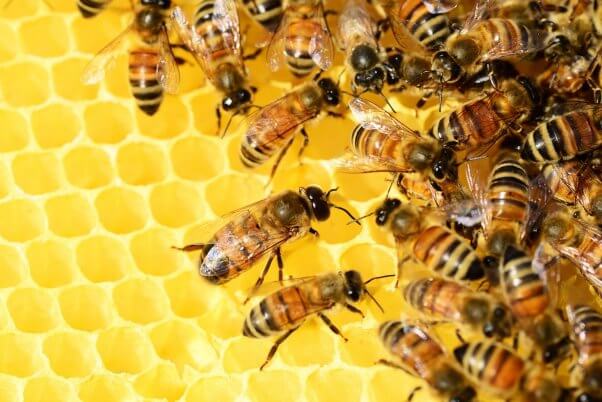
Three types of bees make up a hive. The queen bee’s main role is to reproduce, laying around 1,500 eggs daily. Worker bees keep the hive clean, feed the queen and baby bees, guard the hive, and collect nectar from flowers. Drone bees leave the hive to find a queen to mate with and start a new hive.

interesting bee facts bee hive honeycomb

4. Only female bees can sting—and they don’t want to sting you.

Since one of their roles as worker is to protect the colony, female bees will only sting if they think you’re a threat. A worker bee dies if she uses her stinger, so she will use it only as a last resort. Respect a bee’s space and she’ll happily fly along.

5. Honeybees have a powerful sense of smell.

They use odor receptors located in their antennae to identify and trace the scent of nearby pollen- and nectar-rich flowers. They also use their sense of smell to find other bees.

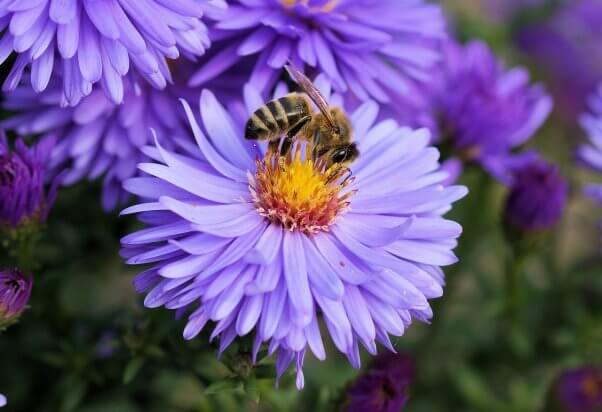
bee facts bee on purple flower

6. They are meticulously clean.

Bees bathe themselves in order to keep their colony free from any viruses that might spread throughout it. In the honey industry, they’re genetically manipulated and forced into stressful conditions that make them more susceptible to pathogens.

via GIPHY

7. They need and use all the products that humans often steal.

Honey is an essential food source for bees during the winter. Honeycomb is a bee’s hive—the hexagons hold bee’s eggs and store pollen and honey. Royal jelly is used to feed future queens, as it triggers the development of ovaries. Bee pollen and “bee bread” are not produced by bees but are important sources of protein for growing bees.

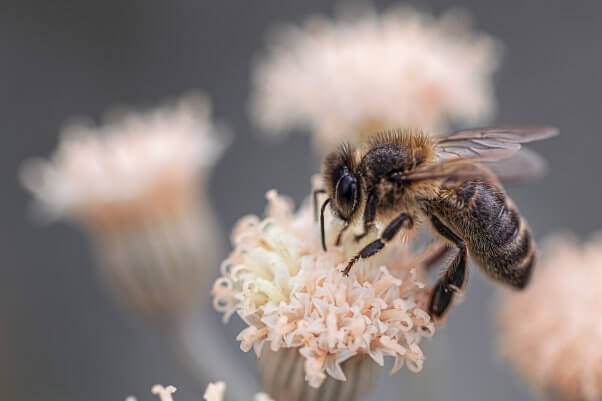
bee facts bee on pale pink flower

8. Bees can recognize others in their colonies and are protective of their hives.

The honey industry manipulates hives and steals all the honey that bees work hard to produce, replacing it with a sugary syrup that lacks essential nutrients. Workers are protective of the honey that they produce because it’s the result of hard work and important to the colony’s survival.

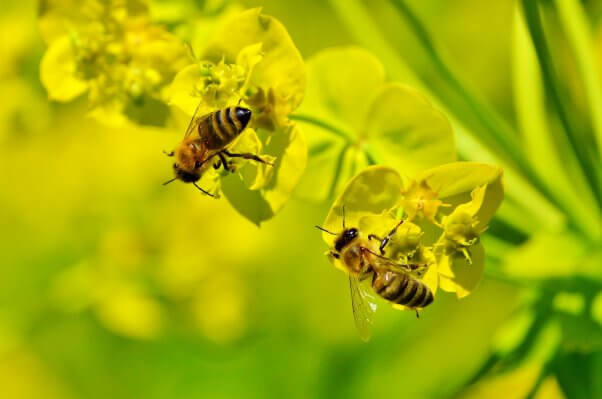
facts about bees two bees on yellow flowers

9. Native bees are better pollinators than honeybees.

Supporting native bee species is a great way to pollinate crops, and it doesn’t require the exploitation of hives. Native bees are often solitary, and they collect pollen to take back to their nests. Honeybees also collect pollen, but they’re more interested in a flower’s nectar. Planting bee-friendly flowers and not using pesticides are simple ways you can support the native bees in your own backyard.

facts about bees, native bee species on purple blue flowers

10. Without them, our ecosystem would collapse.

Bees pollinate many of the plants that humans eat, but their work is also essential to the survival of many other plants and animals. The vast biodiversity that characterizes life on Earth would simply cease to exist without them.


Be Sweet to Bees

No animals, no matter how small, should have their hard work exploited and stolen. Keep bees free and happy by growing bee-friendly plants and by choosing vegan sweeteners like maple syrup, agave nectar, and even dandelion honey.

Take Action to Help Bees and Other Insects

If you liked these bee facts and want to learn more about the other animals who share our planet, pick up a copy of Animalkind by PETA President Ingrid Newkirk:

Note: PETA participates in the Amazon Services LLC Associates Program, an affiliate advertising program designed to provide websites with a means to earn advertising fees by advertising and linking to Amazon.com.

The post Small but Powerful—Here’s the ONE Thing You Can Do to Help Bees appeared first on PETA.