South Africa: Government is failing millions of people trapped in informal settlements and impacted by the climate crisis – new report

The government is putting the well-being and in many cases the lives of the more than five million people living in South Africa’s informal settlements at risk by failing to provide them with access to quality housing and essential services, Amnesty International South Africa said in a new report. 

These people, many of them living on flood-prone land, are routinely left to cope on their own especially during severe weather conditions, despite the fact that the main responsibility for preparing for and responding to these disasters lies with the government.

Informal settlements in South Africa along with other underserved areas like temporary relocation areas, are a sore reminder of the racial injustice and disenfranchisement that were hallmarks of the colonial and apartheid regimes preceding 1994. However, this does not mean that we must ignore the fact that the ongoing housing crisis and the failure of successive governments to guarantee the right to access to adequate housing among other human rights

Amnesty International South Africa, Executive Director, Shenilla Mohamed

Amnesty International South Africa’s report Flooded and Forgotten: Informal Settlements and the Right to Housing in South Africa examines the incidence and impact of floods, both large scale and seasonal caused by heavy rain, on residents of informal settlements and underserved areas in South Africa, particularly in Johannesburg, eThekwini, and Cape Town.

“Informal settlements in South Africa along with other underserved areas like temporary relocation areas, are a sore reminder of the racial injustice and disenfranchisement that were hallmarks of the colonial and apartheid regimes preceding 1994. However, this does not mean that we must ignore the fact that the ongoing housing crisis and the failure of successive governments to guarantee the right to access to adequate housing among other human rights,” Amnesty International South Africa Executive Director Shenilla Mohamed said. 

“The government is failing the millions of people trapped in these underserved areas, especially in a time when economic hardships and poverty are rife. People live in informal settlements because there is a lack of affordable and accessible formal housing and sometimes because they are the only affordable means of living close to work or work opportunities. Article 10 of South Africa’s Constitution, which is part of the Bill of Rights is clear that everyone has inherent dignity and the right to have their dignity respected and protected, no matter who they are.”

More government action urgently needed to deal with increased risk of flooding

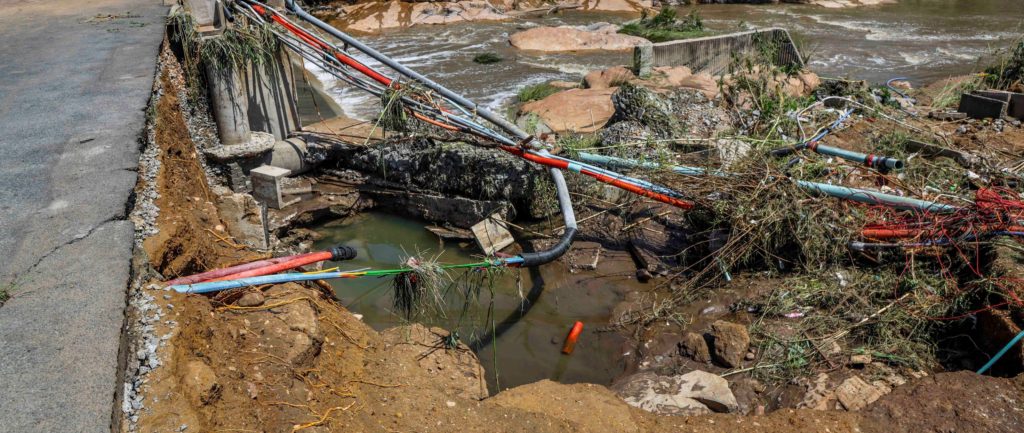
The recent floods in June 2025 in the Eastern Cape province, which caused the death of over 100 people and washed away the homes of thousands of people, was a stark reminder that urgent and long-term action by the government is needed. While South Africa’s Disaster Management Act and National Disaster Management Framework aim to reduce the risk of disaster, there is ample evidence that not enough is being done towards this end. 

Based on the experiences of people living in informal settlements documented in Amnesty International’s report, interviews with experts and practitioners in the field and a review of reports, laws and policies, evidence shows that South Africa’s response to flooding disasters – whether major or seasonal– is patchy and piecemeal, with not enough done to prepare for such events. 

For example, people displaced by KwaZulu-Natal floods in 2022 are still in temporary emergency accommodation in poor conditions nearly three years later, indicating a lack of preparedness for recovery efforts. Some of those displaced died after they were relocated to an area that was severely flooded in 2025, highlighting a serious failure to ensure that flood victims are relocated to safety. In the case of seasonal flooding, the support and assistance that many residents of informal settlements experience is alarmingly poor or absent. 

Although the KwaZulu-Natal Department of Human Settlements, in their response to Amnesty International, dated 30 October 2025, asserted that “informal settlements are not planned settlements and inherently their establishment would not be preceded by the availability of basic services”, South Africa remains bound by constitutional and international obligations to provide essential services to all residents, including those living in informal settlements. 

“The reality, as documented in Amnesty International’s report, is that millions of South Africans living in informal settlements are deprived of these rights due to central government neglect, under-resourced municipalities, and poor urban governance, not simply because their settlements are unplanned,” Shenilla Mohamed said.

“The lack of access to adequate, well-located affordable housing in South Africa has also led to the growth of informal settlements in floodplains and low-lying areas which means that people living there are increasingly impacted by flooding.”

The climate crisis is making the situation far worse

Human-induced climate change has also exacerbated the risks of flooding, already a seasonal problem in South Africa’s informal settlements and underserved areas. As elsewhere in the world, this means that people who have contributed the least to climate change due to their low consumption patterns and are least able to cope with flooding are the worst affected by the impacts of climate change. 

We have no help from anyone, we have to stay and fix it, we can’t run away… where will we go?

Victim from Freedom Park

One of the main concerns expressed to Amnesty International in all three metropolitan areas was that the regular seasonal flooding of informal settlements and underserved areas was rarely seen as warranting a disaster response by the municipalities. The residents were simply left to fend for themselves and rely on charitable organisations. 

A woman from Freedom Park in Johannesburg said: “We have no help from anyone, we have to stay and fix it, we can’t run away… where will we go?”

South Africa must meet its human rights obligations

South Africa has a plethora of laws and policies on issues around access to housing, provision of essential services such as  water and sanitation, upgrading of informal settlements, a healthy environment, and preparing for and responding to disasters. It is also a state party to all the major international and regional human rights instruments including the UN International Covenant on Economic, Social and Cultural Rights which guarantees the rights to access adequate housing, water and sanitation. 
“Despite South Africa having strong legislation and policy and clear international commitments as with so many other things in this country, implementation remains the issue. The reality points to obvious failures of the government to adequately and thoroughly realise these obligations and this comes at a huge cost to the human rights, lives and livelihoods of millions of people,” Shenilla Mohamed said. 

The South African government must provide access to adequate housing for people living in the country and commit to upgrading informal settlements with access to essential services in a manner that complies with human rights law and standards, including through budgetary and policy commitments.

It must also mobilise all the necessary human, financial and technical resources to ensure that disaster risk reduction is fully integrated into urban planning processes and these are implemented with a view to protecting residents of informal settlements from disasters, climate change related or otherwise, and protecting their human rights.

Background

This report documents the experiences of people living in informal settlements and other underserved areas in South Africa. It is based on qualitative research carried out between February and September 2025. These experiences are presented within the framework of key laws, policies and practices related to access to adequate housing, access to essential services, and disaster preparedness and response.

The post South Africa: Government is failing millions of people trapped in informal settlements and impacted by the climate crisis – new report appeared first on Amnesty International.

Tanzania: Unlawful killings and other human rights violations continue amid internet and electricity blackouts 

In response to the ongoing partial internet shutdown by Tanzanian authorities following the October 29 general elections, Amnesty International’s Deputy Director for East and Southern Africa, Vongai Chikwanda said: 

“For close to a week now, many people in Tanzania have suffered nationwide internet and electricity shutdowns.  Amnesty International is particularly alarmed by reports that amidst the blackouts, security forces have used excessive force to suppress and disperse ongoing post-election protests, resulting in the deaths and injuries of protesters.  

Amnesty International is particularly alarmed by reports that amidst the blackouts, security forces have used excessive force to suppress and disperse ongoing post-election protests, resulting in the deaths and injuries of protesters.  

Vongai Chikwanda, Deputy Regional Director, Amnesty International, ESARO

“This is the third time in less than a year that Tanzanian authorities have resorted to an internet blockade to silence dissenting voices. Authorities must immediately refrain from suppressing protests and instead respect, protect, and facilitate the right to peaceful assembly. They must immediately and unconditionally release all those arrested solely for exercising their right to peaceful assembly.” 

“Authorities should promptly, thoroughly, independently, impartially, transparently and effectively investigate all killings by security agents and bring to justice in fair trials those suspected of being responsible.  Authorities must also provide victims and their families with access to justice and effective remedies. 

Authorities should promptly, thoroughly, independently, impartially, transparently and effectively investigate all killings by security agents and bring to justice in fair trials those suspected of being responsible

Vongai Chikwanda

“The authorities must also allow both local and international media to freely report on the human rights situation in the country and refrain from restricting access to information, both online and offline including by immediately restoring internet access and access to basic public services. The ongoing restrictions are making it difficult to verify information, and to document election-related human rights violations.” 

Background 

Tanzanians went to the polls on 29 October in an election dominated by the ruling Chama cha Mapinduzi (CCM) party, with the two main opposition presidential candidates, Tundu Lissu from Chadema (Chama cha Demokrasia na Maendeleo or the Party for Democracy and Progress), and Luhaga Mpina from ACT-Wazalendo, barred from standing. Verified videos showed protesters on the streets of Dar es Salaam, Mbeya, Tunduma, Tanga, and Mwanza among other towns.  Ahead of the elections, Amnesty International issued a briefing outlining how the Tanzanian authorities have intensified their repression of peaceful dissent against the opposition, journalists, human rights defenders, activists and civil society organizations.   

Authorities imposed nationwide internet restrictions on election day disrupting mobile data services and blocking access to social media platforms across major networks. On Monday 3 November, residents reported partial resumption in some cities. 

The post Tanzania: Unlawful killings and other human rights violations continue amid internet and electricity blackouts  appeared first on Amnesty International.

Amnesty International and SALC intervene on landmark multinational mining case at South Africa’s Supreme Court of Appeal

As the Supreme Court of Appeal starts hearing the appeal in Various Parties obo Minors and Another v Anglo American South Africa today, the Southern Africa Litigation Centre (SALC) and Amnesty International have submitted a joint amicus curiae submission urging the Court to consider international law relating to the right to an effective remedy and corporate accountability for transnational conduct in the certifications test of a class action.

This case is about more than one class action or one community in Zambia. It is about whether South African corporations can operate abroad without being held to the same human-rights standards we demand at home. South African courts have the power to close this accountability gap and to ensure that victims, wherever they are, can access remedies when abuses are linked to South African companies

Dr Atilla Kisla, International Justice Cluster Lead at SALC

The appeal concerns the certification of a class action by residents of Kabwe (Zambia) against the mining company Anglo American in South Africa. The claimants allege severe lead poisoning caused by mining operations in Kabwe. SALC and Amnesty International submit that the case represents a pivotal moment for corporate accountability and the rights of communities affected by transnational and transgenerational harm.

“This case is about more than one class action or one community in Zambia. It is about whether South African corporations can operate abroad without being held to the same human-rights standards we demand at home. South African courts have the power to close this accountability gap and to ensure that victims, wherever they are, can access remedies when abuses are linked to South African companies,” said Dr Atilla Kisla, International Justice Cluster Lead at SALC.

In their submission, SALC and Amnesty International emphasise that South Africa’s Constitution requires courts to consider international law, such as the global consensus on the corporate responsibility to respect human rights and  the duty to provide effective remedies to victims  even when abuses occur beyond national borders by multinational corporations. SALC and Amnesty Internaitonal point to principles established under international law that have to be taken into account when Courts conduct an assessment of the interests of justice test relevant to the certification of the class action.

Mandi Mudarikwa, Head of Strategic Litigation, at Amnesty International highlighted that:

“This class action lawsuit stands as a quintessential David versus Goliath confrontation, marking a long-awaited step toward justice for the residents of Kabwe, who have suffered the devastating effects of lead poisoning for generations as a result of multinational mining operations. The certification of this class action could set a transformative precedent for corporate accountability, compelling powerful corporations to answer for their environmental and human rights abuses and inspiring similar movements for justice across jurisdictions.”

As the Court considers whether to certify the Kabwe community class action, SALC and Amnesty International underscore that the decision will resonate far beyond this case, setting an important precedent for how South African courts address corporate accountability and international law and transnational human-rights abuses within the framework of class actions.

This class action lawsuit stands as a quintessential David versus Goliath confrontation, marking a long-awaited step toward justice for the residents of Kabwe, who have suffered the devastating effects of lead poisoning for generations as a result of multinational mining operations. The certification of this class action could set a transformative precedent for corporate accountability, compelling powerful corporations to answer for their environmental and human rights abuses and inspiring similar movements for justice across jurisdictions

Mandi Mudarikwa, Head of Strategic Litigation, at Amnesty International

SALC and Amnesty International are represented by Lawyers for Human Rights.

Background

The Kabwe lead mine, once known as the “Broken Hill” mine, was allegedly operated and managed by Anglo American between 1925 and 1974 and reportedly contributed to extensive environmental pollution in towns and communities living in the vicinity of the mining site.

Today, experts describe Kabwe as one of the most lead-polluted places on earth. Medical studies have shown that children from Kabwe have record-high levels of lead in their blood. Children and pregnant women are at particular risk from lead toxicity, which is known to cause permanent damage to internal organs, including the brain.

The High Court in Johannesburg dismissed the application to certify the class action on 14 December 2023.

The post Amnesty International and SALC intervene on landmark multinational mining case at South Africa’s Supreme Court of Appeal appeared first on Amnesty International.

Algeria: Authorities must quash outrageous 15-year sentence against unionist Ali Mammeri 

In response to the sentencing of unionist and human rights defender Ali Mammeri, head of the independent National Union of Civil Servants in the Field of Culture and Art (SNFC), to 15 years in prison by the first instance criminal court of the Oum El Bouaghi tribunal, Nadege Lahmar, Algeria Researcher, said: 

“Ali Mammeri’s case is illustrative of the Algerian authorities’ use of unfounded and overbroad terrorism charges to crush peaceful dissent and undermine the activities of unions and other independent groups. He was sentenced to 15 years in prison solely for the peaceful exercise of his rights to freedom of association and expression, based on his union work, public advocacy for human rights, and private communications with exiled activists — which included sharing information that the authorities considered ‘classified’ regarding reprisals and restrictive measures against unions.

“Instead of investigating allegations that policemen repeatedly beat Ali Mammeri and stripped him naked to force a confession of involvement in criminal action, judicial authorities relied on his ‘forced confession’ to convict him.

“This travesty of justice and disregard for the rule of law must end. We call on the Algerian authorities to immediately and unconditionally release Ali Mammeri and quash his terribly unjust conviction and sentence. Authorities must conduct a prompt, thorough, independent, impartial, transparent and effective investigation into the allegations of torture and other ill-treatment of Ali Mammeri and bring to justice anyone suspected to be responsible.”

Background

On 29 October, following seven months in arbitrary pretrial detention, Ali Mammeri was convicted of several charges, including ‘glorifying terrorist acts’ and ‘disseminating classified information’. He has appealed the conviction. 

Amnesty International has learned from the Trade Union Confederation of Productive Forces (COSYFOP), to which the SNFC is affiliated, that Ali Mammeri’s conviction was based on his communications with activists and unionists to provide information regarding the authorities’ reprisals and restrictive measures against unions. This was later used in communications with the International Labour Organization’s (ILO) supervisory bodies.

The post Algeria: Authorities must quash outrageous 15-year sentence against unionist Ali Mammeri  appeared first on Amnesty International.

Ukrainian journalist Dmytro: “I never imagined that people would be kidnapped”

Ukrainian journalist Dmytro Khilyuk was arbitrarily arrested, detained and forcibly disappeared by Russian armed forces for three years, five months, and twenty-one days— in hunger, cold, and without cause.

Taken from his home region near Kyiv in March 2022, he disappeared into Russia’s prison system. His case illustrates the plight of Ukrainians being forcibly disappeared, facing torture and other ill-treatment, and the dangers civilians — in particular journalists — face under Russian occupation.

Throughout his ordeal, Amnesty International worked with Ukrainian colleagues to trace his path through contacts inside Russia. Dmytro says he survived by “holding on to the thought that it would end one day.”

On November 2, the International Day to End Impunity for Crimes against Journalists, Dmytro shares his story.

Before captivity, I’d often read in books that in prison the main thing is to remain human. Back then, those were just words to me; I didn’t understand what stood behind them. When I found myself imprisoned, I understood what humanity really meant.

In the hardest conditions, you must keep at least some humanity in yourself, not turn into an animal. Stay human. Even when you’re hungry, cold, and terrified.

We “celebrated” birthdays in captivity. The others would give the birthday person their pieces of bread, their breakfast, or their dinner — so that, for just one day, that someone wouldn’t be hungry.

The beginning of Russian occupation

On February 25, 2022, Russian tanks entered Kozarovychi, a village near Kyiv, where I live. I saw military columns moving down the street, one after another. That was the beginning of Russian occupation.

I never imagined there would be fighting in our village, that people would be kidnapped, taken hostage, looted.

On 1 March, they came to our house and forced my father and me into the street. They placed an armed soldier next to my mother. She’s over 70 and had suffered a stroke. Then they went through the rooms.

They “liberated” me of my watch and flashlight, and my parents of their phones. Neighbours later told me the Russians took food from their fridges, they even took children’s games. They took everything, from money and valuables to the cheapest little things.

A few days later, my father and I were detained near our house. We were led to a warehouse 500 meters away. They tied my hands, blindfolded me, and threw me into a room where there were already people. Some had their legs tied, one man’s fingers had been broken with a hammer. My father was taken to another room.

During the interrogation, I told the Russians I was a journalist. They started asking: “What were you filming? What were you looking for? What were you doing here?”

I answered: “I live here.”

My father was soon released, and I was taken further.  They transported me to Belarus, where we spent a day and a half. And then we were taken to Russia’s Bryansk region, to Pretrial Detention Facility №2 in Novozibkov town, not far from the border with Ukraine,where I spent more than a year.

“We had no outerwear, even for walks”

The hunger was terrible. I was constantly hungry. People went crazy from hunger. We talked about food from morning till night. You’d look at a bar of soap and think it was ice cream.

The cold was unbearable. We stood by the radiator all day. If we stepped half a meter away, we froze. When the radiators didn’t work, we walked in circles in the cell. I wore socks on my hands, and underwear around my neck instead of a scarf, because I had two pairs and didn’t have anything else. We had no outerwear, not even for walks.

We went outside in what we always wore indoors: synthetic prison trousers and jackets, and the cheapest rubber slippers. In the morning, they forced us to sing the Russian anthem.

The next place was Pakino in the Vladimir region. In Pakino, they would tell us to stand in a circle, then throw a mattress on top of us, and tell the biggest guy to climb up — we had to hold him up. I had scabies – most of us had scabies. Some had tuberculosis.

As far as I know, no one ever visited. Tatyana Moskalkova, Russia’s Commissioner for Human Rights, came to once but we didn’t see her. They staged a Potemkin village – a façade – for her in another building. They gathered some prisoners and, for one day, even opened a canteen for them to eat there.

Later, she sent a representative who brought humanitarian aid from Ukraine, but half of it was stolen. He also brought some clothes. We took underwear and socks, but it was a show for the camera, later they took it all away from us.

“We were forced to read a statement that we had no complaints”

There were many civilians in captivity. Most of them were grabbed on the street or at home in occupied cities. A person would walk down the street and disappear.

“You all say you’re civilians, but in reality, you are not,” the guards would tell us. There were no legal explanations, not even pseudo-legal ones. People in the military at least understood they’d been captured in battle, but the civilians like me had no idea why we were there or what our status was.

No charges were ever brought against me. I signed an interrogation protocol, where I was listed as a witness, and somehow it was about events in Donetsk and Luhansk in 2014. I’d never been to Luhansk at all. And I’d been to Donetsk only a few times for work before 2014. 

Civilian people held in Russia are, purely and simply, like hostages. There are no charges.

For all this time I lived with one thought, that it would end someday. I was exchanged on 24 August. Before the exchange, we were forced to read a statement saying that we had no complaints against the Russian Federation. We repeated that ridiculous nonsense on camera.

The recurring thought was: Finally, it’s over. The understanding that I’m home is still “coming to me” even now.

End war crimes against Ukrainians in Russian captivity

Sign the petition

Send a message to Russian authorities to demand an end to the appalling treatment of Ukrainians in Russian captivity. Ukrainian prisoners of war, civilian detainees and their families need your help.

The post Ukrainian journalist Dmytro: “I never imagined that people would be kidnapped” appeared first on Amnesty International.