Honduras: 10 years without justice for Berta 

Ten years after the murder of Lenca Indigenous leader and human rights defender Berta Cáceres, Amnesty International condemns the ongoing violence against those who defend land and the environment in Honduras, and calls on the authorities to carry out a thorough investigation that takes into account new findings revealed by the Interdisciplinary Group of Independent Experts (GIEI), established under the auspices of the Inter-American Commission on Human Rights (IACHR).

“Ten years after the brutal killing of Berta Cáceres, her family and COPINH have only seen partial justice. Those who ordered the crime remain unpunished, and the structural conditions that led to this tragedy have not changed: each year we continue to witness violence and killings of people defending water and forests in Honduras. How much longer?” said Ana Piquer, Americas Director at Amnesty International.

Ten years after the brutal killing of Berta Cáceres, her family and COPINH have only seen partial justice.”

Ana Piquer, Amnesty International’s Regional Director for the Americas.

An outstanding debt of truth and justice 

The GIEI was established in February 2025 with the mandate to analyse and strengthen the investigation into the murder and related crimes, as well as to propose measures of reparation and guarantees of non-repetition.

Its final report not only concludes that the murder of Berta Cáceres was foreseeable and preventable, but also identifies serious omissions in the investigation that have hindered the pursuit of justice to this day. The GIEI outlines concrete lines of inquiry to advance the identification of those who planned and financed the crime, as well as the structural failures that allowed it to occur. It also proposes a comprehensive reparations plan for Berta Cáceres’ family and for the organization she coordinated, the Civic Council of Popular and Indigenous Organizations of Honduras (COPINH).

“The devastating findings of this report must serve as a turning point to expedite criminal investigations and to effectively protect all human rights defenders in the country,” added Ana Piquer.

The devastating findings of this report must serve as a turning point to expedite criminal investigations and to effectively protect all human rights defenders in the country.”

Ana Piquer, Amnesty International’s Regional Director for the Americas.

Amnesty International urges the Honduran authorities to carefully review the report’s recommendations and remove the obstacles that have limited full accountability for the murder. Based on the proposed lines of investigation into the intellectual authors of the crime, the authorities must continue the investigations until criminal responsibility is established for all those involved.

Responsibility does not end with the State

According to Global Witness, Honduras remains one of the deadliest countries in the world for environmental defenders. At the time of her murder, Berta Cáceres was coordinating COPINH, which had denounced irregularities and human rights violations linked to the implementation of the Agua Zarca hydroelectric project and was leading a peaceful protest against the dam on Lenca territory.

Amnesty International also calls on the states whose financial institutions participated in the Agua Zarca project to conduct a thorough review of the GIEI’s findings and, where appropriate, adopt corresponding measures.

Amnesty International recalls that states have an obligation to protect human rights, including in relation to actions by private actors such as corporations. This includes effectively investigating allegations of corporate-related abuses and, where appropriate, bringing those responsible to justice. States must also ensure effective remedies and full reparation for victims and their families. There is also a clear international consensus that companies have a responsibility to respect human rights and, where they have caused or contributed to abuses, to cooperate in remediation.

“It is essential that all Honduran authorities, including those recently elected, commit to implementing the roadmap set out by the GIEI and to guaranteeing full justice, truth and reparation. Honouring Berta Cáceres’ memory means ensuring that a tragedy like this never happens again,” concluded Ana Piquer.

It is essential that all Honduran authorities, including those recently elected, commit to implementing the roadmap set out by the GIEI and to guaranteeing full justice, truth and reparation.”

Ana Piquer, Amnesty International’s Regional Director for the Americas.

For more information or to arrange an interview, please contact press@amnesty.org

The post Honduras: 10 years without justice for Berta  appeared first on Amnesty International.
Zimbabwe: Authorities must investigate brutal attack on constitutional lawyer and political activists

Responding to the brutal attack in Harare on Professor Lovemore Madhuku, the leader of the opposition National Constitutional Assembly (NCA), and several other political activists on March 1, by armed men in full view of the police, Amnesty International Zimbabwe’s Executive Director, Lucia Masuka, said:

“Professor Lovemore Madhuku, Effort Manono, and other activists from his party had gathered for a meeting when they were violently beaten with batons in the presence of uniformed police officers. This violent attack is a blatant violation of the rights to personal security, freedom of expression, and peaceful assembly.

This violent attack is a blatant violation of the rights to personal security, freedom of expression, and peaceful assembly.

Lucia Masuka, Executive Director, Amnesty International Zimbabwe

“This assault is the latest outrage targeting critics opposed to changing the Constitution to allow the extension of presidential term limits. Zimbabwean authorities must immediately end the escalating crackdown on peaceful dissent, which has seen public meetings banned and critics brutally attacked, arbitrarily detained, and silenced.

Zimbabwean authorities must immediately end the escalating crackdown on peaceful dissent, which has seen public meetings banned and critics brutally attacked, arbitrarily detained, and silenced.

Lucia Masuka

“Authorities must promptly, thoroughly, impartially, independently, transparently, and effectively investigate the attacks on these NCA members and bring to justice those suspected to be responsible.  Authorities must ensure access to justice and effective remedies for victims and their families. They must create an environment that guarantees and ensures the effective exercise of the human rights of everyone in the country, including the rights to freedom of opinion, expression, and peaceful assembly, allowing everyone to peacefully express their opinions without the risk of interference, intimidation, attacks, or reprisals.”

Background

On 1 March 2026, armed unidentified men forced their way into the Harare offices of Professor Lovemore Madhuku’s political NCA party, violently interrupting a meeting and attacking several participants. Zimbabwean authorities have targeted activists opposed to the extension of presidential term limits. Political activist Godfrey Karembera has been in pretrial detention since his arrest on 20 October 2025. He faces charges of incitement to commit public violence for allegedly distributing flyers ahead of a protest march that was scheduled for 17 October 2025. Over 90 other activists opposed to the extension of term limits were arrested on 31 March 2025 for allegedly gathering with intent to promote public violence

The post Zimbabwe: Authorities must investigate brutal attack on constitutional lawyer and political activists appeared first on Amnesty International.
South Sudan: As violations increase, UN Human Rights Council must renew mandate of Commission on Human Rights in South Sudan

Responding to the presentation of a report by the Commission on Human Rights in South Sudan (CHRSS) on Friday 27 February to the UN Human Rights Council that documents the deteriorating human rights situation in the country, Amnesty International’s Regional Director for East and Southern Africa Tigere Chagutah said;

“The report by the Commission on Human Rights in South Sudan, which paints a bleak picture of the human rights situation in the country, finds that the “scale and recurrence of violations are enabled by impunity, implicating all parties to the conflict.

“Speaking at the Human Rights Council on 27 February, Amnesty International called on the Council to extend the mandate of the Commission for at least two years. The critical conditions that led to the establishment of the CHRSS in 2016 remain unchanged. Now is not the time to end or relax scrutiny of the violations occurring in South Sudan.

Speaking at the Human Rights Council on 27 February, Amnesty International called on the Council to extend the mandate of the Commission for at least two years.

Tigere Chagutah, Amnesty International’s Regional Director for ESARO

“It is also critical that the Council passes a strong resolution that reflects the worsening situation in South Sudan, making clear that it stands ready to respond to any further deterioration of human rights in the country.”

It is also critical that the Council passes a strong resolution that reflects the worsening situation in South Sudan, making clear that it stands ready to respond to any further deterioration of human rights in the country.

Tigere Chagutah

Background

A new report presented by the CHRSS to the UN Human Rights Council on 27 February 2026, documents serious violations of international human rights law and international humanitarian law in various regions of South Sudan, including Upper Nile and Jonglei states, as well as Central and Western Equatoria states. The report implicates senior military and political officials in the violations, which include airstrikes on civilians and indiscriminate bombardments, and the forced recruitment of boys and young men by the South Sudan People’s Defence Forces (SSPDF).

The Human Rights Council established the CHRSS in March 2016 and mandated it to collect and preserve evidence of, and clarify responsibility for, alleged gross human rights violations and abuses and related crimes. South Sudan is one of the few states to cooperate with a mechanism set up to address its human rights situation.

The post South Sudan: As violations increase, UN Human Rights Council must renew mandate of Commission on Human Rights in South Sudan appeared first on Amnesty International.

Algeria: Ensure fair retrial of dozens accused of violence in Kabylie without resort to the death penalty

The Algerian authorities must ensure the upcoming retrial of 94 people in connection with the August 2021 events in the Kabylie region, in northeastern Algeria, adheres strictly to international fair trial standards without recourse to the death penalty and excluding any torture-tainted statements, Amnesty International said today.

On 1 March 2026, 94 individuals will face trial again by the Algiers Court of Appeals after the Supreme Court overturned a previous appeal ruling related to the lynching of an activist, devastating wildfires and other violence in the Kabylie region in August 2021. On 24 November 2022, 56 people were convicted of involvement in acts including membership in an organisation committing acts of sabotage, premeditated murder, torture and arson. They were sentenced to death in proceedings marred by uninvestigated torture claims and politically motivated charges.  

During the initial trial, at least five defendants said they were subjected to torture and other  ill-treatment in detention, including the use of electric shocks, attempted waterboarding, and threats of rape, to extract statements under duress, which were used to convict them. Despite this, the court failed to investigate the claims, with judges instead telling defendants it was their own responsibility to file complaints.

“The flawed investigation and grossly unfair trial that led to these callous death sentences are a stain on Algeria’s justice system. The new trial represents an important opportunity for the Algerian authorities to end the travesty of justice, redress past violations and ensure accountability without recourse to the death penalty,” said Diana Eltahawy, Deputy Regional Director for the Middle East and North Africa at Amnesty International.

“Justice for the terrible violence of the events of August 2021 must mean a fair trial fully in line with international standards. All allegations of torture and other ill-treatment must be thoroughly, impartially, transparently and effectively investigated and forced ‘confessions’ extracted under torture or duress must be excluded from evidence. Individuals detained solely for the peaceful exercise of their human rights must be immediately released and charges against them dropped.”

The new trial represents an important opportunity for the Algerian authorities to end the travesty of justice, redress past violations and ensure accountability without recourse to the death penalty

Diana Eltahawy, MENA Deputy Regional Director

Amnesty International analysed the initial ruling and interviewed three lawyers and four family members who asked to remain anonymous. According to the information gathered, the prosecution of at least 10 defendants sentenced to death appears to solely be based on their political affiliations or alleged ties to the Movement for the Self-determination of Kabylie (MAK), a political opposition group labelled as “terrorist” by the Algerian authorities. No evidence has been presented by the prosecution indicating their presence at the scene of the crime and/or linking them to acts of violence. Four of the 10 defendants were outside of the country at the time of the events.  

Furthermore, the court failed to allow defence lawyers to cross examine prosecution witnesses including police officers, relying instead on written testimonies. In August 2021, Algerian television channels aired videos of 12 of the defendants in which they appeared to ‘confess’ their involvement in the lynching or their ties with the MAK, violating their rights to presumption of innocence and against self- incrimination.

Amnesty International is calling on the Algerian authorities to ensure the right to a fair trial, including by the rights to a fair and public hearing, to adequate defence and to examine witnesses.

Background

Algeria has not carried out any executions since 1993. Amnesty International opposes the death penalty unconditionally, in all cases and under any circumstances. Under international law, the imposition of the death penalty following unfair proceedings renders the punishment arbitrary.

Since April 2021, the Algerian authorities have extensively used Article 87 bis of the Penal Code and overbroad terrorism accusations to prosecute activists, human rights defenders, and journalists. Many have been targeted for demanding political change or for their alleged ties to the MAK or Rachad, both opposition groups which were designated as “terrorists” in 2022 through a process that runs counter to international human rights standards.

The current case involves the August 2021 lynching of activist Djamel Ben Smail in Larbaa Nath Irathen and the fires that spread throughout the Kabylie region, resulting in at least 90 deaths. On 24 November 2022, as shared by the public prosecutor’s office at the Court of Algiers, a criminal court in Algiers sentenced 49 individuals to death after convicting them on charges including terrorism, murder and setting fires, in addition to seven people sentenced to death in their absence. The court issued sentences ranging from two to ten years in prison against 28 others. Seventeen people were acquitted. While the Algiers Court of Appeals maintained 38 death sentences in October 2023 and retained prison sentences for 30 others and acquitted 26 people, the Supreme Court overturned the appeal ruling in cassation on 28 November 2024 and ordered a retrial. Among the defendants, 52 are currently detained.

The post Algeria: Ensure fair retrial of dozens accused of violence in Kabylie without resort to the death penalty appeared first on Amnesty International.

Trump’s anti-green stance leaves Mozambique at mercy of climate crisis

As Trump tears down renewable energy, once again, Mozambique bears the brunt of climate harm caused by fossil fuel producers.

By Tigere Chagutah

In his address to the World Economic Forum (WEF) in Davos on 21 January, US President Donald Trump argued against renewable energy solutions. In a wide-ranging speech, he described them as a “green new scam”, while calling world leaders, mainly from the Global North, to extract more fossil fuels to “avoid a catastrophic energy collapse”. The burning and production of fossil fuels is the major driver of global warming, accounting for 89% of greenhouse gas emissions. In addition to global harm to the planet, fossil fuel production harms nature and human rights.

As Trump made this speech, Mozambique was experiencing deadly floods caused by a tropical depression, an event in part made more likely by human-induced climate change.

Mozambique is not helping itself

Daniel Chapo, Mozambique’s president, cancelled his participation at the 2026 WEF, ostensibly to monitor the impact of the floods and the delivery of assistance to victims. However, such actions are meaningless in the absence of an adequate, consistent and coherent implementation of Mozambique’s Climate Action Strategy.

As global calls for the world to equitably phase out fossil fuels and transition to renewable energy grow ever louder, Mozambique continues to invest heavily in fossil fuel production.

The aftermath of Cyclone Idai in Mozambique

The country is home to the biggest fossil gas project in Africa, the Mozambique Liquefied Natural Gas project, in the poorest province of Cabo Delgado, owned by TotalEnergies, the French oil and gas giant. After its halt in 2021, due to a deadly attack by armed groups that have been fighting against the government since 2017, Chapo authorised the project to resume operation, despite strong allegations of human rights abuses and violations, and the improper displacement of communities to give way to the project.

Besides this project, there are three other major fossil fuel projects in the same province: Rovuma LNG, owned by Eni and ExxonMobil; Coral Sul FLNG, owned by Eni; and Coral North LNG, also owned by Eni. Combined, these facilities will produce 9.9 gigatons of CO2 greenhouse emissions, which will significantly increase Mozambique’s total emissions.

In 2019, Cabo Delgado province was hit by Cyclone Kenneth, which flattened the villages of Quissanga, Macomia and Ibo, killing dozens and leaving thousands of people without shelter, food, crops and assets.

Deadly floods

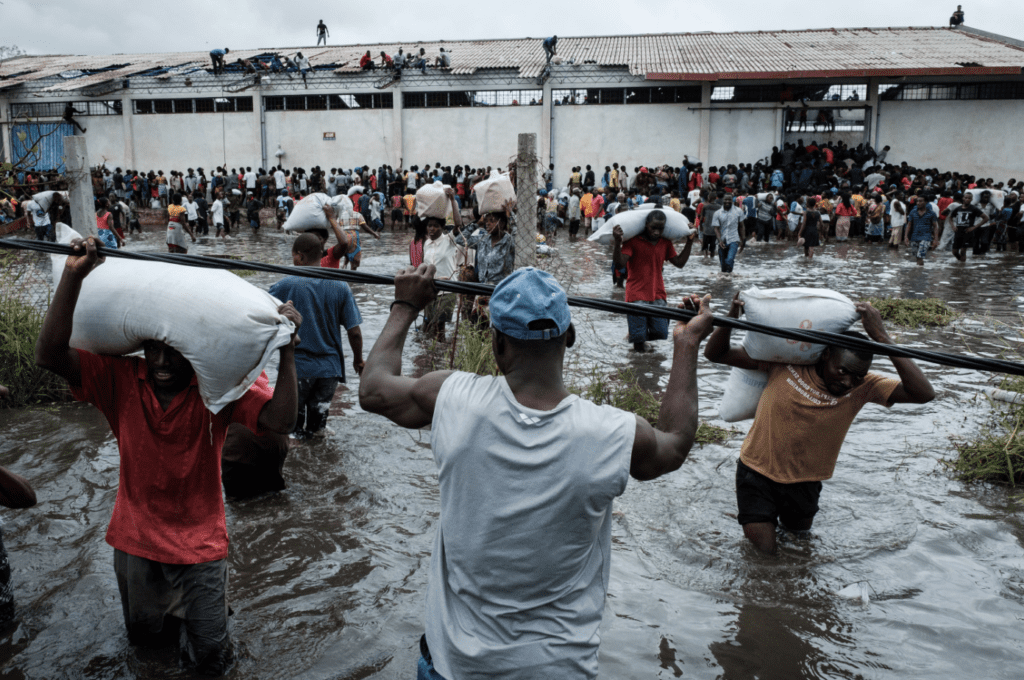
Once again, Mozambique is experiencing deadly climate-related floods. Between 9 and 26 January, about 692,522 people (151,962 families) were affected across southern and central Mozambique, mainly in Gaza (75%), Maputo and Sofala provinces, where 12 people died, 45 were injured, and four remain unaccounted for. The floods destroyed or damaged more than 4,000 homes and flooded almost 155,000 others.

According to the Mozambique Disaster and Risk Management Institute, since the beginning of the rainy season in October, 137 people have died and 800,000 people have been affected. About 72,000 homes were destroyed, and essential infrastructure, including roads, bridges, health care facilities, agricultural land and schools, was damaged.

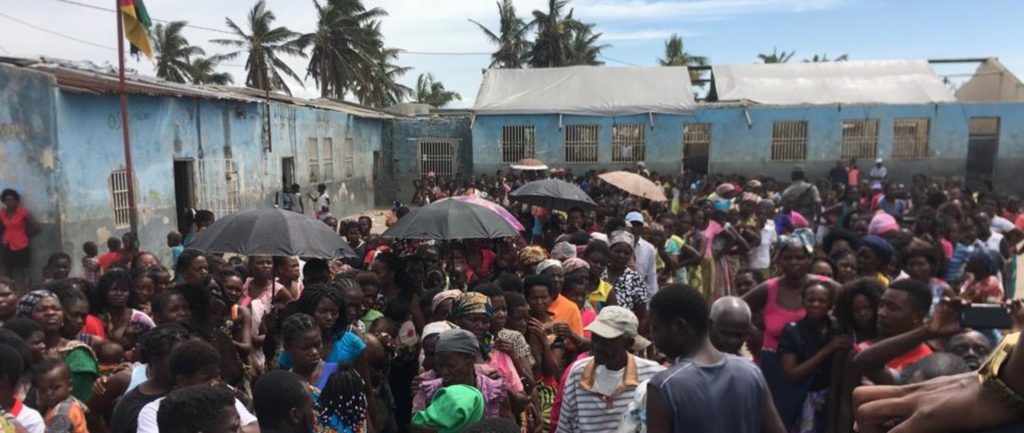
Pictures taken by activists in different communities in Sofala province, Mozambique in the weeks after the cyclone.

The country will need $644-million to rebuild its essential infrastructure washed away by the rains, which are expected to continue, with the situation likely to worsen.

Despite its insignificant greenhouse gas emissions (60.26 megatons of CO2, about 0.11% of the global total, in 2024), Mozambique is among the top 10 countries most severely affected by climate change and natural hazards. Climate projections indicate that Mozambique’s land surface temperatures are likely to keep rising.

Unprecedented warming

As Trump fiercely opposes renewable energy, the world is warming at an unprecedented rate. After record heat in 2024, the first year to exceed 1.5°C above pre-industrial levels, the critical temperature threshold set in the Paris Agreement, 2026 is likely to be the fourth year in succession with high temperature levels (at least 1.44ºC, above the pre-industrial levels).

Besides Trump’s obstruction of climate action and the devastating effects of climate change, research has shown that fossil fuel companies were responsible for half of all greenhouse gas emissions globally.

According to a recent update to the Carbon Majors’ database, state-owned companies comprised 17 out of the top 20 emitters. All 17 companies are controlled by countries that refused the proposed phase-out plan at COP30, including Saudi Arabia, Russia, China, Iran, the United Arab Emirates and India.

If the world wants to address global warming, unlike the outcome of COP30, at which world leaders failed to commit to a phase-out roadmap, the transition to renewable energy produced in a manner consistent with human rights is paramount, and it must be just.

As reflected in Amnesty International’s COP30 outcome analysis, this must also be accompanied by, inter alia, the operationalisation of the Fund for Responding to Loss and Damage, to meet the needs of vulnerable nations such as Mozambique, which is among the most affected by climate change impacts and is currently experiencing the unjust impact of climate change.

Higher income historical emitters must:

  • Provide technical and grant-based or non-debt financial assistance to support Mozambique’s mitigation and adaptation efforts; and
  • Provide reparations for loss and damage due to irreversible climate harm, such as the recent floods.

On its side, Mozambique must:

  • Invest in more robust emergency disaster response systems and provide remedies to individuals or groups affected by the floods; and
  • Embark on an equitable transition away from fossil fuels and invest in adaptation. DM

Tigere Chagutah is the regional director for Amnesty International East and Southern Africa.

This opinion piece first ran in South Africa’s Daily Maverick.

The post Trump’s anti-green stance leaves Mozambique at mercy of climate crisis appeared first on Amnesty International.