
Amnesty International to close its Hong Kong offices

Amnesty International will close its two offices in Hong Kong by the end of the year, the organization announced today.

The local ‘section’ office will cease operations on 31 October while the regional office – which is part of Amnesty’s global International Secretariat – is due to close by the end of 2021. Regional operations will be moved to the organization’s other offices in the Asia-Pacific.

“This decision, made with a heavy heart, has been driven by Hong Kong’s national security law, which has made it effectively impossible for human rights organizations in Hong Kong to work freely and without fear of serious reprisals from the government,” said Anjhula Mya Singh Bais, chair of Amnesty’s International Board.

“Hong Kong has long been an ideal regional base for international civil society organizations, but the recent targeting of local human rights and trade union groups signals an intensification of the authorities’ campaign to rid the city of all dissenting voices. It is increasingly difficult for us to keep operating in such an unstable environment.”

There are two Amnesty International offices based in Hong Kong: a local membership section focused on human rights education in the city; and a regional office which carries out research, advocacy and campaigning work on East and Southeast Asia and the Pacific. All of the regional office’s work will continue from new locations.

“We are deeply indebted to Amnesty members and staff who over the last 40 years have worked tirelessly to protect human rights in and from Hong Kong. From successfully pushing for the full abolition of the death penalty in Hong Kong in 1993, to exposing evidence of excessive use of force by police during the 2019 mass protests, Amnesty in Hong Kong has shone a light on human rights violations in the darkest of days,” said Agnes Callamard, Secretary General of Amnesty International.

“In the wider region, our research and campaigning has tackled subjects including freedom of expression in North Korea, conscientious objection to military service in South Korea, the right to housing in Mongolia, Japan’s wartime atrocities against “comfort women”, and the crackdown on human rights lawyers in China.

“Moreover, Amnesty International Hong Kong’s education programmes – from classroom talks to a documentary film festival – have enhanced awareness of human rights not only in the city’s schools but among the general public as well. No one and no power can demolish that legacy.”

The national security law, imposed by the Chinese central government, was enacted on 30 June 2020. It targets alleged acts of “secession”, “subversion of state power”, “terrorist activities” and “collusion with foreign or external forces to endanger national security”. 

Its sweeping and vaguely worded definition of “national security”, which follows that of the Beijing authorities, has been used arbitrarily as a pretext to restrict the human rights to freedom of expression, peaceful assembly and association, as well as to repress dissent and political opposition.

Amnesty documented the rapid deterioration of human rights in Hong Kong one year after the enactment of the national security law in a June 2021 briefing.

“The environment of repression and perpetual uncertainty created by the national security law makes it impossible to know what activities might lead to criminal sanctions. The law has repeatedly been used to target people who have upset the authorities for any number of reasons – from singing political songs to discussing human rights issues in the classroom,” said Anjhula Mya Singh Bais.

“The pattern of raids, arrests and prosecutions against perceived opponents has highlighted how the vagueness of the law can be manipulated to build a case against whomsoever the authorities choose.”

A government crackdown targeting activists, opposition politicians and independent media has recently expanded to include civil society organizations. At least 35 groups have disbanded since the law was enacted, including some of the city’s largest unions and activist groups.

“There are difficult days ahead for human rights in Hong Kong, but Amnesty International will continue to stand with the people of Hong Kong.  We will fight for their rights to be respected and we will be vigilant in our scrutiny of those who abuse them,” said Agnes Callamard.

“While leaving the city that we have called home for decades is devastating, we do so proud of our achievements over that time, and confident that the strength of Amnesty’s 10 million-plus supporters worldwide will enable us to continue our work together to end human rights abuses everywhere.”

Background

Amnesty International is a global human rights movement of 10 million people, with operations in more than 70 countries. The organization holds governments around the world accountable to equal standards under international law.

Amnesty’s local Hong Kong section works principally on building awareness of human rights issues in the city and is funded primarily by individual donations from the Hong Kong public.

The Hong Kong regional office – which has a sister location in Bangkok – conducts research, campaigning and advocacy work across the region including on mainland China, Taiwan, Japan, South Korea, North Korea, Mongolia, Myanmar, Thailand, Viet Nam, Cambodia, Laos, Indonesia, Philippines, Brunei, Singapore, Timor-Leste, Australia, New Zealand, Papua New Guinea and the Pacific islands.

The overwhelming majority of Amnesty’s income comes from individuals the world over. These personal and unaffiliated donations allow the organization to maintain full independence from any and all governments, political ideologies, economic interests or religions. Amnesty neither seeks nor accepts any funds for human rights research from governments or political parties.

The post Amnesty International to close its Hong Kong offices appeared first on Amnesty International.
Cuba: Rejection of request to protest is yet another example of intolerance of freedom of expression

In light of the Cuban government’s negative response to requests from civil society to hold a Civic March for Change, planned for 15 November, to call for the release of activists detained for exercising their rights, including following the historic protests of 11 July, as well for human rights to be respected and for differences to be resolved through dialogue, Erika Guevara-Rosas, Americas director at Amnesty International, said:

“Groups of people from various provinces around the country have been submitting requests in recent weeks to different local governments asking for authorization to carry out peaceful marches, organized in a clearly defined way in a legitimate exercise of their right to freedom of expression. Instead of guaranteeing these rights, President Miguel Díaz-Canel’s government has declared these civil society marches ‘illegal’ and ‘unconstitutional’, once again violating the right to peaceful protest in Cuba.”

The international community must not forget the hundreds of people detained during the historic protests on 11 July 2021 simply for peacefully exercising their right, as well as the six people named prisoner of conscience by Amnesty International shortly afterwards

Erika Guevara-Rosas, Americas director at Amnesty International

“Amnesty International has received reports that activists have been arbitrarily detained and that people who have responded to the Archipelago group’s calls to demonstrate have been harassed, intimidated and put under surveillance by members of the security forces. This response by the authorities is consistent with the policy of repression, applied for decades in Cuba, which criminalizes peaceful protest and imprisons and ill-treats Cubans from all walks of life solely for expressing their opinions. We will be monitoring the actions of the authorities, to denounce any act of repression against protesters.”

“The international community must not forget the hundreds of people detained during the historic protests on 11 July 2021 simply for peacefully exercising their right, as well as the six people named prisoners of conscience by Amnesty International shortly afterwards, as a symbolic gesture towards the many hundreds more who likely deserve this designation, who must be released immediately and unconditionally.”

For more information or to arrange an interview, please contact Duncan Tucker: duncan.tucker@amnesty.org

The post Cuba: Rejection of request to protest is yet another example of intolerance of freedom of expression appeared first on Amnesty International.

Israel/OPT: Designation of Palestinian civil society groups as terrorists a brazen attack on human rights

The Israeli Defense Ministry on 19 October 2021 issued a military order declaring six Palestinian civil society organizations in the Occupied Palestinian Territory to be “terrorist organizations.” The groups are Addameer, al-Haq, Defense for Children Palestine, the Union of Agricultural Work Committees, Bisan Center for Research and Development and the Union of Palestinian Women Committees.  The designation, made pursuant to a 2016 Israeli statute, effectively outlaws the activities of these civil society groups. It authorizes Israeli authorities to close their offices, seize their assets and arrest and jail their staff members, and it prohibits funding or even publicly expressing support for their activities.

Human Rights Watch and Amnesty International, who work closely with many of these groups, said in a joint statement:

“This appalling and unjust decision is an attack by the Israeli government on the international human rights movement. For decades, Israeli authorities have systematically sought to muzzle human rights monitoring and punish those who criticize its repressive rule over Palestinians. While staff members of our organizations have faced deportation and travel bans, Palestinian human rights defenders have always borne the brunt of the repression. This decision is an alarming escalation that threatens to shut down the work of Palestine’s most prominent civil society organizations. The decades-long failure of the international community to challenge grave Israeli human rights abuses and impose meaningful consequences for them has emboldened Israeli authorities to act in this brazen manner.

How the international community responds will be a true test of its resolve to protect human rights defenders. We are proud to work with our Palestinian partners and have been doing so for decades. They represent the best of global civil society. We stand with them in challenging this outrageous decision.”

The post Israel/OPT: Designation of Palestinian civil society groups as terrorists a brazen attack on human rights appeared first on Amnesty International.

100 Day Countdown

In September 2021, Amnesty International launched The 100 Day Countdown. Our campaign calls on states and pharmaceutical companies to share vaccines with low and lower-middle income countries, so that millions more people can be protected from Covid-19 in 2021.

More than 1.2 billion additional people in low and lower-middle income countries could be vaccinated by the end of the year, if rich countries and vaccine makers agreed to redistribute more fairly. Are they up to the challenge?

Background: Scandalous inequality

An end to the Covid-19 pandemic is in sight. For almost a year now, we have had the safe and effective vaccines we need to finally bring this virus under control.

But we won’t beat this pandemic until everyone has access to a vaccine. Not just people in rich countries, whose governments have struck deals with a handful of pharmaceutical companies – everyone. And right now, that moment is a long way off.

As of late October, 63% of people in high-income countries are fully vaccinated. But elsewhere it’s a very different story:

  • About half the global population has not received a single dose
  • Just 1.4% of people in low-income countries, and 17.5% in lower-middle income countries, are fully vaccinated
  • Only 2.8% of people in low-income countries have received at least one dose, and 35.6% in lower-middle income countries. In high-income countries, it’s 70.5%.

[* Source: Our World in Data. All figures as of 21 October 2021]

The unequal global roll-out of Covid-19 vaccines is a stark reminder of how the pandemic has magnified existing inequalities. While Europe, the US and a handful of other states emerged from lockdowns in the summer of 2021, parts of Africa, Asia and Latin America were plunged into renewed crises.

Meanwhile, the threat of new variants, which spread more easily among unvaccinated populations, remains. If we continue down our current path, the end of the pandemic will remain a glimmer on the horizon.

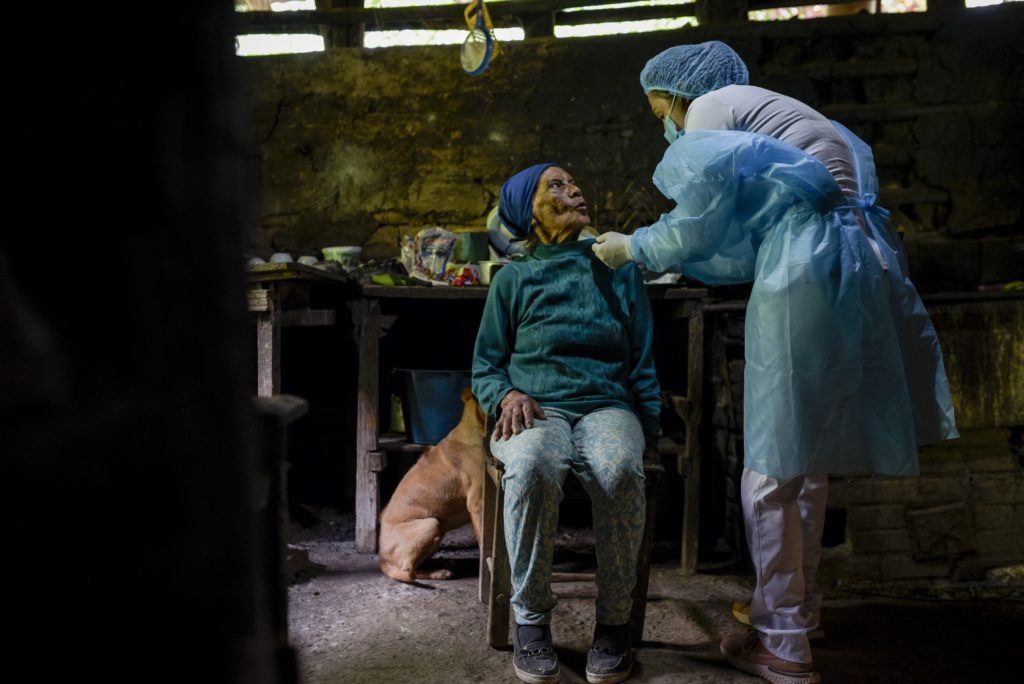
CHAGUANI, COLOMBIA – APRIL 08: Elvira Bermúdez, 90, receives the second dose of the Novavax vaccine in the kitchen of her house during the rural vaccination day on April 08, 2021 in Chaguani, Colombia

Who is responsible?

This shameful inequality, which is stalling our progress against Covid-19, was not inevitable. It is a manufactured crisis, brought about by the decisions key pharmaceutical companies and wealthy governments have made. There are enough vaccines to go round – but they’re not being shared.

Despite receiving billions of dollars in government funding, most pharmaceutical companies have insisted on maintaining control over production, which stunts the global supply of vaccines.

By refusing to waive intellectual property rights or share their technologies, most western vaccine developers have blocked other companies from manufacturing much-needed doses.

Intellectual property rights also mean companies can set the price of vaccines. Unsurprisingly, many have chosen to sell them at sky-high prices, mostly to wealthier countries.

Hoarding

Since the very beginning of the pandemic, wealthy states have been hoarding vaccines by buying up almost all the world’s supplies. Many now have a significant surplus of doses.

A conservative estimate by data science company Airfinity found that by the end of September 2021, wealthier states had more than 500 million excess vaccine doses in stock.

This includes:

  • 174 million+ among EU states
  • 160 million+ in the US
  • 140 million+ in China
  • 26 million+ in the UK
  • 16 million+ in Canada

These stockpiled doses are gathering dust while millions of at-risk people worldwide remain unprotected against Covid-19.

We can still fix this!

In July, a task force led by the World Health Organization (WHO) set a target to vaccinate 40% of people in every country by the end of 2021. But so far, less than 10% of people in low and lower-middle income countries are fully vaccinated.

On 21 September Amnesty International launched the 100 Day Countdown,  calling on states and pharmaceutical companies to take urgent action to meet that lifesaving target.

We calculated that if 2 billion vaccines were delivered to 82 low- and lower-middle income countries, an additional 1.2 billion people could be fully vaccinated by the end of 2021. That’s the number of vaccinations needed in for the WHO to meet its 40% target in these countries.

Airfinity estimates that between 100,000 and 225,000 lives can be saved for every 100 million doses delivered – meaning that meeting this target could save at least 2 million lives.

Amnesty found that this could be achieved if:

  • Pharmaceutical companies deliver 50% of vaccines they produce between 21 September and 31 December to low and lower-middle income countries. More than 2.6 billion vaccines could be provided in this way.
  • States redistribute the hundreds of millions of surplus vaccines currently in their stocks. Right now, more than 500 million vaccines could be made available immediately if Australia, Canada, China, the EU, Japan, UK, and US, redistributed their spare vaccines.

The World Health Organization and the UN High Commissioner on Human Rights have expressed strong support for the 100 Day Countdown. You can sign the petition here.

Is this realistic?

Our analysis showed that there are enough vaccines available to meet the 40% target, if states redistribute surplus doses, and companies prioritise deliveries to COVAX, the African Union and other mechanisms benefiting lower-income countries.

Many lower-middle income countries have already given one dose to over 20% of their populations – showing that systems are already in place in these countries. Others may need additional resources, support and time to be able to implement vaccine rollouts effectively – so it is also crucial that assistance is provided to ensure effective distribution systems.

What about people in wealthy countries who haven’t been vaccinated yet?

Given the high vaccination rates in higher-income countries, and the fact they have ordered many times more vaccines than required, redistributing doses should have no significant impact on vaccine access in these countries.

Countries with surplus vaccines have already inoculated the most at-risk people in their populations. Many are now giving booster jabs to these groups, and offering the vaccine to teenagers and schoolchildren. Meanwhile, in other countries, health workers, older people and those with serious health conditions are still waiting.

How much have pharma companies done to deliver vaccines more fairly?

WHO has set up a number of initiatives to encourage technology sharing and boost supply, but pharma companies have refused to join.

In June, WHO established the mRNA vaccine technology transfer hub in South Africa, so that African manufacturers can make mRNA vaccines like Pfizer/BioNTech and Moderna’s. But these companies have refused to participate – despite knowing full well that doing so could save tens of thousands of lives.

Nor have any of these companies joined the Covid-19 Technology Access Pool (CTAP), established to support the sharing of open and non-exclusive licences. They have also lobbied aggressively against proposals to temporarily lift intellectual property rights, such as the WTO TRIPS Waiver proposed by India and South Africa.

Amnesty International launched a report in September 2021 about vaccine inequality. Among our key findings:

  • Pfizer and BioNTech had so far delivered nine times more vaccines to Sweden alone than to all low-income countries combined.
  • Moderna had not yet delivered a single vaccine dose to a low-income country and had provided just 12% of its vaccines to lower-middle income countries.
  • AstraZeneca delivered the most vaccines to lower income countries, sold at cost price, and had issued some voluntary licenses to other manufacturers. However, it has refused to share its technology with WHO initiatives, and has opposed the WTO TRIPS Waiver.

We need to end vaccine inequality now

Redistributing vaccines will save countless lives lives. It will make all of us safer, because global vaccination will reduce the likelihood of dangerous variants developing. The longer we wait, the more time the virus has to mutate.

States and pharma companies hold millions of lives in their hands. With enough pressure we can ensure they respect everyone’s human rights, no matter where they live.

There is no more time to waste. No one should spend another year living without access to these life-saving vaccines.

The post 100 Day Countdown appeared first on Amnesty International.

Syria: Chilling execution spree with 24 people put to death over last year’s wildfires

Syrian authorities have executed 24 people accused of involvement in igniting the wildfires that ravaged the country last year. In a Facebook post on 21 October, the Syrian Ministry of Justice described the 24 men as “criminals who carried out terrorist attacks that led to deaths and damage to infrastructure and public property”. It also said 11 others were sentenced to life in prison in the same case and nine, including five children, received prison sentences.

Responding to the news, Lynn Maalouf, Deputy Director for the Middle East and North Africa at Amnesty International, said:

“The Syrian state has embarked on a horrifying execution spree which exposes its callous disregard for the right to life and contempt for international law. Our research over the years has shown that death sentences are often passed after secret trials without the most basic fair trial guarantees or based on torture-tainted confessions. The death penalty is a cruel punishment and can never be justified – no matter the offence.

“The Syrian authorities should immediately impose a moratorium on the death penalty and work towards its complete abolition. They should also ensure that all criminal procedures and trials follow international standards of fairness.”

Background

Executions are common in war-torn Syria, although the government tries to keep them behind closed doors. Until this day, the Syrian Penal Code allows for the death penalty and Syria remains a retentionist state.

In 2017, Amnesty International exposed the Syrian government’s campaign of extrajudicial executions by mass hangings at Saydnaya Prison. Before they were hanged, the victims were condemned to death in flagrantly unfair and shambolic “trials” at the Military Field Court located in Damascus, which lasted between one and three minutes. Between 2011 and 2015, as many as 13,000 people, most of them civilians believed to be opposed to the government, were hanged in secret at Saydnaya.

The death penalty is the ultimate cruel, inhuman and degrading punishment. Amnesty International opposes the death penalty in all cases without exception, regardless of the nature or circumstances of the crime; guilt, innocence, or other characteristics of the individual; or the method used to carry out the execution.

The post Syria: Chilling execution spree with 24 people put to death over last year’s wildfires appeared first on Amnesty International.