
Afghanistan: Taliban authorities must reveal Alia Azizi’s whereabouts

The Taliban authorities must urgently investigate the abduction of Alia Azizi, a senior female prison official who has been missing for more than three months after she reported for duty in Herat, and immediately and unconditionally release her if in their custody, Amnesty international said.

Alia Azizi, a member of the ethnic Hazara community and the Head of Herat Women’s Prison, never returned home after going to work on 2 October 2021. Despite several pleas by her family to the Taliban to investigate the case, a veil of secrecy still shrouds her disappearance. 

“It’s been more than three months since Alia Azizi disappeared and her family still remains completely in the dark about her whereabouts. Her apparent abduction takes place within the context of the Taliban illegally detaining members of the former government, journalists, and assorted critics across the country,” said Zaman Sultani, Amnesty International’s South Asia Researcher.

At the Taliban’s request, Alia Azizi returned to her job on 24 August 2021, just nine days after the collapse of the Afghan Government, her brother Mohammad Nazir Arefi told Amnesty International. She was earlier given an amnesty letter, guaranteeing her safety, by the Taliban on 12 August 2021, the day the group took over Herat province.

According to Mohammad Nazir Arefi, the family`s continued pleas to the Taliban authorities in Herat have failed to get the group to initiate an investigation into her disappearance. The only information they have received in response is that she is not with the Taliban. Since Alia Azizi’s disappearance, her telephone has been disconnected and, according to Arefi, when the family tracked her phone conversations through the service provider, Alia’s last communication was with the Taliban’s Head of Herat Prison.

“As the de facto authorities, the Taliban must take immediate steps to conduct a thorough, impartial and independent investigation into this and other cases of enforced disappearance, provide answers to the families whose loved ones are missing, and hold those within its ranks accountable across the country for committing crimes under international law and other serious human rights violations,” said Zaman Sultani.

On 16 January 2022, the Taliban tried to silence women’s protests in Kabul calling for the Taliban to release Alia Azizi.  In dispersing the women protesters, the Taliban used electric devices to shock women protesters and used chemical substances such as pepper spray that caused the protestors severe skin and eye irritation, according to Human Rights Watch. In September, the Taliban’s Ministry of Interior issued an order banning all demonstrations and gatherings “until a policy of demonstration is codified”.  

“It is quite evident that the promises made by the Taliban, particularly to Afghan women and girls are being broken, and there is complete disregard for their obligations under international human rights and humanitarian law. The Taliban must immediately end the use of unlawful force against those exercising their right to peaceful assembly.” said Zaman Sultani.

Amnesty International contacted the Taliban for comment on 19 January; despite them initially promising to investigate the cases with their relevant authorities and get back to Amnesty, they have not provided an answer to Amnesty regarding the case at the time of publication. Amnesty International plans to publish the Taliban`s response if it receives a response to its query.

Background

Alia Azizi is among the few women who, despite the perpetual violence against women in the country, joined the former Afghan National Police. She is a high school graduate and has more than ten years’ experience working in the former police in Herat – including as the Head of Herat Women’s Prison.

Recent Amnesty International investigations have documented that the Taliban has extrajudicially and willfully killed members of the former security forces, government supporters and ethnic Hazaras across the country.

The post Afghanistan: Taliban authorities must reveal Alia Azizi’s whereabouts appeared first on Amnesty International.

A man’s life – and Singapore’s reputation – are in the balance

Nagaenthran K Dharmalingam, who is on death row in Singapore, has few chances left. 

Over the last few months, the fate of the 34-year-old Malaysian, who is set to be executed by hanging for drug-related offenses, has captured international attention. From experts at the United Nations to British billionaire Richard Branson, who tweeted that the case exposed the “fatal flaws” of the death penalty, to members of the public internationally, tens of thousands have urged for his execution to be called off. 

There was collective outrage when, despite medical experts finding that Nagaenthran has an intellectual disability, his family learned that the Singapore authorities had scheduled his execution for 10 November. Concerns mounted when his family reported that his mental condition had deteriorated significantly when they visited him in prison, where he appeared to not fully understand what was happening to him. 

The UN body monitoring compliance of the Convention of Rights of Persons with Disabilities (CRPD), to which Singapore is a party, has stated that the imposition of the death penalty on people whose mental and intellectual disabilities may have impeded their effective defense is prohibited. 

In an unexpected twist, Nagaenthran’s appeal hearing was postponed when he tested positive for Covid-19. However, he has now presumably recovered and his life is again in peril. His appeal hearing has now been re-set to 24 January and, with other legal claims denied, this could be his last chance to be spared execution. 

There is still time left for Singapore to change course and prevent a travesty of justice. Authorities should ensure Nagaenthran has a fair hearing and halt his execution, which would be unlawful under international law in light of the numerous flaws in his case. This includes the fact his sentence was imposed as a mandatory punishment and for an offence that does not meet the threshold of the “most serious crimes” to which the use of the death penalty must be restricted under international law. 

A significant factor remains Nagaenthran’s intellectual disability and mental health state, which may have severely impacted his right to a fair trial including effective defense, up to these last critical stages. 

His intellectual disability would also have impacted his ability to communicate his knowledge of relevant information and his engagement with the authorities, including when questioned by officers of Singapore’s Central Narcotics Bureau, without the presence of a lawyer, after his arrest in 2009 for importing 42.72 grams of heroin. 

This in turn might have had a bearing on the information he provided for what’s called a certificate of assistance, which is needed to qualify for sentencing discretion in Singapore – itself a flawed process. In addition, from information on his present mental state, Nagaenthran’s cognitive function appears to have been severely impaired after years in detention. 

Accommodation measures as required by international law and guidelines on access to justice for persons with disabilities were not yet built into Singapore procedures when Nagaenthran was arrested in 2009. These may also have spared him the death sentence, and should be applied retrospectively to prevent a terrible injustice from taking place. 
 
There is no evidence that the threat of execution acts as a greater deterrent to crime than life imprisonment, something confirmed in multiple studies, including by the UN, across the globe. Singapore, which regularly tops global indexes for standards of living, lags far behind global sentiment against the death penalty. As of today, the majority of the world’s states have abolished this cruel punishment in law for all crimes. The number of states that have voted in favour of UN General Assembly resolutions calling for a moratorium on executions has consistently increased, from 104 in 2007 to 123 at the most recent vote, in December 2020.

Trends have been shifting in the Asia-Pacific region as well, where 20 countries have abolished the death penalty for all crimes and a further eight are abolitionist in practice. In 2020, six Asia-Pacific countries carried out executions – the lowest number since Amnesty International began keeping records. 

Within ASEAN, only five countries in the region − Indonesia, Malaysia, Thailand, Singapore, and Viet Nam − have carried out executions in the period 2016-2020, yet no executions have been carried out in Indonesia since 2016 and Malaysia has been observing an official moratorium since 2018.  

The Singapore authorities should immediately halt plans to execute Nagaenthran and establish a moratorium on all executions as a critical first step. After global outcry from around the world, the life of a man on death row, and Singapore’s human rights reputation including its treatment of persons with disabilities, are in the balance.  
 
Should the courts fail, Singapore’s leaders must be ready to act. Throughout his 18 years in power, Singapore Prime Minister Lee Hsien Loong’s cabinet has not once approved an order for the President to grant clemency. But if there was ever a time to do so, it would be now. 

Rachel Chhoa-Howard is a researcher on Southeast Asia for Amnesty International

The post A man’s life – and Singapore’s reputation – are in the balance appeared first on Amnesty International.

Europe: MEP vote takes ‘significant step’ towards restricting invasive tracking-based advertising

Responding to today’s vote by MEPs to amend the Digital Services Act and regulate tracking-based advertising, Claudia Prettner, Legal and Policy Adviser at Amnesty Tech, said:

“Amnesty International has long been highlighting the dangers of surveillance advertising, and today’s vote represents a significant step towards seriously protecting people’s rights.

“It is encouraging that the amendments outlaw the most invasive practices, including the targeting of children and the use of our most sensitive data. However, there remains more work to be done to fully ban the intrusive practice of surveillance advertising.

“With this vote, MEPs are helping us move towards an online environment that better respects our rights to privacy, freedom of expression and non-discrimination.

“Further meaningful regulation of Big Tech platforms remains crucial to forcing companies – such as Google and Facebook – to address the human rights harms created by their surveillance-based business model.” 

Background 

The Digital Services Act is a proposal by the European Commission, which was submitted to the European Parliament and the European Council on 15 December 2020. Amnesty International has publicly campaigned and advocated for the legislation to include a ban on invasive tracking-based advertising.

In a plenary vote on the Digital Services Act taking place yesterday, the European Parliament passed amendments 499 and 500. Amnesty International had previously called for the Digital Services Act to include a ban on invasive tracking-based advertising to rein in the power of Big Tech platforms, and ensure companies uphold their obligations to respect human rights principles.

In a poll published Amnesty International and Global Witness earlier this week, small business leaders in France and Germany said they wanted alternatives to Facebook and Google’s dominant tracking-based advertising.

The post Europe: MEP vote takes ‘significant step’ towards restricting invasive tracking-based advertising appeared first on Amnesty International.

India Should Stop Using Abusive Foreign Funding Law

End Harassment Against People’s Watch, Other Rights Groups

(Geneva, January 18, 2021) – The Indian government should immediately stop harassing the Centre for Promotion of Social Concerns and its program unit People’s Watch, ten human rights groups said today. The government should stop using the Foreign Contribution Regulation Act and other abusive laws to silence civil society in India. 

The groups are Amnesty International, Asian Forum for Human Rights and Development (FORUM-ASIA), Christian Solidarity Worldwide (CSW), Front Line Defenders, Human Rights Watch, International Commission of Jurists (ICJ), International Dalit Solidarity Network, International Service for Human Rights (ISHR) and International Federation for Human Rights (FIDH) and the World Organisation Against Torture (OMCT) in the framework of the Observatory for the Protection of Human Rights Defenders.

On January 8, 2022, India’s national investigative agency, the Central Bureau of Investigation (CBI) searched the offices of the nongovernmental organisation Centre for Promotion of Social Concerns (CPSC) in Madurai, Tamil Nadu state. Officers from the CBI entered the group’s premises and seized several documents. The CBI officers informed the Centre for Promotion of Social Concerns that they were investigating allegations of fraud and financial irregularities under the Foreign Contribution Regulation Act, a law that regulates foreign funding for Indian nongovernmental organisations. 

The Centre for Promotion of Social Concerns, a prominent human rights organisation better known by its program unit People’s Watch, monitors human rights abuses, works with socially and economically marginalized victims of abuses, including by police, and conducts human rights education and training. In 2016, the Ministry of Home Affairs rejected the group’s application for renewal under the Foreign Contribution Regulation Act. They said it was “on the basis of a field agency report,” which civil society leaders widely believe refer to reports of intelligence agencies or law enforcement personnel. 

When the Centre for Promotion of Social Concerns challenged the government’s decision in the Delhi High Court, the Home Affairs Ministry told the court that the group used foreign funding to share information with United Nations special rapporteurs and foreign embassies, “portraying India’s human rights record in negative light…to the detriment of India’s image.” The government characterized this as “undesirable activities detrimental to national interest.”

The government’s response in court is evidence that it is violating India’s international obligations by targeting a group for promoting respect for international human rights instruments and cooperating with UN human rights mechanisms. The government also alleged financial irregularities even though the Delhi High Court had previously cleared the group of those charges in 2014 after the organisation challenged similar suspensions in 2012 and 2013. The case is still pending. 

The government appears to have routinely disregarded court rulings in favor of civil society organisations and their constitutional rights to freedom of expression and association. The courts have repeatedly reminded the government that in a democracy, peaceful dissent is protected and may not be muzzled. 

The ongoing harassment of the Centre for Promotion of Social Concerns and People’s Watch violates their right to freedom of association and access to funding and appears to be aimed at punishing the organisation for its human rights activities and at intimidating its staff. 

This crackdown is part of a wider repression of civil society in India, including through the use of draconian laws such as sedition and terrorism. Since 2016, the authorities have revoked, suspended, refused to renew the FCRA license of hundreds of civil society groups, or accused them of evading the law and frozen their bank accounts. These include the Indian Social Action Forum, Lawyers Collective, Sabrang Trust, Navsarjan Trust, Anhad, Oxfam India, Greenpeace and Amnesty International India. Groups working on rights of India’s most vulnerable populations such as Dalits, religious minorities, and Adivasis are particularly vulnerable.

Over the years, a number of United Nations bodies have expressed concerns over the use of the Foreign Contribution Regulation Act to silence dissenting voices. In 2016, three UN human rights experts urged the government to repeal the law, stating that it was being used to “obstruct” access to foreign funding and that it “fails to comply with international human rights standards.” In October 2020, the High Commissioner for Human Rights Michelle Bachelet said in a statement that the overbroad and vaguely formulated FCRA provisions are “open to abuse” and that the Act is “indeed actually being used to deter or punish NGOs for human rights reporting and advocacy that the authorities perceive as critical in nature.”

Yet, in 2020, the Indian parliament passed amendments to the law, adding intrusive governmental oversight, additional regulations and certification processes, and operational requirements, which have further adversely affected civil society groups’ access to foreign funding and their ability to carry out human rights work. 

India’s National Human Rights Commission should promptly investigate the government’s refusal to renew the registration of the Centre for Promotion of Social Concerns under the law and take all appropriate and necessary actions to protect human rights defenders and organisations, including their right to freedom of association and access to funding. 

The Indian authorities should immediately put an end to all acts of harassment against the Centre for Promotion of Social Concerns and People’s Watch, drop all complaints against them and renew their registration under the Foreign Contribution Regulation Act, to allow them to resume their human rights work. The government should also amend the Foreign Contribution Regulation Act to bring it in line with international law and human rights standards and stop using it to target defenders and others exercising their basic human rights. It should further ensure that all human rights defenders and organisations are able to carry out their activities without any hindrance or fear of reprisals. 

Signatories:

  • Amnesty International
  • Asian Forum for Human Rights and Development (FORUM-ASIA)
  • Christian Solidarity Worldwide (CSW)
  • FIDH, within the framework of the Observatory for the Protection of Human Rights Defenders
  • Front Line Defenders
  • Human Rights Watch
  • International Commission of Jurists (ICJ)
  • International Dalit Solidarity Network (IDSN)
  • International Service for Human Rights (ISHR)
  • World Organisation Against Torture (OMCT), within the framework of the Observatory for the Protection of Human Rights Defenders

The post India Should Stop Using Abusive Foreign Funding Law appeared first on Amnesty International.

Don’t let Big Tech fool you: Small businesses don’t want surveillance advertising.

by Claudia Prettner (Legal/Policy Advisor, Amnesty Tech), Alia Al Ghussain (Campaigns and Communications Officer, Amnesty Tech) and Nienke Palstra (Senior Campaigner, Global Witness)

Tracking-based advertising has become all pervasive in the digital world. Our new research shows that small businesses know very well how harmful these practices are to human rights but have little alternative.

Big Tech companies claim that regulating tracking-based advertising would harm small and medium-sized enterprises (SMEs). Google and Facebook (Meta) often style their lobbying efforts as being on behalf of the interests of SMEs, claiming they are simply looking out for the small businesses and consumers who use their advertising tools.

To micro-target people, this kind of advertising is based on monitoring people on and offline to develop hyper-specific profiles and provide them with advertisements tailored to match their inferred interests and traits.

Many SMEs use tracking-based advertising to reach new audiences. But pervasive tracking of people’s lives is having adverse effects on people’s rights – including privacy, freedom of expression, and non-discrimination. Furthermore, this toxic practice has allowed Facebook and Google to dominate the internet. This means that many SMEs have no choice but to use these companies’ services, as there is no meaningful alternative.

We wanted to find out from SMEs themselves – are they happy with the tracking-based advertising offered by Big Tech platforms?

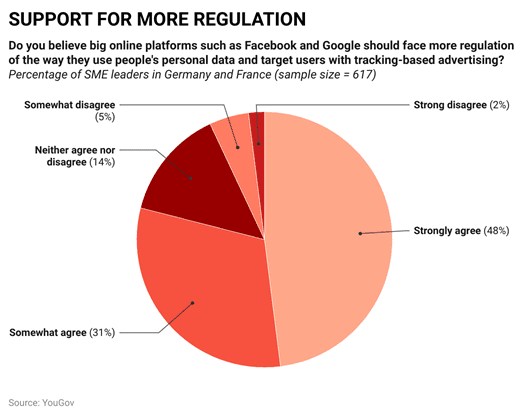
The answer is overwhelming: SMEs don’t like tracking-based ads. That is what a YouGov survey of 617 SME leaders in Germany and France has shown.

The poll commissioned by Amnesty International and Global Witness found that three out of four SME leaders believe that tracking-based ads undermine people’s right to privacy and other human rights.

More than two thirds of the businesses questioned feel that the dominance of Google and Facebook over the digital advertising market means they have no choice but to advertise with them.

Additionally, almost eight out of ten SME leaders believe Big Tech platforms like Google and Facebook should face stricter regulation when it comes to the use of personal data for targeting ads to people.

These results clearly counter the lobby narrative of Big Tech, which defends their business model by claiming that it supports small businesses. On the contrary, the polling shows small business leaders in France and Germany are deeply wary of their ad tech practices – but don’t see an alternative.

Furthermore, the French and German business owners think their own customers are uncomfortable being targeted with ads based on the use of their personal data. Their discomfort is consistent across many data categories: the SME leaders believe their customers to be uncomfortable being targeted using information about their health (67%), their sexual orientation (66%), their race or ethnicity (62%) or personal events in their life (62%).

This reinforces previous polling conducted by Global Witness, which found that the majority of people in France and Germany were opposed to their personal information being used to target them with ads online.

Tech companies should serve the communities who use their platform, rather than using their dominance to force them to choose between access to the digital world, and the enjoyment of their rights. The EU has a unique opportunity to reshape the rules of the internet by bringing in strong regulation on tracking-based advertising in the Digital Services Act (DSA).

Our poll should give legislators pause over any assumption that businesses want tracking-based advertising at any cost. MEPs are voting in plenary on the DSA this week. This vote gives them the opportunity to include stronger rules on tracking-based ads in this piece of legislation. We therefore urge legislators to listen to the voices of civil society and small businesses and end online advertising practices that rely on intrusive surveillance in the DSA.

The post <strong>Don’t let Big Tech fool you: Small businesses don’t want surveillance advertising.</strong> appeared first on Amnesty International.