If the international community continues to drag its feet on the grave human rights violations including lethal violence targeted at protestors that we have seen in Myanmar this past year, many more people will suffer and this human rights crisis could worsen, Amnesty International said today ahead of the one-year anniversary of the 1 February, 2021 coup.
“Enough is enough, the 55 million people of Myanmar cannot afford another year of wavering and sitting on the sidelines by many governments around the world. Concrete action aimed at holding the military accountable and preventing their access to weaponry used to commit widespread human rights abuses must be taken now or the shocking death and misery that have defined life in Myanmar since the coup is likely to persist,” said Ming Yu Hah, Amnesty International’s Deputy Regional Director for Campaigns.
“As the anniversary of the coup draws near, the military has launched indiscriminate air strikes that have killed civilians in the southeast, blocked life-saving aid, and kept up a bloody campaign against activists and journalists, who have been detained and killed in custody. Too many governments continue turning a blind eye to all these atrocities, as they did following the gross violations of human rights against the Rohingya people. As a result, the military has been increasingly brazen, acting with impunity in its efforts to wipe out any resistance to its rule.
“The Myanmar people are desperate and have become disillusioned about help from the international community. But there are clear steps that need to be taken to prevent the Myanmar military from maintaining its dystopian campaign of terror and persecution. The UN Security Council must stop dragging its feet, and instead impose a global arms embargo and targeted sanctions against military leaders, and urgently refer the situation in Myanmar to the International Criminal Court.
“In addition, all local and foreign companies in business partnerships with the military or military-owned businesses need to responsibly disengage, cutting the flow of funds that the military uses to prop up its lethal operations.
“Closer to home, the Association of Southeast Asian Nations (ASEAN) must present a unified front on Myanmar and demand the military to immediately stop the violence against civilians. The ASEAN should also exert pressure on the military to stop blocking humanitarian access and expand on and implement with a clear timeline its five-point consensus adopted last year, which has proved a failure.
“The new year must bring new approaches to Myanmar, placing human rights for the people of Myanmar, accountability, and a zero tolerance to human rights violations and abuses at the forefront.”
Background:
Myanmar’s military seized power in a coup in the early hours of 1 February, 2021. Since then it has killed more than 1,400 people and arrested more than 11,000, with over 8,000 currently in detention, according to the Assistance Association for Political Prisoners. The shocking violence fits into a long history of well-documented crimes under international law against ethnic minorities in the country, including the Kachin, Shan and Rohingya.
The UN Fact-Finding Mission on Myanmar has previously called for Senior General Min Aung Hlaing and other senior officials to be investigated and prosecuted for war crimes, crimes against humanity, and genocide.
The former civilian leader Aung San Suu Kyi has been sentenced to six years on bogus charges and faces more than 100 years if convicted on all the counts against her. Many of her closest allies, including President Win Myint, have also been convicted on similarly trumped-up charges.
Following the violent crackdown on peaceful protesters, some opponents of the military authorities have established the armed People’s Defense Force, which claims to have killed hundreds of soldiers through shootings, bombs and ambushes.
On top of the chaos that has gripped major cities and towns across the country in the aftermath of the coup, economic and food insecurity as well as pandemic-related challenges have caused millions to face hunger. Hundreds of thousands have also been internally displaced while thousands have fled across the border to Thailand.
The Saudi-led coalition used a precision-guided munition made in the United States in last week’s air strike on a detention centre in Sa’adah, north-western Yemen, which, according to Doctors without Borders, killed at least 80 people and injured over 200, Amnesty International said today. The laser-guided bomb used in the attack, manufactured by US defense company Raytheon, is the latest piece in a wider web of evidence of the use of US-manufactured weapons in incidents that could amount to war crimes.
Over the past week, the Saudi-led coalition (SLC) has relentlessly pounded northern Yemen with air strikes — including the capital city, Sana’a — that have inflicted dozens of civilian casualties and destroyed infrastructure and services. The escalation followed Huthi strikes on 17 January that targeted an oil facility in Abu Dhabi, which killed three civilians.
“Horrific images that have trickled out of Yemen despite the four-day internet blackout are a jarring reminder of who is paying the terrible price for Western states’ lucrative arms sales to Saudi Arabia and its coalition allies,” said Lynn Maalouf, Amnesty International’s Deputy Director for the Middle East and North Africa.
“The USA and other arms-supplying states must immediately halt transfers of arms, equipment, and military assistance to all parties involved in the conflict in Yemen. The international community has a responsibility to close the gates to all arms sales that are fueling the needless suffering of civilians in the armed conflict.
“By knowingly supplying the means by which the SLC has repeatedly violated international human rights and humanitarian law, the USA — along with the UK and France — share responsibility for these violations.”
Amnesty International’s arms experts analysed photos of the remnants of the weapon used in the attack on the detention centre and identified the bomb as a GBU-12, a 500lb laser-guided bomb manufactured by Raytheon.
The international community has a responsibility to close the gates to all arms sales that are fueling the needless suffering of civilians in the armed conflict.
Lynn Maalouf, Amnesty International
In September 2021, the US House of Representatives passed a provision to its yearly defence bill ending US support for the SLC’s offensive operations and air strikes in Yemen, yet it was removed from the final bill that later passed into law.
US President Joe Biden has abandoned promises made after first taking office in early 2021 to end US support for offensive operations in Yemen, including arms sales, and to “center human rights in foreign policy” and ensure rights abusers “are held accountable.” Saudi Arabia and the UAE are apparent exceptions. Since November 2021, the Biden administration has approved sales of — and awarded US firms contracts for — missiles, aircraft, and an anti-ballistic defense system to Saudi Arabia, including a $28 million deal for US maintenance of Saudi aircraft in mid-January.
Among these was the approved sale of $650 million in missiles to Saudi Arabia, also from Raytheon, which Congress greenlit despite motions to block it. In December, the administration stated it “remains committed” to the proposed sales of $23 billion in F-35 aircraft, MQ-9B, and munitions to the UAE — despite strong human rights concerns. Continuing to arm the SLC not only fails to meet the US’s obligations under international law, it also violates US law. The Foreign Assistance Act and Leahy Laws both bar US arms sales and military aid to gross violators of human rights.
On 20 January, the Saudi-led coalition launched air strikes on the port city of Hudaydah, killing at least three children, according to Save the Children. Air strikes have also targeted a telecommunication building in Hudaydah, causing a nationwide internet blackout. Yemen was largely without internet access for four days, leaving friends and families out of touch and restricting people’s ability to access or share information on the situation.
Under international humanitarian law, all parties to the conflict have a clear obligation to protect the lives of civilians caught up in the hostilities, including detainees. The deliberate targeting of civilian objects and extensive, unjustified destruction of property are war crimes.
The coalition has denied targeting the detention centre in Sa’adah that was hit in the 21 January air strike. The United Nations described the attack as the “worst civilian-casualty incident in the last three years in Yemen”.
Background
The conflict in Yemen has taken a devastating toll on civilians across the country. The people of Yemen have been exposed to unlawful practices by state and non-state armed groups alike, while violations of human rights and international humanitarian law, including war crimes, have been committed by all parties in the conflict throughout the nation.
One year after the ruling of Poland’s discredited Constitutional Tribunal banning access to abortion in almost all circumstances took effect, its devastating impact on the lives of women and all those in need of abortion care continues. The ruling has increased the extreme barriers women seeking access to abortion face and has had tragic consequences for many of them and their families.
Since the ruling took effect on 27 January 2021, more than 1000 women have turned to the European Court of Human Rights in an effort to vindicate their rights, challenging Poland’s highly restrictive abortion law and seeking justice. These groundbreaking cases mark the first direct challenges to be filed before the European Court against Poland’s abortion law and the 2020 Constitutional Tribunal ruling. The applicants claim that the Polish abortion law causes them grave harm and violates their rights to privacy and freedom from torture and other ill-treatment. The Court is expected to begin ruling on some of these cases: K.B. v. Poland and 3 other applications; K.C. v. Poland and 3 other applications; and A.L.- B. v. Poland and 3 other applications.
Nine leading international human rights organizations have filed third-party interventions to the European Court of Human Rights in these cases, including Amnesty International, the Center for Reproductive Rights, Human Rights Watch, the International Commission of Jurists (ICJ), the International Federation for Human Rights (FIDH), the International Planned Parenthood Federation European Network (IPPF EN), Women Enabled International, Women’s Link Worldwide, and the World Organisation Against Torture (OMCT). The interventions provide evidence and analysis drawing on international human rights law, comparative European law and guidelines from the World Health Organization. They outline the profound implications that highly restrictive abortion laws have on the lives and health of women and girls of reproductive age.
“Restrictive abortion laws such as Poland’s are contrary to international and European human rights standards and public health guidelines. They compromise women’s freedom, dignity, health, and lives. Our organizations’ interventions seek to highlight critical human rights aspects of such restrictive laws, and we are proud to support efforts to hold Poland accountable for these ongoing human rights violations” said the organizations.
Background
Poland has one of Europe’s most restrictive abortion laws. Together with Malta, it is one of only two European Union Member States that has not legalized abortion on request or broad social grounds. In Poland, abortion is only permitted in situations of risk to the life or health of a pregnant woman, or if a pregnancy results from rape. In practice, however, it is almost impossible for those eligible for a legal abortion to obtain one. Every year thousands of women leave Poland to access abortion care in other European countries, while others import medical abortion pills or seek extra-legal abortion in Poland. Polish women, particularly those in difficult socio-economic situations, have to depend on the crucial help from civil society organizations, with often limited resources.
On 22 October 2020, Poland’s discredited Constitutional Tribunal ruled that abortion on grounds of “severe and irreversible fetal defect or incurable illness that threatens the fetus’ life” was unconstitutional. The ruling followed a case filed by members of the Polish Parliament and formally supported by the Prosecutor General. The ruling came into force on 27 January 2021. Both the European Court of Human Rights and the European Commission have found that the Constitutional Tribunal does not meet fair trial requirements due to its lack of independence from the legislative and the executive powers.
The ruling eliminated one of the only remaining legal grounds for abortion under Poland’s highly restrictive law and its entry into force means that there is now effectively a near-total ban on abortion in Poland. Previously, over 90 percent of the approximately 1,000 legal abortions annually performed in Poland were on this ground. The ruling came as the COVID-19 pandemic restrictions made travel for abortion care prohibitively difficult and costly. It spurred the country’s largest public protests in decades, led by women human rights defenders. Activists and women’s rights organizations report that the ruling is having a significant chilling effect as medical professionals fear repercussions even in situations where abortion remains legal. Women human rights defenders and civil society organizations advocating for the ruling to be overturned and for reform of Poland’s abortion law have faced threats of violence and several protestors have been prosecuted.
Read the third-party submissions here.
For more information about the cases filed by 12 Polish women see: K.B. v. Poland and 3 other applications K.C. v. Poland and 3 other applications A.L.- B. v. Poland and 3 other applications
For more information on the developments following the Tribunal’s ruling see e.g.: https://reproductiverights.org/poland-a-year-on-abortion-ruling-harms-women/ https://ec.europa.eu/commission/presscorner/detail/en/ip_21_7070
In protest against a dramatic rise in fuel prices, thousands of people took to the streets of Kazakhstan in early January 2022. Their economic discontent was quickly followed by broader popular calls against corruption, political stagnation, and widespread injustice. Authorities responded with hostility to the protestors, by targeting and silencing journalists and activists, and by suppressing freedom of expression and the flow of independent information.
In an alarming development, as damage to property and the number of casualties grew, troops in the streets were instructed by President Kassym-Jomart Tokayev to open fire without warning. Additionally, when the protests spread and violence broke out in Almaty and elsewhere, the authorities shut down the Internet and disabled social media and other means of digital communication. Amid the violence and chaos of quickly unfolding events, the people of Kazakhstan and the international community were deliberately left in the dark by the government and unable to find the critical information needed to track events on the ground. As local human rights defender Tatyana Chernobil put it, “the full shutting down of the Internet in the entire country for over a day and in some regions longer left people basically incommunicado.” Those who might have been able to provide this information, including independent journalists and human rights defenders, were hampered in their efforts, faced reprisals by the authorities, and were even singled out publicly by the President as supposedly responsible for stirring up trouble.
Today the authorities appear to have restored order and are in full control of the situation in the streets. The government block on the Internet has been lifted and, unlike in the first days of the protests, we are now able to communicate with our colleagues in Kazakhstan. But we are not even close to understanding the full story surrounding these events and there are still many questions that the authorities have left unanswered. In the service of transparency and to quell harmful speculation and fear, President Kassym-Jomart Tokayev and his government should provide immediate, direct and honest answers to these pressing questions.
In the service of transparency and to quell harmful speculation and fear, President Kassym-Jomart Tokayev and his government should provide immediate, direct and honest answers to these pressing questions
The authorities conducted mass arrests in response to both the peaceful protests and the outbreaks of violence and, by their own account, held close to 10,000 people in detention by11 January. Now, the official figure has been reduced. According to the President’s statement on 20 January, the authorities are holding around 2,000 detainees. But urgent questions remain. How many of those detainees were peaceful protesters arrested under Kazakhstan’s strict law on public assemblies? What are the grounds for their detentions and what, if anything, is the evidence against them? And what are the conditions of their detention? Are they being provided access to lawyers? Are they being brought promptly before a court in order to review whether their detention is legal? Are they being allowed to communicate with the outside world and to notify their families or others of their whereabouts? Without clear answers to these questions, the people of Kazakhstan and international community are left fearing the worst.
So far, the authorities have given conflicting and vague messages about who they were targeting while trying to restore order. Given the history of lack of respect for the right to freedom of assembly in Kazakhstan, there is room for deep concern that many of those detained were in fact peacefully exercising their rights and were swept up in an overly aggressive operation by police and other security forces.
Under Kazakhstan’s unduly restrictive legislation, street protest is only allowed with express prior permission from the authorities, and even that is routinely and arbitrarily denied. Spontaneous protest, however peaceful, is “unlawful” in Kazakhstan. Under this law, any of the 1000s of people across the country who joined the protests in January are liable to receive heavy penalties, including fines and up to 10 days of “administrative detention” (up to 25 days if committed repeatedly within a year). This is short-term imprisonment imposed for exercising one’s right to freedom of peaceful assembly.
As information has slowly become available, there have been an increasing number of specific cases of detention around the country that we have been able to confirm. Among these were journalists arrested for reporting on the events from the street, including Lukpan Akhmediarov from Uralskaya Nedelya and Daryn Nursapar from Altaynews. In fact, the Ministry of Information confirmed on 19 January that as many as 18 journalists had been arrested and held for hours – six of them were given “administrative detention.” Activists Marua Eskendirova and Omangeldy Ozazbaev, from Uralsk, were arrested and detained for 20 days each for visiting a colleague in hospital, which the authorities classified as an “unlawful protest.”
The Ministry of Information confirmed on 19 January that as many as 18 journalists had been arrested and held for hours – six of them were given “administrative detention”
There are even more harrowing stories. Environmentalist Artyom Sochnev, from Stepnogorsk, may face criminal prosecution for the “crime” of “inciting social discord” in connection with his solitary picket on 4 January in solidarity with other protesters.
As with questions that remain about the scale and nature of the detentions related to the early January events, we also are left without essential information about the people killed in that unrest. On 15 January the authorities reluctantly announced that 225 people had died in the protests, 19 of whom they said were identified as police or army personnel. But this number may not reflect the full picture. The Coalition of NGOs of Kazakhstan Against Torture said on 19 January that “the exact number of killed, wounded, or otherwise hurt civilians including casualties remains unknown”.
The lack of transparency regarding the circumstances of civilian deaths and any use of lethal force by law enforcement has been especially troubling. “From the human rights’ perspective, the government is yet to explain and account for the restrictions and the countrywide terrorism-related state of emergency” says Tatyana Chernobil, “For instance, the President must explain his order to use lethal force without warning, and the fact that a day earlier, on 6 January, police shot with live ammunition at the obviously peaceful protesters in Almaty and left at least one person dead and many injured”.
The President must explain his order to use lethal force without warning, and the fact that a day earlier, on 6 January, police shot with live ammunition at the obviously peaceful protesters in Almaty and left at least one person dead and many injured
Similarly, the practice of holding detainees incommunicado, together with initial reports coming out about mistreatment of people in detention, has caused concern and consternation. People are looking for members of their families who disappeared during the protests. More reports are emerging of people being shot or beaten by the police and others interrogated in violation of their basic rights for fair trials. For instance, there are already two accounts of torture by the police in Atyrau: one from Zinat Urynbasarova who spent the night in the sports hall of the local police headquarters witnessing torture and other ill-treatment, and another from Sergei Shutov, who was subjected to torture or other ill-treatment in the same place for 11 hours.
In their statement, the Coalition of NGOs of Kazakhstan Against Torture confirm that people have been tortured by the police, but report that not a single official investigation into police conduct has been started. The right to freedom from torture is an absolute right that may not be restricted under any circumstances, including when there is a state of emergency.
The Coalition of NGOs of Kazakhstan Against Torture confirm that people have been tortured by the police, but report that not a single official investigation into police conduct has been started
The vulnerability of detainees to abuse is exacerbated by the endemic problem of violation of the right to a fair trial, not only in criminal but also administrative proceedings. Tatyana Chernobil raised this concern, saying, “The other issue is rapid administrative trials throughout the country without the due process of the law and the ensuing mass jailing, including of several journalists. People reported that hundreds, and probably thousands, of arrested civilians were denied access to their lawyers and families”. Justice and access to effective legal remedies, safeguards against torture and full respect for the right to a fair trial are fundamental for ensuring full and effective accountably for all the abuses committed in Kazakhstan during the turbulent events of January 2022.
The current crisis in Kazakhstan is the result of many years of ongoing and persistent governmental restrictions, the undermining of fundamental human rights and freedoms, and persecution of those who tried to exercise their rights. This must stop! The only way out of the crisis for Kazakhstan is through full respect for all human rights for all people in the country. And right now freedom of expression is paramount: everyone, mostly particularly the people of Kazakhstan, has the right to know precisely what occurred in the past few weeks and what precisely will come next.
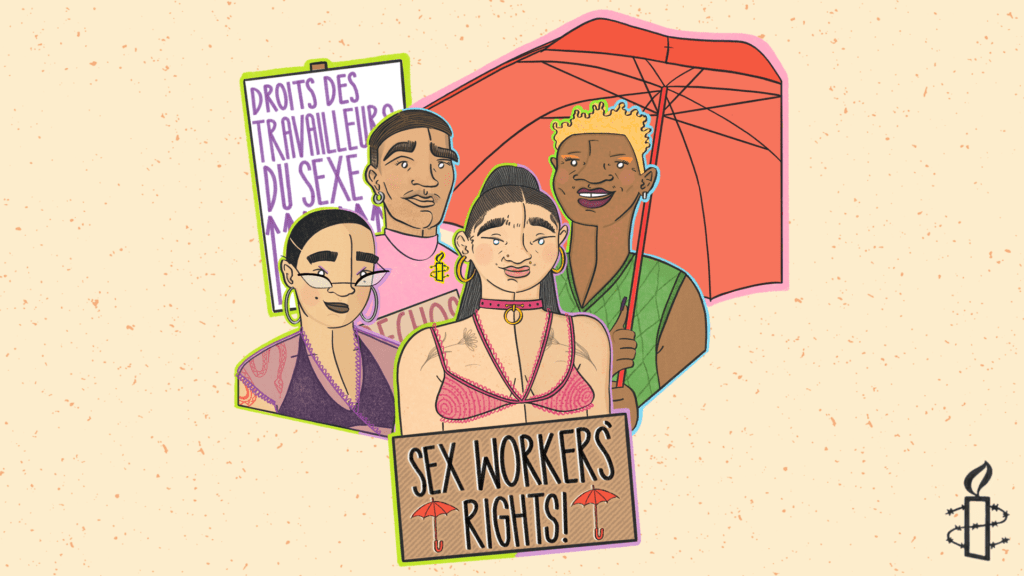
Women’s rights and gender equality issues have exploded into public consciousness in recent years, with the #MeToo movement galvanizing millions of people worldwide to demand change. But one demographic facing such human rights violations every day has struggled to make people hear them and their demands.
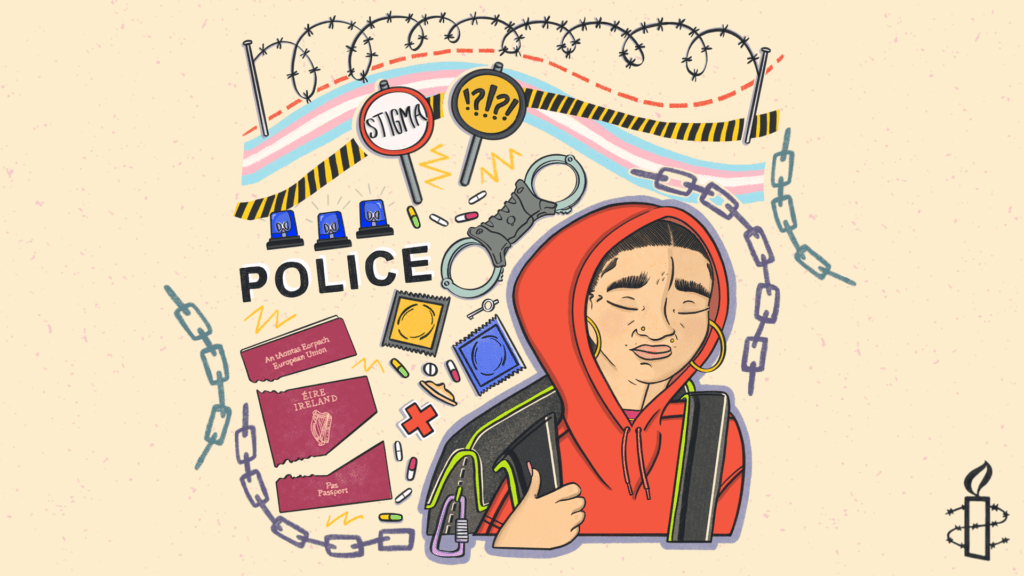
Sex workers are among the most marginalized and stigmatized people in our societies. Harmful laws and practices combined with structural and systemic barriers – including racism, transphobia, gender stereotypes and socio-economic inequalities – are often at the root of high levels of violence and other human rights abuses against them.
In 2017 Ireland reformed the Sexual Offences Act and criminalized the purchase of sex, with the stated aim of better addressing human trafficking for sexual exploitation and making it easier for sex workers to report violence.
Five years on, as the Irish government reviews the operation of its 2017 law, new research by Amnesty International exposes how stigma, and the legal framework in place in Ireland, are causing sex workers harm.
Here sex workers share their lived experiences, insights and demands for a better world, free from unjust criminal laws, violence and stigma; where their human rights and dignity are respected and upheld.*
*NOTE: Amnesty has protected the identity of some of the people who we have spoken to by using a pseudonym in accordance with their wishes.
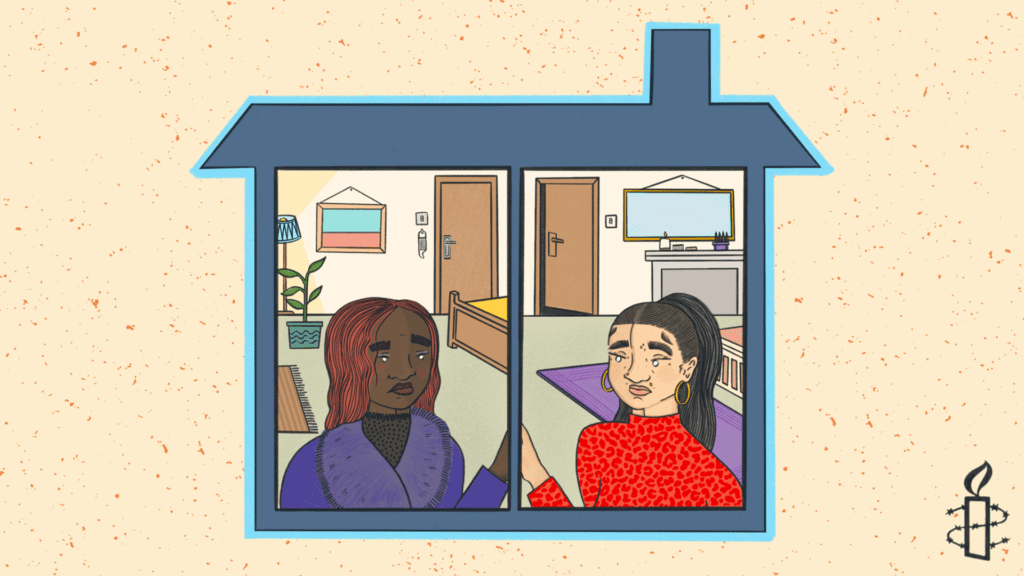
Sex workers often experience horrific human rights abuses. They have told us that in Ireland, this is in part due to the laws that instead of protecting them from violence, endanger, stigmatize and marginalize them.
In Ireland selling sex is legal but the activities around it are not. This includes a ban on buying sex. ”Vanessa”, an Irish street sex worker, says the law fails to make her safer because she has to hide in remote places, take more risks and has fewer chances to seek help:
“I was going down a cul de sac that was discreet, so I wasn’t going to be found by the Guards here, you know, they couldn’t drive by the spot we were in. But at the same time, I had no escape route, if anything went wrong… And that was a very direct result of the Garda presence there targeting of clients… So yeah, they’re not targeting me, but it has as much of an effect on my ability to survive if they want.”
Under the brothel keeping provision in Irish law, sex workers who work together in a residence for safety are viewed as brothel keepers and risk hefty fines and even jail if convicted. Renting accommodation or premises to sex workers can also be prosecuted as a crime under this provision or another one, which criminalizes “living on earnings of prostitution.”.
“It’s just not right … You’re not allowed now to be working where there’s two people, which is ridiculous. Just for safety. As well as for company. …It’s horrendous they’re not allowed to work in pairs.”, says “Ashley”, an Irish woman in her 50s.
“Please take this law out, let us work together, we don’t do any harm… It’s dangerous to work alone. Very dangerous.”, adds “B.”, a 31-year-old Romanian sex worker.
“I was just so paranoid that I’d be caught doing it and obviously I can’t afford to lose my money on fines or anything like that. So, really, that policy has just completely isolated me….”, explains “Poppy”, a 24-year-old Irish student about the impact of the law on her well-being.
Adeline, a trans and intersex activist and PhD student, says she and her wife, who is also a sex worker, were evicted from the flat where they were living and working in Dublin because of these laws.
“Gardaí [police officers] never work alone, but sex workers can’t work together?”
Adeline, trans and intersex activist
“We really just lost everything… We sank everything we had in the space; it was really beautiful. We sank every penny we had into it, like complete morons, and we had nothing left. We considered a planned suicide for a while afterwards more seriously than I had in a long time”.
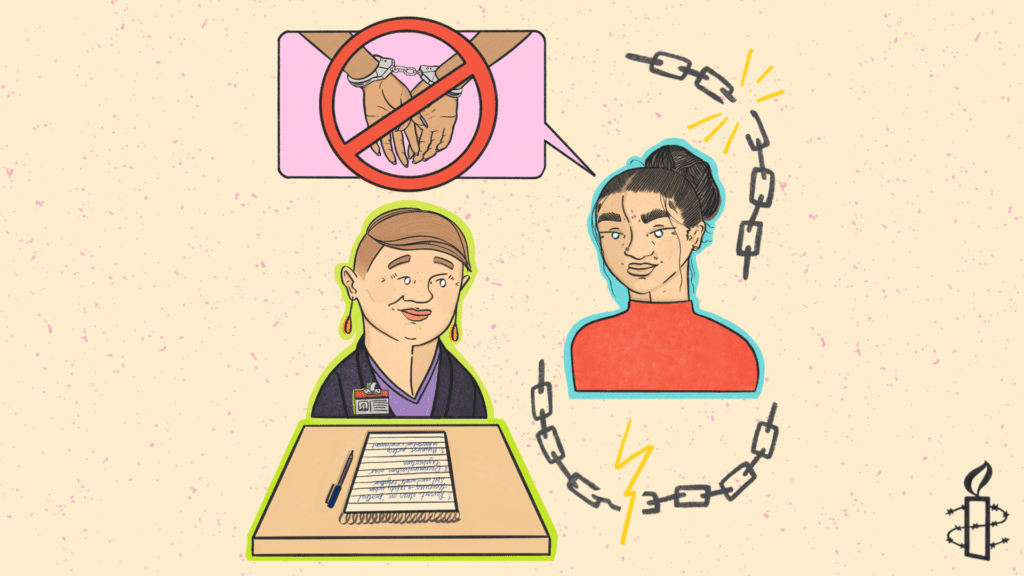
Fear of prosecution and a profound lack of trust in the police affect sex workers’ ability to report crimes against them.
“If today, if I was living in my apartment and there were two or three of us in there doing it and something happened to me, I probably wouldn’t go to the guards because they would raid my house a week later”, says Trish a 35-year-old Irish student.
“Nia”, a 26-year-old mixed-race Irish woman, says racism also plays a key role here:
“It’s a lot of foreign nationals that are being prosecuted for it in Ireland… I am looked at as a foreign national, even though I’m not, so I’m more likely to be prosecuted for that.”
“A.”, a migrant sex worker, works alone and experienced three violent incidents, including oral rape, yet going to the police is not an option for them:
“I want to get Irish citizenship. Any criminal record would be detrimental. If I’m working with someone else, it’s putting me at higher risk. I’d personally rather be at risk with a client than with a police officer… I don’t want to go to jail. I’d kill myself.”
Sex workers are relentlessly campaigning against the pervasive stigma they face that exacerbates gender-based violence and stops them from accessing help and services they are entitled to.
“Few people know I work… If people knew a sex worker was living in there, they’d nearly stone them out of the house.”, says “Ashley”.
“There’s a stigma and people look down on us as trash”, adds “M.R.T.R”, a 40-year-old Irish woman with experiences of drug use and homelessness.
“Vanessa”, describes how the general public perceive street sex workers:
“I think opinions range from being very negative – you know, that ‘you’re scumbags, you’re dirt’, ‘you’re criminals’ – to the kind of pitiful and pathetic image the other people might have. And so, the ‘kind view’ of street workers is one dripping in sympathy.”
Rape is under-reported everywhere, and women and girls are disproportionally impacted by its destructive effects. For sex workers, barriers to reporting gender-based violence, including rape, are further compounded by additional myths that reinforce the harmful belief that sex workers always consent to sex. Consenting to sex doesn’t mean consenting to violence.
Anybody can be raped, even if you are a sex worker.
“Neka”
“I think that there is a kind of perception by a lot of people that if you are a sex worker you can’t be raped. Anybody can be raped, even if you are a sex worker” says “Neka”, a 27-year-old British sex worker living in Ireland.
A seat at the table
For many of the sex workers interviewed for Amnesty International’s report, the central issue about the ongoing review of the law is the lack of consultation of sex workers in the process so far.
How about we try listening to the people who actually know what’s going on?
“Kristina”
“How about we try listening to the people who actually know what’s going on, who know what they’re talking about for once?” “Kristina” is a 22-year-old student and sex worker based in Dublin. Her frustration is shared by many sex workers who too often see how law and policies that affect their lives are decided without consulting them.
The threats sex workers face are not just from clients or individuals in society; the very system they and we live within is at the root of much of the violence they face.
As Amnesty’s report highlights, laws intended to protect them are exacerbating risks they face, alongside other structural and systemic factors like racism, transphobia, stigma and socio-economic barriers. With an issue so complex and intersecting, surely the people most affected by it should be consulted by the State?
Ignoring sex workers’ experiences of violence when developing and reviewing laws and policies that affect them only puts them in greater danger, like “Aoife”, a 29-year-old sex worker who was raped by a client:
“First I was angry at the guy who did this… But then my second reaction was to get really angry at the Guards [Irish police] and really angry at the government and politics and the state. Because I’m in a situation where this was able to happen because of these laws.”
Respect for sex workers’ individual decisions
No one should be coerced to sell sex and everyone should be able to leave sex work if and when they choose to, but those who decide to sell sex for a living are entitled to safety, dignity and for their human rights to be protected.
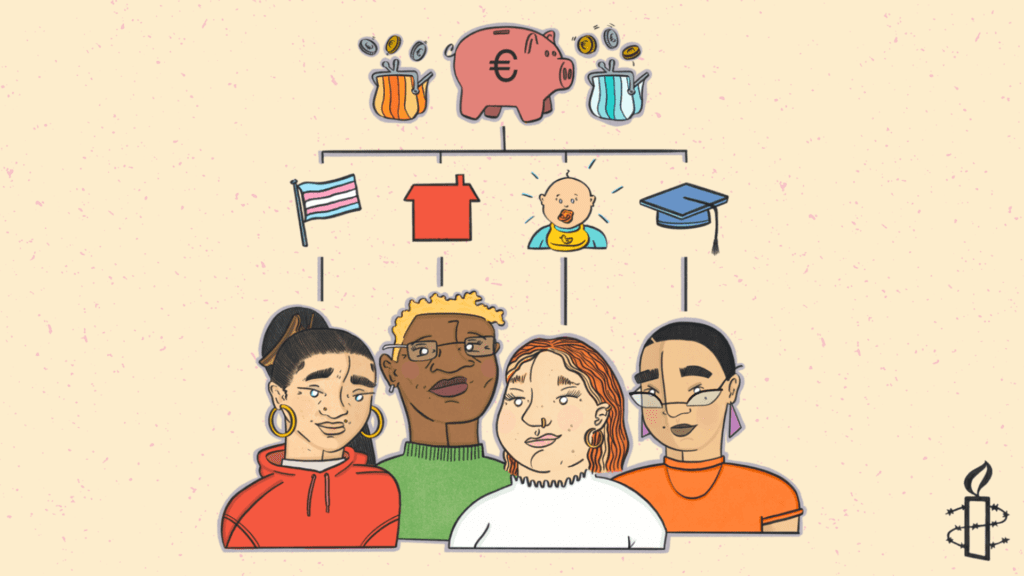
The reasons for doing sex work are often complex and intersecting. Sex workers tell us that difficult circumstances do not eliminate their individual ability to make decisions about their own lives.
“This is such an intersectional issue, where you have issues of gender identity, of migration, of all these different things involved with poverty, homelessness, parenting, single parents, I mean, the list is endless… When someone looks at the situation they’re in and says, Okay, I need to do this kind of work…. I don’t have access to a legal income, or I’m a migrant, or I’m a trans person who’s trying to get access to healthcare, I need to make a certain amount…people are making decisions in those situations”, explains “Aoife”, who is a trans and non-binary person.
“Vanessa”, who has experience of drug use and homelessness says:
“I just couldn’t afford clothes. And I just couldn’t even get the basics. And naturally, I thought, again, I’ll go back to what I know, and because, you know, even after years of supposedly working in services, the only work that I’ve ever really gotten paid for in my life is sex work… And actually, part of going back to street work was because it was like, that’s my home, and I feel pushed out of this society that I’ve been trying to kind of muscle my way in on.”
Adeline, who is trans and intersex, says trans people face systemic discrimination in access to employment and complains that moralistic views and opinions about banning sex work disregard their realities.
“You’ve got a whole bunch of people in the middle class going, ‘I can’t imagine being a sex worker’. Yeah, but if you’re in a position you have to imagine it… because that’s what you got to do to survive. So basically, we’re punishing the poor for the failings of the imaginations of the middle class… We’re doing sex work because we need to survive, because nobody will hire me”.
Similarly, “Kiko”, who has multiple sclerosis, stresses the difficulties she faces to do other types of work because of her disability: “Not only do disabled people have sex, but some of us also sell sexual services because traditional employment is often inaccessible to us”.
Sex workers cite increasing difficulties in accessing and retaining adequate housing in Ireland as one of the reasons some people engage in selling sex. “B.”, who is a single parent with a young baby, managed to receive the COVID-19 Pandemic Unemployment Payment, but says having to pay monthly rent of approximately 1,000 euros with no Housing Benefit is completely insufficient. “This is why I work”, she says.
For other people like “Bianca”, a 34-year-old woman from Brazil, sex work was one of the few options for meeting her financial needs:
“I have been studying English in Ireland at an English college and doing sex work at the same time. I’d be in college from 9am to 5pm and do sex work from 6 to 11:30.”
The COVID-19 pandemic is also influencing individual decisions. “Rana”, a 33-year-old Brazilian man, says:
“Because of the pandemic I lost my job. I was working in a warehouse. And at that time, I had no job and because my friends work as sexual workers and they told me about that, and then I actually started because I had no income. And it was hard to pay bills and everything.”
Support for sex workers’ human rights
Sex workers are entitled to safety, to live free from violence – including sexual violence – and equal access to affordable housing, healthcare, and justice, like everyone else.
this is not a sex workers’ issue. This is an issue of oppression.
“Five”
“It’s less about giving sex workers ‘special this and special that’ … but I think that the core point here that this is not a sex workers’ issue. This is an issue of oppression…A true community is inclusive and supportive”, stress “Five”, a migrant sex worker.
It’s time to stand in solidarity with the growing sex worker-led rights movements in Ireland and elsewhere.
We must ensure they are not subjected to violence, forced labour or trafficking, that States repeal laws that criminalize sex work and harm sex workers, and guarantee their human rights are upheld.
It is time to end gender-based violence, systemic inequalities, poverty and discrimination that keep sex workers and others at the margins.
Fight with them now for a fairer society.
Sex workers demand their rights
Sex workers in Ireland are standing up for their rights: share their stories! It’s time to destigmatise and decriminalise sex work and guarantee everyone’s human rights. https://tinyurl.com/4brrjxmj