Following a speech by Bekir Bozdag, Turkey’s Justice Minister, where he said the government would recommend that trial in abstentia against 26 Saudi nationals charged in the murder of journalist Jamal Khashoggi be suspended and the case be transferred to Saudi Arabia, Agnès Callamard, Amnesty International’s Secretary General said:
“Today is a dark day for those who have spent more three years campaigning for justice for the murder of Jamal Khashoggi.
“By transferring the case of a murder that was committed on its territory, Turkey will be knowingly and willingly sending the case back into hands of those who bare its responsibility. Indeed, the Saudi system has repeatedly failed to cooperate with the Turkish prosecutor and it is clear that justice cannot be delivered by a Saudi court.
“What has happened to Turkey’s declared commitment that justice must prevail for this gruesome murder and that this case would never become a pawn in political calculations and interest?
“Should the government indeed recommend the suspension of the prosecution, this would guarantee impunity – the opposite of justice for Jamal.
“Even though Amnesty International is concerned about trials in absentia, the Justice Minister has paved the path to impunity and injustice but It is still not too late to to reverse this ill-thought through decision.”
Responding to the news that Bahraini human rights defender, Abdulhadi Al-Khawaja, wrongfully imprisoned for the past 11 years, is being denied medical care, Lynn Maalouf, Amnesty International’s Deputy Regional Director for the Middle East and North Africa said:
“We are very concerned about the health of Abdulhadi Al-Khawaja, whom his daughter says is being denied medical treatment for suspected glaucoma, which could lead to blindness، as a result of the injuries he sustained back in 2011 when he was subjected to torture.
“This is the latest show of cruelty by the Bahraini authorities who have a track record of medical neglect of prisoners. Healthcare in Bahrain’s prison system is marred by regular instances of denial of medical care, delay, and arbitrary exercise of authority, which in specific cases rise to the level of intentional ill-treatment.
“We call on the authorities to immediately ensure he receives the medical treatment and care he needs and remind them that medical negligence could amount to a violation of the right to health.”
Background
On 16 February 2022, Abdulhadi Al-Khawaja stood in the prison yard and chanted slogans in solidarity with Palestinians, at the time of Israel’s Prime Minister Naftali Bennett’s visit to Bahrain. His daughter Maryam Al-Khawaja believes that his medical treatment was stopped as retaliation for this incident.
His daughter also reported that on 16 January, he was taken to a hospital appointment and made to sit in the car for three hours, and then brought back to prison without having seen a doctor. He has not been given access to any doctors since.
Abdulhadi Al-Khawaja is among a group of opposition leaders and activists who were arrested in the spring of 2011 simply for taking part in peaceful protests. His arrest at the hands of the security forces was violent, resulting in a broken jaw. He was subjected to additional physical, psychological and sexual torture in detention.
Eleven years later he suffers from chronic pain and requires additional surgery. Despite repeated requests, his medical records have not been shared with his family and authorities have claimed that the records had “gone missing”.
Since the Taliban seized power seven months ago, Women and girls in Afghanistan have almost disappeared from the public life. This includes most of the several million girls who were enrolled in schools, the 88,000 female students who were studying at public and private universities, and the many many women barred from returning to their jobs as judges, prosecutors, senior security officials, businesspersons and teachers.
Previously, women accounted for 36% of media workers, 28% of parliamentarians and the governors or deputy governors in more than half of Afghanistan’s 34 provinces. All have been removed. Their absence is a stark inditement which brutally exposes women and girls’ loss of fundamental rights and freedoms.
This week, the UK Government jointly hosts a virtual pledging summit to raise the £3.3 billion which the United Nations says is urgently needed to respond to the urgent humanitarian crisis in Afghanistan. It’s crucial that during negotiations and discussions with the Taliban, women and girls’ rights are made a non-negotiable issue. This may well be the last chance we have to ensure that half the population are not permanently vanished.
Taliban assurances that this time around they would allow girls to exercise their rights “within Islamic Law” have turned out to be empty words. Rather, they wasted little time in expunging women and girls from the political and public spheres and confining them to their homes.
Within days of the Taliban’s takeover, women were told that they should not show up to work until “proper systems” were put in place to “ensure their safety”. Despite subsequent announcements that women can resume their jobs, various factors prevent many women from doing so. These include recently introduced restrictions on freedom of movement which require women to be chaperoned by male relatives, which in theory should apply for longer journeys or travel abroad but in practice is required also for travel closer to home. The restrictions include a dress code for women when using public transport and in certain other settings and there have already been reports of women being lashed for failing to conform.
Women no longer have a voice in government. Not only have they been excluded from the Taliban’s Interim Government, but the Ministry of Women’s Affairs has also been abolished, and women have been dismissed from local government and senior civil service roles.
According to reports, women who have a public profile routinely face threats, detentions, abductions and little protection in place. Women associated with the previous administration are among those who have been allegedly hunted down by the Taliban. Among those are Banu Negar, a former female police officer who was killed in Ghor Province in early September 2021, and Alia Azizi, the head of Herat Women’s Prison, who remains missing since 2 October 2021 after responding to a request by the Taliban to report for work.
On 23rd March, the Taliban backtracked on their decision to re-open secondary schools for girls denying them education. 17-year-old Nadia, a Grade 12 student in Badakshan province of Afghanistan told Amnesty International: “We were all shattered. Some started crying, some stood silent. As much as I did not want to leave the school, I forced myself to move towards the exit gate. It broke my heart to once again leave the school not knowing if I will ever be allowed to return.”
Women have taken to the streets in protest, unwilling to accept this new reality and in defiance of a ban on demonstrations and public gatherings imposed by the Taliban. But they had to pay a heavy price. Excessive force has been widely used against protestors and, since last two months, at least 33 women’s rights activists and their families were detained or disappeared for speaking out or taking part in protests, and 40 more detentions were reported in the city of Mazar-e Sharif.
Among them are 29 prominent women activists and their children were arrested on 11 February while hiding in a women’s shelter in Kabul and who were detained for over two weeks. Prior to this, in January, Tamana Zaryab Paryani, Parwana Ibrahimkhel, Zahra Mohammadi and Mursal Ayar – were abducted from their homes, workplaces or off the streets and disappeared for 25 days after participating in demonstrations in Kabul. While the Taliban has denied any involvement in these cases, they are in line with what is becoming a well-established pattern of reprisals against and intimidation of women activists, including reports of torture.
At the same time, essential services for women and girls have been dismantled including any protections for survivors of gender-based violence (GBV). Following the Taliban takeover, GBV reporting systems have been suspended, the nationwide network of shelters closed, and essential medical care and other support services are no longer available. In a country where levels of violence against women are among the highest in the world, this puts the lives of millions of women and girls at risk.
But, despite the odds, women in Afghanistan continue to fight. Although fewer in number, street protests still occasionally take place, and Afghan women are finding other ways to keep their cause alive. A new social media campaign – #StandAfghanWithWomen – was launched earlier this year by Afghan women’s groups and activists calling on the international community to support their fight for the restoration of their rights and freedoms.
The failure up until now to leverage decades of support to secure respect for women’s rights in Afghanistan is unacceptable. The international community must use every available lever to pressure the Taliban authorities to respect women and girls’ rights including their rights to education, work and equal participation in political and public life. Once the Taliban can access international aid and if formally recognized by the world – there will be little scope to negotiate for girls’ access to education and respect for all other rights of women and girls. Failure to do so will be a catastrophe we must avoid at all costs, or the next generation of Afghan girls will never forgive us.
Responding to the recent arrests and use of unlawful force by Sri Lankan authorities against protestors gathered outside President Gotabaya Rajapaksa’s residence to agitate against the economic crisis in the country, Amnesty International’s South Asia Regional Director, Yamini Mishra, said:
“The Sri Lankan authorities must not use unnecessary or excessive force to disperse protesters who are suffering the consequences of an economic crisis that is spiraling out of control. Even in instances where protests turn violent, law enforcement officers must only use force where absolutely necessary and it must be strictly proportionate to the situation.
The state must refrain from using force to create fear and stifle dissent.
Yamini Mishra, Amnesty International’s South Asia Director
“According to sources, 54 individuals, including journalists covering the incident, have been arrested, and dozens more injured. Many of them have been assaulted and subjected to torture or other ill treatment in police custody. The protestors also complained that police had recorded their statements without giving them access to lawyers.
“Sri Lankan authorities must refrain from arresting people for exercising their right to peaceful protest and follow due process safeguards such as prompt access to legal counsel. We are very concerned by the human rights violations currently taking place in Sri Lanka as the authorities are using unlawful force and restrictions on movement in an attempt to quell dissent.”
Background
On 31 March, crowds gathered outside the President’s residence to agitate against the escalating economic crisis in the country that is depriving residents of basic necessities, including essential medicines, food, cooking gas and electricity. Thirteen hour power outages have been experienced in some areas, and at least four individuals died while queuing in the heat hoping to purchase cooking gas. Peaceful protests have been witnessed around the country for weeks.
According to media reports and videos circulating online, people were participating in a largely peaceful protest before the police began using tear gas and water cannons to disperse protestors, and it escalated quickly with a bus being set on fire. Dozens of people were injured including civilians, journalists and law enforcement officers. A curfew was also imposed in an attempt to control the situation.
The Russian military’s siege warfare tactics in Ukraine, marked by relentless indiscriminate attacks on densely-populated areas, are unlawfully killing civilians in several cities, Amnesty International said today in a new on-the-ground investigation.
For the first time, Amnesty International field investigators in Ukraine have independently verified physical evidence of banned cluster munitions, the use of which violates international law. They have also collected testimony that documents Russian siege tactics, including unlawful indiscriminate attacks, disruption of basic utilities, cuts to communication, destruction of civilian infrastructure, and restrictions on access to medicine and healthcare.
A defining feature of these cruel sieges is Russia’s relentless indiscriminate attacks, which cause utterly devastating harm over time.
Joanne Mariner, Amnesty International’s Crisis Response Director
In recent weeks, Russian forces have been using inherently indiscriminate weapons – such as cluster munitions, and inaccurate weapons with wide-area effects such as unguided ‘dumb’ bombs and Multiple Launch Rocket Systems (MLRS) salvos – in attacks on densely-populated civilian areas.
As such, Russian forces’ assaults on towns and cities and wanton destruction of the infrastructure of daily life violates international humanitarian law and international human rights law. Launching indiscriminate attacks which kill or injure civilians also constitute war crimes.
“A defining feature of these cruel sieges is Russia’s relentless indiscriminate attacks, which cause utterly devastating harm over time,” said Joanne Mariner, Director of Amnesty International’s Crisis Response Programme.
“For five weeks now, civilians across Ukraine have seen their cities razed day-by-day. Our on-the-ground research has documented how some of society’s most at-risk people are disproportionately suffering as these brutal siege tactics continue.
“Civilians trapped in cities under siege must urgently have access to humanitarian corridors to enable the safe evacuation of all who wish to leave. Humanitarian supplies must also be allowed to reach those who remain behind.”
Amnesty International conducted in-person and remote interviews with people who experienced sieges in five cities, including Kharkiv and Mariupol. Amnesty International’s Crisis Evidence Lab analyzed relevant satellite imagery, and verified videos and photos of the incidents described below. In the coming weeks, Amnesty International will publish further evidence gathered during on-the-ground investigations in Ukraine.
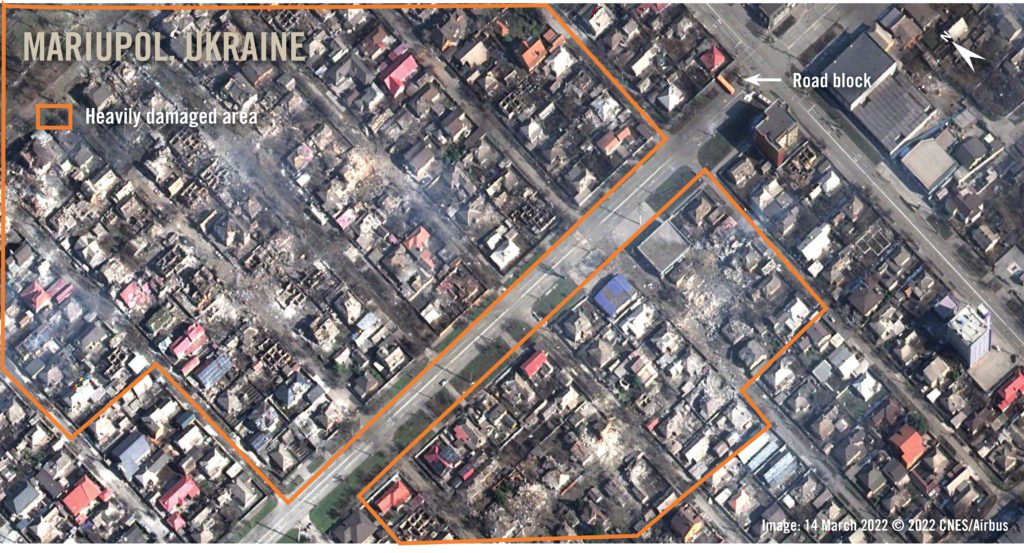
Satellite imagery showing the destruction of Mariupol, March 2022.
Indiscriminate attacks
Russian forces reached the northern suburbs of Kharkiv in the first days of the invasion, and quickly implemented siege tactics, attempting to encircle the city and firing inaccurate weapons into populated areas.
Amnesty International has documented a broad pattern of unlawful indiscriminate attacks across populated areas in Kharkiv. On 28 February, three MLRS salvos struck the northern part of the city and killed at least nine civilians, including children, and wounded at least another 18.
In an attack on the morning of 4 March, Olesky Stovba, a 41-year-old father, was injured by a cluster munition while buying groceries on Zaliznychna Street in Kharkiv’s Mala-Danylivka district.
He told Amnesty International: “We found some food, and we stood outside the food shop and I heard a great sound. I turned myself and I saw a lot of little fire. It was the height of my knees, 50 metres from me. I fell down, and my wife too, and I felt something hit my right leg… I pulled down my trousers and saw lots of blood.”
Surgeons later removed three fragments from his right groin, calf, and foot. Amnesty International’s Crisis Response weapons investigator examined the physical evidence in person, and confirmed the largest fragment was from either a 9N210 or 9N235 cluster munition.
Kharkiv’s Saltivka district has also been repeatedly targeted during the siege of the city. Amnesty International’s Crisis Evidence Lab verified 22 incidents in the district, showing damage to civilian areas including schools, residential blocks, food markets, and a tram depot, between 27 February and 16 March. Photos from strikes depict remnants of Smerch rockets and cluster munitions across the area.
One man*, who has been running a bomb shelter in Saltivka, told Amnesty International: “It has become my new reality — shootings and bombings, helping older women out of the rubble, no gas, no water, no electricity. Once every three days, we boil ice for water. There are 300 people in the shelter. The majority are older, fragile, [they have] asthma, diabetes. There are some who haven’t left the shelter in three weeks. The biggest problem in Saltivka is that the older people die for lack of medicine, from shock, from a heart attack. It is important to get them in the ground and bury them, it will get warmer soon and they will decompose.”
In a shelter in Lviv, Amnesty International researchers interviewed a 16-year-old girl who had been evacuated alone from Kharkiv. The organization verified a photo showing the remains of a 220mm Uragan rocket that struck close to her family’s apartment complex, which is near a school.
She told Amnesty International: “The missile struck at night, and I smelled the fire and felt the waves. All of my family, we all live in the corridor of the apartment building from the first day of the war.”
Amnesty International has previously confirmed that cluster munitions killed a child and two other civilians taking shelter at a preschool in Sumy Oblast, and documented an airstrike that killed civilians queueing for food in Chernihiv.
Denial of basic services
Communication with civilians in besieged cities is extremely difficult due to disrupted mobile and internet service. Many people spend the majority of their time in underground bomb shelters with weak or no signal. Access to communications and the internet are essential for safety, and for access to vital information regarding possible evacuation routes.
In the cities of Kharkiv and Izium, compounds containing TV towers were damaged by strikes. Open-source research and satellite imagery analysis by Amnesty International shows that Kharkiv's TV tower compound was likely damaged twice between 27 February and 17 March, and service outages were reported from 6 March. A building associated with Izium’s TV tower was damaged on 12 March, then further damaged by 20 March. Open-source reports again confirmed disruption to broadcasting. Many older residents rely on television for news and for emergency information from the government.
Amnesty International previously documented how civilians in Izium are on the brink of a humanitarian disaster as Russian forces have bombarded the town since the invasion began.
Impact on at-risk people
The conflict continues to have a significant impact on older people and people with disabilities, which siege warfare further exacerbates.
Alexander Mihta, a 39-year-old in Kharkiv, is diabetic and has severe trouble walking due to the damage the disease has caused to his feet. He drove his wife and daughter to the Polish border, but then had to stay in Ukraine following the implementation of martial law. His apartment building in Kharkiv was struck by Smerch rockets, which smashed steam pipes, cutting heating and flooding the lower floors. Amnesty International’s Crisis Evidence Lab verified 21 photos that confirmed damage to the residential building. Mihta later escaped to a shelter in Lviv with his father.
He told Amnesty International: “The shelling worsened the whole time. I needed food, so I left and went to shop. I have diabetes and I ran when the shelling worsened, and I twisted my leg. I was trying to get to the bomb shelter but couldn’t. I broke six bones, and they [doctors] want to amputate.”
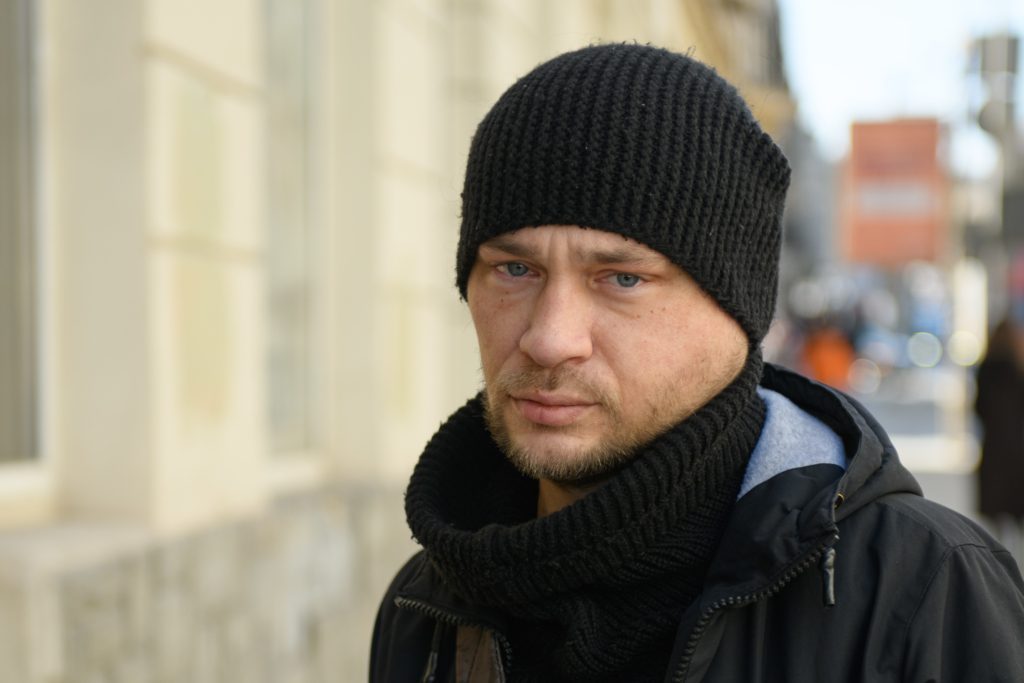
Alexander Mihta.
Amnesty International also interviewed a 61-year-old woman* who has stayed in Kharkiv to care for her mother, aged 84, who has dementia and is unable to travel.
She said: “The older people, we are staying. My mother can hardly move… We are from Luhansk and had to get my mother from Luhansk… We left for my daughter’s flat in Kharkiv and we are stuck here. One in every 24 hours we spend outside.
“I talk to my mother. I take her to the toilet and help her undress. I have to always explain to her why we are in Kharkiv, and why we are in the basement. She has dementia and always forgets why she is in the basement, and I have to tell her all day long. She used to have a decent life, she could walk in the garden. Not anymore.”
Older people and people with disabilities, as well as other groups who may face particular risks and challenges when fleeing, should be prioritized for evacuation, as specified in international humanitarian law. Planning and communication about evacuations and safe humanitarian corridors must also be undertaken in an inclusive way, including by ensuring that information, transportation, and services are all accessible.
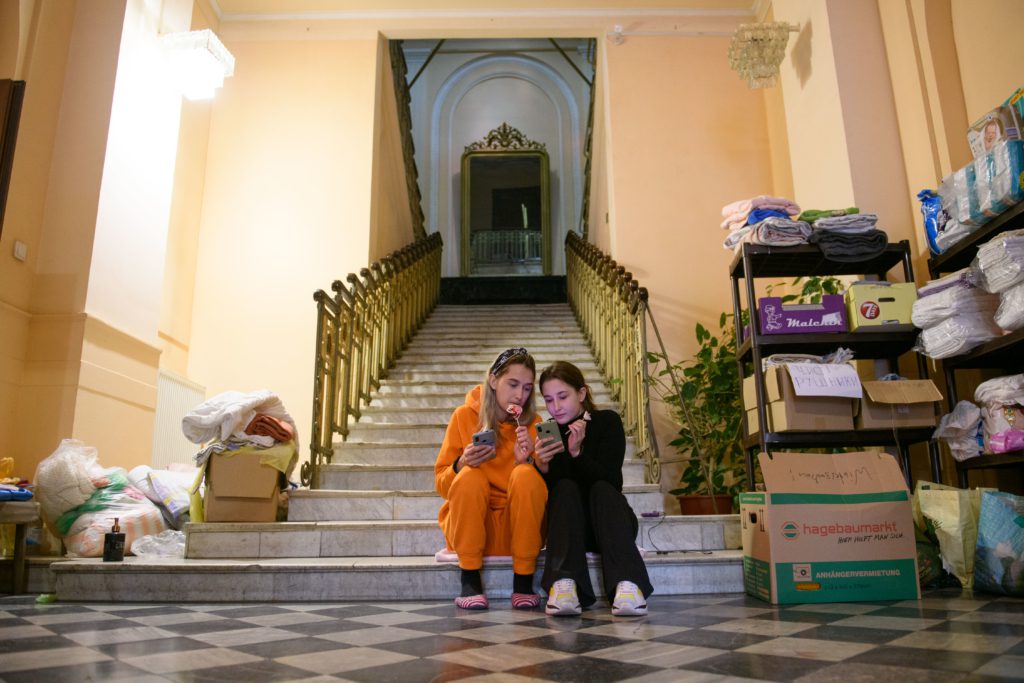
Girls take shelter in Lviv.
STOP THE AGGRESSION AND PROTECT CIVILIANS IN UKRAINE
Right now, people in Ukraine are facing a catastrophic human rights crisis. People are dying, including children, and many thousands of lives are at risk. Take action to demand that the Russian authorities stop this act of aggression and protect civilians now.