Russia: Artist detained amid clampdown on anti-war feminists

The Vasileostrovsky District Court in Saint Petersburg today placed Aleksandra Skochilenko, an activist who replaced price tags in supermarkets with anti-war slogans, into pre-trial detention amid a wider clampdown on a network of feminist-led anti-war activists, Amnesty International said today.

Skochilenko, an artist and musician who performs anti-war songs, was initially detained on 11 April, before being interrogated until 3am the next morning. She was then ordered into pre-trial detention until 1 June after being charged with “discrediting the Russian Armed Forces”. She faces up to 10 years in jail.

“The Russian authorities continue to wage war against the human rights of Russian people. All activists detained for peacefully participating in acts of anti-war dissent must be immediately and unconditionally released. Cracking down on this feminist-led anti-war movement represents yet another desperate attempt to silence criticism of Russia’s invasion of Ukraine,” said Marie Struthers, Amnesty International’s Director for Eastern Europe and Central Asia.

Cracking down on this feminist-led anti-war movement represents yet another desperate attempt to silence criticism of Russia’s invasion of Ukraine

Marie Struthers, Amnesty International’s Director for Eastern Europe and Central Asia

According to the prosecution, Skochilenko’s supermarket activism on 31 March was an act of “political hostility” that “disseminated false information” about the use of Russia’s armed forces.

The court hearing was closed to the public to “preserve the secrecy of the investigation” and “ensure the safety of witnesses.” According to Skochilenko’s lawyer, she was reported to the police by a supermarket customer.

The Feminist Anti-War Resistance

Despite relentless efforts by the state to crack down on anti-war sentiment, shutter or block independent media, and the arrests of tens of thousands of protesters, Russian feminists have continued to play a role in the nation’s anti-war movement.

The replacing of the price tags in supermarkets was one of the anti-war actions promoted by the Feminist Anti-War Resistance (FAS). Launched on 25 February, a day after Russia invaded Ukraine, the group aims to strengthen the anti-war movement by establishing a network of feminist groups that are critical of the conflict. 

“From the outset of the war… we quickly organized ourselves and launched a call stating that the war is contrary to all goals of the feminist movement,” Ella Rossman, one of the movement’s few public faces, told Amnesty International.

From the outset of the war… we quickly organized ourselves and launched a call stating that the war is contrary to all goals of the feminist movement

Ella Rossman, Feminist Anti-War Resistance Representative

FAS supporters have used visual campaigning tools, such as leaflets and anti-war graffiti. They also stamp anti-war slogans on banknotes and print out articles from banned independent media, which remain inaccessible within Russia.

The activists have launched a hotline to offer psychological support to anti-war activists, and an Anti-War Foundation, which helps those who have been fired or expelled from universities over their anti-war views.

By 4 April, FAS said they had installed 500 wooden crosses in 41 cities to commemorate civilian victims of the war, while at least 3,000 supporters have taken to the streets with anti-war slogans on their clothes, in activism known as ‘silent pickets’.

Harsh reprisals

FAS women activists have faced harsh reprisals for their activism. At least 100 women activists have been detained, arrested, searched or threatened by the authorities, according to the group.

Yevgenia Isaeva, an artist from Saint Petersburg, was fined 45,000 rubles ($530) on 30 March, and later detained for eight days under charges of “hooliganism” over her performance art.

Another artist, Yulia Kaburkina from Cheboksary in Central Russia, was detained on 2 April for “discrediting the Russian military” after she also attached paper figurines of people holding anti-war posters to price tag labels in a supermarket.

In a telegram channel, the activists said: “By replacing something very routine with something alien and unusual, we show that there is not a single place in our country that would not be affected by the war, and we do not let people simply close their eyes to what is happening.”

By replacing something very routine with something alien and unusual, we show that there is not a single place in our country that would not be affected by the war, and we do not let people simply close their eyes to what is happening

A member of Feminist Anti-War Resistance

Background

Aleksandra Skochilenko is the second anti-war activist who has been criminally charged and put under arrest for replacing price tags in supermarkets. On 5 April, Vladimir Zavyalov from Smolensk, Central Russia, has been charged with “discreditation of the Russian Armed Forces” under Article 207.3. Overall, more than 20 Russian citizens have been charged under this newly introduced repressive article of the Criminal Code.

STOP THE AGGRESSION AND PROTECT CIVILIANS IN UKRAINE

Right now, people in Ukraine are facing a catastrophic human rights crisis. People are dying, including children, and many thousands of lives are at risk. Take action to demand that the Russian authorities stop this act of aggression and protect civilians now.

The post Russia: Artist detained amid clampdown on anti-war feminists appeared first on Amnesty International.
Pakistan: Immediately release eight people arrested over critical tweets

QUOTE

Responding to the arrest of eight people, all of whom were detained by the Federal Investigative Agency after they published criticism of the state on Twitter, Dinushika Dissanayake, Amnesty International’s South Asia Research Director, said:

“The Pakistani authorities must stop using the draconian Pakistan Electronic Crimes Act to punish people who are simply exercising their right to freedom of expression online. For far too long, successive governments have used this law as a tool to crush peaceful dissent and intimidate supporters of political opposition.

Nobody should be arrested merely for expressing their views — whether online or offline

Dinushika Dissanayake, Amnesty International’s South Asia Research Director

“The eight people arrested across Punjab today must be immediately and unconditionally released. Instead of stepping up their efforts to quash dissenting voices, the Pakistani authorities should end their repressive crackdown on right to freedom of expression.”

Background

On 13 April, the Federal Investigation Agency (FIA) arrested eight people across Punjab. The arrests came after the FIA launched a crackdown on social media activists that the agency believes were involved in a smear campaign against state institutions. The FIA has told the media that the arrests are not related to any political opposition parties.

On 9 April, Imran Khan was ousted as prime minister of the country after a vote of no-confidence in the Pakistani parliament. His exit came just days after he tried to block the vote from taking place — an effort that was ruled to be unconstitutional by the Supreme Court.

Imran Khan and his party, the Pakistan Tehreek-e-Insaf, allege that their removal was a result of collusion between the United States and the opposition, prompting nationwide protests from his supporters. The party’s social media team has since launched a campaign on Twitter that seeks to condemn the army, the courts and the country’s new leadership.

The post Pakistan: Immediately release eight people arrested over critical tweets appeared first on Amnesty International.
South Africa: Migrants living ‘in constant fear’ after deadly attacks

The South African authorities must do more to protect migrants in Diepsloot, Johannesburg, who have repeatedly suffered from violent attacks by anti-migrant vigilante groups, Amnesty International said today following deadly unrest over the past week, which led to the killing of Zimbabwean national Elvis Nyathi.

The killings that have occurred in Diepsloot over recent days are not isolated incidents These attacks represent just the latest wave in a rising tide of violence against migrants in South Africa

Shenilla Mohamed, Executive Director of Amnesty International South Africa

Migrants in Diepsloot, located in the north of Johannesburg, told Amnesty International that they are living in constant fear and that they are being made scapegoats for rising levels of crime and unemployment in the area. 

South African President Cyril Ramaphosa has acknowledged the violence against migrants, especially Zimbabwean nationals, by anti-migrant “vigilante” groups comprised of non-state actors operating outside of the law, who claim to be ridding communities of crime. According to the government, at least seven people have lost their lives at the hands of these vigilante groups.

“The killings that have occurred in Diepsloot over recent days are not isolated incidents These attacks represent just the latest wave in a rising tide of violence against migrants in South Africa,” said Shenilla Mohamed, Executive Director of Amnesty International South Africa.

“These assaults mirror the heavily-orchestrated, anti-migrant attacks we have seen recently in Soweto and Hillbrow over recent months. This ongoing violence also highlights the inaction of police and a lack of political will within government to address the problem. In each case, the deaths of locals and migrants were entirely preventable.”

Killings

The protest was ignited by the alleged murders of seven people in the area. During the unrest, Zimbabwean national, Elvis Nyathi, was burned to death after he failed to present proof of his identity to vigilante groups who demanded to see it. It remains unclear whether anyone has been arrested over his murder.

President Ramaphosa has pledged to boost police capacity to respond to crime around the country, and urged South Africans not to resort to violence, intimidation and extra-judicial attacks against foreign nationals.

‘We are afraid to live here and we don’t feel safe anymore’

Migrants from Zimbabwe and Mozambique told Amnesty International they are terrified of living in Diesploot. The migrants say they feel unsafe in South Africa and face constant harassment from both the police and anti-migrant vigilante groups, who unlawfully demand to see their identity documents.

Joyce Mpofu*, a Zimbabwean mother of two, arrived in South Africa in 2010 and lives in Diepsloot, where she sells vegetables on the street. She told Amnesty International that the past week has been traumatizing. She could only survive by locking herself and her two children in her shack to avoid the violence inflicted against migrants. She said: “We are terrified, and we live in constant fear and we don’t know what to do. We are afraid to live here and we don’t feel safe anymore.”

President Ramaphosa must organize permits [identity documents] for us, so that we can live [freely], because we are working for ourselves and our children who are at school. We cannot go back to Zimbabwe because we cannot survive hunger.

Zimbabwean Migrant

Mpofu and other migrants have appealed to President Ramaphosa, asking him to guarantee their safety and offer proper documentation after their special residence permits expired at the end of 2021. She said: “President Ramaphosa must organize permits [identity documents] for us, so that we can live [freely], because we are working for ourselves and our children who are at school. We cannot go back to Zimbabwe because we cannot survive hunger.”

Another Zimbabwean woman, whose special dispensation residence permit has also expired, who is also a street vendor and has lived in South Africa since 2004, said: “I am no longer free to live here. We no longer work well because we live in fear of what will happen to us next.”

Another said: “I feel pained by what is happening [to us] here, because when I crossed the border to come here, I was coming to work for myself. As you can see, I am selling [vegetables]. I don’t know how to steal. They cannot paint us all with the same brush, of being criminals.”

Salvador Valoyi*, a Mozambican national, said: “It’s painful because they [anti-migrant vigilante groups] see us [as] criminals in this country, when we are trying to make an honest living. We are working for our families here. I did not just wake up one day and decide to leave Mozambique. I left because the situation is tough there and I wanted to work for my family and provide for them. I am not a criminal.”

Violence against migrants in South Africa first erupted in May 2008, when more than 60 people were killed. Since then, attacks against migrants have occurred every year. Amnesty International has repeatedly called for a national strategy to prevent violence against migrants, and an end to the impunity enjoyed by the perpetrators of these fatal assaults.

The fact that President Ramaphosa has condemned the recent killings is a welcome development. He must now take concrete steps to protect migrants, refugees and locals from vigilante groups and ensure that the perpetrators of these heinous crimes face justice

Shenilla Mohamed

“The fact that President Ramaphosa has condemned the recent killings is a welcome development. He must now take concrete steps to protect migrants, refugees and locals from vigilante groups and ensure that the perpetrators of these heinous crimes face justice,” said Shenilla Mohamed.

Background

Migrants from Zimbabwe, many who have been living and working in South Africa for years under previously granted special dispensation residence permits, have fallen into an irregular migration status due to governmental capitulation to anti-migrant sentiment in late 2021 through a decision to suddenly refuse renewal of these permits. Now living in precarious and uncertain conditions, these people have been repeatedly targeted by  violent non-state actors, known as “vigilante groups”, due to deteriorating economic conditions in the country.

The vigilante groups who are orchestrating the violence against migrants have used hashtags such as #OperationDudula and #PutSouthAfricaFirst and have been targeting Zimbabweans and others whose special dispensation residence permits have lapsed. Though the government later reversed that decision and has given Zimbabweans until the end of 2022 to stay in the country while they regularise their status through visa applications, the lack of regular status has made people even more vulnerable to attacks.   In Diepsloot, violent attacks against migrants erupted on 3 April 2022.

In February 2022, similar attacks took place in Soweto, a township in the south of Johannesburg, and Hillbrow, a central business district in the city. Although police were present during these assaults, they failed to respond appropriately.

Operation Dudula, led by Soweto resident Nhlanhla “Lux” Dlamini, began its anti-foreigner campaign in June 2021. Members of the group say they want foreign nationals to leave the country.

*Names changed to protect identity.

The post South Africa: Migrants living ‘in constant fear’ after deadly attacks appeared first on Amnesty International.

Mali. A justice at loss with the crimes against civilians in the central regions

Mali has witnessed increased war crimes and violence against civilians since 2018, particularly in the central regions of the country (Mopti and Segou). Despite commitments and investigations, justice has been slow in coming for the victims and/or their families and impunity still prevails, writes Amnesty International in a new report published on 13 April 2021.

Amnesty International’s 64-page report, Mali. Crimes without Convictions: An Analysis of the Judicial Response to Crimes in Central Mali, reviews the state of investigations into several crimes committed in central Mali since 2018 and identifies various institutional and legal barriers that are contributing to a denial of justice and truth for the victims.

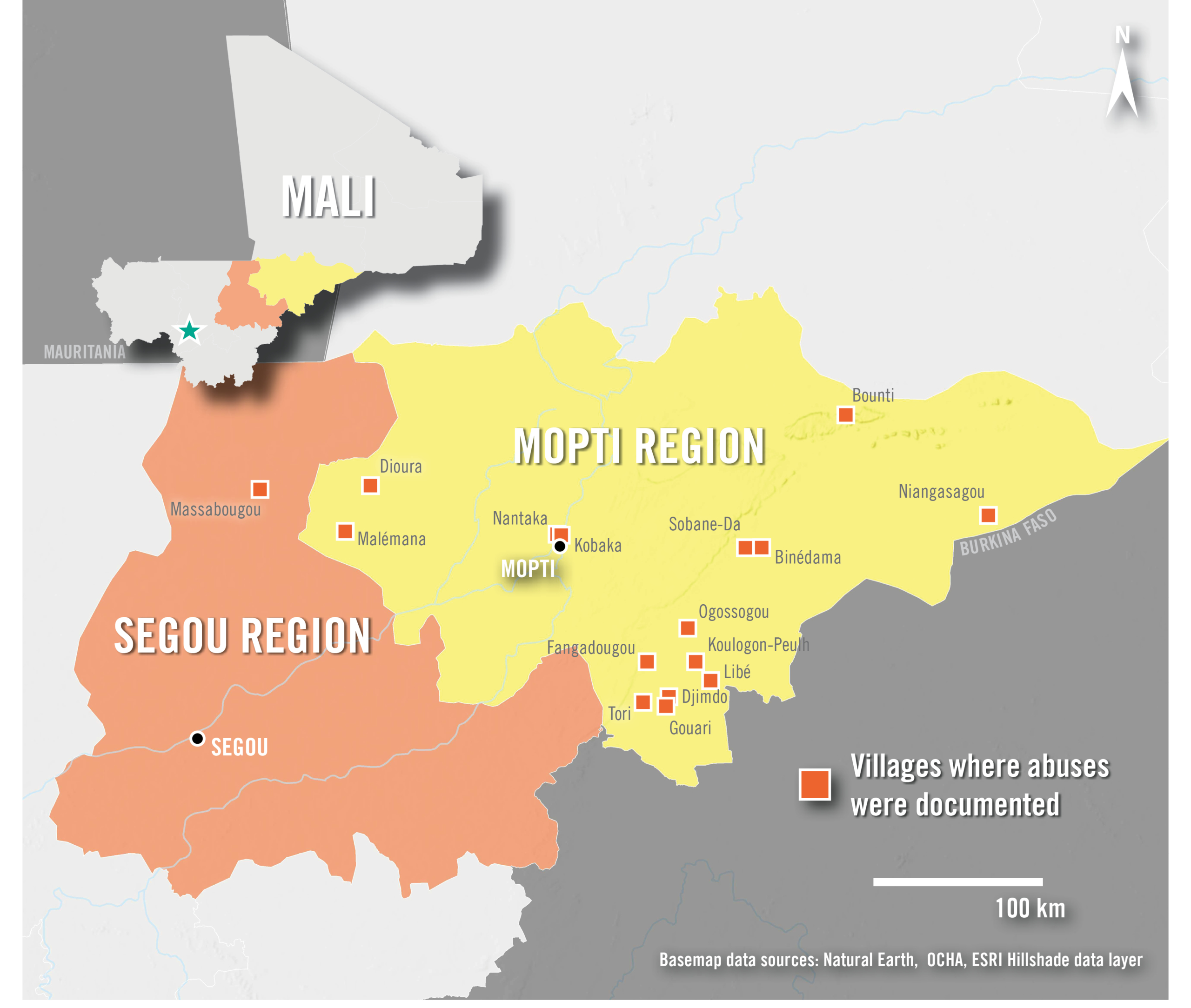
Despite repeated commitments on the part of the Malian authorities, a number of judicial investigations –such as those into the Ogossagou and Sobane Da killings– have made little to no progress and the victims are continuing to demand justice while fearing reprisals in the absence of protection measures.


Map showing some of the villages where serious crimes have been committed since 2018 ©Amnesty International

“Impunity must end if we are to fulfil the right of victims and their families to justice and help ensure that such crimes against civilians are not repeated. The Malian authorities must follow through on their commitments by putting justice at the heart of their actions,” said Samira Daoud, Amnesty International’s Regional Director for West and Central Africa.

While the conflict and insecurity in the centre of the country undoubtedly hampers judicial investigations, this report shows that legislative and institutional reforms, additional technical and financial resources for the judicial system and greater political will are all needed if significant progress is to be made in the investigation and prosecution of crimes under international law, in accordance with international human rights standards.

One of the factors contributing to the impunity for crimes related to the armed conflict is the weakness of the legal framework. The National Concord Law passed in the wake of the 2015 Peace Agreement, establishes amnesties for “acts that may be qualified as crimes or offences (…)” but is ambiguous as to the exact temporal or material scope of such amnesties. These ambiguities need to be clarified to ensure, among other things, that amnesties are not given for serious human rights violations committed in the context of the armed conflict.

“As part of the review of Mali’s main codes of justice, the Malian authorities must bring their legal framework into line with international law and grant civil courts exclusive jurisdiction over crimes under international law.”

Samira Daoud, Regional Director, Amnesty International West and Central Africa

Moreover, while in 2019 the Specialized Judicial Unit responsible for combatting terrorism and crimes under international law (PJS) saw its jurisdiction extended to the entire national territory and all crimes of international law, in practice, the military justice system still exercises its jurisdiction over crimes committed against civilians by military personnel in operations. This is in contradiction with the African Commission on Human and Peoples’ Rights’ Guidelines and Principles on the Right to a Fair Trial and Legal Assistance in Africa (2003), which specify that military courts should only hear cases relating to purely military offences and not crimes committed against civilians.

Other provisions, such as the July 2014 Defence Agreement between Mali and France granting French courts primacy of jurisdiction over “any act or negligence of a member of its personnel in the performance of official duties” may prevent Mali’s justice system from acting on allegations of crimes committed by French military personnel operating in Mali. This is particularly true of the French army’s bombing of a wedding ceremony in Bounti (Mopti region) on 3 January 2021 in which 19 civilians and three suspected members of armed groups were killed, according to an investigation by the United Nations Multidimensional Integrated Stabilization Mission in Mali (MINUSMA).

Barriers to justice that will have to be lifted

Judicial proceedings opened by the Malian judiciary are hampered by insecurity in the centre of the country, which limits access to crime sites on the part of investigators and investigating judges. Judicial staff remain dependent on logistical support from the Malian army and MINUSMA to gain access to certain areas. Requests from judges to execute arrest warrants or to hand over suspects to the courts –especially in the case of military personnel– are not implemented. Several investigations into emblematic cases involving crimes committed since 2018 have, for example, made little to no progress. This is particularly true of investigations into the unlawful killings and extrajudicial executions, some of which constitute war crimes, committed in Ogossagou, (157 people killed in March 2019 and 35 in February 2020), Sobane Da (35 people killed in June 2019), Nantaka (25 people killed in June 2018), Massabougou (9 people killed in June 2020), Binédama and Yangassadiou (37 and 15 people killed in June 2020 respectively).

As testified by one of the judges involved in investigating these cases: “The priority right now is to ensure a state presence [in areas where it is absent], not access to justice. An investigation has been opened but it takes time. These are crimes for which there is no statute of limitations and so the Specialized Judicial Unit have all the time they need. And, let’s face it, in many of these incidents, an investigation is not possible [at this stage].”

The lack of protection for victims and witnesses is another barrier to ongoing investigations because there is a real risk of reprisals. “In the villages, everyone knows each other. There’s no point in kidding ourselves: everyone knows who has spoken to the justice system,” said an investigating judge interviewed by Amnesty International.

At a time when investigations into crimes suffered by the population in the centre of the country are stalled, however, the Malian authorities are expediting legal proceedings for acts allegedly perpetrated in those very same regions for what they call “terrorism” and which do not concern crimes committed against civilians. In October 2021, the Malian authorities held a special trial session during which 47 cases were heard. Some of these proceedings are marred by serious violations of the rights of the accused, who are detained incommunicado by the General State Security Directorate (DGSE), sometimes without charge and possibly suffering torture or other ill-treatment, for weeks or months before being sent to trial. These people often only see a lawyer on the day of the trial and their case is fast-tracked through the court. These practices on the part of the DGSE, an intelligence agency with no connection to the judiciary, are contrary to Mali’s obligations to protect human rights, in particular the right to be detained in humane conditions and the right to a fair trial.

“They kidnap you and you don’t even know who they are. Then the judges play into the hands of the DGSE,” said a civil society actor. “The DGSE isn’t a detention facility, but it is us (the justice system) that keep people there. The Bamako prison is a sieve,” said a judge interviewed by Amnesty International.

The state must end all incommunicado detentions of individuals within the DGSE and prevent the DGSE’s unlawful intrusion into ongoing legal proceedings. In the meantime, access must be facilitated to the National Commission for Human Rights, the ICRC and MINUSMA, to places of detention, under the control of the DGSE.

Unlawful detentions within the DGSE must cease immediately and the authorities must investigate all allegations of torture in custody. Suspects must have effective access to a lawyer from the moment of their arrest.

Samira Daoud, Regional Director Amnesty International West and Central Africa

A way out of this impasse

Impunity for the most serious crimes only encourages their repetition and the cycle of violence thus continues. The Malian state has an obligation to respect human rights, international humanitarian law and the right of victims to justice and truth and this must not be subordinated to a security imperative.

“We are calling on the Malian authorities to take action to protect victims and witnesses and, with the support of their partners, to strengthen the technical, financial, and human capacity of the judiciary so that it is able to ensure that all persons suspected of crimes under international law are prosecuted and tried in fair proceedings,” said Samira Daoud.

Methodology

This report is based on a series of interviews conducted by Amnesty International during two research missions to Bamako in June and October 2021, analysis of legal and judicial documents, surveys and other reports, and observation of judicial proceedings in Mali. A total of 35 people were interviewed as part of this research, including members of the government, the Specialized Judicial Unit responsible for combatting terrorism and transnational organized crime (PJS), the Mopti Court and the Bamako Appeals Court, investigators from the Specialized Investigation Brigade (BIS), judges from the military courts of Bamako and Mopti, lawyers, and members of civil society involved in some of the judicial cases.

The post Mali. A justice at loss with the crimes against civilians in the central regions appeared first on Amnesty International.

Deadly Denial of Medical Care in Iran’s Prisons


The Iranian authorities are committing shocking violations of the right to life by deliberately denying ailing prisoners lifesaving healthcare. The deadly cruelty has involved both blocking or delaying prisoners’ access to emergency hospitalization, and denying prisoners access to adequate healthcare throughout their imprisonment, which leads to worsening health problems, inflicts additional pain and suffering on sick prisoners, and ultimately results in preventable loss of life.

These violations of the right to life stem from an institutional culture in Iran’s prisons which has little regard for sanctity of human life and the inherent dignity of prisoners and are facilitated by unchecked powers granted to prison officials, amid a culture of impunity for torture and other ill-treatment and other violations against prisoners.

Consistent with entrenched patterns of systematic impunity, the Iranian authorities have refused to conduct any effective, prompt, thorough, transparent and independent investigations into deaths in custody following reports of deliberate and unlawful denial of medical care, let alone ensure that those responsible are prosecuted and punished.

Building on its long-term findings on deliberate denial of access to adequate healthcare in Iran’s prisons, Amnesty International has examined the circumstances surrounding the death in custody of 92 men and four women across Iran since January 2010, as documented by the organization or reported by independent human rights groups.

The 96 cases reviewed are illustrative, rather than exhaustive since the true number of deaths in custody is likely far higher. This is because human rights violations in Iran often go unreported due to well-founded fears of reprisals.

The list of cases excludes deaths in custody involving credible reports of physical torture or the lethal use of firearms, which Amnesty International addressed in a separate output in September 2021.

IN DEATH’S WAITING ROOM: DEATHS IN CUSTODY FOLLOWING DELIBERATE DENIAL OF MEDICAL CARE IN IRAN’S PRISONS

Deaths in custody resulting from the deliberate denial of healthcare amount to arbitrary deprivation of life, which is a serious human rights violation under international law.

Diana Eltahawy, Amnesty International

Ailing prisoners left to die

In Iran, prison clinics are not equipped with the facilities required for addressing complex health problems. Nor are they staffed by an adequate number of qualified general practitioners, let alone medical specialists. As a result, prisoners who experience medical emergencies and need specialized medical care must always be immediately transferred to outside medical facilities.

Sadly, Iranian prison officials have consistently refused to acknowledge this reality and respect the right to health and life of prisoners through timely transfers to outside medical facilities.

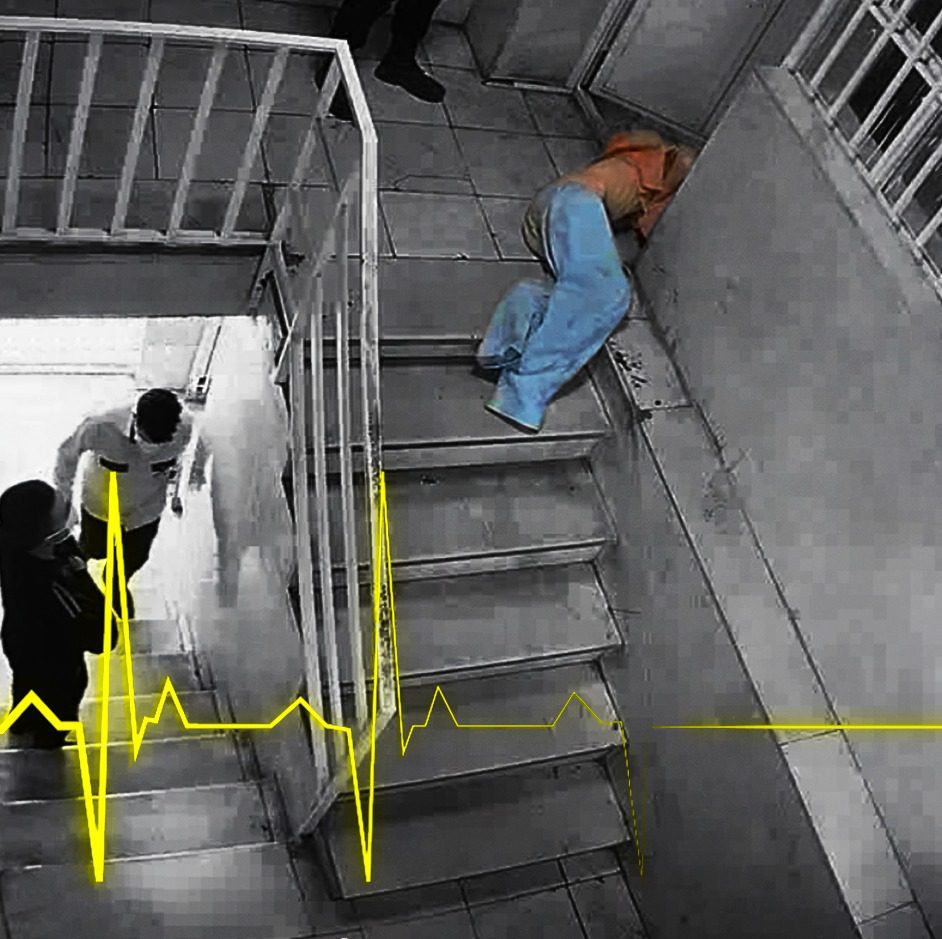
Sixty-four out of the 96 prisoners, whose cases Amnesty International reviewed, died in prison. Most died in their prison cells which means they were not given basic medical supervision in their final hours. Some died while held in poorly equipped and staffed prison clinics.

In at least six cases, critically ill prisoners were moved to solitary confinement, punishment wards, or quarantine sections; four of them died alone while two were eventually authorized for hospital transfers, but it proved too late.

At least 26 prisoners died during transfer or shortly after admission to hospital, following deliberate delays by prison officials, which proved fatal.

In many cases, both prison clinic medical staff and prison officials accused prisoners experiencing medical emergencies of “faking” or “exaggerating” their symptoms.

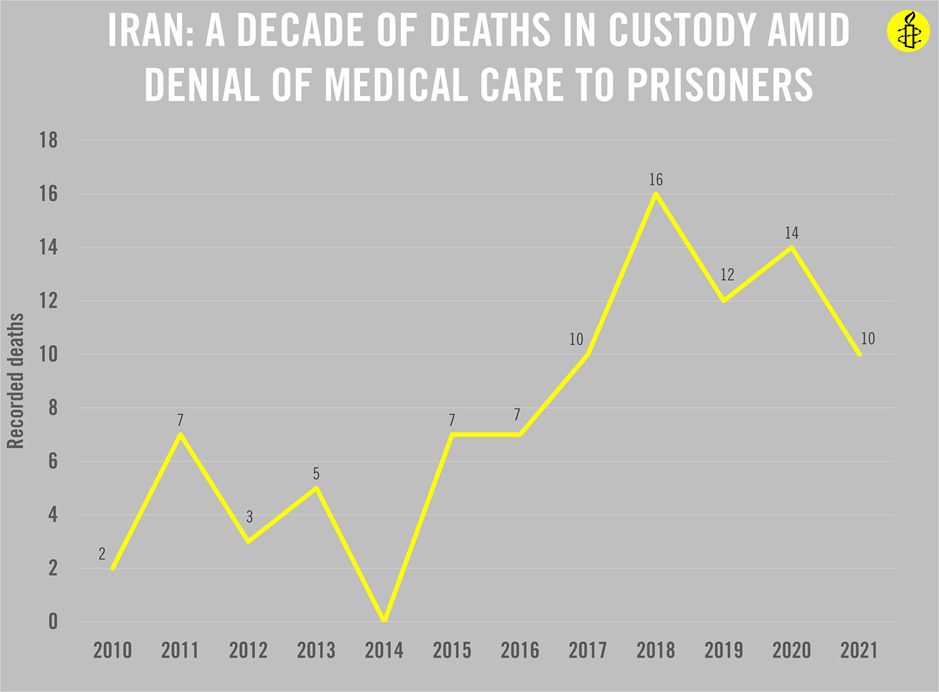
Of the 96 deaths in custody recorded, the vast majority (65) took place since January 2017. While this may be due to greater access to information in recent years, it serves as an alarming indication of how the prevailing climate of impunity continues to perpetuate serious violations of the right to life across Iran’s prisons.

In most cases, prisoners who died were young or middle aged – 23 were between the ages of 19 and 39, and 26 between the ages of 40 and 59, raising further concerns that lives are being cut short by denial of healthcare.

64

Sixty-four out of the 96 prisoners, whose cases Amnesty International reviewed, died in prison.

Many of them reported to the prison clinic before their death, complaining of various alarming health problems, including severe pain in their chest and breathing difficulties. Prison clinic staff frequently dismissed these emergencies and returned prisoners to their wards where they died shortly afterwards.

Some died while held in poorly equipped and staffed prison clinics. Others died in their wards amid the refusal of prison officials to even take them to the prison clinic.

26

At least 26 prisoners died during transfer or shortly after admission to hospital, following deliberate delays by prison officials, which proved fatal.

6

In at least six recorded cases, critically ill prisoners were moved to solitary confinement, punishment wards, or quarantine sections; four of them died alone while two were eventually authorized for hospital transfers, but it proved too late.

Lives cut short across Iran

The 96 recorded deaths in custody cover 30 prisons in 18 provinces across the country. The four provinces of West Azerbaijan, Tehran, Sistan and Baluchestan and Alborz account for most of the recorded deaths.

Prisons with high populations of oppressed ethnic minorities feature particularly heavily – 22 of the 96 deaths recorded took place in the prison in Urumieh, West Azerbaijan province, where most prisoners are from Kurdish and Azerbaijani Turkic minorities. Thirteen deaths were recorded at the main prison in Zahedan, Sistan and Baluchestan province, where prisoners mostly belong to Iran’s oppressed Baluchi minority.

Amnesty International believes the extent of human rights violations being committed in many prisons across the country remains largely hidden from public view. Therefore, greater access to information about some prisons compared to others poses serious limitations to conducting effective comparative analysis.  


Mishandled medical emergencies leading to prisoners’ deaths


At least 11 prisoners died after being denied adequate healthcare for traumatic injuries resulting from specific incidents that occurred at the time of arrest or during imprisonment. These incidents involved beatings or gunshot wounds sustained at the time of arrest, accidents during arrest or in prison, drug overdose, hunger strikes, attempted suicides, and physical fighting among inmates.

Other prisoners died after being denied adequate medical care for serious medical emergencies involving, among other things, heart attacks and strokes, Covid-19 and other infectious diseases, gastrointestinal complications, neurological complications, respiratory complications and kidney problems, which either emerged suddenly or were related to pre-existing illnesses for which they had not received adequate specialization healthcare, including diagnostic tests, regular check-ups, and post-operative follow-up care, throughout their imprisonment.


Heart attacks & stroke

  • Habibollah Naderi
  • Hoda Saber
  • Ali Ashkan
  • Mansour Radpour
  • Afshin Osanlou
  • Anvar Lajevard
  • Shahrokh Zamani
  • Mousa Mir
  • Aziz Anvarian
  • Mohammad Esalati
  • Saeed Nouhi
  • Shiva Fekri
  • Akbar Kamali
  • Abdolnour Sharafnahal
  • Dariush Mansouri
  • Fardin Faramarzi
  • Nader Alizehi
  • Mohsen Moradi
  • Omar Badalipour
  • Omar Rasouli
  • Mehrdad Barideh
  • Nobakht (Nobat) Sahraei
  • Ali Paya
  • Dariush Kangarlou
  • Payam Khaledi
  • Hassan Javadi
  • Parviz Ghahremani
  • Farhad Rahimi
  • Shamsoddin Tatari

Traumatic brain injuries

  • Abdolvahed Gomshadzehi
  • Morteza Kargar

Diabetes

  • Khabat Moradi

Covid-19 & other infectious diseases

  • Fatemeh Alizadeh
  • Seyfoddin Bamoradi
  • Saeed Heidary
  • Zogh Ali Abbasi
  • Abdolvahid Rahmani
  • Akram Rahimi
  • Giti Hajrahimi
  • Baktash Abtin (legal name Mehdi Kazemi)
  • Alireza Karami Kheirabadi
  • Ayoub Raoufpour
  • Shafi Mohammad Tanoumand
  • Mehdi Narouiee
  • Abdolraouf Pahang
  • Gholamreza Goul
  • Eskandar Badrlou
  • Asghar Samani
  • Amir Najivash

Overdose toxicity

  • Hossein Afrasiabi
  • Sadegh Maleki
  • Rouhollah Maleki

Kidney problems

  • Arash Arkan

Cancer

  • Alborz Ghassemi-Shall
  • Mohsen Doghmehchi
  • Hassan Nahid
  • Abdolaziz Ma’reiee
  • Esmail Mostakhdem
  • Agha Shahbakhsh

Respiratory complications

  • Mohammad Mehdi Zaleh-Naghshbandian
  • Mohammad Javad Khoshnevisan
  • Ali Batrani

Drug withdrawal symptoms

  • Ramin Dokaleh

Gastrointestinal complications

  • Naser Khanizadeh
  • Mohammad Zinati
  • Reza Pour-Ramezan
  • Adel Naghizadeh
  • Moloud Vanousheh
  • Vahid Sayadi Nasiri
  • Shahab Daroonparvar

Neurological complications

  • Qolam Nabi Rigi
  • Behnam Mahjoubi
  • Sasan Niknafas

Bleeding resulting from injuries sustained in prison

  • Mohammad Talebi
  • Esmail Toutazehi
  • Hossein Pahandipour
  • Iman Rashidi Yeganeh

Medical condition unknown

  • Zaher Mostafaiee
  • Eshagh Hemati Janikanlou
  • Saman Amini
  • Jalalvand (first name unknown)
  • Gholam Rabani Barahouei
  • Saeed Mohammadi
  • Parviz Moradi
  • Ghorbanali Miresmaili
  • Abdolnabi Saresi
  • Sajad Jamalifard
  • Gholamreza Toupragh (also reported as Toubragh) Ghaleh
  • Reza Malekrezaiee
  • Abouzar Ghodsi
  • Hossein Atri
  • Ahmad Amoukhteh
  • Maraan Khamou
  • Mehdi Narimani
  • Ebrahim Johari
  • Shokrollah Jebeli

Crisis of impunity

The crisis of systemic impunity prevailing in Iran has emboldened prison officials to persist with deadly denial of medical care to prisoners.

The crisis is characterized not only by the authorities’ systematic refusal to investigate suspicious deaths in custody, but also by their promotion of narratives praising the quality of health services offered to prisoners as “exemplary” or “unparalleled” throughout the world, which indicates that they have no intent to change course.

Family members of people who die in custody in suspicious circumstances are also routinely subjected to various forms of harassment and intimidation by intelligence and security officers, particularly when seeking legal redress. 

Critical action needed

To prevent further avoidable loss of life as a result of denial of vital medical care, Amnesty International is urging Iranian authorities to require, in law and practice, that, pending structural improvements in prison clinics, prisoners experiencing medical emergencies are immediately transferred to medical facilities outside prison. Prisoners diagnosed with serious pre-existing illness or displaying signs and symptoms of what may be serious health problems must similarly be promptly transferred to medical facilities outside prison for adequate medical care.

Amnesty International also calls on the Iranian authorities to reform deeply flawed provisions in Iran’s prison regulations, which grant prison directors and prosecution officials the power to ignore or overrule medical advice and make healthcare decisions concerning the transfer of prisoners for treatment.

Given systematic impunity in Iran, Amnesty International reiterates its call for the UN Human Rights Council to set up an investigative and accountability mechanism to collect, preserve and analyze evidence of the most serious crimes under international law and human rights violations committed in Iran to facilitate fair criminal proceedings.

Call on the Iranian authorities to stop violating prisoners’ right to life and health through denial of medical care

The Iranian authorities’ chilling disregard for human life has effectively turned Iran’s prisons into a waiting room of death for ill prisoners, where treatable conditions tragically become fatal. Deaths in custody resulting from the deliberate denial of healthcare amount to arbitrary deprivation of life, which is a serious human rights violation under international law.

Iranian prison officials are causing or contributing to unlawful deaths in custody by blocking or delaying prisoners’ access to timely hospitalization. Iran's authorities must stop violating prisoners’ right to life through denial of medical care! @khamenei_ir amn.st/5464

The post Deadly Denial of Medical Care in Iran’s Prisons appeared first on Amnesty International.