
Iran: UK government must investigate Iranian officials who held Nazanin-Zaghari Ratcliffe hostage

The UK government must investigate Iranian officials who are suspected of responsibility for the crime of hostage-taking against British-Iranian national Nazanin Zaghari-Ratcliffe to force the UK government to settle a decades-old debt, and where sufficient evidence exists, request their extradition in order to prosecute them in fair trials.

In a detailed analysis issued today, Amnesty International laid out compelling evidence that Iran’s detention of Nazanin Zaghari-Ratcliffe amounted to an act of hostage-taking, which is a crime under international law and highlighted the plight of other held dual and foreign nationals whose arbitrary detention may amount to hostage-taking. 

Amnesty International submitted this evidence last month to the UK Parliament’s Foreign Affairs Committee, which launched its own inquiry into state level hostage situations.

“The Iranian authorities deliberately and shamelessly deprived Nazanin Zaghari-Ratcliffe of her freedom. They used spurious national security charges and sham judicial proceedings against her with the aim of exerting pressure on the UK government to settle its debts,” said Diana Eltahawy, Deputy Director for the Middle East and North Africa at Amnesty International.

“The prevailing climate of impunity in Iran has emboldened the authorities to continue using dual and foreign nationals as political bargaining chips without any fear of consequences. The hostage-taking of Nazanin-Zaghari-Ratcliffe must not go unpunished. We urge the UK government to investigate all Iranian officials who are suspected of responsibility for this crime. Where sufficient evidence exists, the UK must request their extradition and prosecute the officials in line with international fair trial standards.”

The urgent need for the international community to accelerate efforts to prevent and prosecute the crime of hostage-taking is further brought into sharp relief by mounting evidence indicating that Iranian authorities are holding Swedish-Iranian national Ahmadreza Djalali hostage and threatening to execute him to compel third parties to swap him for former Iranian officials convicted and/or on trial abroad.

Another case of likely hostage-taking is that of Anoosheh Ashoori, a 67-year-old retired British-Iranian engineer who had been arbitrarily detained in Iran since 2017. Both Nazanin Zaghari-Ratcliffe and Anoosheh Ashoori were allowed to leave Iran for the UK on 16 March 2022. Their release came after the UK government paid £393.8 million to settle a decades-long debt dispute with Iran related to an unfulfilled arms deal dating back to the 1970s. 

The prevailing climate of impunity in Iran has emboldened the authorities to continue using dual and foreign nationals as political bargaining chips without any fear of consequences.

Diana Eltahawy, Amnesty International

Nazanin Zaghari-Ratcliffe’s release immediately after the UK paid its debt was followed by a slew of reports by Iranian state media outlets, stating that she had been released “in exchange” for the payment. These reports mirrored almost identical statements made by the Iranian authorities to Nazanin Zaghari-Ratcliffe and her family during her detention. Only two days before her release, officials from the Islamic Revolutionary Guards summoned Nazanin Zaghari-Ratcliffe for interrogation and told her explicitly that she was going to be “swapped for money”.

Amnesty International reviewed detailed evidence in the case of Nazanin Zaghari-Ratcliffe before concluding that her unlawful deprivation of liberty amounted to the crime of hostage-taking. The organization interviewed sources close to her, thoroughly examined documents related to the debt dispute between UK and Iran, and analysed not only public statements by Iranian officials, but also comments they made privately to Zaghari-Ratcliffe and her family.

The organization notes that if similar evidence exists in the cases of other detained dual and foreign nationals proving that the Iranian authorities are conditioning their treatment and/or release on acts or omissions by other states, their deprivation of liberty may also amount to the crime of hostage-taking.

In addition to Ahmadreza Djalali, Amnesty International has documented the cases of at least six other dual nationals currently held in Iran and they include Austrian-Iranians Kamran Ghaderi and Massud Mossaheb; German-Iranians Nahid Taghavi and Jamshid Sharmahd; and two British-Iranians: Mehran Raoof and Morad Tahbaz (who is also a US national).

In March 2022, an 82-year-old Australian-Iranian national, Shokrollah Jebeli, died in custody after the authorities deliberately denied him adequate specialized medical care and withheld his medication for his multiple serious health conditions.  

In light of ongoing concerns regarding the Iranian authorities’ practice of using detained dual and foreign nationals as leverage, Amnesty International urges all states whose nationals are or have been detained at any point in Iran to promptly examine whether the deprivation of liberty amounts to an act of hostage-taking, and if so, take all appropriate measures to secure their release and ensure accountability. 

Both Iran and the UK are state parties to the International Convention Against the Taking of Hostages, which criminalizes acts of hostage-taking committed by state and non-state actors and obligates states to take action to prevent and punish such acts. The Convention defines the crime of hostage-taking as the seizure or detention of any person accompanied with threats to cause them harm including by killing, injuring or continuing to detain them in order to compel a third party, such as a state, to do or abstain from doing any act as an explicit or implicit condition for the release of the hostage.

On 1 April 2022, the UK Parliament’s Foreign Affairs Committee announced an inquiry into hostage-taking by states and made a call for submissions of evidence.

The post Iran: UK government must investigate Iranian officials who held Nazanin-Zaghari Ratcliffe hostage appeared first on Amnesty International.
Egypt: Exclude security agencies from reviewing releases of jailed critics

The fate of thousands of arbitrarily detained men and women should not rest in the hands of Egypt’s security agencies, namely the National Security Agency and General Intelligence, Amnesty International said today following the release of four prisoners held for political reasons, based on recommendations by the recently re-activated Presidential Pardons Committee.

Over the last three days, the Egyptian public prosecution ordered the release of Abdelrahman Tarek (known as Moka), Kholoud Saeed and nine others, who had been arbitrarily detained from as early as 2018, following a statement from the Presidential Pardons Committee earlier this month that they submitted a list of over “1000 political prisoners” to security agencies for review.

“We welcome the long overdue release of those detained solely for exercising their human rights — and the promise to free more. Yet thousands of opponents and critics continue to languish in Egyptian jails, while fresh arrests and prosecutions continue unabated,” said Amna Guellali, Amnesty International’s Deputy Director for the Middle East and North Africa.

“Previous promises to release prisoners held for political reasons amounted to little more than disingenuous attempts to deflect international criticism of Egypt’s abysmal human rights record. To prove they are committed now, the Egyptian authorities must immediately and unconditionally release anyone detained solely for exercising their human rights, including politicians, journalists, lawyers and human rights defenders.”

Amnesty International is calling on the authorities to adopt a rights-based approach and to end mass arbitrary detentions in line with their obligations under international human rights law and demands by independent Egyptian human rights groups.

Exclusions for pardons

On 5 May, following the re-activation of the Presidential Pardons Committee by President Abdel Fattah al-Sisi, eight Egyptian human rights NGOs called on the authorities to publicly clarify the criteria and timeline used to review prisoners’ files.

The groups expressed concern that prisoners of conscience and others held for political reasons could be excluded on discriminatory grounds, with security agencies in control of the decision-making process for releases.

Indeed, several committee members said that they would not consider releasing detained Muslim Brotherhood members. Several relatives who submitted requests for the committee to review their loved-ones’ detention told Amnesty International that two committee members demanded to see evidence that detainees did not belong to the Muslim Brotherhood.

Previous promises to release prisoners held for political reasons amounted to little more than disingenuous attempts to deflect international criticism of Egypt’s abysmal human rights record.

Amna Guellali, Amnesty International

In a statement released on 9 May, Tarek al-Kholi, a member of the Presidential Pardons Committee and an MP, said that “members of terrorist groups” or those involved in violence would be excluded from pardons. This admission is highly alarming, considering the fact that thousands of individuals have been held in prolonged-pretrial detention in Egypt following baseless accusations of “membership in a terrorist group”. Among them is Youssef Mansour, a human rights lawyer, arbitrarily detained since 24 March 2022, pending investigations into “membership in a terrorist group”, solely due to his critical social media posts.

Thousands of others have been imprisoned on violence-related charges following grossly unfair, mass trials by emergency or military courts. On 29 May, an emergency court sentenced 25 political opponents, including politician Mohamed al-Kassas and former presidential candidate Abdel Moneim Aboul Fotouh to 10 and 15 years in prison respectively for trumped-up terrorism-related charges and spreading false news.

Security forces should play no role in reviews

On 6 May, Tarek al-Kholi confirmed that requests for release received by the Presidential Pardons Committee would be sent to security forces for review. Yet security forces, including the National Security Agency (NSA), should not be granted any authority over releases, as they have repeatedly barred the release of prisoners held for political reasons and targeted individuals affiliated to the Muslim Brotherhood and other high-profile activists, who played a prominent role in the 25 January Revolution, for particularly punitive and discriminatory treatment in prison. Since December 2014, Anas al-Beltagy, son of imprisoned Muslim Brotherhood figure Mohamed al-Beltagy, has remained in prison despite being acquitted by courts in four separate trials. Each time a judge ordered his release, the NSA has barred it.

According to an article by independent news site Mada Masr, which is blocked in Egypt, a source close to the committee who asked to remain anonymous said security agencies will not allow the release of prominent activist Alaa Abdel-Fattah, a dual Egyptian-British national on a hunger strike for 60 days, who has been unjustly jailed since September 2019, or activist Ahmed Douma, who was sentenced to 15 years’ in prison in a grossly unfair trial over his participation in anti-government protests.

The releases of those held solely for exercising their human rights must also be unconditional. Amnesty International has learned that several of those released in April were warned by the NSA not to engage in any activism, or else face re-arrest. At least two were instructed to report weekly to the NSA for “monitoring”.

The Egyptian authorities must also immediately instruct security forces and prosecutors to stop arbitrarily arresting and detaining critics. Since April 2022, authorities have arrested three journalists Mohamed Fawzi, Hala Fahmy and Safaa al-Korbagi and detained them for sharing posts on social media deemed critical by the authorities, on accusations of “membership in a terrorist group” and/or “spreading false news”.

“To ensure meaningful progress on the scourge of mass arbitrary detention in Egypt, sustained joint action is needed by the international community to privately and publicly press on the Egyptian authorities to release all those arbitrary detained in Egypt regardless of their political affiliation, and to put an end to the crackdown on peaceful dissent,” said Amna Guellali.

Background

On 26 April 2022, during an “Iftar” attended by some opposition figures, President Abdelfattah al-Sisi called for the reactivation of the Presidential Pardons Committee to re-examine individuals detained for political reasons or for failure to pay debts. The move followed the release on the occasion of Eid al-Fitr of around 30 men and women held for political reasons. The committee is composed of two MPs, a former minister and two independents. 

The Egyptian authorities have arrested tens of thousands of men and women since the military ousted former president Mohamed Morsi in July 2013, many of whom remain unjustly imprisoned in conditions that violate the absolute prohibition of torture and other ill-treatment.

The post Egypt: Exclude security agencies from reviewing releases of jailed critics appeared first on Amnesty International.

Myanmar: Military onslaught in eastern states amounts to collective punishment

  • Post-coup military assault in Kayin and Kayah States includes war crimes and likely crimes against humanity
  • More than 150,000 displaced, with entire villages emptied and burned
  • Amnesty International interviewed almost 100 people and visited border area

Myanmar’s military has been systematically committing widespread atrocities in recent months, including unlawfully killing, arbitrarily detaining and forcibly displacing civilians in two eastern states, Amnesty International said today in a new report.

The report, “Bullets rained from the sky”: War crimes and displacement in eastern Myanmar, found that Myanmar’s military has subjected Karen and Karenni civilians to collective punishment via widespread aerial and ground attacks, arbitrary detentions that often result in torture or extrajudicial executions, and the systematic looting and burning of villages.

The violence in Kayin and Kayah States reignited in the wake of last year’s military coup and escalated from December 2021 to March 2022, killing hundreds of civilians and displacing more than 150,000 people.

“The world’s attention may have moved away from Myanmar since last year’s coup, but civilians continue to pay a high price. The military’s ongoing assault on civilians in eastern Myanmar has been widespread and systematic, likely amounting to crimes against humanity,” said Rawya Rageh, Senior Crisis Adviser at Amnesty International.

“Alarm bells should be ringing: the ongoing killing, looting and burning bear all the hallmarks of the military’s signature tactic of collective punishment, which it has repeatedly used against ethnic minorities across the country.”

Alarm bells should be ringing: the ongoing killing, looting and burning bear all the hallmarks of the military’s signature tactic of collective punishment, which it has repeatedly used against ethnic minorities across the country.

Rawya Rageh, Senior Crisis Adviser at Amnesty International

Post-coup surge in violence

For decades, ethnic armed organizations in Myanmar, including in Kayin and Kayah States, have been engaged in struggles for greater rights and autonomy. Fragile ceasefires in place in both states since 2012 broke down after the February 2021 coup, and new armed groups have emerged. In its operations, the military has relentlessly attacked civilians.

Some attacks appear to have directly targeted civilians as a form of collective punishment against those perceived to support an armed group or the wider post-coup uprising. In other cases, the military has fired indiscriminately into civilian areas where there are also military targets. Direct attacks on civilians, collective punishment, and indiscriminate attacks that kill or injure civilians violate international humanitarian law and constitute war crimes.

Attacks on a civilian population must be widespread or systematic to amount to crimes against humanity; in Kayin and Kayah States, they are both, for crimes including murder, torture, forcible transfer, and persecution on ethnic grounds.

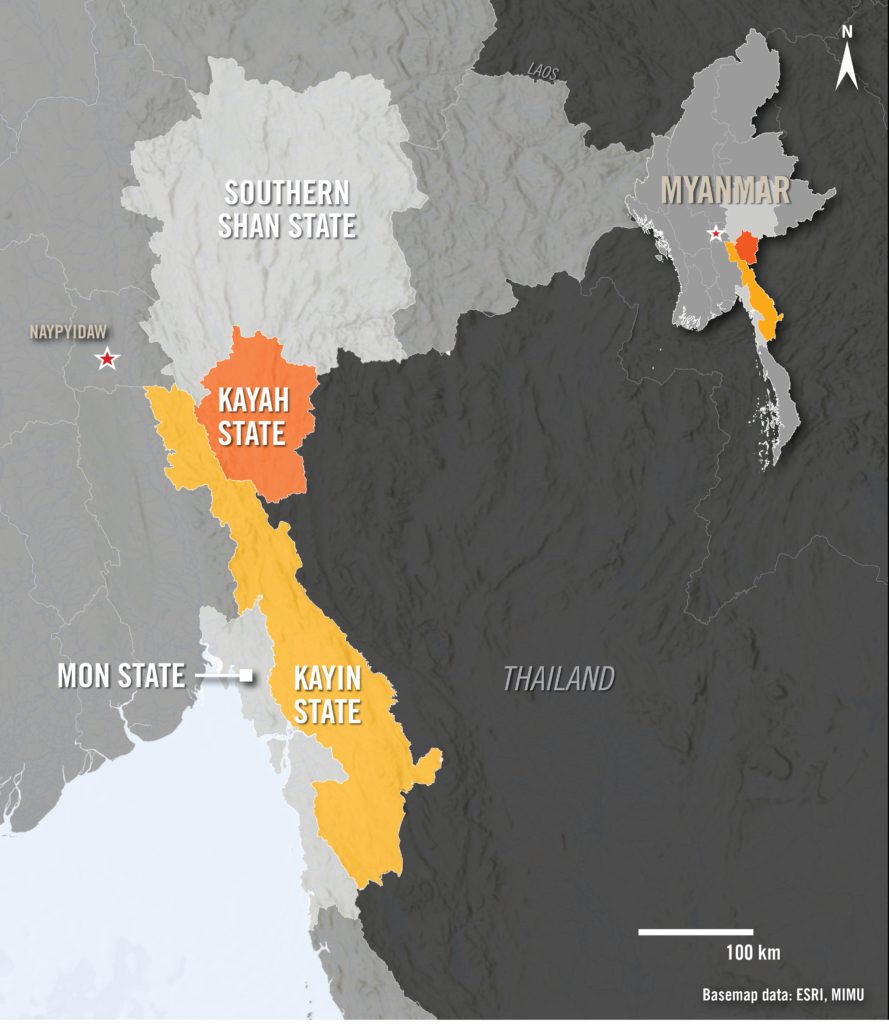
Map of Kayin and Kayah States, Myanmar
An overview map of Myanmar highlighting Kayah and Kayin States.

Unlawful strikes

In its ongoing operations, Myanmar’s military has repeatedly fired explosive weapons with wide-area effects into populated civilian areas. Dozens of witnesses told Amnesty International about barrages that lasted days at a time. The organization documented 24 attacks by artillery or mortars between December 2021 and March 2022 that killed or injured civilians or that caused destruction to civilian homes, schools, health facilities, churches, and monasteries.

For example, on 5 March 2022, as families were at dinner, the military shelled Ka Law Day village, Hpapun Township, Kayin State, killing seven people, including a woman who was eight months pregnant. A close family member of four of the people who were killed said he had to sit in his house all night looking at the bodies, for fear of being injured by further shelling, before burying them in the morning.

Many people described the military’s use of fighter jets and attack helicopters as particularly terrifying. Witnesses described not being able to sleep at night out of fear of air strikes, or fleeing to seek shelter in bunkers and caves.

Amnesty International documented eight air strikes on villages and an internally displaced persons (IDP) camp in eastern Myanmar in the first three months of 2022. The attacks, which killed nine civilians and injured at least nine more, destroyed civilian homes and religious buildings. In almost all documented attacks, only civilians appear to have been present.

In one case, at around 6pm on 23 February 2022, a fighter jet fired on Dung Ka Mee village, Demoso Township, Kayah State, killing two civilian men and injuring several others. Amnesty International interviewed two witnesses and a relative of one of the deceased as well as an aid worker who responded after the attack. They said there was no fighting that evening and that the nearest armed group base was a mile or more away.

A local resident, a 46-year-old farmer who witnessed the attack, said the military aircraft made three passes, firing guns and a rocket:

“When that fighter jet was flying toward us in a nose-down position, I was numb… When they fired the rocket, I got myself together and realized I had to run [to a bunker]… We were shocked to see the dust and debris come towards us… There is a two-story building… The family lives upstairs and the downstairs is a mobile phone store. This building collapsed and it was also on fire.”

Another witness, a 40-year-old farmer, saw the remains of a neighbour’s body:

“We couldn’t even put them in a coffin, we put them in a plastic bag and buried them. People had to pick up the body pieces and put them in a bag.” In another incident, the military carried out an air strike on Ree Khee Bu IDP camp at around 1am on 17 January 2022, killing a man in his 50s as well as 15- and 12-year-old sisters.

We couldn’t even put them in a coffin, we put them in a plastic bag and buried them. People had to pick up the body pieces and put them in a bag.”

A 40-year-old farmer who witnessed an air strike.

Extrajudicial executions

The report documents how Myanmar’s military carried out arbitrary detentions of civilians on the basis of their ethnicity or because they were suspected of supporting the anti-coup movement. Often, detainees were tortured, forcibly disappeared or extrajudicially executed.

In one of many cases where soldiers extrajudicially executed civilians who ventured out from displacement sites to collect food or belongings, three farmers from San Pya 6 Mile village in Kayah State went missing in January 2022. Their decomposed bodies were found in a pit latrine around two weeks later.

The brother of one of the victims said he identified the men by their clothes and the state of their teeth. Soldiers fired on him and others as they tried to retrieve the bodies; they could only return to finish the burial a month later. 

In a massacre that prompted rare international condemnation, soldiers near Mo So village in Kayah State’s Hpruso Township reportedly stopped at least 35 women, men and children in multiple vehicles on 24 December 2021, and then proceeded to kill them and burn their bodies. Doctors who examined the bodies reportedly said many of the victims had been tied up and gagged, bearing wounds suggesting they were shot or stabbed.

Amnesty International maintains that the incident must be investigated as a case of extrajudicial executions. Such killings in armed conflict constitute war crimes.

Witnesses also described Myanmar’s military shooting at civilians, including those attempting to flee across a river along the border with Thailand.

Looting and burning

Following a pattern from past military operations, soldiers have systematically looted and burned large sections of villages in Kayin and Kayah States. Witnesses from six villages reported having items including jewellery, cash, vehicles and livestock stolen, before homes and other buildings were burned.

Four men who fled Wari Suplai village, on the border of Shan and Kayah States, said they watched from nearby farmland as houses went up in flames after most villagers fled on 18 February 2022. They told Amnesty International that the burning went on for days, destroying well over two-thirds of the houses there.

“It’s not a house anymore. It’s all ashes — black and charcoal… It’s my life’s savings. It was destroyed within minutes,” said a 38-year-old farmer and father of two young children.

Amnesty International’s analysis of fire data and satellite imagery shows how villages were burned, some of them multiple times, in parts of Kayah State. The burning directly tracks military operations from village to village in February and March 2022.

A defector from the military’s 66th Light Infantry Division, who was involved in operations in Kayah State until October 2021, told Amnesty International that he witnessed soldiers looting and burning homes: “They don’t have any particular reason [for burning a specific house]. They just want to put the fear in the civilians that ‘This is what we’ll do if you support [the resistance fighters].’ And another thing is to stop the supply and logistics for the local resistance forces… [Soldiers] took everything they could [from a village] and then they burned the rest.”

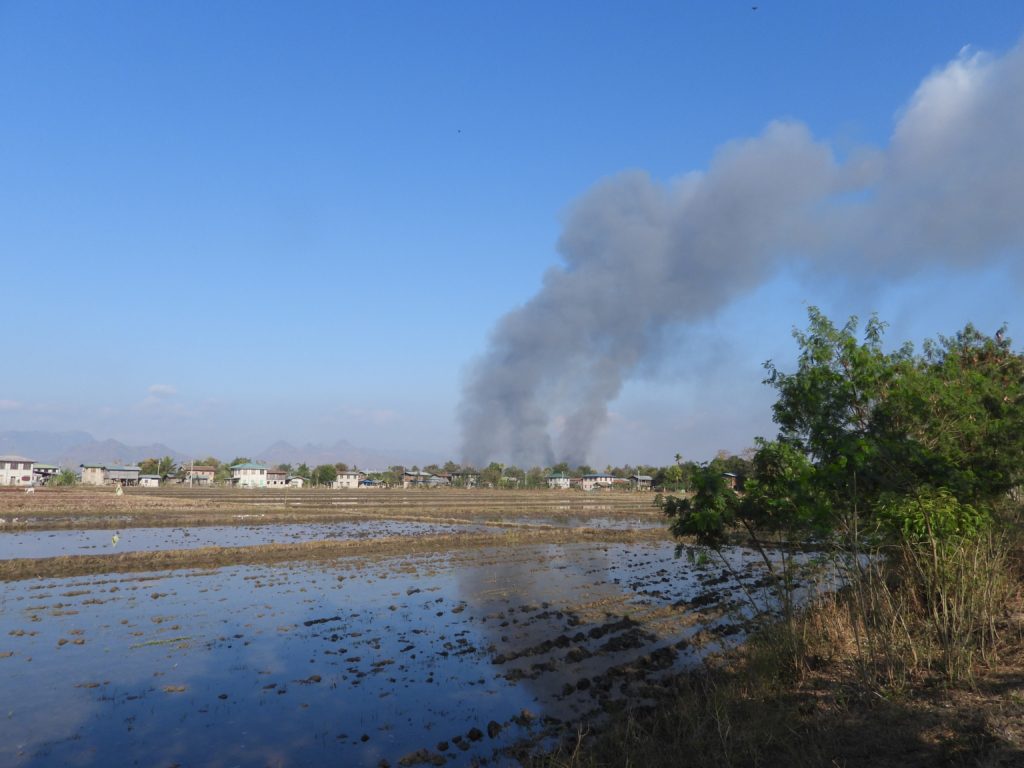
Smoke billowing from Wari Suplai village, in southern Shan State, after buildings were set on fire by the Myanmar military, 18 February 2022. Well over two thirds of the houses in the village were destroyed in February; soldiers set more alight in March.

They don’t have any particular reason [for burning a specific house]. They just want to put the fear in the civilians that ‘This is what we’ll do if you support [the resistance fighters].’…[Soldiers] took everything they could [from a village] and then they burned the rest.

A defector from the military’s 66th Light Infantry Division.

The violence has caused the mass displacement of more than 150,000 people, including between a third and a half of Kayah State’s entire population. In some cases, entire villages have been emptied of their populations; at times, civilians have had to flee repeatedly in recent months.

Displaced people are enduring dire conditions amid food insecurity, scant health care — including for the conflict’s enormous psychosocial impact — and ongoing efforts by the military to obstruct humanitarian aid provision. Aid workers spoke of growing malnutrition and increasing difficulties in reaching displaced people due to the ongoing violence and military restrictions.

“Donors and humanitarian organizations must significantly scale up aid to civilians in eastern Myanmar, and the military must halt all restrictions on aid delivery,” said Matt Wells, Amnesty International’s Crisis Response Deputy Director – Thematic Issues.

“The military’s ongoing crimes against civilians in eastern Myanmar reflect decades-long patterns of abuse and flagrant impunity. The international community — including ASEAN and UN member states — must tackle this festering crisis now. The UN Security Council must impose a comprehensive arms embargo on Myanmar and refer the situation there to the International Criminal Court.”

“The military’s ongoing crimes against civilians in eastern Myanmar reflect decades-long patterns of abuse and flagrant impunity. The international community — including ASEAN and UN member states — must tackle this festering crisis now. The UN Security Council must impose a comprehensive arms embargo on Myanmar and refer the situation there to the International Criminal Court.

Matt Wells, Amnesty International’s Crisis Response Deputy Director – Thematic Issues

Methodology

The report is based on research carried out in March and April 2022, including two weeks on the Thailand-Myanmar border. Amnesty International interviewed 99 people, including dozens of witnesses or survivors of attacks and three defectors from Myanmar’s military.

The organization also analysed more than 100 photographs and videos related to human rights violations — showing injuries, destruction and weapon use — in addition to satellite imagery, fire data, and open-source military aircraft flight data.

The post Myanmar: Military onslaught in eastern states amounts to collective punishment appeared first on Amnesty International.

Turkey: Baseless conviction of Amnesty’s Honorary Chair must be quashed, following long-awaited ECtHR ruling

The European Court of Human Rights ruled today that the 2017-2018 detention of Amnesty Turkey’s then-chair, Taner Kılıç was a violation of his rights to liberty and security (Article 5.1, 5.3 and 5.5) and freedom of expression (Article 10). Following the ruling, Amnesty International reiterated its call on the Turkish authorities to overturn the unjust and baseless conviction of Taner Kılıç, who faces another two-and-a-half years in prison if his conviction is upheld.

Taner Kılıç was arrested in June 2017 and detained for more than 14 months. In July 2020, he was sentenced to six years and three months. The verdict is currently pending at the Court of Cassation – Turkey’s highest court of appeal.

“This long-awaited European Court ruling confirms what we have known from the start: that Taner Kılıç – a life-long human rights defender was arbitrarily deprived of his liberty when jailed in a high security prison on trumped up charges,” said Amnesty International’s Europe Director, Nils Muižnieks.

“Despite the fact that the allegations levelled against him were comprehensively exposed as baseless during the trial, the court in Turkey convicted Taner Kılıç, who still faces a return to jail to serve out the rest of his politically motivated sentence. The European Court has this morning reaffirmed that the authorities in Turkey did not have ‘any reasonable suspicion that Taner had committed an offence’ to justify his pre-trial detention and no further evidence was ever presented to justify his conviction.”

Despite the lack of evidence, Taner Kılıç, a refugee rights lawyer and former and now honorary chair of Amnesty’s Turkey section, was convicted of ‘membership of a terrorist organisation’.

“Today’s ruling provides a clear and emphatic framework for Turkish authorities to ensure that Taner’s human rights are not further violated,” said Nils Muižnieks.

“This politically motivated attempt to silence a human rights defender is part of the Turkish authorities’ wider crackdown on rights and freedoms and those who defend them. Taner’s conviction must be quashed.”

For more information about the case

https://www.amnesty.org/en/latest/campaigns/2020/01/turkey-istanbul-human-rights-activists-justice/

For the ECtHR ruling

https://hudoc.echr.coe.int/eng#{%22itemid%22:[%22003-7348547-10034706%22]}

For an analysis of the case against Taner Kılıç visit: https://www.amnesty.org/en/documents/eur44/7331/2017/en/

The post Turkey: Baseless conviction of Amnesty’s Honorary Chair must be quashed, following long-awaited ECtHR ruling appeared first on Amnesty International.

Using the wrong tool for the job: Four lessons from states’ responses to Covid-19

Carrie Eisert, Amnesty International’s Policy Advisor for Gender, Racial Justice, Refugees and Migrants

In March 2020, as the world began to shut down in response to the rapid spread of Covid-19, Amnesty staff scrambled to deliver our first assessment of states’ human rights obligations in the context of a global pandemic. A flurry of activity and collaboration resulted in our first public statement on 12 March, just as we said goodbye at the office, laptops and hand sanitizer in hand, with a plan to work from home that was meant to last just two weeks.

More than two years of (mostly) remote working later, we are ready to share our report, entitled ‘There is no help for our community: The impact of states’ Covid-19 responses on groups affected by unjust criminalization’. The product of more than 20 months of participatory research with 54 community-led organizations in 28 countries, it explains how government responses that saw people fined, arrested and jailed for non-compliance with public health measures, had a disproportionate impact on society’s most marginalized and criminalized communities. The damaging consequences for groups including LGBTI people in Zambia and Kyrgyzstan, sex workers in Argentina and France, people who use drugs in Mexico, and people in need of an abortion in India, are just some of those included.  

From the outset of this research, the uneven impact of Covid-19 on certain groups, and issues of stigma and discrimination, were foremost in our minds. We were guided by a range of questions about the possible consequences of repressive Covid-19 measures: who would be most impacted by travel bans and restrictions? Would people living in poverty or experiencing homelessness be able to manage “stay at home” orders without the necessary resources? What would be the impacts on people needing access to specific healthcare services such as abortion, drug treatment, gender-affirming healthcare, or HIV treatment?

Based on the human rights concerns that emerged in past epidemics, we knew that when states use punitive policies to achieve public health aims, it’s rarely a winning strategy.

And so it proved once again. Our research shows that governments have largely failed to learn from previous public health emergencies about the importance of respecting human rights and engaging with communities to build trust and solidarity.

Amnesty International is calling for governments to put human rights at the centre of all future pandemic responses. Here are the top four lessons that must be learned.

Don’t use punishment to promote public health

Governments prioritized punishment over support and used security forces to enforce public health rules. This meant that people who were unable to easily isolate and “stay at home”, such as those experiencing homelessness or sex workers who needed to go out to work, were put at even greater risk of criminalization and a whole range of human rights abuses from the authorities.

Guarantee that everyone is supported

Abortion, contraception, gender-affirming healthcare and harm reduction services for people who use drugs are “essential” healthcare services. However, governments’ failure to treat them as such during the pandemic meant that people requiring these services faced unnecessary barriers and were denied support that could have enabled them to stay safe and better comply with Covid-19 restrictions.

Address the drivers of marginalization and exclusion

The stigma associated with criminalization meant that many marginalized communities were scapegoated for supposedly spreading the virus. This in turn discouraged people from seeking healthcare and social protection because they feared being judged, arrested, detained or otherwise punished.

Ensure participation of marginalized people and communities 

Unjust criminalization created barriers to the meaningful consultation and participation of individuals and organizations whose expertise and experience could have informed and improved pandemic responses. A focus on protecting human rights would benefit the health and wellbeing of everyone.

For more information about the report, see here.

The post Using the wrong tool for the job: Four lessons from states’ responses to Covid-19 appeared first on Amnesty International.