Zimbabwe: Authorities must do more to stop culture of abductions and killings

Responding to the discovery of the dismembered body of Moreblessing Ali, Lucia Masuka, Executive Director of Amnesty International Zimbabwe, said:

Authorities must not leave any stone unturned in the investigation of this case and ensure that suspected perpetrators are held accountable

Lucia Masuka, Executive Director of Amnesty International Zimbabwe

“Authorities must not leave any stone unturned in the investigation of this case and ensure that suspected perpetrators are held accountable.”

“Abductions are being fueled by impunity of perpetrators. Authorities must do more to ensure Zimbabwe breaks this cycle of killings and abductions and impunity associated with it. Authorities must ensure access to justice and effective remedies for victims and their families.”

authorities must guarantee and protect people’s rights to life, physical integrity and security

Lucia Masuka

“Furthermore, authorities must guarantee and protect people’s rights to life, physical integrity and security.”

Background

Moreblessing Ali was out with her friend in Beatrice on 24 May 2022 when she was allegedly taken by an identified man following an argument. She was missing for three weeks before being found murdered and her body mutilated on 11 June.

Cases of abductions where perpetrators are never held to account are common in Zimbabwe.

The family of journalist and pro-democracy activist Itai Dzamara are yet to find closure after he was abducted on 9 March 2015. He was at a barbers’ shop in Harare’s Glen View suburb when five men reportedly accused him of stealing cattle before handcuffing him, forcing him into a white truck with concealed number plates and driving off. He has not been seen since and fears for his safety remain.

The post Zimbabwe: Authorities must do more to stop culture of abductions and killings appeared first on Amnesty International.

UN: Michelle Bachelet has just months to address her failures on China

The UN High Commissioner for Human Rights Michelle Bachelet announced today that she will not be seeking a second term when her current one ends in August, but said that her office intends to finalize a long-awaited report on the human rights situation in China’s Xinjiang region before her departure.

Michelle Bachelet’s refusal to call out the Chinese government’s crimes against humanity has betrayed countless victims and survivors.

Amnesty International’s Secretary General, Agnès Callamard

Bachelet was heavily criticized during her recent mission to China for failing to condemn crimes against humanity and other grave human rights violations by the Chinese authorities. Addressing the UN Human Rights Council today, Bachelet said the report was currently being updated and would be shared with Chinese authorities for comments.

We call on Michelle Bachelet to finish her term by acting with the courage and principles that the office of High Commissioner demands.

Agnès Callamard

 “Michelle Bachelet now has just two-and-a-half months to address her failures on China. Her refusal to call out the Chinese government’s crimes against humanity in Xinjiang, and their dismal human rights record throughout the country, has betrayed countless victims and survivors. Without immediate action, Michelle Bachelet’s failure to stand up to political pressure from China will be a major part of her legacy,” said Amnesty International’s Secretary General Agnès Callamard.

“We call on Michelle Bachelet to finish her term by acting with the courage and principles that the office of High Commissioner demands. The long-overdue report on Xinjiang must be released as soon as possible – the path to justice begins with exposing the true depth and scale of the abuses taking place. We reiterate our call for Michelle Bachelet to condemn the Chinese government’s ongoing human rights violations in Xinjiang and elsewhere, paving the way for accountability, truth and justice.

“We urge UN Secretary-General António Guterres to ensure that the appointment of the next High Commissioner is made in an open and transparent manner, based on clear criteria. This important post requires a mandate holder who is principled and independent, and who has a proven record of deep commitment to human rights.”

Michelle Bachelet announced her departure during the presentation of her annual report to the UN Human Rights Council.

The post UN: Michelle Bachelet has just months to address her failures on China appeared first on Amnesty International.

Ukraine: Hundreds killed in relentless Russian shelling of Kharkiv – new investigation


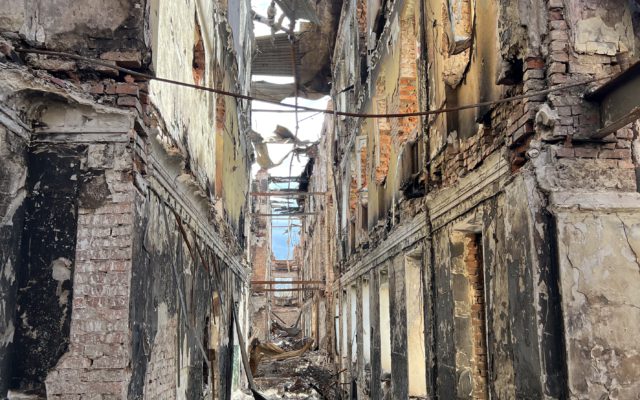
Hundreds of civilians have been killed in the Ukrainian city of Kharkiv by indiscriminate Russian shelling using widely banned cluster munitions and inherently inaccurate rockets, Amnesty International said today. 

A new report, ‘Anyone can die at any time’: Indiscriminate attacks by Russian forces in Kharkiv, Ukraine, documents how Russian forces have caused widespread death and destruction by relentlessly bombarding residential neighbourhoods of Kharkiv since their invasion began in late February. 

During an extensive investigation, Amnesty International found evidence of Russian forces repeatedly using 9N210/9N235 cluster munitions as well as scatterable mines, both of which are subject to international treaty bans because of their indiscriminate effects. 

“The people of Kharkiv have faced a relentless barrage of indiscriminate attacks in recent months, which killed and injured hundreds of civilians,” said Donatella Rovera, Amnesty International’s Senior Crisis Response Adviser. 

“People have been killed in their homes and in the streets, in playgrounds and in cemeteries, while queueing for humanitarian aid, or shopping for food and medicine. 

“The repeated use of widely banned cluster munitions is shocking, and a further indication of utter disregard for civilian lives. The Russian forces responsible for these horrific attacks must be held accountable for their actions, and victims and their families must receive full reparations.” 

The director of the Medical Department at the Kharkiv Regional Military Administration told Amnesty International that 606 civilians had been killed and 1,248 injured in the Kharkiv region since the conflict began. Most of the strikes investigated by Amnesty International inflicted multiple casualties over widespread areas. 

While Russia is not a party to either the Convention on Cluster Munitions or the Convention on Anti-Personnel Mines, international humanitarian law prohibits indiscriminate attacks, and the use of weapons that are indiscriminate by nature.  Launching indiscriminate attacks resulting in death or injury to civilians, or damage to civilian objects, constitutes war crimes. 

Destruction caused by Russian forces in Kharkiv

The people of Kharkiv have faced a relentless barrage of indiscriminate attacks in recent months, which killed and injured hundreds of civilians

Donatella Rovera, Amnesty International’s Senior Crisis Response Adviser

Playground attack 

The bombardment of Kharkiv, home to 1.5 million people, started on 24 February when the Russian invasion of Ukraine began. Residential neighbourhoods in the northern and eastern parts of the city bore the brunt of the shelling. 

On the afternoon of 15 April, Russian forces fired cluster munitions in and around Myru Street, in the Industrialni neighbourhood. At least nine civilians were killed and more than 35 injured, including several children. Doctors at Kharkiv’s City Clinical Hospital 25 showed Amnesty International metal fragments they had removed from patients’ bodies, including the distinctive pieces of steel rods contained in 9N210/9N235 cluster munitions. 

Tetiana Ahayeva, a 53-year-old nurse, was standing by the entrance of her building when several cluster bombs exploded. She told Amnesty International: “There was a sudden sound of firecrackers everywhere, lots of them, all over. I saw puffs of black smoke where the explosions occurred. We dropped to the ground and tried to find cover. Our neighbour’s son, a 16-year-old boy called Artem Shevchenko, was killed on the spot… His father had a shattered hip and a shrapnel wound in his leg. It’s hard to say how long the explosions lasted; a minute can seem to last forever.” 

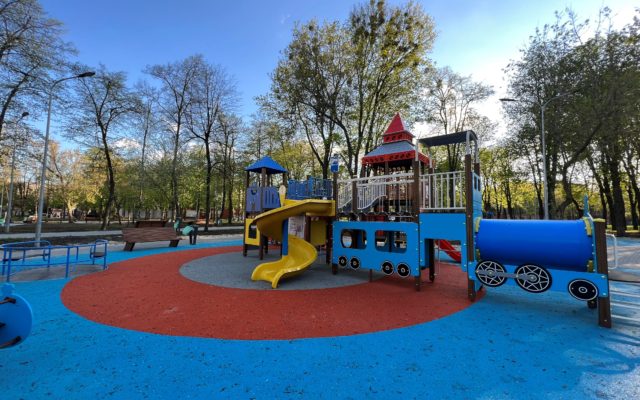
In a nearby playground, Oksana Litvynyenko, 41, suffered devastating injuries when several cluster munitions exploded while she was walking with her husband Ivan and their four-year-old daughter. Shrapnel penetrated her back, chest and abdomen, puncturing her lungs and spine. She tragically died on 11 June. The strike took place in the middle of the afternoon, while many other families were at the playground with their children.

Ivan told Amnesty International on 26 April: “All of a sudden, I saw a flash… I grabbed my daughter and pushed her against the tree and hugged the tree, so that she was protected between the tree and my body. There was a lot of smoke, and I couldn’t see anything… Then as the smoke around me eased, I saw people on the ground… my wife Oksana was lying on the ground. When my daughter saw her Mum on the ground in a pool of blood, she said to me, ‘Let’s go home: Mum is dead and the people are dead’. She was in shock and so was I. I still don’t know whether my wife will recover; the doctors cannot say if she will be able to speak or walk again. Our world has been turned upside down.”

After more than one month in intensive care, Oksana’s condition had improved slightly, but she died from her injuries on 11 June. Amnesty International researchers found the distinctive fins and metal pellets and other fragments from the 9N210/9N235 cluster munitions at the playground. Several small craters in the concrete ground were also visible, consistent with the damage expected from the explosion of such munitions.

The playground near Myru Street

All of a sudden, I saw a flash… I grabbed my daughter and pushed her against the tree and hugged the tree, so that she was protected between the tree and my body

Ivan Litvynyenko, playground attack survivor.

Humanitarian queue strike 

At least six people were killed and 15 were injured on the morning of 24 March, when cluster munitions struck a parking lot near the Akademika Pavlova metro station where hundreds of people were queuing for humanitarian aid. 

Valeriia Kolyshkina, a sales assistant in a pet shop close to the scene of the strike, said that one man was killed when the explosions destroyed the glass front of a nearby store.  

She told Amnesty International: “A man was killed just outside the shop. He was standing outside smoking while his wife was buying pet food… Metal shrapnel came through the front window, flying over my head as I was behind the counter. Then there were several more explosions. It was utter panic. The shop was full of people. We ran to the storage room at the back of the shop for protection. It was very scary… I thought I would die.” 

Ruslan*, a local policeman who witnessed the attack, said: “It was really a horrible situation, shrapnel was falling like rain.” 

Amnesty International researchers found parts of a 220mm Uragan rocket, which carries 30 submunitions, still embedded in a crater in the tarmac. Around the area, they also found fins and fragments from the 9N210/9N235 cluster munitions, and multiple other craters. 

Two other cluster munitions also hit the roof of the Holy Trinity Church, approximately 500 metres from where the rocket landed. The church serves as a humanitarian hub where volunteers prepare food and aid packages to be distributed to people who struggle to access humanitarian assistance distribution points, such as older people and those with disabilities and reduced mobility. Pastor Petro Loboiko and Pastor Serhii Andreiivich showed Amnesty International shrapnel from two cluster munitions that had penetrated the church’s walls and doors after exploding on the roof.   

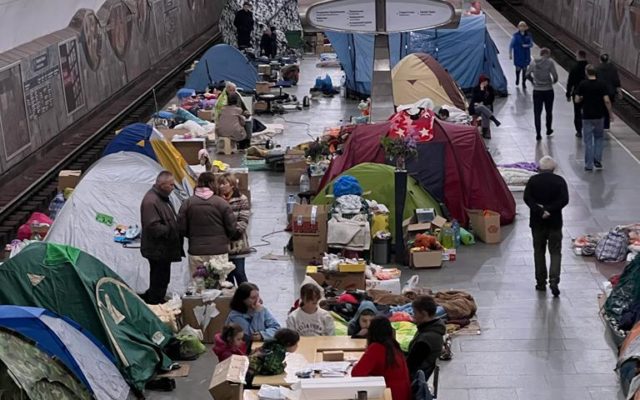
People seeking shelter in the Akademika Pavlova metro station

It was utter panic. The shop was full of people. We ran to the storage room at the back of the shop for protection. It was very scary… I thought I would die

Valeriia Kolyshkina, a sales assistant in a pet shop close to the scene of the strike.

Lost limbs 

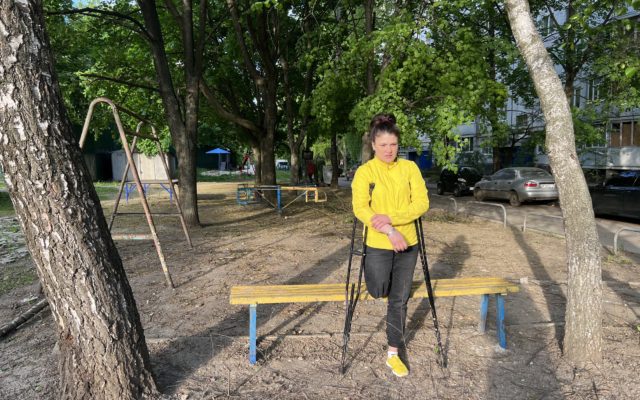
On the afternoon of 12 March, Veronica Cherevychko, a 30-year-old logistics manager and mother, lost her right leg when a Grad rocket struck a playground in front of her home in the Saltivka neighbourhood. 

She told Amnesty International: “I was sitting on this bench when the explosion happened. I remember hearing a whistling sound just before the explosion. Then I woke up in hospital, without a leg; my right leg was gone. Now my life is divided into before 12 March, and after 12 March. I will get used to this. Now I am not yet used to it; I often try to touch my leg, to scratch my foot… I don’t know what to say about [the] people who did it. I will never understand them.” 

Three people were killed and six injured when a series of cluster munitions exploded in the same neighbourhood on the morning of 26 April. Olena Sorokina, a 57-year-old cancer survivor, lost both legs in the blast. She was sitting outside her building waiting for a delivery of humanitarian aid when she heard the sound of a flying shell and ran to the entrance of the building. 

Olena blacked out, then woke up in an ambulance and realized that she had lost a leg. She was taken to hospital, where her other leg also had to be amputated. She is now in western Ukraine, hoping to be transferred to a rehabilitation facility elsewhere in Europe. Olena told Amnesty International: “After the battle with cancer, now I have to face another battle to learn to function without legs.” 

Unguided rockets – such as Grads and Uragans, which have been routinely used by Russian forces – are inherently inaccurate, making them indiscriminate when used in populated areas. Unguided artillery shells have a margin of error of over 100 metres. In residential areas where buildings are no more than a few metres apart, such inaccuracies are virtually certain to cost civilian lives and cause widespread destruction and damage to civilian infrastructure. 

Ukrainian forces, for their part, often launched strikes from residential neighbourhoods, endangering civilians in those areas. Such a practice violates international humanitarian law, but does not in any way justify Russian forces’ repeated indiscriminate strikes. 

Veronica Cherevychko

I don’t know what to say about [the] people who did it. I will never understand them

Veronica Cherevychko, a 30-year-old logistics manager who lost her right leg.

Methodology 

Amnesty International researchers investigated 41 strikes (which killed at least 62 people and injured at least 196) and interviewed 160 people in Kharkiv over 14 days in April and May, including survivors of attacks, relatives of victims, witnesses, and doctors who treated the injured. The organization’s researchers collected and analysed material evidence from strike locations, notably munitions fragments, as well as an array of digital materials. 

All of Amnesty International’s ongoing documentation of violations of human rights and international humanitarian law committed during the war in Ukraine is available here. 

STOP THE AGGRESSION AND PROTECT CIVILIANS IN UKRAINE

Right now, people in Ukraine are facing a catastrophic human rights crisis. People are dying, including children, and many thousands of lives are at risk. Take action to demand that the Russian authorities stop this act of aggression and protect civilians now.

The post Ukraine: Hundreds killed in relentless Russian shelling of Kharkiv – new investigation appeared first on Amnesty International.

Algeria:  Release members of Ahmadi religious minority

Algerian authorities must immediately and unconditionally release, and drop all charges against, three members of the Ahmadi Religion of Peace and Light, who were arrested earlier this week solely for peacefully exercising their right to freedom of religion, said Amnesty International today.

The authorities must also drop all charges against 21 other members of the group who are currently released pending investigation.

On 6 June 2022, the First Instance Tribunal in Bejaia charged the 24 men who identify as members of the Ahmadi religious group with ‘participation in an unauthorized group’ and ‘denigrating Islam’, under Article 46 of the Law on Associations and Article 144 bis 2 of the Algerian Penal Code, respectively. The judge ordered the immediate detention of three members and released the others pending further investigation. Their lawyer appealed this decision on 8 June.

“The Algerian authorities have legal obligations to respect, protect, promote and fulfil the right to freedom of religion of everyone in the country which includes those with religious beliefs that are different to the majority. It is outrageous that a group of people find themselves behind bars simply for practising their faith or for their beliefs,” said Amna Guellali, Amnesty International’s Deputy Director for the Middle East and North Africa.

“Algerian authorities must immediately and unconditionally release the three detained men and drop all charges against them and the 21 other members of the Ahmadi Religion of Peace and Light.”

Redouane Foufa, the coordinator of the group of religious members in Bejaia, told Amnesty International before his arrest that the Algerian authorities have been intimidating and harassing the group in Bejaia since April 2022. They interrogated them about their religious beliefs and confiscated their passports, phones and laptops on 2 April. They returned their passports on 7 June but kept their electronic devices.

On 5 June, police in Bejaia held the 24 members of the group for 13 Hours. They interrogated the adults and took their photographs and fingerprints.

According to Nadia Saliba, a group member and wife of detainee Khireddine Ahman, one officer said they are traitors of Islam and do not deserve rights as citizens. The members of the group were told they would appear in court the next morning and that their children were prohibited from attending Algerian schools until next year.

On 6 June, the group of 24 spent 14 hours in court before three of them — Redouane Foufa, the coordinator of the movement in Bejaia, and two other members, Khireddine Ahman and Cherif Mohamed Ali — were charged and sent to Bejaia’s Oued Ghir prison.

The Ahmadi Religion of Peace and Light was established in 1993. It follows the teachings of Imam Mahdi and believes in Imam Ahmed al-Hassan as its divine guide. There are currently an estimated 70 members in Algeria.

It is outrageous that a group of people find themselves behind bars simply for practising their faith or for their beliefs.

Amna Guellali, Amnesty International

According to Hadil El Khouly, a spokesperson for the Ahmadi Religion of Peace and Light, the members of the group in Bejaia have been interrogated by police a total of ten times over the past three months.

In an interview with Amnesty International before his arrest, Redouane Foufa said that around 30 soldiers had previously searched the house he shares with the members of the group and seized documents such as ID cards and passports, as well as phones and laptops.

Youssra Bezai, another member of the religious minority group, told Amnesty International: “We were living peacefully in our home. We never tried to take our beliefs outside. It is them who came to us and violated our privacy and our rights.”

The post Algeria:  Release members of Ahmadi religious minority appeared first on Amnesty International.

Türkiye: “Another dark day” as police use excessive force and fire pepper balls on Pride marchers

Reacting to the news that police violently broke up a student-organised Pride march at the Middle East Technical University (METU) campus in Ankara, Türkiye’s capital, arresting some students after dragging them on the ground, Nils Muižnieks, Amnesty International’s Europe Director said:

“Scenes of peaceful Pride marchers on the METU campus being confronted with police using unnecessary and excessive force, including pepper balls, are deeply disturbing, particularly as this is a repeat of the brutality we saw here three years ago.

“It is a dark day when university authorities notify the police to break up students who are simply marching peacefully for their rights to dignity and equality. All those detained by police solely for exercising their right to peaceful assembly must be immediately and unconditionally released.”

The post Türkiye: “Another dark day” as police use excessive force and fire pepper balls on Pride marchers appeared first on Amnesty International.