Russian air strikes on an apartment block and beach resort hotel in the coastal town of Serhiivka in southern Ukraine killed at least 21 civilians, Amnesty International said today following a new on-the-ground investigation.
The strikes, apparently using anti-ship missiles, hit the town in the Odesa region shortly before 1am on 1 July, injuring at least 35 people. Five people remain in serious condition in intensive care, meaning the total death toll may rise.
“These powerful weapons were designed to destroy warships, and firing them into residential areas is extremely reckless,” said Donatella Rovera, Amnesty International’s Senior Crisis Response Adviser.
“This attack is yet another example of the Russian military’s utter disregard for civilians in Ukraine as they continue to cause needless death and destruction. All those responsible for such war crimes must face justice for their actions.”
Amnesty International visited the strike locations in Serhiivka and found no evidence of the presence of Ukrainian soldiers, weapons, or other valid military targets nearby. Satellite imagery reviewed by Amnesty International also did not indicate any military activity in the area prior to the attack.
This attack is yet another example of the Russian military’s utter disregard for civilians in Ukraine
Local government officials told Amnesty International that the weapons used in the attack were two Kh-22 guided missiles. With an estimated warhead of more than 900kg and a targeting system designed to hit ships rather than land objects, the missile is potentially extremely inaccurate, and therefore completely inappropriate for use in a populated area.
Amnesty International’s Crisis Response weapons expert found ordnance fragments consistent with a large guided missile at the scene of the strike on the hotel. Notably, the fragments contained old-style rivets, consistent with a 50-year-old weapon such as a Kh-22.
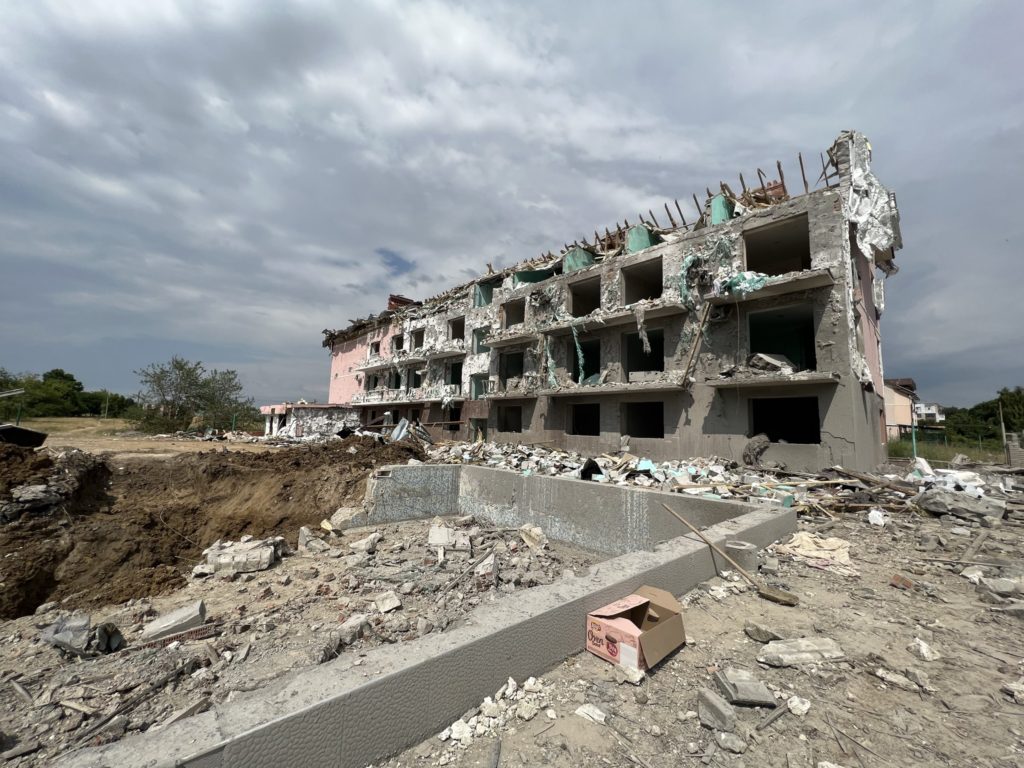
Residential nine-storey building at 23 Budzhaska Street in Serhiivka, which Russian forces hit on 1 July, killing 15 civilians. Ⓒ Amnesty International
A core principle of international humanitarian law (the laws of war) is that parties to an armed conflict must at all times distinguish between civilians and civilian objects, and members of the military and military objectives. Military objectives can be targeted, but it is unlawful to target civilians or civilian objects. Prior to any attack, members of the military are required to take steps to ensure that they are reasonably certain they are not targeting civilians and civilian objects.
To date, there have been numerous examples of Russian forces routinely launching unlawful attacks in Ukraine which have killed and injured civilians, some of which may have been deliberate attacks on civilians or civilian objects.
Resort hotel strike
Just after midnight on 1 July, Russian forces launched at least two missiles towards the Black Sea resort of Serhiivka, around 45 miles southwest of the city of Odesa. The first missile hit the Godji Hotel, and killed six civilians. Just minutes later, a second missile hit the hardware store at the front of a residential nine-storey building at 23 Budzhaska Street, and killed 15 civilians.
Amongst those killed at the Godji Hotel were Nadiya Rudnitskaya, the hotel manager, and her 12-year-old son Dmytro Rudnitsky. Olha Ilyashevych, 30, and her mother Maria, who had both fled fighting from Slovyansk in the Donbas region, were also killed.
The fatalities also included Oleksander Shishkov, 41, a well-known football coach who lived in Odesa but who had been staying at the hotel following a children’s football match the day before between the local team and the team from the nearby town of Bilhorod-Dnistrovsky.
Godji Hotel resort in Serhiivka, destroyed by a Russian attack on 1 July, killing six civilians. Ⓒ Amnesty International
Residential block strike
Amongst those killed in the strike on Budzhaska Street were Volodymyr Chulak, a 68-year-old physical education teacher, his wife Tetiana, a 64-year-old chef, and their son Mykhaylo, 35, who lived in Odesa and was visiting his parents.
Tetiana Chulak’s sister Valentyna told Amnesty International: “I heard the explosions and ran to the street… I ran there [number 23] and into the building, and found Tetiana in her bed, dead, covered in smashed-up furniture and debris, and her husband Volodymyr was dead in the kitchen. Their son Mykhaylo had been standing on the terrace, and was directly hit by the missile; he was in shreds.”
Also killed were Halyna Rumashuk, a 50-year-old receptionist, and her husband Serhii, a 48-year-old builder. They had initially survived the strike and managed to escape the building, but the couple then returned to look for some of their belongings, when a wall collapsed and killed them both.
Roman, 36, a resident of the fourth floor of the building, told Amnesty International that he and his mother only survived because at the time of the strike they were behind a poured-concrete wall in their kitchen, bathing their puppy who had undergone surgery. The rest of their apartment was obliterated in the blast. Roman attempted to save his next-door neighbour, Proskovia Pavlenko, 63. She was mortally wounded in the blast, and died as he carried her from the building.
Natalia Yankovska and her partner Maksym Nedomov both died from serious injuries caused by the blast. Natalia’s two young sons from a previous marriage, aged 10 and 14, both remain in hospital, with one in critical condition.
Other victims killed in the strike on the residential block include Oleksander Sribny (47), Tetiana Nesterenko (64), and Vira Maksymenko (71).
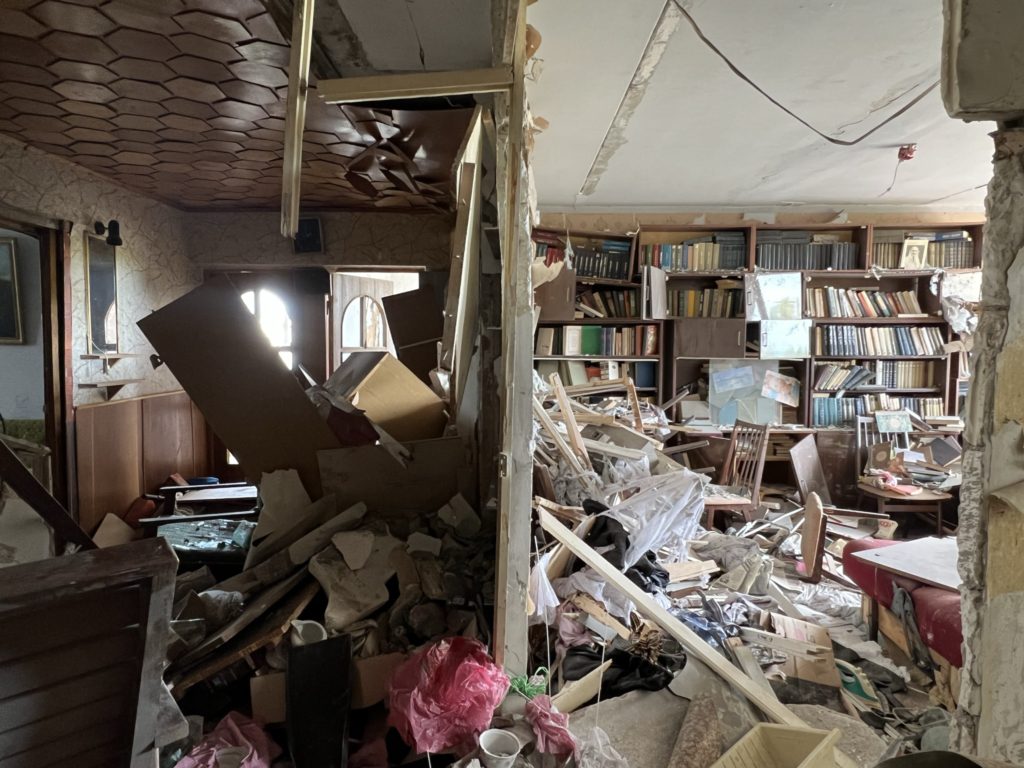
Damage to the interior of the residential apartment block on Buszhaska street. Ⓒ Amnesty International
“The Russian military’s relentless bombardment of residential areas full of civilians, killing people as they sleep, shocks the conscience,” said Donatella Rovera.
“How many more civilians must die before there is justice and accountability for these crimes? The Russian forces responsible for these ongoing serious violations of international humanitarian law must be held accountable for their actions, and victims and their families must receive full reparations.”
Amnesty International’s ongoing documentation of violations of human rights and international humanitarian law committed during the war in Ukraine is available here.
Responding to the execution of Malaysian national Kalwant Singh in Singapore, together with that of another man, Amnesty International’s Deputy Regional Director for Research Emerlynne Gil said:
“Singapore has once again executed people convicted of drug-related offenses in violation of international law, callously disregarding public outcry.”
“Going against a worldwide trend towards abolishing the death penalty, Singapore is just one of four countries known to have executed people for drug-related offenses in recent years. The death penalty is never the solution and we oppose it unconditionally. There is no evidence that it acts as a unique deterrent to crime.”
The death penalty is never the solution and we oppose it unconditionally.
Emerlynne Gil, Deputy Regional Director for Research
Despite the court finding that his role was limited to the transportation of drugs, Kalwant was denied a certificate of substantive assistance by the prosecution. He was then sentenced by the court to the mandatory death penalty. His application for a last minute stay, which asked for a review on the decision not to issue him with a certificate, was rejected by the Court of Appeal a day before the execution.
Last week, in a media interview, Minister of Law K Shanmugam publicly defended the use of the death penalty for drug-related offences in Singapore, citing the United Nations Office on Drugs and Crime’s (UNODC) recognition of problems caused by drugs in Southeast Asia.
“Contrary to what the Singaporean authorities have claimed, both the UNODC and the International Narcotics Control Board (INCB) – the UN bodies tasked with crime prevention and drug policy – have condemned the use of the death penalty for drug-related offences and have urged governments to move towards abolition. In fact, the UN Common Position on drugs has always been to urge governments to shift away from punitive responses because of their ineffectiveness in reducing drug trafficking or in addressing the use and supply of drugs.”
“The government has a duty to protect human rights for all, and its use of the death penalty is a blatant violation of human rights. We urge the Singaporean authorities to immediately stop this latest wave of hangings and impose a moratorium on executions as a step towards ending this shameful and inhuman punishment.”
Background
Kalwant Singh, a Malaysian national, was convicted and sentenced to the mandatory death penalty in 2016 for drug trafficking in 2013. The High Court found him to have been a “courier”, but the prosecution did not provide him with a certificate of substantive assistance, a requirement for the judges to be able to decide between the death penalty and life imprisonment with caning. His conviction and death sentence were upheld by the Court of Appeal in 2016.
Singaporean authorities set his execution for 7 July 2022, leaving his family little time to make arrangements to travel from Malaysia. Another man was also convicted in the same case and sentenced to the mandatory death penalty for drug trafficking. His execution was also set for 7 July.
Singapore has carried out four executions this year, all of people convicted of drug offences, after a pause of over 2 years during the pandemic.
Amnesty International opposes the death penalty in all cases without exception. As of today, 110 countries have abolished the death penalty for all crimes and more than two-thirds are abolitionist in law or practice.
Reacting to the news that a court in Belarus sentenced Danuta Pyarednya, a 20 year- old student from Mahiliou, to 6.5 years in jail for reposting a message criticizing the war in Ukraine and the role of Belarus’ ruler Alyaksandr Lukashenka in it, Marie Struthers, Amnesty International’s Director for Eastern Europe and Central Asia, said:
“The Belarusian authorities are increasingly clamping down on all dissent and continuing to support Russia in its aggression against Ukraine. Danuta Pyarednya and all persons in Belarus jailed for peacefully expressing their opinions and speaking out against the war must be released immediately and all charges against them dropped.”
Danuta Pyarednya and all persons in Belarus jailed for peacefully expressing their opinions and speaking out against the war must be released immediately and all charges against them dropped
Marie Struthers, Amnesty International’s Director for Eastern Europe and Central Asia
Background
On 5 July, a court in Kirausk, Mahiliou Oblast, sentenced Danuta Pyarednya, former student of Kulyashou Mahiliou State University, to six and a half years in a penal colony. She had been accused of “harming the national interests of Belarus” (Article 361(3) of the Criminal Code) and of “insulting the President” (Article 368(1)), a conduct that should not be criminalized in the first place.
The Belarusian authorities detained Pyarednya on 28 February, for reposting a text criticizing Vladimir Putin and Alyaksandr Lukashenka for waging war in Ukraine. A top student, she was promptly expelled from the university. On 10 June, while she was in detention, the Belarusian State Security Committee added her to the official list of “individuals involved in the terrorist activities.”
Since the start of the full-scale Russian invasion of Ukraine on 24 February, more than a thousand people have been detained in Belarus, Russia’s ally, for expressing their anti-war views.
Almost 50 new detainees added to Amnesty International campaign on arbitrary detention, bringing total to 120
Family members describe injustice and horror of prolonged separation
UN High Commissioner yet to release report on situation despite recent Xinjiang visit
Amnesty International today published heartbreaking new testimony from relatives of 48 ethnic Uyghur and Kazakh people detained in China’s Xinjiang Uyghur Autonomous Region, as it reiterated its call for the UN High Commissioner for Human Rights to take action.
The outgoing High Commissioner, Michelle Bachelet, has yet to release a long-awaited report on serious human rights violations in Xinjiang, and has repeatedly failed to recognize the gravity of violations by Chinese authorities in the region. It is deeply disappointing that due to this delay, yet another UN Human Rights Council session will close this week without having been able to discuss the UN’s findings on Xinjiang.
The new testimony gathered by Amnesty International is part of its Free Xinjiang Detainees campaign, which now tells the stories of 120 individuals who have been swept up in China’s vast system of prisons and internment camps in Xinjiang.
“The accounts of these families offer a window into the horrors taking place in Xinjiang, which amount to crimes against humanity. Many people said they have several family members in detention, illustrating the industrial scale of the abuses – one man said 40 of his relatives had been detained,” said Agnès Callamard, Amnesty International’s Secretary General.
“The foot-dragging which has characterized the UN response to the dystopian nightmare in Xinjiang adds insult to injury for victims and survivors of China’s campaign of mass imprisonment, torture and persecution against predominantly Muslim minorities in Xinjiang since 2017. We continue to call on the Chinese government to dismantle its vast system of internment camps; end all arbitrary detention, enforced disappearances and ill-treatment whether in prisons or other locations; and end its horrific persecution of Uyghurs, Kazakhs and other minorities in Xinjiang.
“Chinese authorities must be held accountable, and a crucial step is for High Commissioner Bachelet to publish her long-delayed report that should be presented urgently at the UN Human Rights Council. Her ongoing failure to call out crimes against humanity and other serious human rights violations in Xinjiang is an obstacle to justice. It also puts the UN system to shame.”
Chinese authorities must be held accountable, and a crucial step is for High Commissioner Bachelet to publish her long-delayed report that should be presented urgently at the UN Human Rights Council. Her ongoing failure to call out crimes against humanity and other serious human rights violations in Xinjiang is an obstacle to justice. It also puts the UN system to shame.
Agnès Callamard, Amnesty International’s Secretary General
Almas has appealed on behalf of his wife Buzaynap Abdureshit, who is in prison for having studied abroad: “She was seven weeks pregnant. She was on her way to the hospital to have some checks on the pregnancy when her mom called her saying that there were police at home waiting for her. So, she went back home. From there…no news [from her].”
Mafivet has appealed on behalf of her uncle, Abudumijiti Abudula, who was arrested in July 2016, allegedly for travelling abroad: “To be killed is one thing but living without being in touch with the family is also a very hard feeling.”
Habubulla has appealed on behalf of his brother Zekeriya Emet, who is in prison for having prayed in his restaurant: “I could not sleep for several days… I have been arrested by the Chinese [authorities] in the past. The police are very brutal. They treat us very badly. Only if all the people of the world together will take action to stop China’s oppression, then this oppression will end.”
Minawa has appealed on behalf of her younger brother, Aniver Ablimit, who is in prison for having a family member living abroad: “We want to live [freely] like you. We want to live in our own country. We want to sit [on the same table] with our relatives and eat together.”
Abuduaini has appealed on behalf of his brothers Ablet Ablez, in prison for having violated China’s birth policy, and Abdulshukür Ablez, in a prison or internment camp for having travelled to Turkey: “We [Uyghurs] have committed no crimes, yet we are being detained in camps and we are experiencing lives full of suffering.”
Selamet has advocated on behalf of her sister, Muherrem Muhammed Tursun, who is either in prison or in an internment camp because her son studied abroad and for her ethnicity: “If the Chinese government says, ‘the people there are living happily with normal lives’, I should be able to communicate with my own family normally. My family members and especially my mother who is 70 years old should be at home, not in a camp.”
Abudureheman has appealed on behalf of his wife Peride Yasin (in prison for having lived abroad) and children, and for his mother Aymur Kasim (in prison for having travelled to Turkey) and father Tohti Emet (in prison or an internment camp because of his ethnicity): “On one hand, they [Chinese authorities] detained my father and mother, on the other hand, my brother and sister, my own children, my wife whom I loved and married. They did not leave anyone of my loved ones, I am the only one who remained.”
Gulaisha has advocated on behalf of her brother, Dilshat Oralbay, who is in prison for travelling to Kazakhstan: “There is no court, they just put him in jail, tell him 25 years, nobody knows, I don’t think himself knows the reason. Somebody said because he travelled to Kazakhstan. There is no clear justifications and reason.”
Memet has appealed on behalf of his mother Baishihan Hushur, who is in an internment camp for reading the Qur’an: “My mom was arrested in mid-March 2018 because she attended a religious ceremony in 2013. I felt very sad, I was mentally broken because my mother was ill at the time… I really miss her face, I always imagine I could see her.”
Zohre has appealed on behalf of her cousin, Muhammedali Omer, who is in prison for being able to speak Arabic: “We can’t describe the feelings that we had [when we heard he was arrested]…Why did they arrest him. He was not a guy who would do any bad things. We were surprised that they arrested him. We didn’t know the reason.”
Tursuncan has appealed on behalf of his sister Aygul Ablet, who is in an internment camp for being a successful student and for having a brother living in Turkey: “When I heard my sister was being subjected to such atrocities in camps, I wished it was me instead…At some point I couldn’t take it anymore, I was having bad dreams, I couldn’t stop crying. I had a psychological breakdown. I didn’t want to talk to anyone.”
Amnesty International recently carried out in-person interviews in Turkey with exiled relatives of 48 detainees. They described how their loved ones had been arrested for “terrorism”-related or other spurious charges, apparently for things as mundane as traveling or paying for their children’s education abroad. Others appear to have been arrested solely on the basis of their religion or ethnicity.
Gulaisha Oralbay, a Kazakh woman, described what happened to her brother, Dilshat Oralbay, a retired Uyghur journalist and translator, after the Chinese authorities coaxed him into returning to Xinjiang from Kazakhstan in 2017. His passport was confiscated immediately upon his return, and he was arrested several months later.
“There is no court, they just put him in jail, [and told him it would be] for 25 years,” Gulaisha said.
“I don’t even think [he] himself knows the reason. Somebody said [it was] because he travelled to Kazakhstan, and different excuses; there is no clear justification and reason.”
Gulaisha and Dilshat’s two sisters, Bakytgul and Bagila Oralbay, are also in detention.
Abdullah Rasul told Amnesty International how his brother Parhat Rasul, a Uyghur farmer and part-time butcher, was detained and taken to an internment camp in May 2017. The family have not heard from him directly since then, but in 2018 a reliable source told them Parhat had been sentenced to nine years in prison.
Parhat’s family believes that he was arrested simply because he is an observant Muslim and was doing charity work. Family members said Parhat’s wife Kalbinur and his mother-in-law Parizat Abdugul were also imprisoned. Parhat and Kalbinur have two daughters, aged 14 and 16, and a son aged 11.
“They [the Chinese government] want to erase our identity, erase our culture, erase our religion,” Abdullah Rasul said. “I hope everyone can see clearly what is happening in our homeland.”
[The Chinese government] want to erase our identity, erase our culture, erase our religion. I hope everyone can see clearly what is happening in our homeland.”
Abdullah Rasul, relative of an arbitrary detainee in Xinjiang.
Medine Nazimi described how she last heard the voice of her sister, Mevlüde Hilal, at the end of 2016. Mevlüde had been studying in Turkey but, after she returned to Xinjiang to help her ailing mother, she was sent to an internment camp in 2017 and later allegedly sentenced to 10 years in prison on a charge of “separatism”. She is married and has a young daughter.
“When they took my sister, my niece, Aisha, was only one year old,” Medine told Amnesty International. “We were just going about our daily lives, and we were a happy family. My sister was taken for only one reason: it’s because she’s a Uyghur.”
People who speak out about the situation do so at great risk; several family members of detainees described being threatened by the authorities for going public.
Abudurehman Tothi, a Uyghur businessman and activist living in Turkey was interviewed by international media about his wife and mother’s imprisonment and father’s arbitrary detention. He told Amnesty International that afterwards the Chinese consulate in Turkey contacted him and threatened him with detention or death in a “car crash”.
Mountain of evidence
Since 2017, there has been extensive documentation of China’s crackdown against Uyghurs, Kazakhs and other predominantly Muslim ethnic minorities in Xinjiang, carried out under the guise of fighting “terrorism”. In 2021, a comprehensive report by Amnesty International demonstrated that the systematic state-organized mass imprisonment, torture and persecution perpetrated by Chinese authorities were crimes against humanity.
Chinese authorities have used their repressive surveillance state to try to sweep these violations under the carpet, but information continues to seep out of Xinjiang. In May 2022, several international media outlets published a joint investigation, the Xinjiang Police Files, which included a cache of leaked speeches, images, documents and spreadsheets obtained from Chinese internal police networks.
“Despite a growing body of evidence, Chinese authorities are still lying to the world about arbitrary detention on a massive scale in Xinjiang,” said Agnès Callamard.
“Amnesty International supports the joint call by dozens of UN experts to establish an independent, impartial and international mechanism. Such a mechanism must investigate crimes against humanity and other serious human rights violations committed by the Chinese government in Xinjiang. The many thousands of people still arbitrarily detained, and their families, deserve truth, justice and accountability.”
The many thousands of people still arbitrarily detained, and their families, deserve truth, justice and accountability.
Agnès Callamard
Bachelet should as a matter of urgency address the demands of the detainees’ families and indicate whether her office has been able to take any steps towards facilitating information on those detained.
High Commissioner’s visit to China
The UN Human Rights Council’s 50th session is ongoing and will end on 8 July. It will be the last with Michelle Bachelet as High Commissioner; her mandate ends on 31 August 2022 and she has announced she will not seek a second term.
At the end of May, in a press conference following her long-awaited trip to China – including a brief visit to Xinjiang, Bachelet failed to acknowledge serious human rights violations in China. Her statement at the end of her visit undermined efforts to advance accountability in the region, instead giving the impression she had walked straight into a highly predictable propaganda exercise for the Chinese government. She admitted afterwards that she could not speak to any detained Uyghurs or their families while in Xinjiang, and was accompanied by state officials at all times in the region.
Amnesty International Zimbabwe has been following closely the case of Job Sikhala, chairman of Citizens Coalition for Change, and Godfrey Sithole, MP for Chitungwiza North, both of whom are facing charges of inciting violence after attending the funeral of Moreblessing Ali. The two remain in detention and have been denied bail by the magistrate court. Muleya Mwananyanda, Amnesty International’s Deputy Director for Southern Africa, said:
The continued detention of Job Sikhala and Godfrey Sithole and the denial of their lawyers access is an absolute travesty of justice
Muleya Mwananyanda, Deputy Director for Southern Africa
“The continued detention of Job Sikhala and Godfrey Sithole and the denial of their lawyers access to meet with them is an absolute travesty of justice. There is an emerging trend where critics of government and members of the opposition are consistently harassed and denied bail by the courts, brought to court in iron legs and at times denied access to their lawyers. Yet high profile political elites facing criminal offences are in most cases treated entirely differently with bail being granted regardless of the seriousness of the offence.
The denial of bail against Sikhala and Sithole shows all the hallmarks of an effort to silence political opposition
Muleya Mwananyanda
“The charges levelled against Sikhala and Sithole and the denial of bail at the magistrates court show all the hallmarks of an effort to persecute and silence political opposition by the Zimbabwean authorities.
“The authorities should refocus their efforts on ensuring that Moreblessing Ali’s killers face justice, and ensuring access to justice and effective remedies for victims and their families.”
Background
Members of political opposition Job Sikhala and Godfrey Sithole were arrested on 14 June after attending Moreblessing Ali’s funeral. Ali, a political activist, was missing for three weeks before being found murdered and her body mutilated on 11 June. The Zimbabwean authorities have accused them of encouraging their supporters to cause violence in Nyatsime, Chitungwiza, during Ali’s memorial. They were denied bail when they appeared in the magistrates court and they have since appealed to the High Court.
Sikhala’s lawyers, Alec Muchadehama and Jeremiah Bhamu, insist that his arrest is politically motivated. He has been arrested a record 67 times on politically-motivated charges without conviction.