
Amnesty International launches global campaign to confront unprecedented worldwide threat to the right to protest


Amnesty International launches global campaign to confront unprecedented worldwide threat to the right to protest

The right to protest is under unprecedented and growing threat across all regions of the world, Amnesty International said today, as the organization launched a new global campaign to confront states’ widening and intensifying efforts to erode this fundamental human right.

From Russia to Sri Lanka, France to Senegal, and Iran to Nicaragua, state authorities are implementing an expanding array of measures to suppress organized dissent. Protesters across the globe are facing a potent mix of pushbacks, with a growing number of laws and other measures to restrict the right to protest; the misuse of force, the expansion of unlawful mass and targeted surveillance; internet shutdowns and online censorship; and abuse and stigmatization. Meanwhile, marginalized and discriminated groups are subjected to even further barriers.

Amnesty International’s “Protect the Protest” campaign will challenge attacks on peaceful protest, stand with those targeted and support the causes of social movements pushing for human rights change.

“In recent years we have seen some of the biggest protest mobilizations for decades. Black Lives Matter, MeToo, and the climate change movements have inspired millions the world over to take to the streets and online to demand racial and climate justice, equity and livelihoods, and an end to gender violence and discrimination. Elsewhere, people have stood up in their thousands against police violence and killings, state repression and oppression,” said Agnès Callamard, Amnesty International’s Secretary General.

“Almost without exception, this wave of mass protest has been met with obstructive, repressive and often violent responses by state authorities. Instead of facilitating the right to protest, governments are going to ever greater lengths to quash it. This is why, as the world’s biggest human rights organisation, we have chosen this moment to launch this campaign. It’s time to stand up and loudly remind those in power of our inalienable right to protest, to express grievances, and to demand change freely, collectively and publicly.”

Instead of facilitating the right to protest, governments are going to ever greater lengths to quash it.

Agnès Callamard, Amnesty International’s Secretary General

Protest under attack around the world

It’s time to stand up and loudly remind those in power of our inalienable right to protest, to express grievances, and to demand change freely, collectively and publicly.

Agnès Callamard, Amnesty International’s Secretary General

Restrictive legislation, blanket bans, and emergency powers

A range of issues including the environmental crisis, growing inequality and threats to livelihoods, systemic racism and gender-based violence have made collective action ever more necessary. Governments have responded by introducing legislation imposing illegitimate restrictions on the right to protest. For example, we have seen blanket bans on protests, as seen in Greece and Cyprus during the Covid-19 pandemic. In the UK, a new law contains provisions providing police officers with wide-ranging powers, including the ability to ban ‘noisy protests’, while in Senegal, political demonstrations in the centre of Dakar have been banned since 2011, precluding protests near government buildings.

Governments of all kinds are also increasingly using emergency powers as a pretext to clamp down on dissent. This was seen at the height of the Covid-19 pandemic in countries including Thailand, while in the Democratic Republic of Congo, a government-imposed ‘state of siege’ has provided military and police officers with extensive powers to restrict protest in the provinces of Ituri and North Kivu since May 2021.

A man runs from rocks and teargas during a protest that erupted due the voting of a new anti-terror bill in Dakar on June 25, 2021, that opponents think might be used to stop protests against the government on the streets.

Demonization of protestors

Governments across the world are justifying restrictions by arguing that protest constitutes a threat to public order and by stigmatizing protesters; branding them “troublemakers”, “rioters”, or even “terrorists”. By casting protesters in this light, authorities have justified zero-tolerance approaches: introducing and misusing vague and draconian security laws, deploying heavy handed policing, and taking pre-emptive deterrent measures.

This approach was witnessed in Hong Kong, where the National Security Law and its expansive definition of “national security” have been used arbitrarily, among other things, to restrict protest.

And, in India, the anti-terror Unlawful Prevention (Activities) Act (UAPA) and the crime of “sedition”, have been used repeatedly against peaceful protesters, journalists, and human rights defenders.

Police move people on as they gathered in the Causeway Bay district of Hong Kong on June 4, 2021, after police closed the venue where Hong Kong people traditionally gather annually to mourn the victims of China’s Tiananmen Square crackdown in 1989 which the authorities have banned citing the coronavirus pandemic and vowed to stamp out any protests on the anniversary.

Protesters at risk

Vahid Afkari
Vahid Afkari was arbitrarily arrested following his peaceful participation in nationwide protests that took place across Iran in 2017 and 2018.
Chow Hang-Tung
Human rights lawyer and labour rights advocate Chow Hang-tung, currently imprisoned, was charged for “inciting subversion” under the new National Security Law on 9 September 2021 and faces up to 10 years’ imprisonment.
Joanah Mamombe, Cecillia Chimbiri and Netsai Marova
Political activists Cecillia Chimbiri, Joana Mamombe and Netsai Marova were arrested in May 2020 at a police roadblock in Harare, Zimbabwe’s capital, for leading an anti-government protest over the authorities’ response to the Covid-19 pandemic and widespread hunger in the country.
Gustavo Gatica
Chilean university student who was blinded after being shot with riot shotguns by the police while peacefully participating in the wave of mass protests that took over Chile in late 2019.
The Saturday Mothers
On 25 August 2018, police in Istanbul used tear gas and water cannons to disperse a peaceful gathering, mainly of women, some of whom were in their 80s, known as ‘Saturday Mothers’.

Militarization of policing

While governments have long relied on aggressive tactics to police protests, security forces have increased the amount of force they use in recent years.

So-called less lethal weapons, including batons, pepper spray, tear gas, stun grenades, water cannons, and rubber bullets are routinely misused by security forces. And, since the early 2000s, Amnesty International has documented a trend towards the militarisation of state responses to protests, including the use of armed forces and military equipment. In countries including Chile and France security forces in full riot gear are often backed by armoured vehicles, military-grade aircraft, surveillance drones, guns and assault weapons, stun grenades and sound cannons.

During the mass uprising that followed the 2021 coup in Myanmar, the military used unlawful lethal force against peaceful protesters. More than 2,000 people have been killed, according to monitors, and more than 13,000 arrested since the military seized power.

Protesters hold banners and shout slogans while Myanmar military soldiers who arrived to guard the Central Bank overnight place barbed wire barricades on February 15, 2021 in Yangon, Myanmar. The U.S. Embassy in Myanmar told Americans in Myanmar to “shelter in place” in an announcement after military movements and reports of possible interruptions to telecoms overnight. Armored vehicles were seen on the streets of Myanmar’s capital, but protesters turned out in force despite the military presence.

Inequality and discrimination

People who face inequality and discrimination, whether based on race, gender, sexual orientation, gender identity, religion, age, disability, occupation, social, economic or migratory status are also more affected by restrictions on their right to protest and face harsher repression. 

For example, women, LGBTI and gender-non-conforming people are facing different types of gender-based violence, marginalization, social norms and legislation.  In countries including Sudan, Colombia and Belarus, women have been sexually assaulted for participating in protests, while in Turkey, for example, Pride marches have been banned for years.

“Our campaign comes at a critical juncture. The precious right to protest is being eroded at a terrifying pace, and we must do all we can to push back,” said Agnès Callamard.

“Countless protesters have been killed in recent years, and it is partly on their behalf that we must now raise our own voices and defend our right to speak truth to power through protests in the streets and online.”
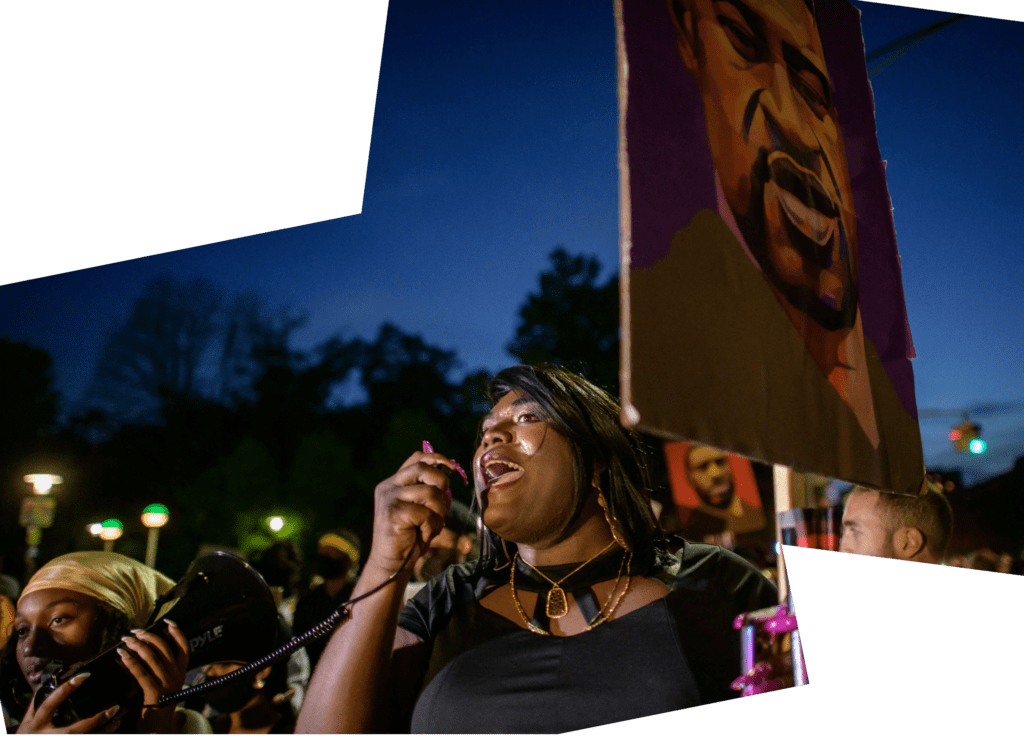
Black Lives Matter (BLM) protesters hold placards and shout slogans during a march on the anniversary of the death of George Floyd, in Brooklyn, New York on May 25, 2021. – The family of George Floyd appealed on May 25 for sweeping police reform on the anniversary of the African American man’s murder by a white officer, as they met President Joe Biden at the White House. 

Background

International human rights law protects the right to protest through a number of separate provisions enshrined in various international and regional treaties which, taken together, provide protests with comprehensive protection. Even though the right to protest is not codified as a separate right in human rights treaties, when people engage in protests, whether individually or collectively, they are exercising a variety of rights, which can include the rights to freedom of expression and peaceful assembly.

Throughout history, protest has been a powerful tool for change. But governments around the world are cracking down on protests and it must be protected.

Protect the protest

Add your voice to our global call to protect the protest and join our campaign today.

The post Amnesty International launches global campaign to confront unprecedented worldwide threat to the right to protest appeared first on Amnesty International.

Thailand: Pegasus spyware found on phones of dissidents involved in mass protests

Thailand must thoroughly investigate the use of the invasive Pegasus spyware found on the phones of dozens of activists, Amnesty International said today, after a new report identified 30 people who were targeted or infected with the harmful software, the first time its use in the country has been confirmed through technical analysis.

The joint report by the Thai NGO iLaw, Digital Reach and The Citizen Lab found that the infections spanned 2020 to 2021 and involved prominent individuals leading the mass pro-democracy protests, which called for major political and economic reforms, as well as academics and human rights defenders who have publicly criticized the Thai government.  

These findings stemmed from alarming notifications sent by Apple to many Thai activists that they had been targeted with the spyware in November 2021. Amnesty International’s Security Lab independently confirmed five of the cases in the report through forensic analysis. 

“We can now officially add Thailand to the growing list of countries where people peacefully calling for change, expressing an opinion, or discussing government policies may trigger invasive surveillance with a profound toll on an individual’s freedom of expression, privacy, and sense of security,” said Etienne Maynier, Technologist at Amnesty International. “It is worth remembering that this is only what has been found so far, and the scale of surveillance attempts could be bigger and more damaging.” 

It is worth remembering that this is only what has been found so far, and the scale of surveillance attempts could be bigger and more damaging.

Etienne Maynier, Technologist at Amnesty International

According to the report, Pegasus spyware was found on the phones of leading Thai protest organizers, including Arnon Nampa, Benja Apan and Panusaya Sithijirawattanakul, also known as Rung, who authorities have targeted with multiple unwarranted criminal proceedings for peacefully exercising their rights to assembly and freedom of expression.  

“Instead of listening and engaging with these protesters, academics, and human rights defenders, intrusive surveillance has been used to harass, intimidate, and target them in an attempt to break their spirit and create a society-wide chilling effect. These new revelations are a shocking example of just how low authorities might stoop to control peaceful dissent.”  

NSO Group, the company behind Pegasus, claims that it only sells products to government intelligence and law enforcement agencies.  

States have binding obligations under international law to not only respect human rights, but also to protect them from abuse by third parties, including private companies. 

Amnesty International continues to call for a global moratorium on the sale, transfer, and use of spyware until human rights regulatory safeguards that govern its use are in place. 

“Thai authorities must launch an independent, prompt, thorough, and effective investigation into the use of Pegasus spyware and take necessary measures to foster a safe environment for civic engagement. Such measures must include the amendments of legislation enabling state surveillance, including the Computer Crimes Act, the Cybersecurity Act, and the National Intelligence Act in line with international human rights law, as well as implementing safeguards to protect the right to privacy and freedom of expression, association and peaceful assembly.” 

Background: 

The new report was released one year after the global Pegasus Project revelations, which uncovered how governments worldwide were using NSO Group’s invasive Pegasus spyware to put human rights activists, political leaders, journalists and lawyers under unlawful surveillance. 

The lack of a global moratorium on the sale of spyware is allowing the surveillance industry to continue unchecked, Amnesty International warned in a separate statement today. 

Following repeated calls for the surveillance industry to be regulated, some steps have been taken in the right direction – but government action has not yet been enough. 

The Pegasus Project was a collaboration by journalists from 17 media organizations in 10 countries, coordinated by Forbidden Stories. Amnesty International’s Security Lab used cutting-edge digital forensic tests and research methodologies to confirm evidence of targeting and infections on scores of phones around the world. 

In the last year, the Security Lab uncovered new instances of targeting using Pegasus in Morocco-Western Sahara and Poland. In addition, the Security Lab independently confirmed numerous additional cases where Pegasus was still being used to unlawfully target people, including cases in El Salvador, Israel/Occupied Palestinian Territories, Poland, and Spain. 

The post Thailand: Pegasus spyware found on phones of dissidents involved in mass protests appeared first on Amnesty International.

The Pegasus Project: One year on, spyware crisis continues after failure to clamp down on surveillance industry

One year after the Pegasus Project revelations, the lack of a global moratorium on the sale of spyware is allowing the surveillance industry to continue unchecked, Amnesty International warned today.

The Pegasus Project uncovered how governments worldwide were using NSO Group’s invasive Pegasus spyware to put human rights activists, political leaders, journalists and lawyers around the world under unlawful surveillance.

Following repeated calls for the surveillance industry to be regulated, some steps have been taken in the right direction – but government action has not yet been enough.

Everyone targeted with NSO Group’s spyware has a right to remedy

Danna Ingleton, Amnesty Tech’s Deputy Director

“One year after the Pegasus spyware revelations shocked the world, it is alarming that surveillance companies are still profiting from human rights violations on a global scale,” said Danna Ingleton, Amnesty Tech’s Deputy Director.

“The Pegasus Project offered a wake-up call that action was urgently needed to regulate an industry that is out of control. Shamefully, governments worldwide are yet to step up and fully deal with this digital surveillance crisis.

“Everyone targeted with NSO Group’s spyware has a right to remedy. Global governments’ failure to take meaningful action is an insult to all those who have suffered, physically and psychologically, after being targeted with this invasive software.

“The unlawful targeted surveillance of human rights defenders and civil society is a tool of repression. It is time to clamp down on this industry that continues to operate in the shadows.”

The Pegasus Project was a collaboration by journalists from 17 media organizations in 10 countries, coordinated by Forbidden Stories. Amnesty International’s Security Lab used cutting-edge digital forensic tests and research methodologies to confirm evidence of targeting and infections on scores of phones around the world.

In the last year, the Security Lab uncovered new instances of targeting using Pegasus in Morocco-Western Sahara and Poland. In addition, the Security Lab independently confirmed numerous additional cases where Pegasus was still being used to unlawfully target people, including cases in El Salvador, Israel/Occupied Palestinian Territories, Poland, and Spain.

Unlawful surveillance violates the right to privacy, and can also violate the rights to freedom of expression, opinion, association, and peaceful assembly.

‘A very violent form of censorship’

Amnesty International has been investigating unlawful surveillance for many years. There is mounting evidence of human rights violations being committed by governments, and how companies profit from unlawful targeted surveillance.

Every month, there are new cases confirmed of people being targeted with Pegasus. Amnesty International interviewed several people who had been infected with Pegasus, who told of their distress at being targeted.

That’s their goal: to make you paranoid, isolate you from people and lock you in a prison

Hicham Mansouri, Moroccan journalist

Julia Gavarrete, a journalist in El Salvador, said: “It’s a shame that a powerful tool to combat criminals is being used to attack independent journalists and human rights defenders. It’s a shame that we have no clue about who was behind the targeting. It’s impossible not to feel angry when our entire life is at someone else’s hands, and there’s no answers about the responsibility of this. 

“Being targeted led me to change my way of communicating, the places I used to go, and also to think twice about the type of information I want to share with others – not only because of my own security, but to protect the integrity of those who communicate with me. I have to be aware of the places we visit and try to be very careful every time we have our devices near…  As a journalist, I have to guard my sources, but as a woman, I need to protect my family and friends. Surveillance entails an indignity to our professional life and our private life.” 

Hicham Mansouri, a Moroccan journalist living in France, described being targeted as “a very violent form of censorship, because we deprive ourselves of expressing ourselves on many subjects both in a professional and personal context”. He added: “That’s their goal: to make you paranoid, isolate you from people and lock you in a prison.”

Ongoing investigations

There are currently open investigations and cases pending against NSO Group in France, India, Mexico, Poland and Spain. In March, the European Parliament established the PEGA Committee to investigate the use of Pegasus and other spyware in Europe.

In November 2021, the United States’ government placed NSO Group on its Entity List, for “engaging in activities that are contrary to the national security or foreign policy interests”. Later that month, Apple filed a lawsuit against NSO Group to hold it accountable for the surveillance and targeting of Apple users.

In recent weeks, there have been reports that US defence contractor company L3Harris is in talks to buy ownership of Pegasus software. NSO Group’s future remains uncertain.

“Any attempt by NSO Group to alter its business model in a bid to evade accountability must be resisted. The entire surveillance industry is broken and needs urgent reform,” said Danna Ingleton.

“We continue to call for a global moratorium on the sale, transfer and use of spyware until human rights regulatory safeguards that govern its use are in place.”

States have binding obligations under international law to not only respect human rights, but also to protect them from abuse by third parties, including private companies.

The post The Pegasus Project: One year on, spyware crisis continues after failure to clamp down on surveillance industry appeared first on Amnesty International.

Russia: Opposition activist sentenced to four years in prison under repressive ‘undesirable organization’ law

Reacting to news that a Russian court has sentenced opposition activist and human rights defender, Andrei Pivovarov, to four years in a penal colony, on charges brought under the country’s repressive ‘undesirable organizations’ legislation, Marie Struthers, Amnesty International’s Director for Eastern Europe and Central Asia, said:

“Andrei Pivovarov’s unjust prosecution and cruel prison sentence are part of a campaign by Russian authorities to weaponize the Criminal Code against anyone who dares to exercise their right to freedom of expression. Both the verdict today and the criminal article under which it was issued are shameful.”

Andrei Pivovarov’s unjust prosecution and cruel prison sentence are part of a campaign by Russian authorities to weaponize the Criminal Code against anyone who dares to exercise their right to freedom of expression

Marie Struthers, Amnesty International’s Director for Eastern Europe and Central Asia

“Andrei Pivovarov should be immediately and unconditionally released. The authorities must also urgently repeal the legislation on ’undesirable organizations’ and ensure people can exercise their right to association without fear of reprisals. This law is clearly not concerned with criminal activity, but with repressing any form of dissent or criticism of the government. It simply should not exist.”

Andrei Pivovarov said in his final statement in court on 11 July: “And even if now those who stand for the future are trampled and imprisoned, I know that progress cannot be stopped, changes for the better are inevitable, and they are not far off. See you in our new, desirable and open Russia. We will pull through!”

Background

On 15 July, the Leninsky District Court of Krasnodar, southern Russia, sentenced Andrei Pivovarov, the former head of the now-disbanded Otkrytaya Rossiya (Open Russia) movement founded by Kremlin critic Mikhail Khodorkovsky, to four years in a penal colony. Andrei Pivovarov was found guilty of leading an “undesirable organization”, a law that clearly contravenes the right to association. The charges relate to at least 30 social media posts he had shared about the group’s activities which he had led.

The crackdown came after the Russian authorities banned a UK-based organization called Open Russia in April 2017, which led to widespread reprisals against the Russian group of the same name. Pivovarov’s Otkrytaya Rossiya movement had ceased all work several days before his arrest on 31 May 2021, when he was taken off a flight from Saint Petersburg to Warsaw and put in pre-trial detention.

The post Russia: Opposition activist sentenced to four years in prison under repressive ‘undesirable organization’ law appeared first on Amnesty International.

Russia: Feminist activist acquitted of absurd ‘pornography’ charges

Responding to the acquittal of feminist activist and artist Yulia Tsvetkova, who was charged with “disseminating pornography” for creating body-positive illustrations of female sexual organs, a crime punishable by up to three years in prison, Marie Struthers, Amnesty International’s Director for Eastern Europe and Central Asia, said:

“The acquittal of Yulia Tsvetkova today marks a rare and welcome triumph of sanity and justice over remorseless repression. In a country where state-sponsored homophobia and misogyny are the norm, Tsvetkova’s trial was a landmark case. Her acquittal must now set a new precedent that ensures the right to freedom of expression is upheld and protected for all.

“For more than three years, Yulia Tsvetkova has suffered unrelenting mistreatment by the authorities in the form of criminal proceedings, fines, threats, arrests and travel restrictions, all of which were imposed solely in response to her peaceful activism.

For more than three years, Yulia Tsvetkova has suffered unrelenting mistreatment by the authorities in the form of criminal proceedings, fines, threats, arrests and travel restrictions

Marie Struthers, Amnesty International’s Director for Eastern Europe and Central Asia

“The Russian authorities must immediately stop targeting feminists and LGBTI activists. Instead, they should honour their international human rights obligations by enabling a safe and supportive environment in which human rights defenders can work without fear of reprisals.”

Background

On 15 July, the Central District Court of Komsomolsk-on-Amur in Russia’s Far East acquitted Tsvetkova and cleared her of all charges. She had been accused of creating and sharing “pornographic” images — including body-positive drawings of women’s bodies that depict the vagina as a beautiful, flower-like symbol — on VKontakte, a Russian social media site.

She was detained on 20 November 2019 and held under house arrest until 16 March 2020. In December 2019, she was found guilty of sharing “propaganda of non-traditional sexual relations with minors” and fined 50,000 roubles (US$780). In July 2020, she was fined a further 75,000 roubles (US$1,050).

On 3 June 2022, the Ministry of Justice placed Tsvetkova on its “foreign agents” register, which is used to restrict independent NGOs, media organizations and activists.

The post Russia: Feminist activist acquitted of absurd ‘pornography’ charges appeared first on Amnesty International.