
Sri Lanka: Authorities’ crackdown on protest rights must end 


Sri Lanka: Authorities’ crackdown on protest rights must end 

The Sri Lankan authorities have fiercely clamped down on protests and demonized protesters during a period of economic crisis and hardship in the country, Amnesty International said in a new digest released today. 

The briefing, Penalized for Protesting: Sri Lanka’s crackdown on protestors, details how the authorities have failed to protect peaceful protesters and resorted to excessive use of force, deploying the military to police protests and carrying out reprisals against protestors while also demonizing those who exercise their protest rights peacefully.

“Over the last few months, Sri Lanka has seen widespread protests over the worst economic crisis in the country’s post-independence history. People have the right to express discontent peacefully and the state has an obligation to facilitate this right but the Sri Lankan authorities have repeatedly and unrelentingly stifled the voice of the people,” said Yamini Mishra, Amnesty International’s South Asia Regional Director.

“The new government in Sri Lanka has continued resorting to the unlawful use of force, intimidation and harassment to subdue protestors, sending a chilling message to the people of Sri Lanka that there is no room for dissent. The right to freedom of peaceful assembly is a keystone of any rights respecting society. It must be respected and protected.”

It must be noted that there have been some incidents of violence during protests since the protest movement began in February 2022.  While these protests cannot be deemed as peaceful, the response by the authorities to such protest must still comply with human rights laws and standards. 

The Sri Lankan authorities have repeatedly and unrelentingly stifled the voice of the people.

Yamini Mishra, Amnesty International’s South Asia Regional Director

none

Tear gas, water cannons — and live ammunition

Since the protests began five months ago, the police and armed forces have routinely misused tear gas and water cannons against largely peaceful protesters. On two occasions, security forces fired live ammunition at protesters, killing at least one person in Rambukkana on 19 April.  

This unlawful use of force was also witnessed in other key incidents demonstrating the government’s refusal to facilitate the right to peaceful assembly, despite their obligations under international human rights laws and standards. 

Since President Ranil Wickremesinghe came into power on 21 July, over 140 protesters have been arrested, while a further 18 have been issued travel bans. Furthermore, Members of Parliament and the President have repeatedly described protesters as “terrorists”. President Wickremesinghe, meanwhile, also labelled protesters as “fascists” amid a broader pattern of demonizing the protest movement. The authorities have taken this one step further by weaponizing the draconian anti-terror law Prevention of Terrorism Act (PTA) to arrest three protesters. Amnesty International has, in the past, documented the use of the draconian PTA by the authorities to target, and harass minorities, activists, journalists and critical voices. The PTA is in violation of international human rights law and must be repealed.

Many of us got travel bans, and surveillance and tear gas attacks and baton charged and, at times, court orders and imprisonment…A protestor

none

The right to freedom of peaceful assembly is a keystone of any rights respecting society.
It must be respected and protected.

Yamini Mishra, Amnesty International’s South Asia Regional Director

none

none
none
none
none
none
none

‘They want me in jail’ 

Since 2 April, the authorities have arrested some people in a manner that flouts due process. Security forces did not produce official identification or produce arrest warrants or adequately explain the reason for arrests. Certain individuals were taken away and held for several hours at undisclosed locations. On these occasions, no confirmation of arrest was issued, nor were detainees given the opportunity to inform their relatives, friends or lawyers of their whereabouts.

One of the protestors told Amnesty International: “I’m still worried that they are trying to arrest me and accuse me of things I have not committed, because they want me in jail.” 

These arrests, which constituted unlawful deprivation of liberty, should immediately be stopped and the authorities must carry out arrests in keeping with their obligations under the international law and standards, including the ICCPR which prohibits arbitrary detention and protects the right to liberty and security of person. The authorities must also end their use of Emergency Regulations, which give sweeping powers to the police and the armed forces to search and make arrests without due process safeguards and have been shown to flout international human rights law.
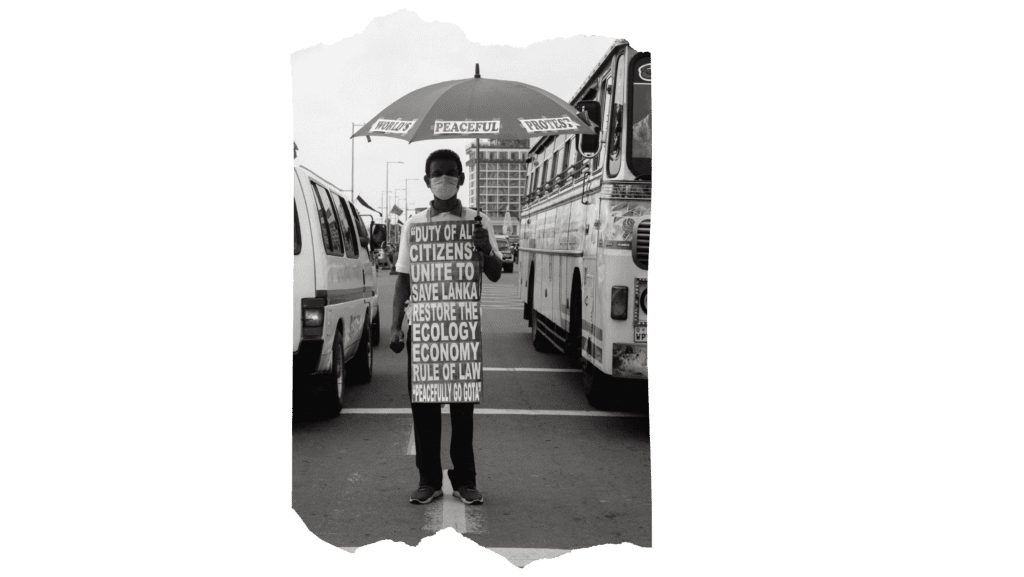
I’m still worried that they are trying to arrest me and accuse me of things I have not committed, because they want me in jail.

A protestor

none

The Sri Lankan authorities should change course and immediately end their suppression of the
people’s right to protest.

Yamini Mishra

none

‘The state does not stand on the side of the people’ 

Another protestor, who suffered repeated harassment at the hands of the authorities, told Amnesty International: “Many of us got travel bans, and surveillance and tear gas attacks and baton charged and, at times, court orders and imprisonment… The state is always protecting and only defending political power and does not stand on the side of the people.” 

Amnesty International calls on the Sri Lankan authorities to drop all charges against those protesters who were participating peacefully in so called “unlawful assemblies”. All those facing such charges must be immediately released. The authorities must also hold prompt, transparent and impartial investigations into all allegations of attacks on peaceful protesters, with support from international observers.

“The relentless repression of the right to freedom of peaceful assembly, movement and expression speaks to Sri Lanka’s legacy of suppressing dissent. Given the immense and historic support for the peaceful protest movement, the Sri Lankan authorities should change course and immediately end their suppression of people’s right to protest,” said Yamini Mishra. 
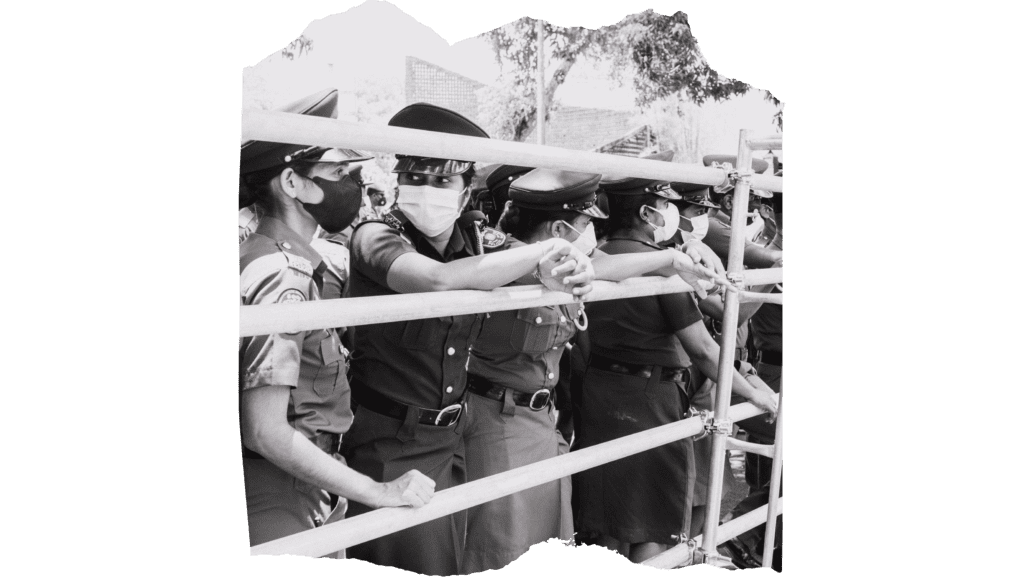
The state is always protecting and only defending political power and does not stand on the side of the people.

A protestor

The relentless repression of the right to freedom of peaceful assembly, movement and expression speaks to Sri Lanka’s legacy of suppressing dissent.

END CRACKDOWN ON PEACEFUL PROTESTS

Add your voice to our global call to protect the protest and join our campaign today:

none

Background

International human rights law protects the right to protest through a number of separate provisions enshrined in various The right to protest is under threat across all regions of the world. Amnesty International’s new global campaign “Protect the Protest” is challenging attacks on peaceful protest, standing with those targeted and supporting the causes of social movements demanding human rights change.

The post Sri Lanka: Authorities’ crackdown on protest rights must end  appeared first on Amnesty International.

Russia: ‘Filtration’ of Ukrainian civilians a ‘shocking violation’ of people forced to flee war

Responding to the news that the UN has verified that Russian soldiers have subjected Ukrainian civilians to a rights-abusing process known as “filtration”, a practice independently verified by Amnesty International as deeply abusive and humiliating, Marie Struthers, Amnesty’s Director for Eastern Europe and Central Asia, said:

“The abusive and humiliating process known as ‘filtration’ is a shocking violation of international human rights and humanitarian law. Our research shows that many displaced Ukrainians end up inside Russia or Russia-occupied territories involuntarily, even if they are not physically forced to move. Deportation and forcible transfer of civilians in occupied territory are prohibited by international humanitarian law and can constitute war crimes or crimes against humanity.  Putting these forcibly displaced civilians through the abuses of ‘filtration’ is both cynical and cruel.

Deportation and forcible transfer of civilians in occupied territory are prohibited by international humanitarian law and can constitute war crimes or crimes against humanity

Marie Struthers, Amnesty’s Director for Eastern Europe and Central Asia

“We are also concerned for vulnerable groups, including unaccompanied, separated, or orphaned children, older people, and people with disabilities, some of whom were prevented from fleeing towards Ukrainian-controlled territory by Russian soldiers. Many found themselves unable to leave Russia or Russian-occupied areas once transferred to such locations.”

“The Russian authorities must urgently allow the international community to access and monitor temporary placement shelters for Ukrainian civilians and evacuation procedures for civilians trapped in the conflict. They must also immediately ensure that Ukrainian civilians are able to safely leave warzones and enter Ukrainian-controlled territories. Those in Russia must be able to access resources that enable them to leave the country for Ukraine or a third country.”

Background

Amnesty International has documented several cases of Russian soldiers abusing detained Ukrainian civilians going through the ‘filtration’ procedures while exiting the warzone or crossing the border into or out of Russia.

Some unaccompanied, separated, and orphaned children, as well as civilians from Mariupol-based institutions that care for older people and people with disabilities, were forcibly transferred to Donetsk. Some of the children and civilians were in the process of being evacuated to Ukrainian-controlled areas at the time.

Older people in particular are at a greater risk of getting trapped in Russian-controlled areas or in Russia, due to a lack of information, funds and mobility issues.

There appear to be no systems in place to facilitate the return of older people or people with disabilities from Russia or Russian-occupied territories to territories controlled by the government of Ukraine.

The post Russia: ‘Filtration’ of Ukrainian civilians a ‘shocking violation’ of people forced to flee war appeared first on Amnesty International.

UN: New High Commissioner must be a champion for the victims of human rights violations

Reacting to today’s expected appointment of Volker Türk as the new UN High Commissioner for Human Rights, Agnès Callamard, Amnesty’s Secretary General, said:

“Volker Türk is being appointed to the UN’s top human rights role at a time of considerable threats to human rights around the world. Immediately, he has to help shape an effective human rights response and accountability for Russia’s war of aggression against Ukraine, China’s persecution of millions of Uyghurs, and far too many forgotten crises, from Yemen to DRC to Myanmar and beyond. His agenda should also include strengthening the human rights response to climate change and rising inequality.

[The High Commissioner’s] voice in defence of the victims of human rights violations around the world will need to be loud and clear. They count on him to stand up to human rights abusers even when they are powerful states.

Agnès Callamard, Amnesty’s Secretary General

“His voice in defence of the victims of human rights violations around the world will need to be loud and clear. They count on him to stand up to human rights abusers even when they are powerful states.

“We equally expect him to respect and support the role of civil society in informing and shaping human rights positions and responses. 

“Amnesty International is looking forward to working with him in responding to the many existential threats and violations to human rights which the world is confronting.”

Volker Türk, an Austrian national, was previously the UN’s Under-Secretary-General for Policy. His four-year mandate begins immediately, ahead of the 51st Human Rights Council Session, which opens on 12 September. He takes over from Chilean national Michelle Bachelet, who decided not to seek a second term. He is the ninth High Commissioner since the role was created in 1994.

The post UN: New High Commissioner must be a champion for the victims of human rights violations appeared first on Amnesty International.

India: Authorities must stop weaponizing central agencies to clamp down on civil society

Responding to the ‘surveys’ conducted on Wednesday by the Income Tax Department of India at multiple locations, including the premises of Oxfam India, Independent and Public-Spirited Media Foundation (IPSMF) and the Centre for Policy Research, Yamini Mishra, South Asia Regional Director at Amnesty International said:

“The coordinated raids, which are being presented as ‘surveys’, carried out by the Income Tax department against multiple civil society organisations in India are yet another blatant example of how financial and investigative agencies of the government have been weaponised to harass, intimidate, silence, and criminalise independent critical voices in the country. It is alarming how the attack on the rights to freedom of expression and association by the authorities keeps growing unabated every day in India.”

It is alarming how the attack on the rights to freedom of expression and association by the authorities keeps growing unabated every day in India.

Yamini Mishra, South Asia Regional Director at Amnesty International

“The raids are clearly a heavy-handed attempt by the government to instill fear among the staff, supporters and funders of these organisations, and to impose a chilling effect to silence civil society at large. Indian authorities must immediately stop these tactics of repression and ensure that civil society organisations are able to operate free from fear of reprisal in the country.”

Background

On 7 September 2022, the Income Tax Department of India conducted raids at multiple locations including the two NGOs and a public policy think-tank named above as part of a probe investigating alleged contraventions of the Foreign Contribution (Regulation) Act. This is not the first time that central investigative or financial agencies have raided premises and conducted investigations against civil society organisations. Previously, Amnesty International India and Greenpeace India’s offices were raided by various central agencies. The Income Tax department have also previously raided the premises of independent media houses critical of the government, including Newclick, Newslaundry, The Quint, Dainik Bhaskar, and Bharat Samachar.

These raids which constitute intrusive scrutiny and burdensome administrative requirements are a violation of the rights to association and to privacy protected under international human rights law. Authorities must ensure that any processes undertaken to ensure transparency and accountability from organizations are not arbitrary and are non-discriminatory.

The post India: Authorities must stop weaponizing central agencies to clamp down on civil society appeared first on Amnesty International.

Hong Kong: Conviction of children’s book publishers an absurd example of unrelenting repression

Responding to the “sedition” convictions handed down today to five Hong Kong speech therapists who published illustrated children’s books about mass protests and other events in the city, Amnesty International’s China campaigner Gwen Lee said:

“In today’s Hong Kong, you can go to jail for publishing children’s books with drawings of wolves and sheep. These ‘sedition’ convictions are an absurd example of the disintegration of human rights in the city.

“Writing books for children is not a crime, and attempting to educate children about recent events in Hong Kong’s history does not constitute an attempt to incite rebellion.

“The Hong Kong authorities’ recent revival of colonial-era sedition charges to prosecutive activists, journalists and writers is a brazen act of repression. No one had been charged with sedition since 1967 until the Hong Kong government began weaponizing these provisions to intensify its crackdown on freedom of expression.

“The Hong Kong government must abolish the archaic sedition laws that are being used to prosecute people solely for exercising their right to freedom of expression. These five speech therapists have been unjustly detained, and they must be immediately released.”

Background:

Two men and three women, who were all members of the General Union of Hong Kong Speech Therapists at the time the books were published, were today convicted of sedition and face up to two years in jail. The government revoked the union’s registration in October 2021, alleging that it was used for “unlawful purpose”. The group are due to be sentenced on Saturday.

All five were arrested in July 2021 for publishing a series of children’s books about Hong Kong’s 2019 pro-democracy mass protests and other issues.

In books such as The Guardians of Sheep Village, The 12 Heroes of Sheep Village and The Garbage Collectors of Sheep Village, Hong Kong residents were depicted as sheep and mainland Chinese authorities as wolves. 

National security police said the illustrated books – which were aimed at children between four and seven years old – had a “seditious intent” and “incited violence”.

Since 2020, the Hong Kong government has been using colonial-era sedition charges – alongside the repressive National Security Law which was enacted in June of that year – to stamp out dissent.

People charged with sedition have faced some of the same draconian measures as those targeted under the National Security Law. When one of the speech therapists, Sidney Ng, applied for bail in 2021, the Court of Final Appeal ruled that the stringent bail threshold applicable in cases involving national security charges was also applicable to this case.

In July, the United Nations Human Rights Committee expressed concern about the Hong Kong government’s use of colonial-era sedition charges to target people for exercising their right to freedom of expression. It called for the repeal of sedition offences and to end their use to suppress criticism or dissent.

Under international law and standards, the right to freedom of expression applies to information, ideas and opinions of all kinds, including those that some may find offensive.

The post Hong Kong: Conviction of children’s book publishers an absurd example of unrelenting repression appeared first on Amnesty International.