FIFA World Cup: All Sponsors Should Back Remedies for Workers

Global Survey Shows Major Support for Sponsors Backing Migrant Worker Compensation Call 

FIFA’s corporate partners and sponsors of the 2022 World Cup should all press the global football association and the Qatari government to provide compensation and other remedies to migrant workers and their families who suffered death or injury, wage theft or debt from illegal recruitment fees while preparing the tournament, Human Rights Watch, Amnesty International, and FairSquare said today. 

The call comes as a new global opinion poll commissioned by Amnesty International shows that two-thirds (66 percent) of those surveyed — and 72 percent of those likely to watch at least one World Cup match — said that FIFA’s corporate partners and sponsors should publicly call on FIFA to compensate migrant workers who suffered while preparing the World Cup in Qatar. The poll was carried out by YouGov and surveyed 17,477 adults in 15 countries. 

In July, the three human rights organizations wrote to FIFA’s 14 corporate partners and World Cup sponsors urging them to call on the football body to remedy abuses of migrant workers linked to preparations for the World Cup. Since then, four of them —AB InBev/Budweiser, Adidas, Coca-Cola, and McDonald’s — have stated their support for such financial compensation. Ten other sponsors have offered no public support and have not responded to written requests to discuss tournament-related abuses. These companies are Visa, Hyundai-Kia, Wanda Group, Qatar Energy, Qatar Airways, Vivo, Hisense, Mengniu, Crypto and Byju’s. 

“Brands buy rights to sponsor the World Cup because they want to be associated with joy, fair competition, and spectacular human achievement on the playing field—not rampant wage theft and the deaths of workers who made the World Cup possible,” said Minky Worden, director of global initiatives at Human Rights Watch. “With only two months until the first ball is kicked, sponsors should use their considerable leverage to press FIFA and Qatar to fulfill their human rights responsibilities to these workers.” 

In addition to World Cup sponsors, national football associations should also use their leverage and call for FIFA and Qatari authorities to publicly commit to a compensation fund to remedy serious abuses against migrant workers who made the World Cup possible. FIFA should also support and contribute financially toward initiatives designed to assist and support migrant workers, such as the Migrant Workers’ Centre recommended by the Building and Wood Workers’ International. 

By country:

Total:

Sponsors’ Responses

Below are the responses from the four sponsors indicating their support for ensuring remedy for workers: 

  • AB InBev/Budweiser, the official beer sponsor of the 2022 FIFA World Cup, released a statement that said, “We support access to procedures that can achieve fair remedies to migrant workers who have been negatively affected.” 
  • Adidas released a statement that said it is “supportive” of FIFA and the Qatari World Cup organizing body, the Supreme Committee for Delivery and Legacy, addressing “all and any worker rights issues arising out of the hosting of the 2022 World Cup, including required actions for remediation and, where appropriate, due compensation for workers and their families with unresolved grievances.” 
  • Coca-Cola responded to the human rights groups stating it continues “to engage in discussions with sponsors and FIFA to explore how best to build upon the progress being made in Qatar to further expand access to effective remedies for migrant workers,” and “encourages FIFA to build on its efforts to date to imbed respect for human rights into the lifecycle of this and future World Cup events, including effective structures to support remedy.” 
  • McDonald’s wrote: “We will continue working with FIFA, human rights experts, and the other sponsors to help spur positive change on human rights, including supporting processes that facilitate access to remedy, both around the tournament and in the communities we serve.” 

Ten other World Cup sponsors and FIFA partners did not respond, despite having policies to respect human rights and environmental, social, and governance standards in their operations and business relationships. The United Nations Guiding Principles on Business and Human Rights spell out the responsibilities of all businesses to respect human rights, including by using their leverage with business partners to prevent or mitigate adverse human rights impacts. 

The Need to Remedy 

In recent years, Qatar has introduced a series of important reforms following a forced labour complaint at the International Labour Organization (ILO), and the Supreme Committee for Delivery and Legacy offered better protections for those building stadiums. Nonetheless, serious labour abuses persist across the country and past abuses have not been adequately remedied. 

A report published by Amnesty International in May highlighted how FIFA failed to conduct any human rights due diligence when awarding the World Cup to Qatar in 2010, despite the risks to workers being well documented, and subsequently failed to take timely and effective measures to mitigate these. 

On May 19, a global coalition of migrant rights groups, labor unions, fan groups, abuse survivors, and human rights organizations called on FIFA to establish with Qatar a comprehensive programme to provide remedy for all abuses related to the 2022 World Cup. To fund this, FIFA should reserve an amount at least equivalent to the US$440 million prize money provided to teams participating in the tournament. With just two months to tournament kick-off, FIFA has not yet committed to remedy abuses and says it is still considering the proposal. 

“There is nothing Qatar nor FIFA could ever do to make up for the loss of a loved one,” said Nick McGeehan, a founding director of FairSquare, which investigates migrant labor abuses. “But financial compensation to struggling families for migrant worker deaths could provide some financial respite and potentially reduce lasting harm.” 

Building on Existing Mechanisms 

Human Rights Watch has documented that compensation can have far-reaching benefits to migrant workers and their families. 

Since 2018, Qatari authorities have put in place measures to protect workers from wage theft and enhance access to justice, but these do not cover all workers or address abuses in the years before the systems were established. Crucially, significant implementation and enforcement gaps remain. For example, workers who have already left Qatar cannot access the labour committees or a fund established to pay them when their employers fail to do so. 

Sponsors, football associations (FAs), and FIFA should use their leverage with Qatar and press the authorities to expand and strengthen the country’s existing compensation schemes and systems, and – where needed to deal with large numbers of past abuses – establish complementary effective mechanisms to remedy all unaddressed harms. 

Survey Background

YouGov surveyed 17,477 adults in Argentina, Belgium, Denmark, Finland, France, Germany, Kenya, Mexico, Morocco, Netherlands, Norway, Spain, Switzerland, UK, and the USA. Of these, 54 percent said they were likely to watch at least one game at the World Cup. 

All figures, unless otherwise stated, are from YouGov Plc. Total sample size was 17,477 adults. Fieldwork was undertaken between August 16 and September 6, 2022. The survey was carried out online. The figures have been weighted and are representative of all surveyed countries adults (aged 18+). 

*** 

“Corporate sponsors have paid FIFA well over a billion dollars to be associated with the 2022 World Cup and will not want their brands to be tarnished by human rights abuses,” said Stephen Cockburn, head of economic and social justice at Amnesty International. “It is clear what the public and their customers want them to do – stand up for workers’ rights in Qatar and demand compensation for every worker that has suffered to make this tournament happen.”

The post FIFA World Cup: All Sponsors Should Back Remedies for Workers appeared first on Amnesty International.
Ukraine: Mass graves in Izium is a macabre reminder of the cost of Russian aggression

Reacting to the reported discovery of a mass burial site containing the bodies of Ukrainian civilians and military in a forest near the town of Izium, Kharkiv region, which the Ukrainian army recaptured following months of Russian occupation, Marie Struthers, Amnesty International’s Director for Eastern Europe and Central Asia, said:

“Back in March, Amnesty International sounded the alarm bell over the fate of civilians in Izium which had been under relentless attack by Russian forces since day four of Russia’s all-out invasion of Ukraine. These newly reported discoveries confirm our darkest fears. The people of Ukraine and the world deserve to know how exactly those buried in the forest near Izium have died. For every unlawful killing or other war crime, there must be justice and reparation for victims and their families and a fair trial and accountability for suspected perpetrators.

The people of Ukraine and the world deserve to know how exactly those buried in the forest near Izium have died

Marie Struthers, Amnesty International’s Director for Eastern Europe and Central Asia

“We reiterate our call for the international community to provide resources to assist Ukraine in securing evidence and conducting the necessary investigations into how these people died and who was responsible. Those who commit or order crimes under international law should remember: there is no statute of limitation, and justice will catch up with them. To ensure justice and reparation for victims, trials of those suspected of war crimes must adhere to international standards for fair trial.”

Background

After retaking control of Izium in Kharkiv region, the Ukrainian authorities announced that they had discovered an improvised grave site in a nearby forest where they counted more than 440 recent burials. According to Oleh Kotenko, Ukraine’s Commissioner for Missing Persons, the grave site was hastily dug to deal with numerous casualties, including from heavy shelling of the town by the Russian forces in February and March 2022. Photographs and testimonies sourced by journalists from the area are consistent with this report.

Journalists reported that several wooden crosses on the graves bear names of those presumed to be buried beneath, while most have only numbers, including one on a mass grave indicating that 17 Ukrainian soldiers are buried there.

Since the beginning of Russia’s full-scale invasion of Ukraine on 24 February 2022, Amnesty International has documented numerous serious violations of international humanitarian law (the law of war) by Russian forces, including unlawful attacks on civilians, residential buildings and civilian infrastructure, unlawful killings and other war crimes.

The post Ukraine: Mass graves in Izium is a macabre reminder of the cost of Russian aggression appeared first on Amnesty International.

Russia: Prison administration imposes harsh conditions on Aleksei Navalny

Responding to the latest disturbing reports and photos of prominent Russian political activist Aleksei Navalny, who is serving a nine-year prison sentence on trumped-up charges of fraud, Marie Struthers, Amnesty International’s Director for Eastern Europe and Central Asia, said:

“We have received deeply disturbing information about Aleksei Navalny’s increasingly harsh treatment in the strict regime penal colony where he is currently locked up. This includes severe penalties for purported offences, and repeated efforts to ostracize him from other prisoners who are reportedly not allowed to speak with or even look at him. In gross violation of his rights as well as Russia’s own laws, Aleksei Navalny is not allowed confidential meetings with his lawyer. His health and wellbeing are at grave risk, and this is tantamount to cruel, inhuman or degrading treatment.”

“Russian prison authorities are using the cruel methods they have been refining for years to try and break the spirit of Aleksei Navalny by making his existence in the penal colony unbearable, humiliating and dehumanizing. We demand the immediate and unconditional release of prisoner of conscience Aleksei Navalny and accountability for all those who are responsible for his unlawful imprisonment and ill-treatment.”

Russian prison authorities are using the cruel methods they have been refining for years to try and break the spirit of Aleksei Navalny by making his existence in the penal colony unbearable, humiliating and dehumanizing

Marie Struthers, Amnesty International’s Director for Eastern Europe and Central Asia

Background

Aleksei Navalny was transferred from penal colony IK-5 (Pokrov, Vladimir region) to another colony, with a stricter security regime, IK-6 (Melekhovo, Vladimir region) on 14 June where his treatment by the administration and colony guards has become harsher, according to his lawyers.

Since 15 August, the colony administration has placed Aleksei Navalny in a punishment cell (shtrafnoy izolyator, or SHIZO, in Russian) four times, either citing minor infringements of prison rules, such as an unbuttoned button on his prison shirt or giving no explanations at all. While in SHIZO, Aleksei Navalny is denied family visits, parcels and letters. The prisoner of conscience has also reportedly been labelled a “malicious violator” of the penal colony’s regime and put in “strict conditions of detention.” It means, among other things, that he is allowed only four visits by relatives per year instead of six.

In addition to the disciplinary measures against Aleksei Navalny, the colony’s administration told him that they were stripping him of his right to have confidential communications with his lawyer. As a result, Aleksei Navalny must now communicate with his lawyer across an opaque plastic sheet, which makes it impossible for them to exchange or examine any documents.

Aleksei Navalny’s communication with other prisoners has reportedly been severely restricted: they are allegedly forbidden from talking to or even looking at him. According to reports from his colleagues and a Russian human rights activist, when Navalny passes by, an alarm is rung which means prisoners must either turn away from Navalny or move away from the windows if the politician is close to them at that moment.

The post Russia: Prison administration imposes harsh conditions on Aleksei Navalny appeared first on Amnesty International.

Serbia: Authorities must repeal “shameful” ban on Euro Pride walk

Ahead of tomorrow’s planned Euro Pride walk in Belgrade which has been banned by Serbian authorities, Eve Geddie, Amnesty International’s Director at the European Institutions Office said:

“The decision by Serbian authorities to ban Euro Pride for purported security reasons is shameful. Instead of giving in to hateful rhetoric towards and threats against LGBTI people, authorities must take all necessary measures to provide adequate protection for the participants and enable them to enjoy their rights without fear of harassment, intimidation or violence.

“By allowing the walk to proceed, Serbia will cement its place as the first country in the Western Balkans to host Euro Pride in a region where LGBTI people experience daily discrimination and frequent violence. The authorities should lift the ban and allow the Euro Pride walk to go ahead unhindered.”

Background

In 2020, Belgrade nominated itself to host the Euro Pride. However, in August 2022, President Aleksandar Vučić, announced that the Pride walk would not be allowed to proceed. Organizers have said that the walk will take place despite the ban.

On 10 September, President Vučić said that the Ministry of Interior would make a decision 96 hours before the planned event.

On 13 September, the Ministry of Interior decided that neither the Pride walk, nor a planned counterprotest, could go ahead citing security issues, including “danger of violence, destruction of property, and other forms of disruption of public order on a larger scale”.

On 14 September, the organizers filed a complaint to the Administrative Court requesting it to overturn the Ministry’s decision. This is still pending.

Earlier today, organizers submitted another formal request to the Ministry of Interior with a proposed shorter route for the walk. This was supported by 27,000 signatures. They are awaiting a decision from the authorities on their request.

The post Serbia: Authorities must repeal “shameful” ban on Euro Pride walk appeared first on Amnesty International.

Afghanistan: Taliban torture and execute Hazaras in targeted attack – new investigation

  • Six people killed during a night raid on a family home in Ghor province, including a 12-year-old girl
  • Ongoing Taliban killings indicate a pattern of attacks on ethnic minorities and members of the former security forces

Taliban fighters killed six Hazara people in a deliberate attack on the ethnic minority group in Afghanistan’s Ghor province, Amnesty International said today following a new investigation.

On 26 June 2022, the Taliban detained and unlawfully executed four men during a night raid operation in search of a former security official. The body of at least one of those executed showed signs of torture. A woman and a 12-year-old girl were also killed during the raid.

The attack is part of a wider pattern of unlawful targeted killings of people whom the Taliban perceives as adversaries, in this case being both members of the Hazara community and those who were associated with the former Afghan government.

These violent deaths are further shocking proof that the Taliban continue to persecute, torture and extrajudicially execute Hazara people.

Agnès Callamard, Amnesty International’s Secretary General

“The Taliban must immediately end this cruel pattern of targeted killings and, as the de facto authorities, ensure the protection of all Afghans,” said Agnès Callamard, Amnesty International’s Secretary General.

“The Taliban must investigate these killings and ensure that those responsible are prosecuted in accordance with international human rights obligations and standards. If the de facto authorities cannot provide justice, the Prosecutor of the International Criminal Court should immediately open full investigations into all cases of extrajudicial executions. In addition, along with the UN Special Rapporteur on the situation in Afghanistan, Amnesty International calls for an independent accountability mechanism in and for Afghanistan.”

Amnesty International documented similar extrajudicial executions of Hazara people in Ghazni province in July 2021, and Daykundi province in August 2021. Despite publicly promising not to target former government officials, the Taliban have still not investigated or prosecuted anyone for the killings.

Amnesty International conducted eight remote interviews, including with witnesses to the June 2022 attack, analyzed 38 photos and three videos that were taken in the aftermath of the attack, consulted a forensic pathologist to review the images of the bodies, and reviewed satellite imagery of the area to confirm the location of one of the killings. Several of the photos analyzed were published online by Taliban media, including the Ghor Province Governor Media Office, which deleted the post soon after publication.

Family members killed

On the night of 26 June 2022, Taliban forces raided the home of Mohamad Muradi, a Hazara man and security official under the former government who had also previously led a People’s Uprising Program force – a local militia – against the Taliban in 2020 and 2021.

Muradi had recently returned to his home in Chahar Asyab, in the Lal wa Sarjangal district in Ghor province, after failing in an attempt to flee to Iran, and then hiding in other cities around the country. Like many who had been involved in Taliban opposition, Muradi had not taken up the offer of a personalized ‘amnesty letter’ – often issued to former security and government officials, offering permission to return home in exchange for a promise to lay down arms – due to the fear of reprisal attacks by the Taliban.

Witnesses told Amnesty International that, on the night of the attack, Taliban forces fired rifles and rocket-propelled grenades at Muradi’s home, killing Taj Gul Muradi, his 22-year-old daughter, who had studied medicine and had been providing health care in the community. The attack wounded Muradi and two of Muradi’s other children, a son and his 12-year-old daughter. The girl suffered severe stomach injuries and died the next day.

Muradi’s left leg was injured, and he surrendered to Taliban forces through the intervention of local elders. However, the Taliban then dragged him outside of the house and shot him dead. An analysis of photos of Muradi’s body shows damage to the front of his shirt, indicating a likely chest wound, and an exit wound in his forehead. 

Amnesty International reviewed photos and videos that show damage to Muradi’s home consistent with witness testimony. The images were also geolocated by analyzing visible features – including vegetation, nearby pavements and the buildings’ layout – and satellite imagery.

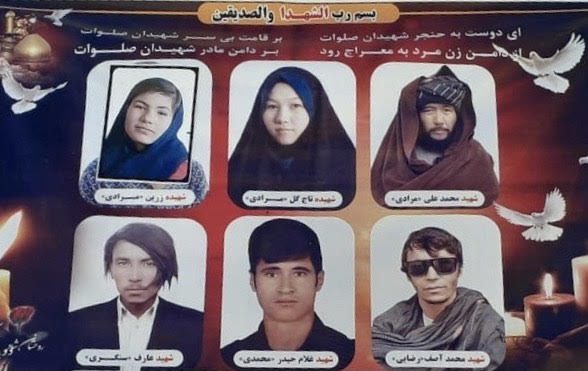
Photographs of those unlawfully killed by the Taliban
Photographs of those unlawfully killed by the Taliban in Ghor province of Afghanistan

Tortured and extrajudicially executed

Three other men who had been staying at Muradi’s home were detained and then extrajudicially executed. Two of them, like Muradi, had previously been members of the People’s Uprising Program force, though none had taken part in fighting with the militia for some time.

Ghulam Haider Mohammadi, Muradi’s nephew, had been visiting relatives. Photos of Mohammadi’s body indicate that he was executed with at least one gunshot to head, while kneeling and with his hands bound behind him. Locals found his body approximately 50 meters from Muradi’s home, left between some rocks in a tree-covered area.

Witnesses told Amnesty International that the other two victims – named Asif Rezayee and Arif Sangaree – were put in a vehicle and driven away to be killed in a separate location. The bodies of the two men were later discovered in an uninhabited part of Takeghal, more than 30 minutes’ drive from where they were initially detained.

Asif Rezayee had been living in Kabul but had returned to his home village a few days prior to visit family members. Rezayee was executed by gunfire while his hands were cuffed behind his back. Photos and a video of his body show four distinct gunshot wounds, to the head, chest, right thigh, and left hand. Based upon the nature of the wounds, apparent bullet trajectory, and gun powder stains, the wounds to the leg and hand were done at close range prior to execution. Such intentional infliction of pain on a bound detainee constitutes torture, a crime under international law.

Photos indicate that Arif Sangaree was also executed while bound and detained, with at least one close range shot to the head. One of the photos posted by the Taliban to Facebook, claiming credit for the successful operation, shows Sangaree with a significant facial wound surrounded by fresh bright red arterial blood, indicating the Taliban took the photo immediately after his death. In contrast, photos provided by people who discovered the body show Sangaree with the identical wound, but the blood dark and dried, meaning time had passed.

The Taliban news sources that posted the image of Arif Sangeree’s body described the night raid as a “targeted operation” that culminated in a fight between “rebels” and “Mujahideen”, or the Taliban. The account claimed seven rebels had been killed, detained and wounded, and that one Taliban member was killed, with two others wounded.

To justify the deaths, the statement went on to say that the raid had occurred after fighters associated with Mawlavi Mahadi, the Hazara leader of a Taliban defector group, had attacked the Taliban in Balkhab district of Sar-e-Pul province, and then fled and established themselves in the village of Chahar Asyab. This Taliban statement is incorrect. While this fighting has been documented by the UN Special Rapporteur on the situation in Afghanistan in his 6 September 2022 report, which includes cases of Taliban executions of fighters hors de combat, Muradi and his family members were not members of Mahadi’s group or taking part in this round of attacks. Rather, Amnesty International believes the Taliban justification is a pretext for targeting ethnic minorities and soldiers associated with the former government.

The Taliban must immediately cease these
acts of revenge and ensure employees
of the former government and their families
can live safely in Afghanistan

Agnès Callamard

Bilal Guler/Anadolu Agency via Getty Images

Background

The Taliban seized power in Afghanistan following the collapse of the government in mid-August 2021. Amnesty International has called for the protection of thousands of Afghans at serious risk of Taliban reprisals. There have been numerous cases of raids and extrajudicial executions targeting those the Taliban perceives as adversaries – those affiliated with the former government particularly Hazaras/Shias or those fighting with the National Resistance Front (NRF).


Read previous investigations by Amnesty International into unlawful killings by Taliban:

The post Afghanistan: Taliban torture and execute Hazaras in targeted attack – new investigation appeared first on Amnesty International.