Etna volcano (Italy): new lava continues to advance, small earthquake swarm on northern flank

Location of recent quakes under Etna volcano (image: INGV Catania)

The volcano observatory in Catania reported a small seismic swarm today affecting the northern slope of Etna. 6 earthquakes of magnitudes of up to 3.7 were detected. Earthquakes on Etna are often associated with internal magma movements.

In the meanwhile the effusive activity from the new vent at the southern base of the summit crater complex continues. It has reached a length of approx. 2 km towards the SW on the upper slope of the volcano.

Ongoing eruption of Etna volcano in Sicily.

Lava flow is ~1.9 km long

Image taken today by Sentinel-2.

NIR and SWIR.[image or embed]

— kosmi.bsky.social (@kosmi.bsky.social) February 10, 2025 at 5:49 PM
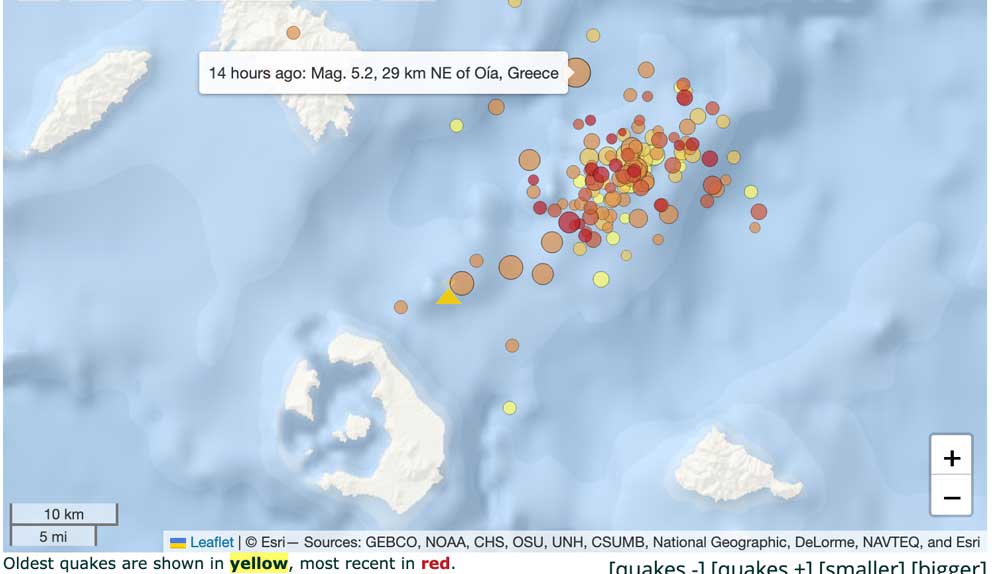
Santorini volcano update: Earthquakes continue with slowly decreasing trend

Earthquakes within 30 km of the submarine Kolumbos volcano NE of Santorini island during the past 24 hours as of Monday morning, 10 Feb 2025

Little change in the seismic activity between Santorini, Amorgos and Anafi islands has occurred in the past 24 hours.

The strongest quake had a magnitude of 5.2 and occurred 30 km NE of Santorini, closer to Amorgos than Santorini. Additionally, the networks detected 14 quakes between magnitude 4 and 5, as well as 48 quakes between magnitude 3 and 4 (plus many more smaller events).

White Island volcano (New Zealand): no more ash observed, Aviation Color Code lowered to Yellow

The activity at the volcano is currently characterized by weak-to-moderate steam and gas plumes, visible through our webcams in Whakatāne and Te Kaha, as well as satellite imagery. Unlike the period since late December, when ash was frequently present in the plumes, no volcanic ash has been observed over the past week.

Occasionally, larger plumes can be seen from the Bay of Plenty coast, particularly when weather conditions are clear or wind speeds are lighter. Activity can also change rapidly, producing stronger steam and gas plumes visible from the coast.

With no sensors on the island, monitoring efforts rely on remote cameras, satellite imagery, and periodic observation and gas measurement flights.

This recent activity aligns with moderate to heightened volcanic unrest, so the Volcanic Alert Level remains at Level 2. However, due to the absence of volcanic ash emissions, the Aviation Colour Code has been lowered to Yellow.