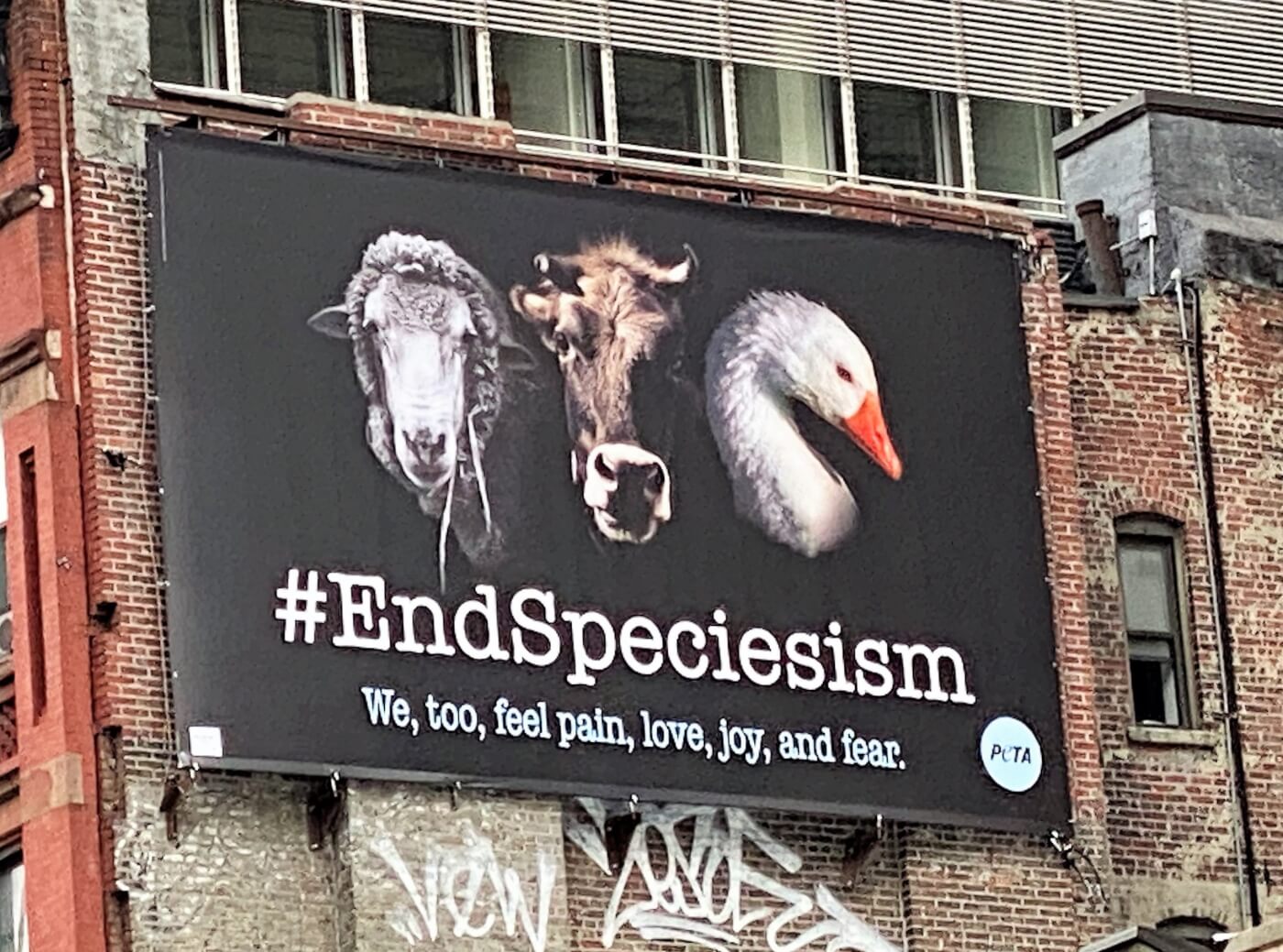
PETA has just placed a billboard in the heart of the Garment District encouraging everyone to show respect to sensitive sheep, cows, and geese this winter by choosing animal-friendly fabrics and leaving wool, leather, and down on the racks.
The ad is part of PETA’s campaign challenging speciesism, the misguided belief that all other animal species are inferior to humans and that it’s therefore somehow acceptable to harm and exploit them and even take the fleece, skin, feathers, or fur off their backs—a human-supremacist notion that’s cut from the same cloth as other forms of prejudice.
“When it comes to feeling pain and fear and valuing their own lives, cows, sheep, and geese are just like you and me,” says PETA President Ingrid Newkirk. “PETA’s ads encourage everyone to reject speciesism by valuing animals for who they are as individuals—and keeping what belongs to them out of our closets.”
PETA and its affiliates have released dozens of videos revealing that workers hit, kick, and mutilate gentle sheep for their wool; burn, electroshock, beat, and slaughter cows for leather; and slit birds’ throats and plunge them into scalding-hot defeathering tanks for down. But vegan fashion is on the rise: Searches for “vegan fashion” have increased 119% since October 2018, and the vegan leather market in particular is expected to reach $45.41 billion by 2025.
PETA—whose motto reads, in part, that “animals are not ours to wear”—offers a vegan clothing shopping guide on its website.
The billboard is located on Eighth Avenue, just below W. 40th Street. PETA also plans to run other #EndSpeciesism ads in Seattle.
Paul McCartney has collaborated with PETA on everything from exposing slaughterhouses to helping greyhounds at a blood bank, and animal testing is no exception. The rock legend sent a letter to TAMU President Michael K. Young, asking him to stop the school’s MD experiments on dogs and release the animals currently being housed in its laboratory to loving, adoptive homes. McCartney also donated his 1993 protest song and anti–animal experimentation anthem “Looking for Changes” to PETA’s campaign to end cruel experiments on animals funded by NIH, which wastes $18 billion in taxpayer funds each year.
“I’m looking for changes that will continue the momentum of getting animals out of laboratories,” says McCartney. “Experiments on animals are unethical—they’re a colossal failure and a waste of time and money. We can and must do better.”
Lily Tomlin
“Enough is enough” was the message that more than 5,000 TAMU faculty and staff heard on their phones. And the voice at the other end of the line was none other than Hollywood icon Lily Tomlin, who made a very personal plea for their support in urging TAMU President Young to end the school’s experiments on dogs.
The Grace and Frankie star and Detroit native also wrote to the University of Michigan (UM) to ask its officials to stop allowing cats and pigs to be abused in cruel and deadly flight training exercises. In a letter to UM President Mary Sue Coleman, Tomlin wrote, “Having trainees jam hard tubes down cats’ throats, cut holes into pigs’ throats and chests, and stab needles into the animals’ bones and the tissue surrounding their hearts is simply unjustifiable when modern and superior alternatives are available.”
After a yearlong campaign by PETA and supporters like Tomlin, UM ended its use of cats in its Survival Flight intubation training laboratory!
James Cromwell
Emmy-winning actor and longtime activist James Cromwell has been handcuffed on several occasions for protesting against cruelty to animals, including during a PETA protest at TAMU’s Board of Regents meeting. The star condemned the university’s experiments on dogs, which have been going on for almost 40 years but have not resulted in a single treatment that can reverse debilitating MD symptoms in humans.
The American Horror Story star also lent his voice to raise awareness of NIH’s monkey fright experiments, leaving voicemails for 10,000 NIH employees. “An ‘American horror story’ is taking place in your agency right now,” Cromwell said. “Your colleague Elisabeth Murray is receiving millions of dollars to torture and experiment on living monkeys.”
The Real Time With Bill Maher host has partnered with PETA several times to speak out against institutions that conduct tests on animals. He called bullsh*t on Murray’s NIH “experiments,” reminding viewers that she’s torturing monkeys on their taxpayer dollars.
PETA honorary board member and Oscar winner Anjelica Huston wrote to NIH Director Francis Collins, urging him to slash the agency’s bloated budget for expensive and ineffective animal experiments and instead pursue human-relevant research that stands a chance of producing results.
“Studies that are pointless, wasteful, or extremely cruel should be ended now, and that means the emphasis should be placed on non-animal studies, because they offer real promise.”
—Anjelica Huston in a letter to NIH
These celebrities are urging the U.S. government to stop tormenting monkeys in fright experiments:
“[F]or almost 20 years, experimenter Tania Roth has been tormenting and killing mother rats and their infants in these horribly painful, inhumane experiments, and ultimately, they are completely worthless.”
When Oscar winner Casey Affleck learned that TAMU experimenters have been tormenting dogs for over 35 years, he knew that he had to speak up. In addition to filming a public service announcement calling out TAMU, the devoted dog guardian also filmed a quick video with an adorable rescued dog and spoke lovingly about his own companion, Bella, who was found on train tracks with three legs—likely after being used as a “bait dog.”
Iggy Pop
“Godfather of Punk” Iggy Pop has worked with PETA on multiple occasions to speak out against animal testing. He donated his hit song “Free” to us for a video highlighting the suffering of monkeys held captive and used in cruel laboratory experiments at NIH and other facilities:
And after learning that his alma mater, the University of Michigan, was abusing and killing cats and pigs in its Survival Flight course for nurses, Iggy fired off a letter on PETA’s behalf, urging the university to drop these cruel and archaic animal labs.
Known for her work on popular TV shows such as The Punisher and Supergirl, actor Floriana Lima used her real-life powers to be a superhero for animals by speaking out against the “forced swim test,” which tortures mice, rats, guinea pigs, hamsters, and gerbils. In this cruel, worthless test, experimenters put animals in inescapable containers filled with water. The panicked animals try to escape and paddle furiously, desperately trying to keep their heads above water. Eventually, exhausted, they’ll start to float.
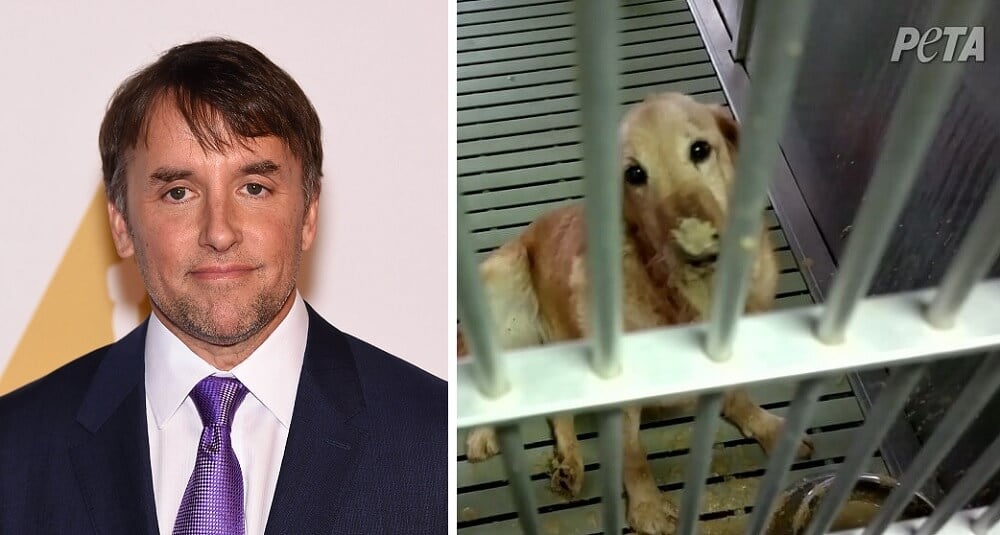
Award-winning director and lifelong Texan Richard Linklater sent a letter on PETA’s behalf, urging TAMU to end its canine MD experiments. “There’s no doubt in my mind that a cure must be found for MD, but these experiments are purposefully bringing dogs into the world in order to subject them to a shortened life of pain, misery, and neglect,” wrote the Boyhood filmmaker. “I’m urging you to end these experiments and release the dogs for adoption so that they can live out their remaining days in comfort.”
The dogs at TAMU have also received support from Mötley Crüe cofounder and bassist Nikki Sixx, who sent a letter to the university’s president stating his opposition to subjecting “man’s best friend” to a life of suffering. “I have enjoyed going to Texas throughout my whole touring career. Getting to experience the culture, the food, and the people there over the last few decades has been incredible,” Sixx told PETA. “My wife and I are the owners of two incredibly lovable golden retrievers. So to say the experiments at Texas A&M University are absolutely heartbreaking is beyond an understatement.”
*****
One more time for the people in the back: Animals aren’t lab equipment.Please join the efforts of these celebrities and PETA to help end animal testing by sharing this blog post on social media.
Halloween will be Halloweird this year because of COVID-19, which originated in a meat market, so PETA is urging locally based Smithfield Foods to share its real-life penchant for blood and guts by opening its slaughterhouses up for public tours. The group points out that even the most hardened gorehound would be bug-eyed to see pigs being turned into bacon and ham and screaming animals’ throats being cut in full view of others on killing floors soaked with blood, feces, urine, and other bodily fluids.
“Smithfield’s slaughterhouses are real haunted houses, where animals’ corpses are dismembered at the rate of roughly 1,500 per hour,” says PETA President Ingrid Newkirk. “PETA’s primary motive is, of course, to have people swear off meat when they see how truly frightful it is to kill animals for a fleeting taste.”
PETA—whose motto reads, in part, that “animals are not ours to eat” and which opposes speciesism, a human-supremacist worldview—also plans to call on other meat companies to host slaughterhouse tours this Halloween season, as the current pandemic has made it more important than ever to see how meat is made and why people should stop eating it.
PETA’s letter to Smithfield Foods President and CEO Kenneth M. Sullivan follows.
October 12, 2020
Kenneth M. Sullivan
President and CEO
Smithfield Foods
Dear Mr. Sullivan,
I’m writing on behalf of our more than 6.5 million members and supporters worldwide, including hundreds across Virginia, with a suggestion. Because of COVID-19, which originated in a meat market, Halloween is expected to look much different this year, and many haunted houses are getting creative to try to bring in guests. Ahead of the holiday, would you consider temporarily allowing tours of your slaughterhouses during operating hours so that the bravest of meat-eaters and horror fans can see that there’s nothing more terrifying than the cruelty inflicted on animals and workers in the meat industry?
Most people don’t like to think about where their meat comes from when they purchase it in neatly wrapped packages at the supermarket. The animals aren’t cuddled to death. In a tour of your facilities, visitors could witness firsthand how hundreds of pigs are murdered each hour, often improperly stunned before being plunged into the scalding-hot water of hair-removal tanks. There’ll be no need to fake the screams or the blood—guests would hear the pigs squealing as they’re hung upside down right before their throats are slit and their bodies are dismembered. You could consider allowing guests to touch actual instruments of cruelty and death—like the electrified prods used to force sick pigs to walk to their demise—or offer VIP opportunities to be “locked” inside small metal-and-concrete crates to see how long people can stand it for a truly heart-stopping experience.
Guests could sign a disclaimer and then brave the horrors facing the workers every day—slitting animals’ throats above blood- and offal-soaked floors, shoulder to shoulder, with line speeds so fast that animals end up thrashing around and injuring them. This would help them understand why slaughterhouses have been hot spots for the spread of COVID-19 and threaten the health of everyone on the planet. The U.S. Centers for Disease Control and Prevention estimates that 75% of recently emerged infectious diseases in humans came from other animals. SARS, which originated in bats, claimed 774 human lives. H1N1 swine flu—which originated in pigs—killed as many as 575,400 people, and COVID-19 has killed at least a million people so far, including more than 200 slaughterhouse workers.
Paul McCartney once said, “If slaughterhouses had glass walls, everyone would be vegetarian.” We believe this is absolutely true and hope you’ll agree that now, while the world continues to battle the current pandemic, it’s more urgent than ever for humans to face the nightmare of their meat’s origins. Thank you for your consideration. We look forward to hearing from you.
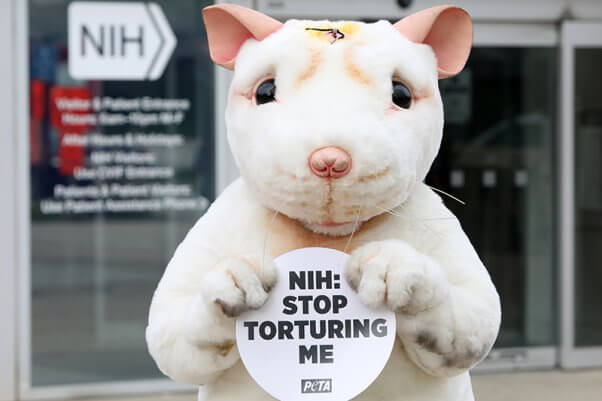
The National Institutes of Health (NIH), the country’s foremost medical research authority, has the lofty and admirable goal of seeking scientific knowledge that will “enhance health, lengthen life, and reduce illness and disability.” But the reality is that at numerous university laboratories across the country, the agency squanders billions of taxpayer dollars on painful and ultimately deadly experiments on animals that do nothing to advance our understanding of human health.
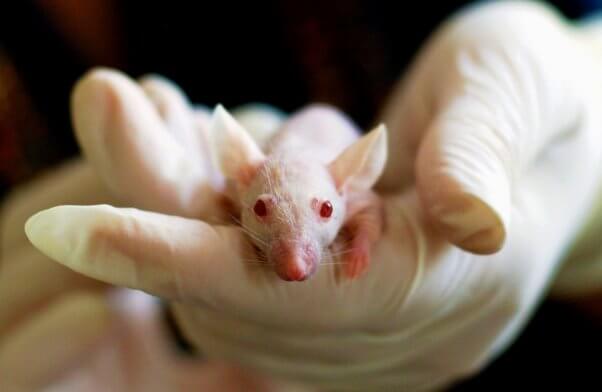
Hundreds of thousands of animals—including monkeys, dogs, rabbits, bats, mice, rats, guinea pigs, and hamsters—are imprisoned at NIH’s sprawling headquarters in Bethesda, Maryland. None of these animals will make it out unharmed, and few will make it out alive.
Here’s NIH, by the numbers.
If numbers really do tell a story, the figures below spin a yarn that would give Stephen King chills. It’s a story of an agency bloated with tax money, indifferent to suffering, and apparently in service of its own perpetuation:
Amount of taxpayer money that funds NIH annually: $41.7 billion
Amount of taxpayer money NIH directed to funding for animal and non-animal research projects in 2020: $37.5 billion
Amount of NIH research project funding that pays for experiments using dogs, rats, monkeys, mice, and other animals: 47%
Total spent on experiments using animals: more than $17.6 billion each year
NIH: National Institutes of Horrors
Take a look at what’s gone on at the NIH Maryland campuses alone.
Number of monkeys used in experiments: 3,272
Number of monkeys imprisoned but not used: 477
Number of monkeys who endured pain or distress without any painkillers: 383
Number of dogs used in experiments: 415
Number of rabbits imprisoned or used in experiments: 487
Approximate number of mice imprisoned or used in experiments: 351,540
Approximate number of rats imprisoned or used in experiments: 8,440
Approximate number of fish imprisoned or used in experiments: 197,887
Number of pigs used in experiments: 185
Number of sheep used in experiments: 2
Number of hamsters used in experiments: 420
Number of guinea pigs used in experiments: 790
Number of bats used in experiments: 414
Number of ferrets used in experiments: 77
Misery and Privation From Cradle to Grave
Amount of space given to a rhesus macaque in a laboratory: 4.3 square feet
Natural home range for a rhesus macaque: over 5 square kilometers
Distance a rhesus macaque can travel in a laboratory cage: two or three steps
Ratio of the natural home range for a rhesus macaque to the floor area provided in a laboratory: 7 million to one
Number of times monkeys in NIH’s Bethesda laboratories will ever go outside: 0
Failure to Comply With Minimum Animal Welfare Laws and Guidelines
Serious violations of federal animal welfare guidelines inside NIH’s Maryland laboratories in the months from January 2018 to October 2019: 31
Number of mice who were denied post-surgical analgesia in just one experiment: between 105 and 140
Number of incidents in which animals starved to death or died of dehydration because NIH staff forgot to give them water or feed them: 6
Number of months overhead lights were left on in a room of caged monkeys: 5
Number of animals injured or killed because of NIH staff incompetence: at least 221
Number of animals who baked to death: 22
Number of mice who had to be killed because they were fed the wrong diet: 205
Failing Science, Failing Human Patients
Ninety-five percent of pharmaceutical drugs that test safe and effective in animals fail in human clinical trials.
The numbers don’t lie—experiments on animals are a waste of time, resources, and lives. You can make a difference for animals trapped in laboratories. Take Action Now!
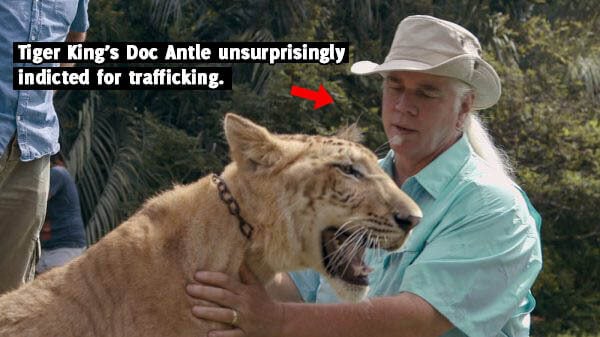
If you watched Tiger King, you know that exploiting big cats for entertainment, photo ops, and cub petting go hand in hand with taking unweaned cubs away from their mothers, imprisoning them in inadequate enclosures, neglecting their most basic needs, and, in some cases, killing them. That’s why PETA is celebrating the recent news that on October 8, notorious wildlife exploiter “Doc” Antle, who appeared in Netflix’s Tiger King, was charged with a felony count of wildlife trafficking, another felony count of conspiracy to traffic in wildlife, and 13 additional misdemeanor charges.
One by one, nearly every animal abuser in #TigerKing is facing the consequences. After years of working to stop @docantle’s cruel use of tigers, chimpanzees, and other animals as props, PETA is eager to see him face the courtroom.
Antle’s charges stem from his involvement in trafficking in lions with the owner of the now-defunct Wilson’s Wild Animal Park, Keith Wilson, who faces similar charges—in addition to 46 counts of cruelty to animals filed against him after state officials seized more than 100 animals they found kept in squalid enclosures, many without food or water.
With a long history of violating the federal Animal Welfare Act, Antle has been cited for endangering the public and for failing to provide animals with needed veterinary care, sufficient cage space, and clean water. Joseph Maldonado-Passage (aka “Joe Exotic”) has claimed that Antle puts tiger cubs who’ve become too old for playtime events in a gas chamber to kill them and then cremates their bodies on site. He’s also sent “aged-out” cubs to other abusers across the country, and one summer, he shipped two 8-month-old cubs who grew too old to be used for visitor photo ops to a circus trainer.
The dominos are falling one by one—nearly every animal abuser featured in Tiger King is now in custody, out of business, or facing administrative or criminal charges. After years of working to stop ‘Doc’ Antle’s cruel tiger-petting sessions and chimpanzee video stunts, PETA is eager to see him face the courtroom—and the consequences.
—Brittany Peet, PETA Foudation’s deputy general counsel of Captive Animal Law Enforcement, who appeared in Tiger King
In their natural habitat, tigers are complex, active animals who can happily swim up to 18 miles a day and cubs stay with their mothers for the first two years of their lives. By contrast, big cats used for entertainment endure constant torment for their entire lives. They either die slowly from neglect or are slaughtered because they’re no longer of an exploitable age or size. Thanks to PETA, 39 tigers from the Greater Wynnewood Exotic Animal Park (or “G.W. Zoo”), which was connected to “Joe Exotic” from Tiger King, are now living in peace at reputable sanctuaries, along with three juvenile lions who were recently rescued from another Tiger King villain, Jeff Lowe.
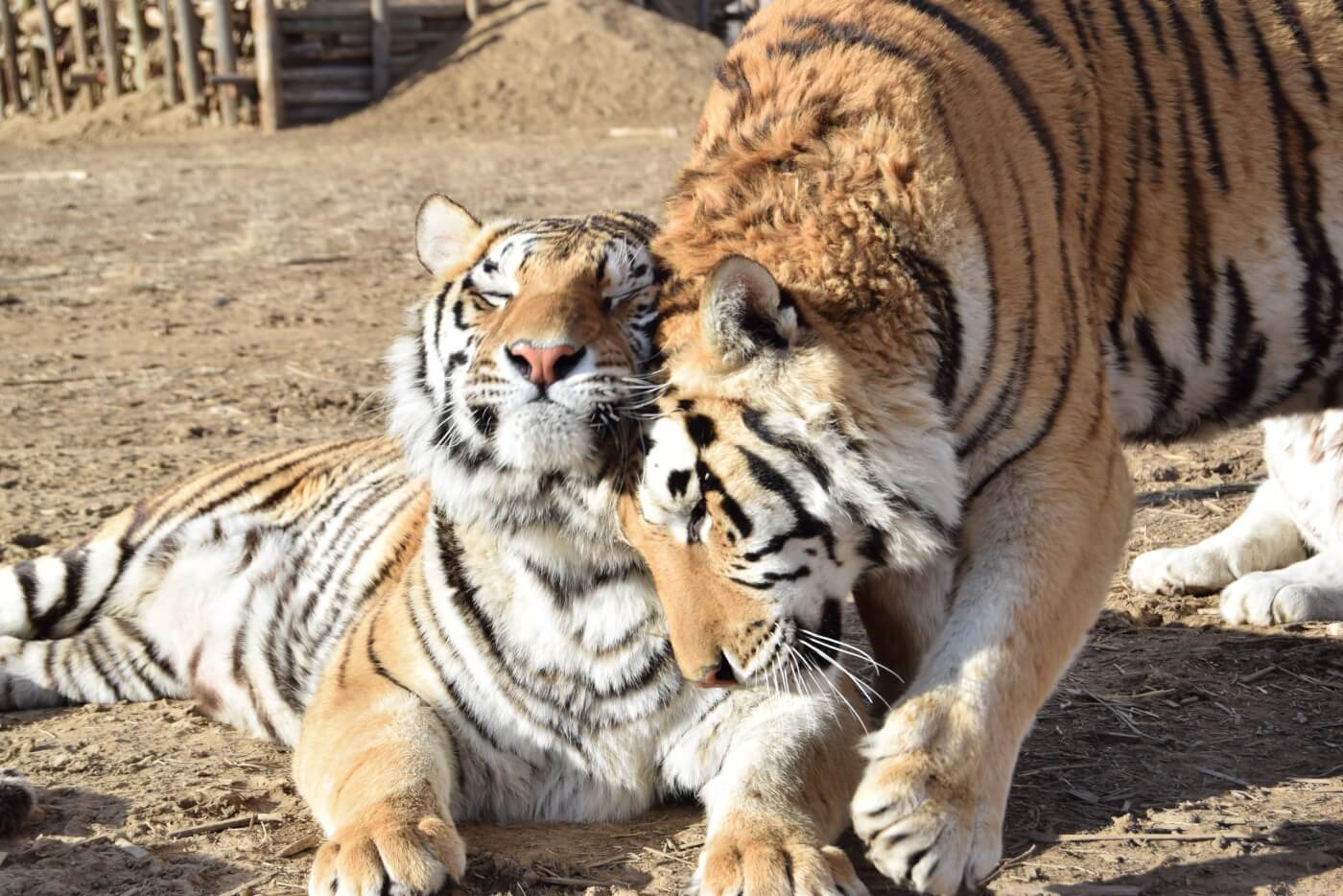
Curly (left) and Mo (right) are now at The Wild Animal Sanctuary in Colorado. They were rescued from G.W. Zoo after being transferred to “Joe Exotic” by roadside zoo operator Tim Stark.
PETA has been winning victory after victory for exploited big cats, including rescuing 22 tigers, lions, and tiger/lion hybrids from the shabby roadside zoo of Tim Stark (who also appears in Tiger King) and liberating 27 tigers from the notoriously cruel Dade City’s Wild Things—and even shutting down this sleazy roadside zoo. Nonetheless, our work to end the exploitation of big cats isn’t done!