Ahead of Severe Winter Weather Awareness Week in Wisconsin (November 9 to 13), PETA is offering tips for keeping animals safe. Animals are especially vulnerable in cold weather, and there were at least 37 cold weather–related companion animal deaths in 2019. (Those are just the ones that were reported—most aren’t.)
The following steps can go a long way in helping animals survive the fierce winter:
Bring Them Indoors
Companion animals should always live indoors. “Backyard dogs” and “outdoor cats”—like those featured in Breaking the Chain, the new documentary produced by Oscar winner Anjelica Huston—often go without adequate food, water, shelter, and veterinary care. They are no better equipped to survive freezing temperatures or extreme weather conditions than humans are, they suffer terribly from frostbite, and they can die of exposure.
Gear Up
Coats will keep dogs comfortable in cold weather, secure harnesses can help prevent them from getting loose on walks, and booties will protect their sensitive paw pads from the frozen ground. Keep walks short in cold weather, especially for shorthaired dogs.
Don’t Forget Birds
During extreme winter weather, provide birds and other wild animals with access to an emergency water supply by filling a heavy nonmetal water bowl (tongues can freeze to metal) and breaking the surface ice at least twice a day.
Good Samaritans who see companion animals kept chained or penned outside 24/7 or without adequate shelter from the elements should note the animals’ exact location and alert local law-enforcement authorities immediately.Anyone who leaves animals outside to suffer in severe weather may be prosecuted.
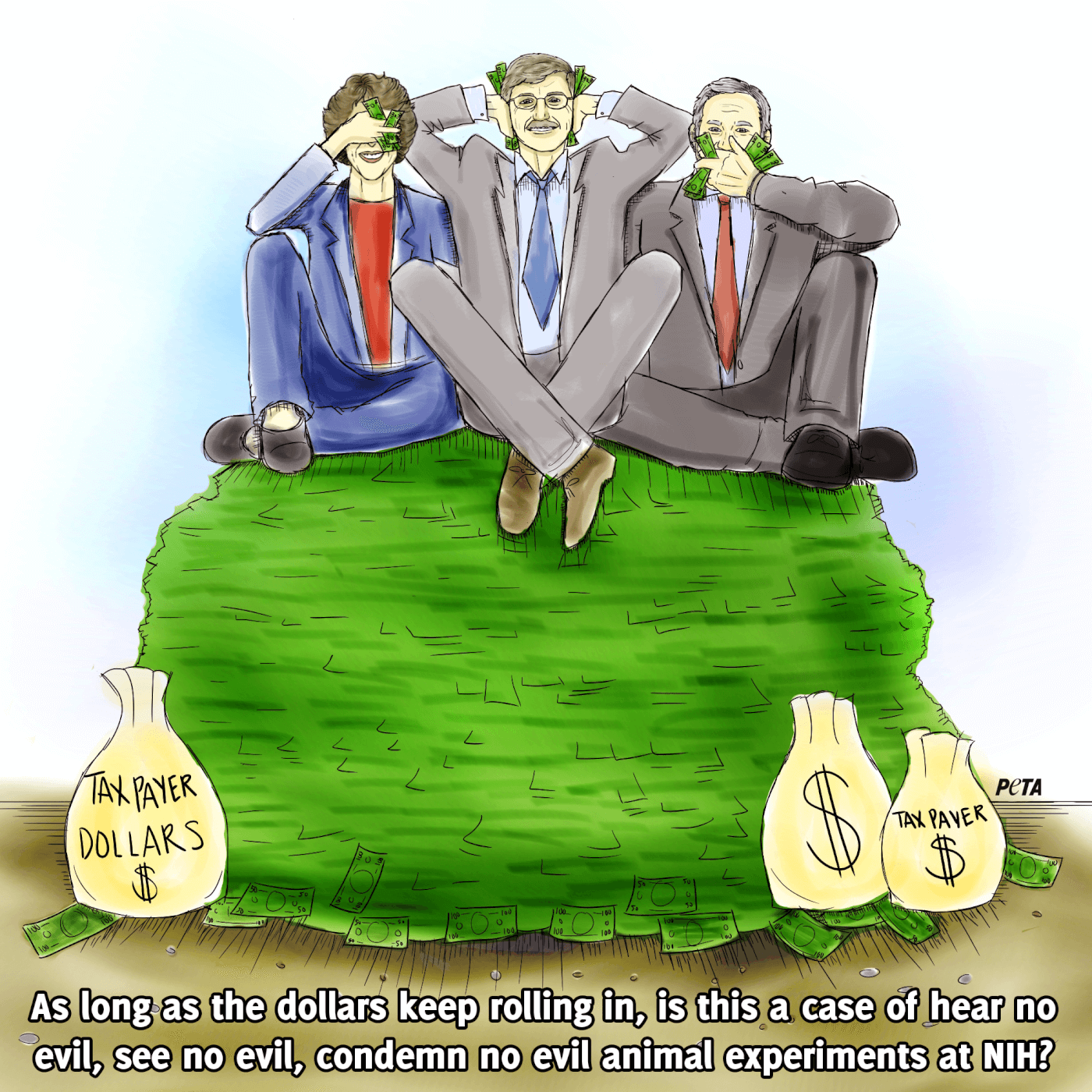
Tormenting animals under the guise of “scientific research” is apparently a profitable endeavor, a PETA review of National Institutes of Health (NIH) employees’ salary has found.
These experimenters and officials aren’t just big earners at NIH—their salaries are among the highest in the nation.
The director of NIH, the director of the National Institute of Mental Health (NIMH), and a longtime monkey experimenter are all sitting pretty at the top of the nation’s income pyramid. As they receive your tax dollars, animals in their charge suffer and die painful and preventable deaths.
NIMH director Joshua Gordon collected a comfortable $337,000 in taxpayer money in 2019. His steep salary puts him solidly among the top 5% of earners in the U.S., as entrance to this exclusive club starts at around $309,000. His salary hasn’t dipped below $310,000 since at least 2016. He has collected just shy of a cool $1 million over the last four years.
NIH director Francis Collins accepted $205,000 in taxpayer money in 2019. He has collected no less than $199,700 since 2015, making him a member of the top 10% of wage earners in the nation.
In 2020, NIH squandered more than $17.6 billion on animal experiments. That’s an epic failure and a colossal waste of money.
Elisabeth Murray, the NIMH experimenter who torments brain-damaged monkeys with fake snakes and spiders, walked away with $245,000 in 2019. She has earned no less than $212,000 since 2015—when she also took home a $1,000 bonus. Like Gordon, she can count herself among the nation’s top 5% of wage earners.
For more than 30 years, Murray has brain-damaged monkeys and subjected them to loneliness, depression, and anxiety in laboratory cages. PETA released video footage of her terrorizing these animals by exposing them to realistic-looking snakes and spiders. Her cruel and pointless experiments have yielded no treatments or cures for humans.
Under Gordon, NIMH throws money hand over fist at junk science. In addition to the $36 million it has used to fund Murray’s grotesque experiments over the past 13 years, funding for a battery of useless tests on other animals continues to be supplied by the agency. These tests include the widely discredited forced swim test, in which mice and other small animals are placed in inescapable beakers filled with water and made to swim to keep from drowning. NIMH also uses the tail suspension test—in which mice are hung upside down by the tail—and the foot shock test, in which mice or rats are shocked inside a locked chamber with an electrified floor.
The agency uses these experiments to test new medications for human depression, even though the results are highly unreliable—they’re no more predictive of human responses to drugs than a coin toss.
In fact, 95% of new pharmaceutical drugs that test safe and effective in animals fail in human clinical trials.
Collins, Gordon, and Murray are allowed to continue cashing in on the needless pain and suffering of animals, despite the failure of these methods to produce real-world solutions to human problems.
It’s time to hold these people accountable for their actions. Please add your voice to ours:
In December 2018, PETA took to social media to ask people to start “bringing home the bagels” instead of the “bacon.” Judging by some folks’ reactions, you would have thought that we had opened a can of worms Pandora’s box.
With so much negativity in the world, why not use language in a way that encourages kindness to animals?
How to Teach Inclusive Language
You may cringe now when you accidentally say “kill two birds with one stone,” but the English language is riddled with conventions that reinforce speciesism, the harmful and misguided belief that all other animal species are inferior to humans. Educators must recognize that their students are picking up on things they say—for better or for worse. Trouble can arise when seemingly inconsequential conversations take on a deeper meaning in their mind and influence their view of others in unintended ways. Since we all want to instill compassion in our students, here are some easy ways to be mindful of the way you and your students think, speak, and write about animals:
Animal-Friendly Idioms
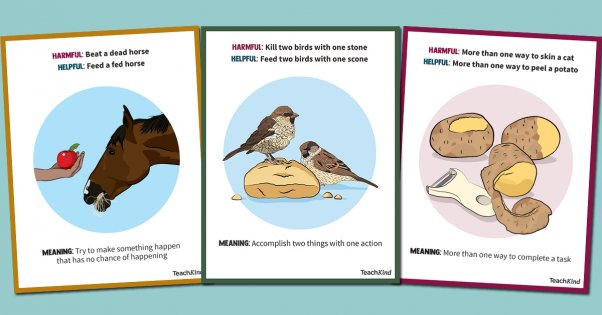
Kind people do not support dogfighting, yet many kind people use the expression “I don’t have a dog in this fight.” Many of us grew up hearing common phrases like this that trivialize violence toward animals. Other cringeworthy anti-animal phrases include “beat a dead horse” and “more than one way to skin a cat.” These old sayings are often repeated in classrooms during lessons on literary devices. While they may seem harmless, they do carry meaning and can send mixed signals to students about the relationship between humans and animals, normalizing abuse.
Instead of perpetuating these outdated and harmful phrases, use these modern, animal-friendly idioms to teach your students the importance of choosing words carefully and the power that language holds to help or hurt others. You could also have students create their own artwork depicting other animal-friendly idioms using PETA’s complete list.
Pronouns Are Important
TheAssociated Press Stylebook currently recommends the use of the pronoun “it” for animals who haven’t been given a name or had their sex identified by humans. This is ridiculous, considering that the billions of animals on our planet are not inanimate objects but instead have unique personalities, likes and dislikes, and the ability to feel pain and suffer. The stylebook offers “The cat, which was scared, ran to its basket,” but this language suggests that the cat is a “thing,” in the same category as the basket—not an individual with thoughts and feelings. To encourage your students to be more considerate of animals in their writing and speech, teach them to use the personal pronouns “he” or “she” for all animals (along with “they” as an acceptable pronoun for an animal of unknown sex). To practice this, you could have students read an article about animals that refers to them as “it,” highlighting all the pronouns as they go, and then have them rewrite it using only personal pronouns to refer to the animals.
Having trouble breaking the bad habit of using “it” when referring to animals? Create a classroom “It Jar”!
Redefining Language
Because Dictionary.com incorrectly defines the word “animal” as “any … living thing other than a human being,” PETA sent a letter pointing out that humans are also animals and asking the dictionary to change the word’s definitions to reflect that. Current definitions foster a divide between humans and other animals that fuels speciesism. But when it comes to fundamental feelings like happiness, pain, love, and fear—we’re all alike.
When studying connotation and denotation, have students discuss the negative connotations of words like “beast,” “vermin,” and “pest” and how they can be harmful to animals.
Using terms like “chicken,” “pig,” “whale,” “snake,” and “dog” as insults is a form of bullying that is harmful to humans, but it also denigrates and belittles other species, who are interesting, feeling individuals, undeserving of being viewed in a negative light. Plus, the implied assumptions about animals are often inaccurate. For example, chickens fiercely defend their young from predators—they’re not so cowardly after all. Have students create a list of common animal-related metaphors and similes (e.g., “they’re as stubborn as mules,” “stop being such a pig,” “she’s a real dog,” “I’ll be the guinea pig,” and “he was as mad as a hornet”). For each one, have them consider the following:
What is the intended meaning of this metaphor or simile? Example: To be called a “rat” suggests that a person is disloyal.
What evidence exists to disprove the intended meaning? Example: As experimenters have subjected rats to cruel experiment after cruel experiment, they’ve discovered that the animals exhibit empathy for one another and try to help each other out. Rats help other rats—even those who are unfamiliar to them.
How can this metaphor or simile be reworded so that animals aren’t denigrated? Example: “Tattletale” and “snitch” are both synonyms for this use of the word “rat.”
You could also have students research metaphors and similes that celebrate animals and their abilities (e.g., “he’s as strong as an ox,” “I was as busy as a bee,” “she has a real eagle eye,” and “he’s definitely a shark”) or create their own, based on amazing animal facts.
*****
The words that we use have the power to influence those around us. We internalize their meanings—whether consciously or unconsciously—and act upon them. We now know that all animals have the ability to reason, have their own forms of communication, and can solve problems by means that we can’t always understand—yet many still suffer terribly at the hands of humans.
Unlearning speciesism takes time—so keep the conversation going with Challenging Assumptions, TeachKind’s social justice curriculum for grades 9 to 12. The lessons are designed to educate and empower students to challenge societal norms and inspire compassion and empathy toward others regardless of species, race, gender, sexual identity, age, or ability.
Rinsing away the sweat, dirt, and makeup from the day requires a little more effort than a quick splash of water. Before you start your nighttime skin-care routine, you’ll want to make sure that all your makeup is removed to prevent clogged pores and breakouts. Unfortunately, some makeup removers out there are still tested on animals or contain ingredients that come from animal exploitation. To help you choose a makeup remover that works for you, here is a list of cruelty-free makeup removers:
SheaMoisture never tests on animals, and this product is vegan and made with 100% extra virgin coconut oil. It’s also rich in vitamin E, which nourishes the skin.
Dr. Bronner’s Coconut Oil can be used pretty much for anything, from cooking food to conditioning hair. It’s also a handy makeup remover that will do the job well while being gentle on your skin.
When it comes to facial cleansing oils, there can be some hidden animal-derived ingredients that you may not know about, like oil from the fat of butchered minks. This formula leaves the unnecessary exploitation behind, combining argan oil and coconut oil to melt makeup off easily, without leaving an oily residue.
Infused with rosehip oil, camellia oil, shea butter, and tons of nourishing vitamins, this cleansing balm dissolves makeup without drying out the skin. It’s also totally vegan, so your fresh skin won’t come at the cost of animal well-being.
Pacifica’s Gel Cleanser is infused with vegan collagen, so it has real collagen proteins made without cruelty to animals. In nonvegan cosmetics, collagen is produced from the tissue of cows, horses, pigs, and even fish. The Pacifica collagen line is made with fermented plant-based ingredients for a clean and ethical product that you can count on.
This dry/wet jelly cleanser is wonderfully soothing and free of parabens and sulfates. The formula is infused with apple and oat amino acids instead of snail mucus, so you can avoid snail harvesting and breeding practices—that is, agitating snails in order to extract the mucus they produce as a self-defense mechanism—that go into many other gel-based skin-care products.
The Original MakeUp Eraser looks like your average washcloth, but it has special soft fibers that remove makeup with ease—all you have to do is add water. This reusable cloth is a great sustainable, vegan option that saves money. It can be found at Walmart, CVS, Amazon, and Ulta.
It’s the PETA victory everyone’s talking about, including USA Today, CNN, and comedian Stephen Colbert: Costco cut ties with coconut milk producer Chaokoh after discussions with PETA and hearing from thousands of our kind supporters.
During The Late Show with Stephen Colbert on Friday, the television host talked about “Costco is pulling products from its shelves that are allegedly made with forced monkey labor.” Colbert appeared dumbfounded, replying to his own question (“Forced monkey labor?”) with a simple statement: “That’s terrible. Monkeys should never be used as forced labor.”
“The product in question is Chaokoh brand coconut milk, which allegedly is made with the help of chained-up monkeys who pick around 400 coconuts a day and are then stuffed in their cages until their next shift,” Colbert explained to his audience.
While The Late Show host never strayed far from humor, he did pause for a serious moment to “reiterate [his] firm position”: “Exploiting monkeys is abuse, it’s wrong, it’s never acceptable,” he stated simply. We couldn’t have said it better ourselves.
Exploiting Monkeys Is Abuse …
… and Colbert isn’t the only one who knows it: Costco, Walgreens, Food Lion, Stop & Shop, and more than 25,000 other stores have banned coconut milk brands that use monkey labor.
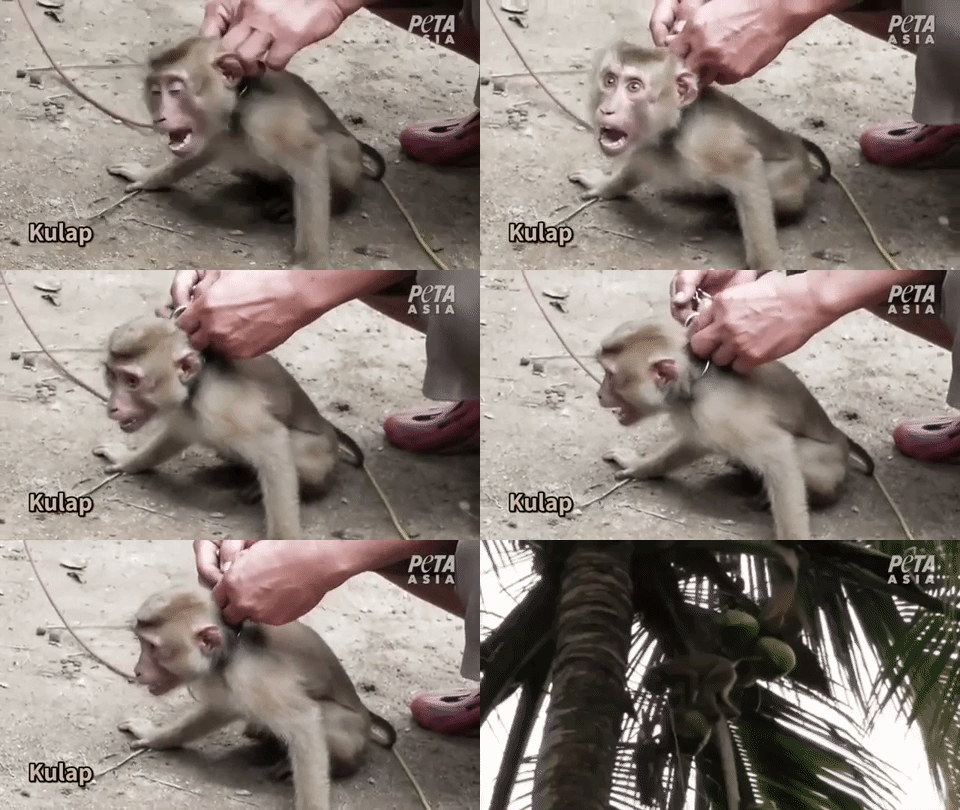
In July, PETA Asia blew the lid off the Thai coconut industry’s use of captive monkeys—a shocking investigation revealed that terrified young monkeys in Thailand are kept chained, abusively trained, and forced to climb trees to pick coconuts that are used to make coconut milk and other products (not coconut sugar or coconut water), including some sold in the U.S.
Some monkeys are reportedly illegally abducted from their families and homes when they’re just babies. Monkeys who may try to defend themselves might have their canine teeth pulled out. It’s why so many people are choosing to leave Chaokoh coconut milk and the brand’s other exploitative coconut products on the shelf, instead opting for brands that don’t use coconuts that monkeys were forced to pick.
For Kulap and his friends, please, join PETA, Colbert, and so many others in speaking up for monkeys: Click below to keep the momentum going.