PETA to Rhode Island Governor and Department of Health: Shut Down Animal Labs

Spiking COVID-19 cases are compromising Rhode Island’s reopening plan, and PETA is calling on the governor and the Rhode Island Department of Health to cut cruel animal experiments statewide—starting with tests on animals whom institutions deemed to be non-essential in response to the pandemic—and protect human health by having staff not come into laboratories to conduct worthless experiments.

In its letter, PETA points out that during the initial COVID-19 shutdown, universities in Rhode Island issued guidance deeming many of their experiments—and the animals used in them—extraneous, which resulted in the apparent euthanasia of numerous animals in their laboratories, including the following:

  • Brown University urged its experimenters to start “ramping down on-campus research activities” and to be prepared for the restriction of “non-critical” research.
  • The University of Rhode Island (URI) informed its experimenters that “[a]ll non-essential animal research … needs to be drawn down and halted” and said that for long-term studies, “preparations should be made to reduce animal counts to minimal needed to complete study goals.”

PETA questions why animals deemed by the universities to be extraneous are being bought, bred, trapped, or experimented on in the first place and notes that staff conducting these experiments are being put at unnecessary risk as a result of working in close proximity to others. In addition, if animal testing resumes and Rhode Island shuts down again, more animals may be euthanized, wasting taxpayer money that could have funded superior, human-relevant studies.

“This pandemic should be a wake-up call to shift away from experiments on animals and toward a ‘new normal’ of modern, non-animal research methods,” says PETA Vice President Shalin Gala. “PETA is calling on state officials to learn from the past and keep all animals from suffering in cruel and wasteful tests.”

More than 90% of results from basic scientific research—much of it involving animal testing—fails to lead to treatments for humans, and 95% of new medications found to be safe and effective in animals fail in human clinical trials.

PETA previously called for an audit of public money, personnel, property, equipment, and space used by URI for animal tests deemed non-essential, noting that the university received nearly $80 million in state appropriations in the last fiscal year, some of which may have funded such animal experiments.

PETA—whose motto reads, in part, that “animals are not ours to experiment on”—opposes speciesism, a human-supremacist worldview. For more information, please visit PETA.org, click here, or follow the group on Twitter, Facebook, or Instagram.

The post PETA to Rhode Island Governor and Department of Health: Shut Down Animal Labs appeared first on PETA.
2020 in Review: How TeachKind Rallied for Students, Educators, and Animals

In 2020, teachers and students had to adapt to new ways of learning—so TeachKind followed suit and adapted our message of compassion for animals so that it could be shared virtually. As educators evolved and became more resilient throughout the year, your efforts to help your students and animals never wavered—and for that, we applaud you. Check out these TeachKind lessons and activities created throughout this whirlwind of a year as well as some standout examples of compassionate teachers continuing to promote kindness to animals in spite of this year’s obstacles.

Teaching About COVID-19 and Eating Animals

As the COVID-19 pandemic continues to grip the world, students are staying at home with their families and very likely questioning just how we got here—so TeachKind created materials for educators to use in explaining how this pandemic began and to help students of all ages understand the connection between eating animals and outbreaks of infectious diseases. Discussing this major event can expose them to important new facts and aid them in synthesizing information that may seem overwhelming. This will allow them to draw their own conclusions.

Enough Is Enough: Current Events Lesson—Understanding COVID-19 and Preventing Future Zoonotic Diseases

Real-World STEM Lessons: Fighting COVID-19 Without Hurting Animals

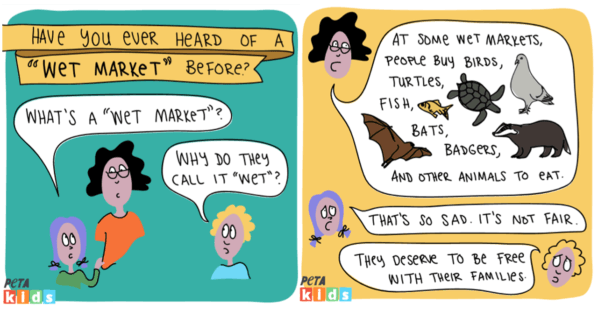
‘Wet Market’ Comic Strip Explains What’s Happening Right Now

animal-free classrooms fall 2020

Switching to Virtual Learning

In an effort to support educators and families during the pandemic, we at TeachKind have adapted our methods of promoting compassion for animals to suit the needs of a virtual classroom. We created a series of videos to provide educators and parents with empathy-promoting lessons, including compassionate stories read aloud by TeachKind staffers who have prior classroom experience, a presentation from Ellie the elephant, and a demonstration involving the future of frog dissection. We anticipate creating more virtual lessons in the coming months.

Let TeachKind Help You—With Our Virtual Lessons and Activities

Attention, Parents! Virtual Learning Resources for Grades K–12

Engage Students With These Humane Virtual Activities!

Celebrating Compassionate Teachers

This year, TeachKind had the pleasure of working with a number of exceptional humane educators, including the participants in our annual Teacher Appreciation Contest and our newest partner, The Good Kid Project.

Meet the Winners of TeachKind’s 2020 Teacher Appreciation Contest

Teacher Inspiration: Meet the Teacher Appreciation Contest’s Stellar Standouts

The Good Kid Project: Stories That Teach Compassion and Equality

Animal Rights and Other Social Justice Issues

Young people are coming together like never before to stand in solidarity against oppression—and if that weren’t exciting enough, harnessing your students’ disdain for inequity and their willingness to speak out against it may be the key to unlocking their academic potential.

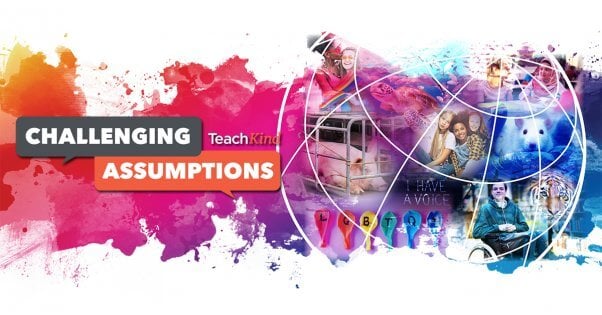
TeachKind created Challenging Assumptions, a free new social justice curriculum designed to educate and empower students in grades 9–12 to challenge societal norms and have compassion and empathy for others regardless of species, race, gender, sexual identity, age, or ability. The lessons spark lively discussion among students with a wide range of perspectives—especially among members of Gen Z, who are generally highly motivated by social justice issues, including animal rights. The curriculum includes a groundbreaking new video featuring the firsthand stories of two activists of color. It explores the ways our everyday language and actions can either reinforce or challenge ideas of power and supremacy.

Challenging Assumptions: A Social Justice Curriculum

Supporting Students’ Social and Emotional Needs During the Pandemic

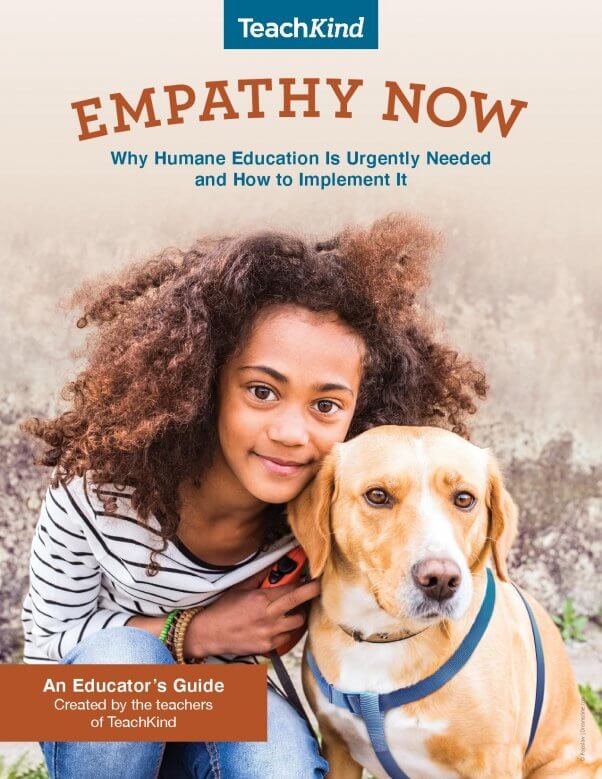
In response to the epidemic of cruelty to animals carried out by young people across the U.S., TeachKind created “Empathy Now,” a step-by-step guide that assists schools in addressing incidents of cruelty to animals within their communities and in implementing humane education to help prevent future tragedies. And because we know that antisocial behavior and violence against others, including animals, often go hand in hand, we also created resources to support students’ social and emotional well-being and help them overcome trauma.

Empathy Now: Why Humane Education Is Urgently Needed and How to Implement It

What Is Trauma-Informed Education?

Help Children Develop Social and Emotional Learning Skills With TeachKind Resources

Other Exciting Highlights

Because safety is of the utmost importance during the pandemic, we created this soft “Teaching Kindness Like It’s My Job” face mask to add to your collection!

We also launched our new Instagram account, so we can connect with you in new and exciting ways. Follow @teachkindteachers for exclusive giveaways, Q&A sessions with our team of former classroom teachers, and more fun, animal-friendly content.

*****

TeachKind will continue to create engaging, animal-friendly materials for the evolving classroom. Connect with us and let us help you incorporate compassion for animals into your classroom curriculum.

We also invite you to fill out the form below to sign up for TeachKind E-News.

All fields in bold are mandatory.

FormBuilder Form – 3364

First Name
Last Name
E-Mail
Please sign me up for Teachkind E-News. Current subscribers: You will continue to receive e-mail unless you explicitly opt out by clicking here
Please sign me up for PETA E-News. Current subscribers: You will continue to receive e-mail unless you explicitly opt out by clicking here
Please sign me up for PETA's Membership Updates. Current subscribers: You will continue to receive e-mail unless you explicitly opt out by clicking here
Get texts & occasional phone calls for Action Alerts, local events, & other updates to help animals with PETA! (optional)
Mobile Phone
By clicking, you agree to receive automated texts and calls from PETA and accept our terms and conditions. Message and data rates may apply. U.S. mobile users only. You can opt-out anytime.

The post 2020 in Review: How TeachKind Rallied for Students, Educators, and Animals appeared first on PETA.

SNL: Jason Bateman Introduced Us to Mikey—Here’s the Chimpanzee’s Real Story

“Something kinda weird happened last time I hosted,” said Jason Bateman during his December 5 Saturday Night Live (SNL) opening monologue. The actor was referring to his first time hosting SNL, in 2005, when a chimpanzee named Mikey was used in a sketch as well as the show’s closing credits. For Mikey, though, it was more horrible than weird.

Bateman got one thing right two nights ago: If SNL filmed its “monkeys throwing poop” sketch today, exploiting Mikey or any other chimpanzee wouldn’t be an option.

“If the show did that sketch today, they would use a puppet or a kid in a fuzzy suit,” Bateman said.

And it’s true: Thanks to campaigns like PETA’s to get live great apes out of entertainment and to the dedication of animal rights activists, exploiting chimpanzees in film and television productions is now recognized as unacceptable.

Curtain Closed: There Are No More Chimpanzees in Hollywood

But the accuracy of Bateman’s reminiscence essentially begins and ends there.

“[B]ack then they used a real male adult chimpanzee—this was 2005,” Bateman claimed in his monologue.

But Mikey wasn’t an adult in 2005; he was 3 years old—a baby.

Bateman did remark on how dangerous chimpanzees can be when they feel threatened: “The monkey tried to kill me. … The chimp unhinges his jaw, he flashes the teeth, and he tries to bite my entire nose off,” he said of Mikey, who was exhibiting severe signs of distress.

In the throwback clip, Mikey screams and backs away from Bateman and exhibits a fear grimace, which is a sign that a chimpanzee is deeply afraid.

Also, Mikey is an ape, not a “monkey,” a common misconception. (Great apes are part of the same taxonomic family that humans belong to, and unlike other primates, apes don’t have tails.)

Mikey was purchased for $45,000 from notorious former breeders Mike and Connie Casey when he was only a few months old to be used as a “pet.” He was ripped from his mother’s arms, like all other chimpanzees who are sold as “pets” and were used for film and television productions. Mikey was exploited and leased out when he was just a baby. Years later, when he was too big to continue being exploited for money, his owners got rid of him—a common fate for most great apes, as they inevitably become too strong and dangerous to control.

The good news: A decade ago, there were at least a dozen chimpanzees like Mikey exploited in Hollywood. Now there are none. 

The bad news: Other animals are still dragged to and from frightening sound stages and forced to perform confusing tricks under bright lights.

Talk shows, music videos, and TV shows exploit bear cubs, tigers, monkeys, and other animals for cheap laughs. Although kind viewers are resistant to watching these exploitative productions and our efforts to stop this cruelty have repeatedly caught up with wildlife exhibitors, certain talk show hosts, musicians, filmmakers, and TV producers have yet to commit to ditching wild-animal use for good.

No wild animal belongs under the spotlight in noisy studios! Tweet if you agree.

See Something? Say Something

If you witness animals being used for a film or a TV show, get in touch with PETA right away. Call our whistleblower hotline at 323-210-2233 or click on the link below to fill out a form online.

Report Animal Abuse in Film and Television

The post SNL: Jason Bateman Introduced Us to Mikey—Here’s the Chimpanzee’s Real Story appeared first on PETA.

PETA Warns Louis Vuitton of Potential Consumer Fraud Lawsuit

This morning, PETA fired off a letter demanding that Louis Vuitton Chair and CEO Michael Burke immediately stop making false claims about the treatment of animals killed for the company’s products.

A PETA investigation into the largest ostrich slaughter companies in the world, including a then-supplier of ostrich leather to Louis Vuitton, revealed workers forcing terrified ostriches into stun boxes—causing many to fall—and then slitting their throats, as the ostriches next in line watched helplessly. Workers were also observed striking ostriches in the face during transport to slaughterhouses. For decades, PETA and its international affiliates have also exposed that animals on fur farms are electrocuted, bludgeoned, gassed, and often skinned alive. Yet despite the cruelty inherent in these industries, Burke recently claimed, “I can say 100 per cent hand on heart our animals are humanely farmed.”

“There’s no such thing as ‘humanely’ hitting an ostrich in the face or slitting her throat while other ostriches watch,” says PETA Executive Vice President Tracy Reiman. “Louis Vuitton must stop lying to shoppers to sell bags and belts—or, better by far, join Calvin Klein, Victoria Beckham, Diane von Furstenberg, Vivienne Westwood, and Chanel in banning fur and exotic skins altogether.”

PETA—whose motto reads, in part, that “animals are not ours to wear”—opposes speciesism, a human-supremacist worldview. For more information, visit PETA.org or follow the group on Twitter, Facebook, or Instagram.

PETA’s letter to Burke follows.

December 7, 2020

Michael Burke, Chair and CEO

Louis Vuitton

Dear Mr. Burke,

I am counsel to People for the Ethical Treatment of Animals (PETA), the largest animal rights group in the world with more than 6.5 million members and supporters, and am writing to demand that you immediately end your false representations that the animals used for Louis Vuitton products “are humanely farmed.” Such representations are courting a consumer fraud action against your company.

Specifically, in comments to the Telegraph, you stated, “I can say 100 per cent hand on heart our animals are humanely farmed.“ Despite this assurance to consumers, there is no such thing as “humanely farmed” animals who are violently killed and skinned for Louis Vuitton products. As you no doubt know, PETA has exposed the cruelty of the exotic-skins industry, including within LVMH’s supply chain. A PETA-affiliate exposé into Vietnam crocodile farms shows tens of thousands of crocodiles in small, concrete enclosures—some narrower than the length of their bodies. The investigator was told the animals were kept there for over a year. LVMH is a majority owner of Heng Long, which LVMH admitted sourced skins from these farms for years. Similarly, a PETA investigation into the largest ostrich slaughter companies in the world, including a supplier of ostrich leather to Louis Vuitton, revealed workers forcing terrified ostriches into stun boxes—causing many to fall—and then slitting their throats, as the ostriches next in line watched helplessly. Workers were also observed striking ostriches in the face during transport. For decades, PETA and its international affiliates have also exposed that animals on fur farms are electrocuted, bludgeoned, gassed, and often skinned alive.

As described in the attached report that was provided to LVMH in 2016, this cruelty is standard wherever animals are killed for human use. And PETA’s investigations into the wool, down, and leather industries have revealed time and again that it is nothing but wishful thinking that certifications—which neither Louis Vuitton nor LVMH even require for all suppliers in their chain—somehow prevent egregious harm.

You can easily rectify this by removing all exotic skins from your offerings immediately, just as major designers, including Calvin Klein and Chanel, and retailers, such as Nordstrom and Selfridges, have already done. We hope you will recognize your untenable position and, at the least, immediately cease making this and any other false claims to misrepresent the suffering inherent in your company’s supply chain.

Very truly yours,

Jared Goodman

Vice President and Deputy General Counsel for Animal Law

The post PETA Warns Louis Vuitton of Potential Consumer Fraud Lawsuit appeared first on PETA.