Just ahead of Christmas, Santa Claus will make a pit stop on Thursday at the Miami Seaquarium to lead PETA supporters in a rousing protest of the park’s imprisonment of the orca Lolita, who has spent five decades in the smallest orca tank in the world. The protest will include a PETA supporter in an orca costume and signs proclaiming, “All Lolita Wants for Christmas Is Her FREEDOM!”
“Lolita won’t know comfort or joy until the Miami Seaquarium agrees to release her into a seaside sanctuary,” says PETA Executive Vice President Tracy Reiman. “PETA is calling on the Seaquarium to give her a chance at diving deep and finding companionship with other orcas after so many years alone.”
The Seaquarium’s parent company also owns Marineland in Antibes, France, where leaders are requiring that captive marine mammals be moved to seaside sanctuaries—and PETA is calling on the company to include Lolita in its cetacean-release plan.
The first-ever federal legislation mandating national medication oversight in horse racing is set to become law. It was several years in the making—and it started with a PETA undercover investigation.
The federal Horseracing Integrity and Safety Act has just passed. The bill includes federal oversight, anti-doping measures, regulations on medications, mandatory drug testing, and new safety procedures.
This huge progress all started with our unprecedented investigation into the activities of one of the industry’s top trainers, Steve Asmussen, covered in 2014 by The New York Times. Our exposé sent shockwaves through the industry, resulting in numerous citations and fines.
Horses train and race so pumped full of drugs that they’ll sprint despite their bleeding lungs or cracking bones. Pushed beyond the point of exhaustion, their limbs snap, the sound of which is louder than a gunshot. Many horses—more than three every day—die right on the track.
New York officials passed “sweeping new regulations” to curb the drug culture in horse racing after our investigation hit the media, and The Jockey Club, which registers all Thoroughbred foals destined for racing, vowed to introduce federal legislation to clean up drugging in the industry. It made good on its promise by working with legislators to introduce the Horseracing Integrity Act. This bill morphed into the current Horseracing Integrity and Safety Act.
What did PETA find while investigating doping in horse racing?
PETA’s investigator worked for the infamous Asmussen and, for the first time ever, captured on camera the aggressive, daily regimen of pain-masking drugs and treatments that trainers administered to horses:
Trainers dumped thyroxine into many, if not all, of the horses’ feed in Asmussen’s New York stable. This drug was recklessly administered apparently just to speed up metabolism—not because any of the horses had thyroid problems.
Lasix—a controversial drug now restricted at major tracks—was injected into “basically all” of Asmussen’s horses who were being raced or timed in New York.A powerful drug meant to prevent pulmonary bleeding in the lungs during extreme exercise, Lasix is a diuretic that can serve as a masking agent for other drugs and also dehydrates horses to make them lose weight and run faster. One of New York state’s top horse racing veterinarians admitted on camera to PETA’s investigator that Lasix is a performance-enhancing medication.
Trainers administered horses a daily cocktail of painkillers, muscle relaxants, sedatives, and other potent pharmaceuticalsto be used for treating ailments such as ulcers, lameness, and inflammation, even when the animals had no apparent symptoms.
This legislation won’t solve all of racing’s problems, and it must be implemented with the horses’ interests first. We’ll continue to watch—and speak out—for horses abused in racing.
Horses are intelligent, sensitive animals who feel joy, pain, fear, and all the other emotions that we do. In no world would these complex individuals choose to run themselves to death for human entertainment.
PETA thanks everyone who has ever signed a petition, held a sign in protest outside a racetrack, or contacted a legislator to help get this historic act passed. We can only advance animal liberation with the support of dedicated activists like you!
Following the announced rerouting of the Iditarod during the COVID-19 pandemic, Dr. Monica Bando, the PETA Foundation’s captive-wildlife veterinarian, sent an urgent letter this morning to Rob Urbach, CEO of the Iditarod Trail Committee, urging him to cancel the race because of the danger to public health.
The full letter is available here. Below, please find a statement from Dr. Bando:
Changing the course of the Iditarod won’t protect dogs from being infected with the novel coronavirus. If people from around the world gather in Anchorage, the danger of transmission will be high—and since dogs can’t socially distance and 81% of those who finish the race end up with lung damage even under normal circumstances, the result could be dire. PETA is calling on the Iditarod Trail Committee to cancel the race now for the safety of dogs and Alaskans alike.
PETA—whose motto reads, in part, that “animals are not ours to use for entertainment”—opposes speciesism, a human-supremacist worldview. For more information, please visit PETA.org or follow the group on Twitter, Facebook, or Instagram.
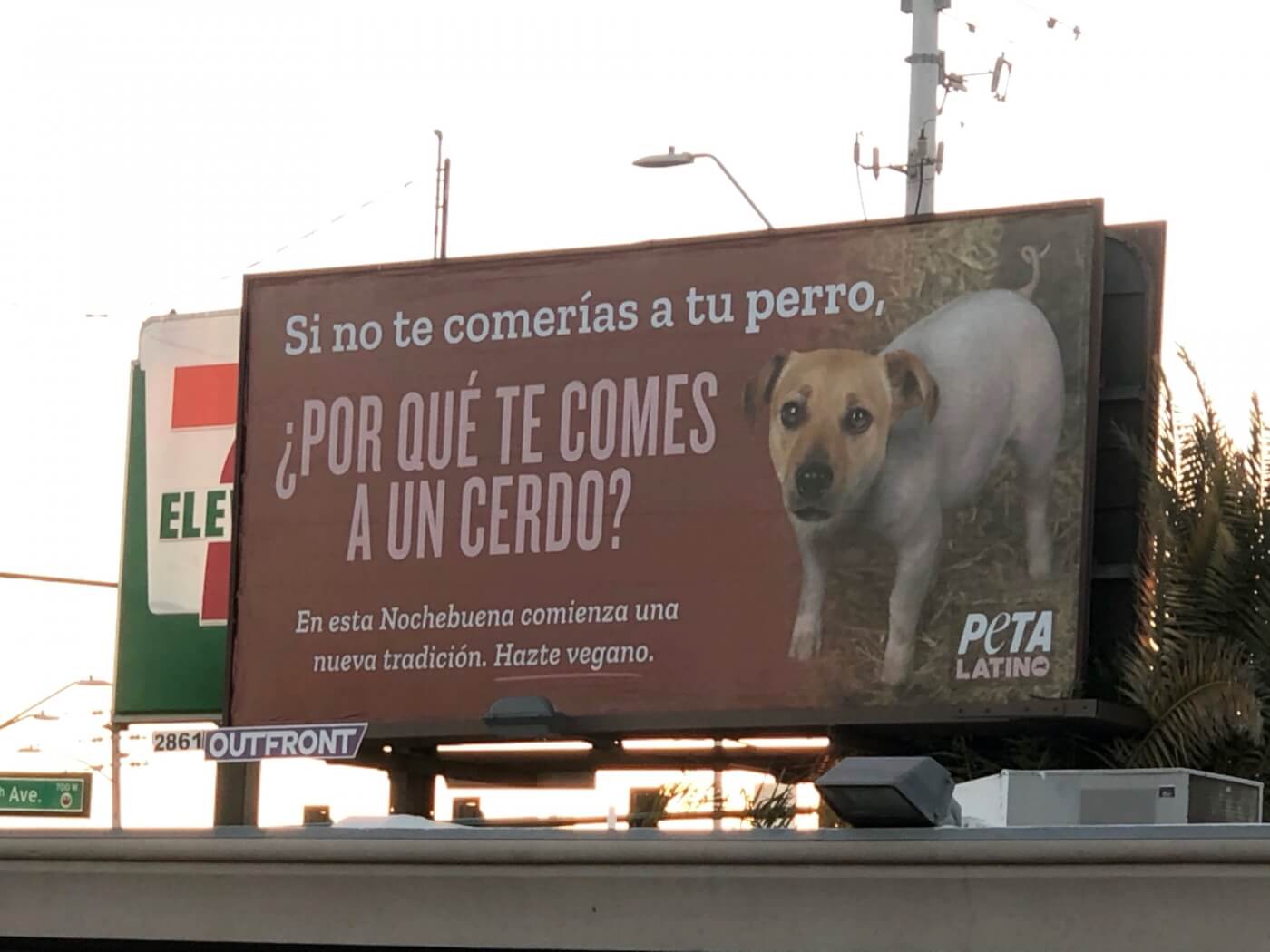
“If you wouldn’t eat your dog, why eat a pig?” That’s the bold message on a new PETA Latino billboard that just went up across the street from a Natural Grocers store in Phoenix. The group is pushing folks to enjoy a vegan feast this year for Nochebuena, a Christmas Eve holiday celebrated in the Latinx community. PETA Latino’s vegan Nochebuena message reminds everyone that the best way to celebrate the spirit of the season is to extend peace and goodwill to all—animals included.
Here’s Why You Shouldn’t Eat Pigs for Nochebuena
It’s speciesist to believe that pigs should be treated any differently from dogs. When it comes to having feelings, loving their families, and valuing their lives, pigs are no different from puppies or humans.
But in today’s meat industry, mother pigs are squeezed into narrow metal stalls barely larger than their bodies and kept almost constantly pregnant or nursing. Pigs’ tails are chopped off, their teeth are cut with pliers, and males are castrated—all without any pain relief. At the slaughterhouse, they’re hung upside down—sometimes while still conscious—and bled to death.
There’s nothing festive about this suffering.
Enjoy a ‘NocheVegana’—PETA Latino Will Help!
PETA Latino stands ready to help people celebrate a humane holiday. We offer vegan recipe guides for Nochebuena and the entire holiday season along with a vegan starter kit filled with more recipes, shopping tips, and guidance on making the switch.
Note: The billboard is located at 646 W. Indian School Rd. in Phoenix.