PETA Asia investigators recently returned to Thailand one year after exposing the use of forced monkey labor on Thai coconut farms—prompting Costco and other retailers around the world to cut ties with Thai coconut milk brands—and found that manufacturers and the Thai government are lying to the public and importers about monkey use, which continues despite false claims. In response, PETA is pushing Itasca-based Jewel-Osco and its parent company, Albertsons, with urgency to reconsider its business relationship with coconut milk brand Chaokoh, the biggest company implicated in the investigation.
PETA Asia’s video, available here, includes interviews with industry insiders who discuss how farms simply hide monkeys until auditors leave or are able to buy monkeys without registering them, even though registration is legally required. Of the 14 coconut farms that PETA Asia’s investigators visited in 2020, half were confirmed to be using monkeys—including two farms visited the previous year. As for the rest, because farmers can hire contractors to bring in monkeys only during harvest time, it’s nearly impossible to know whether they’re monkey-free.
“Useless audits and empty promises haven’t stopped monkeys—some whose teeth have been pulled out—from being chained for life and forced to labor on Thai coconut farms,” says PETA President Ingrid Newkirk. “PETA is calling on Jewel-Osco to stop selling milk from coconuts picked by abused monkeys.”
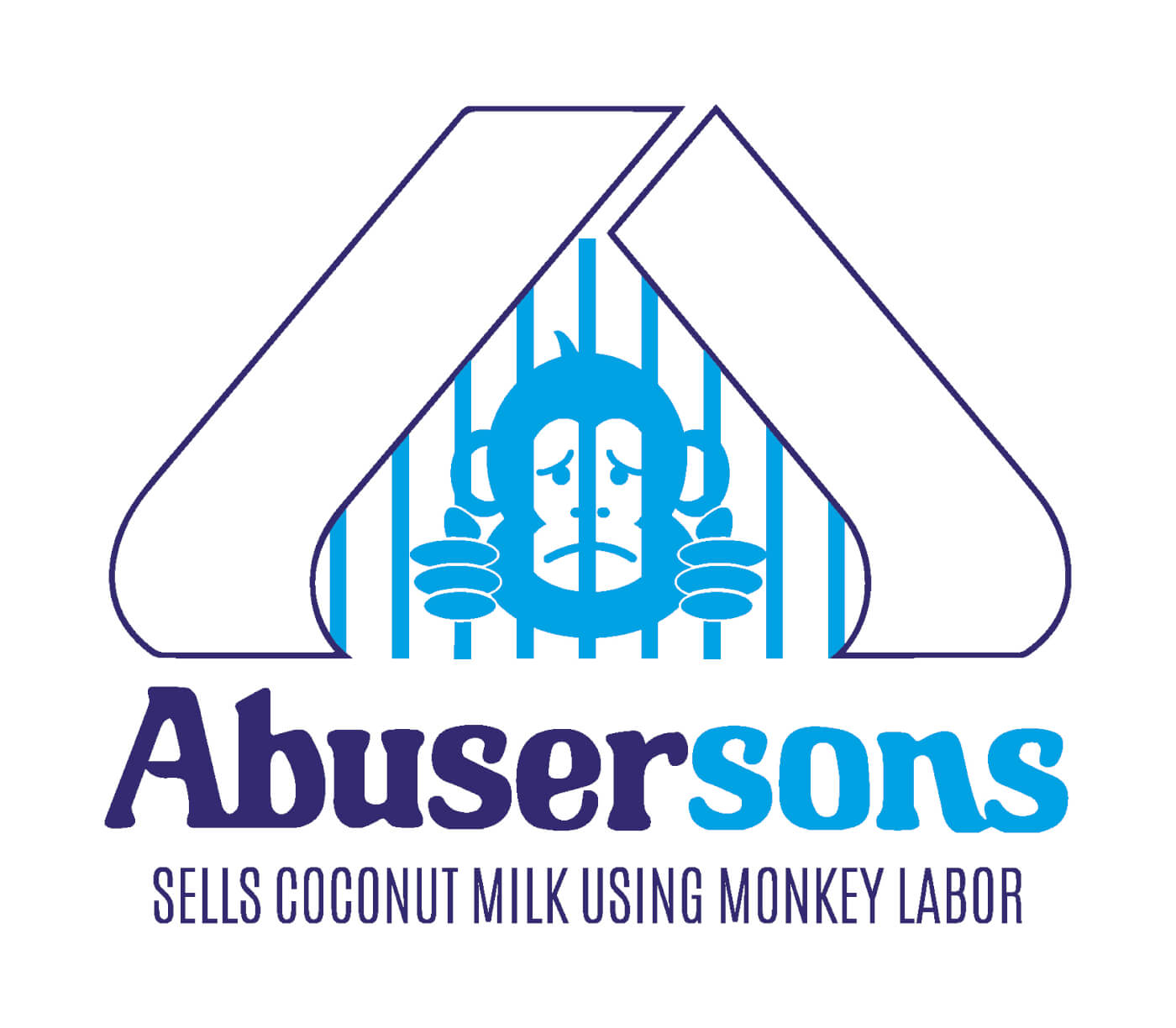
To push Jewel-Osco and Albertsons to reconsider their relationship with Chaokoh, PETA sent Albertsons CEO Vivek Sankaran and four other top executives deliveries of humanely picked coconuts and created a more accurate company logo. Tens of thousands of PETA supporters—including Belinda Carlisle of The Go-Go’s, who lives in Thailand—have joined PETA in calling on the company to stop selling coconut milk obtained via monkey labor.
More than 26,000 other stores—including chains Wegmans, Costco, Walgreens, Food Lion, and Stop & Shop—have banned coconut milk brands that use coconuts picked by monkeys.
Photos from the most recent investigation are available here, and broadcast-quality footage is available upon request. PETA—whose motto reads, in part, that “animals are not ours to abuse in any way”—opposes speciesism, a human-supremacist worldview. For more information, please visit PETA.org or follow the group on Twitter, Facebook, or Instagram.
PETA is offering a reward of up to $5,000 for information leading to the arrest and conviction on cruelty charges of the person(s) responsible for shooting and killing a cat with a carbon crossbow arrow in the 300 block of Millway Road on the night of January 1. Residents heard an animal crying during the night, and in the morning they discovered the body of a brown brindled cat with a white underbelly.
“This cat died alone, crying out in terror and agony—a stark reminder that cats are always in danger when roaming outside,” says PETA Vice President Colleen O’Brien. “PETA is urging anyone with information to come forward immediately so that whoever committed this terrible crime can face consequences.”
PETA—whose motto reads, in part, that “animals are not ours to abuse in any way”—notes that cats should never be left outdoors unattended. Those who are allowed to roam outside may contract diseases such as feline AIDS, be hit by cars, or be harmed by cruel humans, as in this case.
Anyone with information should contact Officer Rivera of the Ephrata Police Department at 717-738-9200, extension 236.
PETA opposes speciesism, which is a human-supremacist worldview. For more information about PETA’s work for animals, please visit PETA.org or follow the group on Twitter, Facebook, or Instagram.
Just in time for the new year, director Fern Levitt’s compelling documentary Sled Dogs—which has been called the Blackfish of the dogsledding industry—is now available to Prime members at no additional cost to their membership and is free on Plex.
The explosive documentary reveals the shocking, secret practices of mushers and trainers from Alaska, Colorado, and Canada who use whatever means necessary to force dogs to pull sleds for tourists and compete in grueling races like the Iditarod:
Dogs used in the 1,000-mile Iditarod were found to be exhausted and injured, and some were too worn out even to eat or drink.
“Surplus” dogs are routinely shot, bludgeoned, or abandoned to starve. As one handler-turned-whistleblower explained, dogs may be killed simply for having the wrong color paw pads.
At the largest tourist dogsledding operation in the U.S., dogs were regularly shot in the back of the head and buried in a pit.
When not being used, dogs are chained outside to plastic barrels, metal posts, and dilapidated wooden boxes in snow, rain, and subfreezing temperatures.
At one operation, a trainer hadn’t noticed that a dog was dead at the end of his chain until the film crew pointed it out.
“Sled Dogs shines a spotlight on the dogs who are chained 24/7 in all weather extremes, forced to run until their bodies break down, and killed if they don’t measure up,” says PETA Executive Vice President Tracy Reiman. “PETA encourages everyone to watch this must-see film and never support the Iditarod or any outfit that forces miserable, abused dogs to pull people on sleds.”
More than 150 dogs have died during the Iditarod since it began—and that doesn’t include those who died during the off-season or who were killed because they weren’t fast or fit enough to make the grade. During the 2020 race alone, more than 220 dogs were pulled off the trail because of exhaustion, illness, injury, or other causes.
Since the release of Sled Dogs, PETA—whose motto reads, in part, that “animals are not ours to abuse in any way” and which opposes speciesism, a human-supremacist worldview—released an undercover investigation into former champion Iditarod mushers’ “kennels,” revealing sick, injured, and crying dogs chained outside in the freezing cold.
More information about the dogsledding industry is available on PETA’s website.
Dorothy was a rhesus macaque born on April 1, 1993, at a Texas laboratory, where she was kept in a pen with other monkeys and eventually used as a breeding machine. There, over the course of 20 years, she gave birth to 13 babies, all of whom were taken from her. By December 2015, she was clearly geriatric but was still considered useful to laboratories, because she hadn’t been subjected to any invasive surgeries or used in any experiments. So she was sold to the University of Washington’s Washington National Primate Research Center (WaNPRC), where she was renamed A15378. At the WaNPRC, when she was 22 years old, she was confined alone to a small metal cage for the first time in her life. She was assigned to experimenter Elizabeth Buffalo’s study, purportedly on the neurobiology of human aging.
During the next 2.5 years at the WaNPRC—the final years of her life—Dorothy never had a fellow monkey companion. Humans exploited her until her final days, when her frail, diseased body had withered and collapsed under the pressure of unrelenting experimentation and she was euthanized.
Dorothy was capable of love, joy, happiness, and affection. But to experimenters like those in Buffalo’s lab at WaNPRC, she was only a tool whose needs and emotions didn’t matter. As is the case with millions of other animals used in experiments every year, once she was of no more use to her captors, she was simply killed, discarded, and replaced.
Immobilized in a Chair: Here’s What Dorothy Endured in Experiments at WaNPRC
The first thing Buffalo did to Dorothy was put a bulky metal collar around her neck, which laboratory staff referred to mockingly as her “jewelry.” Then, experimenters began to withhold food and water from her when she was locked in what was referred to as her “home cage.”
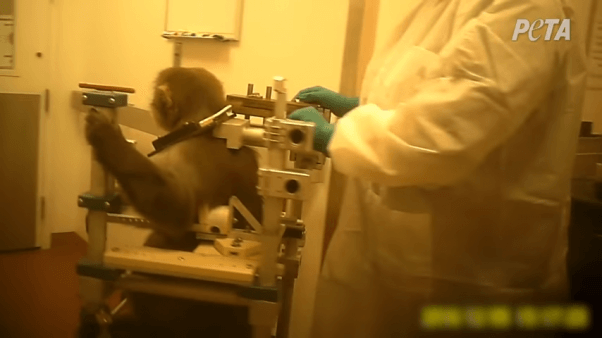
Each day, lab staffers would reach into Dorothy’s cage with a long metal pole and use it to grab her by the collar. She was then taken to another room and locked, upright, into a “restraint chair” for several hours to begin her “training.”
An image of another monkey locked in a restraint chair.
Dorothy was kept immobile for hours in this grossly unnatural position, and she was only offered food or water when she correctly performed certain memory tasks. She was expected to “acclimate” to being hungry and held by her neck in this chair. She never did.
Staff reported that 40% of the time, she was unmotivated and failed to perform her tasks to the level that would ensure that she had adequate nutrition. Dorothy was doing everything in her power to let people know that her spirit and her body were crumbling. They weren’t listening.
In late 2017, experimenters made an incision in Dorothy’s head, drilled a hole in her skull, and surgically implanted and cemented a titanium post. It hadn’t been enough to restrain her by the neck for hours—now, they could control her even more by plugging her directly into the testing apparatus for hours a day. Another elderly monkey at the WaNPRC died 12 days after undergoing the same gruesome surgery.
Dorothy was already a thin monkey when she arrived at the WaNPRC, but by late 2017, she was steadily losing weight. Her appetite was poor, she was anemic, and she had long ago pulled out all of her hair—a sign of extreme anxiety. She suffered from decreased range of motion in her hips, and she was constipated, her stomach often distended. By late March 2018, she had lost more than 20% of her body weight.
Isolated, elderly, hairless, and “underperforming,” Dorothy so obviously needed to be removed from the tortuous protocol that a member of the University of Washington’s oversight body—the Institutional Animal Care & Use Committee (IACUC)—raised detailed concerns about her continued use. But these concerns were dismissed.
According to food restriction guidelines for primates used in biomedical experimentation provided by the Association of Primate Veterinarians, Dorothy’s weight loss alone was reason enough to remove her from “food restriction motivational regimes” such as the one she was on.
But no.
Records show that the head of the IACUC and the director of the Office of Animal Welfare (who at the time was also the WaNPRC’s associate director) met privately with Buffalo, apparently to keep concerns from reaching other members of IACUC.
A month later, staff found Dorothy slumped over in her cage, bloated and not eating.
No matter. Her training regime continued unabated.
Buffalo’s laboratory claimed that Dorothy was merely constipated, and it refused to stop the daily torture, which went on for another month.
On May 8, 2018, a WaNPRC veterinarian euthanized Dorothy. Shortly after, her body was cut apart and examined.
What Did Experimenters Learn From Tormenting Dorothy? Nothing About Human Health
A study of Dorothy’s body after death revealed that her liver was failing and that she had cancer. Her body attacked her from the inside while experimenters waged daily attacks on her from the outside. She was given no respite at the WaNPRC, which took her dignity and willfully skirted rules to continue her torment, right up until the day she was killed.
As is the case with the overwhelming majority of experiments on animals, any results gleaned from the painful tests that Dorothy was forced to endure offer no hope of curing—or even treating—naturally occurring diseases in humans. At most, her torment offered experimenters a few data points regarding the neurobiology of profound despair in a depressed monkey kept in solitary confinement during the last years of her tortured life. Her suffering—like the suffering of all other animals subjected to painful and cruel laboratory tests—was pointless.
It’s speciesist to believe that animals are test tubes or pincushions for humans to use. Animals like Dorothy have their own unique personalities and needs. They lead complex lives with desires and interests that are wholly separate from whatever twisted purpose humans might squeeze out of them through brute force. That’s just one of the many reasons why PETA provides the public and government leaders with information about superior, modern, humane, non-animal testing methods.
Take Action for Monkeys Used in Experiments
It’s too late for Dorothy, but you can help monkeys like her. Join PETA in urging the University of Washington to close down the WaNPRC and transfer the animals to reputable sanctuaries, where they can get the proper rest and care that they’ve so long been denied.