Urgent From PETA Ahead of Arctic Blast: Survival Tips for Animals in Wisconsin

Because a wind chill advisory has been issued for the Eau Claire area because of the Arctic blast, PETA is sharing tips for keeping animals safe. They are especially vulnerable in cold weather and winter storms, and there were at least 37 cold weather–related companion animal deaths in 2019. (Those are just the ones that were reported—most aren’t.) A glimpse of just some of the dogs PETA’s fieldworkers have found suffering in the cold this winter can be seen here.

The following steps can go a long way in helping animals survive this Arctic blast and throughout cold weather:

  • Bring Them Indoors

Companion animals should always live indoors. “Backyard dogs” and “outdoor cats”—like those featured in Breaking the Chain, the new documentary produced by Oscar winner Anjelica Huston—often go without adequate food, water, shelter, and veterinary care. They are no better equipped to survive freezing temperatures or extreme weather conditions than humans are, they suffer terribly from frostbite, and they can die of exposure.

  • Gear Up

Coats will keep dogs comfortable in cold weather, secure harnesses can help prevent them from getting loose on walks, and booties will protect their sensitive paw pads from the frozen ground. Keep walks short in cold weather, especially for shorthaired dogs.

  • Don’t Forget Birds

During extreme winter weather, provide birds and other wild animals with access to an emergency water supply by filling a heavy nonmetal water bowl (tongues can freeze to metal) and breaking the surface ice at least twice a day.

Good Samaritans who see companion animals kept chained or penned outside 24/7 or without adequate shelter from the elements should note the animals’ exact location and alert local law-enforcement authorities immediately. Anyone who leaves animals outside to suffer in severe weather may be prosecuted.

PETA has released a cold-weather public service announcement. For more information, please visit PETA.org or follow us on Twitter, Facebook, or Instagram.

The post Urgent From PETA Ahead of Arctic Blast: Survival Tips for Animals in Wisconsin appeared first on PETA.

‘Cluck, Yeah!’ Free Vegan Wings in Fort Collins for the Super Bowl From PETA

As the Tampa Bay Buccaneers prepare to face off against the Kansas City Chiefs for Super Bowl LV, PETA’s chicken mascot will get in on the action tomorrow with a giveaway of delicious vegan wings from plant-based local restaurant Tasty Harmony. PETA supporters will hold signs proclaiming, “Vegan Wings? Cluck, Yeah!”

When:    Saturday, February 6, 12 noon

Where:    100 N. College Ave. (at the intersection with E. Mountain Avenue), Fort Collins

“Every year, hundreds of millions of chickens are killed for Super Bowl Sunday, so PETA is encouraging fans to tuck into tasty game-day snacks that let chickens keep their wings,” says PETA Executive Vice President Tracy Reiman. “Everyone can score a touchdown for gentle birds by choosing vegan wings.”

As PETA reveals in its “Chicken in Reverse” video, what happens to chickens is nothing to cheer about. The birds are crammed into filthy sheds and bred to grow such unnaturally large upper bodies that their legs often become crippled under the weight. At slaughterhouses, their throats are often cut, often while they’re still conscious, and many are scalded to death in defeathering tanks. Each person who goes vegan saves nearly 200 chickens and other animals every year.

PETA—whose motto reads, in part, that “animals are not ours to eat” and which opposes speciesism, a human-supremacist worldview—offers lists of ready-to-heat wings available at grocery stores and easy vegan game-day recipes on its website. For more information, please visit PETA.org or follow the group on Twitter, Facebook, or Instagram.

The post ‘Cluck, Yeah!’ Free Vegan Wings in Fort Collins for the Super Bowl From PETA appeared first on PETA.

These Food Scientists Keep Fish Alive and Oceans Thriving—Here’s How

Fish without fishing? It’s true. Food innovators are making vegan fish that doesn’t cost lives. Using seaweed and nutrients from the ocean, they’re creating plant-based shrimp and cultured fish—that is, growing fish flesh from in vitro cells instead of slaughtering animals for it. Cultured seafood can spare millions of fish and other animals the agony of fishing. Plus, it’s better for bodies of water all around the world.

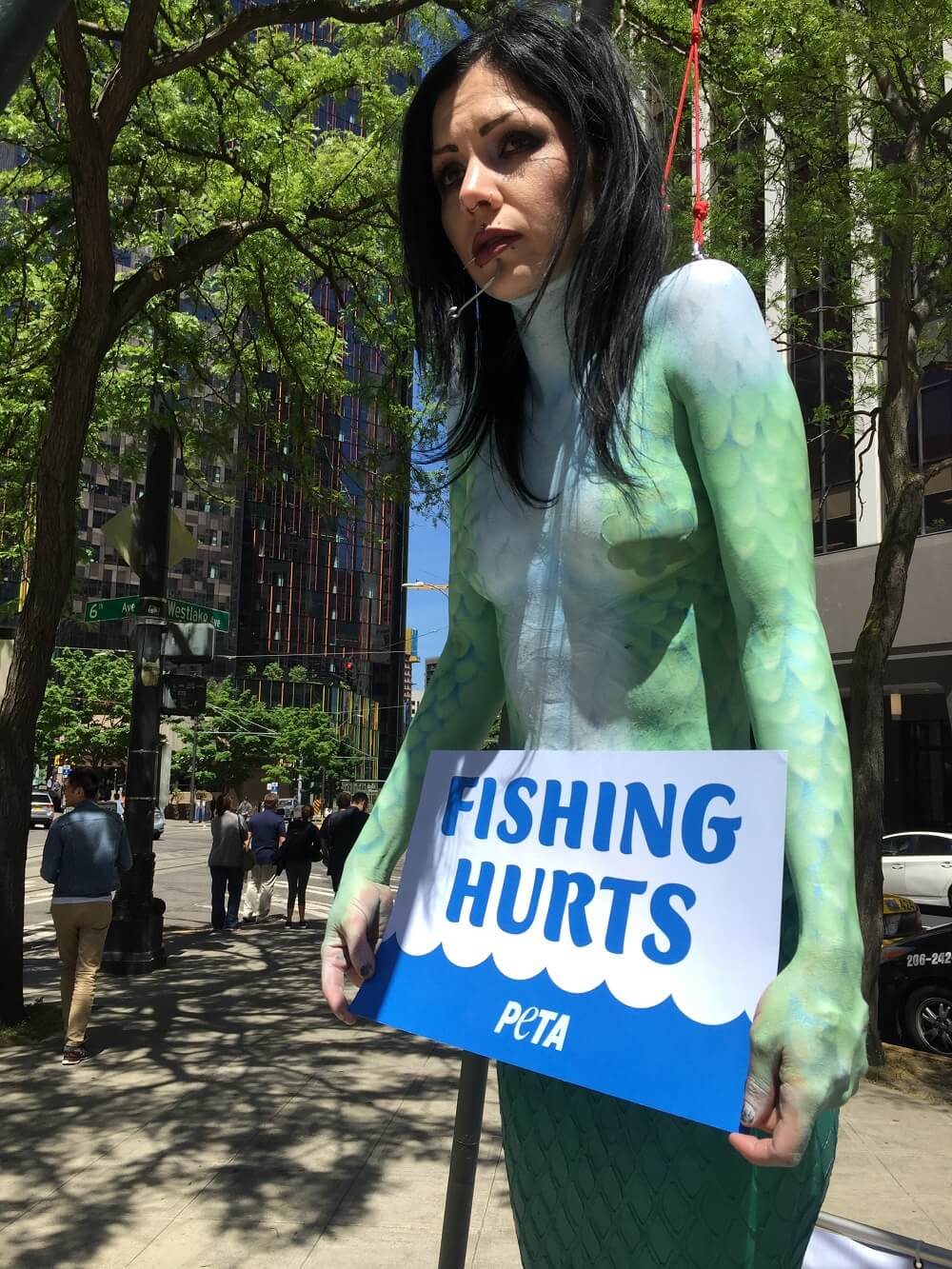
PETA’s decades-long efforts to spare fish and other sea life have included introducing vegan seafood to millions. Our eye-catching demonstrations, like the one with this hooked topless mermaid, brought media attention to the cruelty of the fishing industry. Join the effort to save our oceans—go vegan today! The delights below are nice to sea life and the planet.

This Shellfish Doesn’t Come From the Sea

Shiok Meats is the first of its kind in Southeast Asia. This Singaporean company is reinventing shellfish by making cell-based shrimp, lobster, and crab. Cofounder Dr. Sandhya Sriram describes her clean meat as shiok, or “delicious” in Malaysian slang.

Shrimp dumplings from Shiok MeatsPhoto from Shiok Meats is licensed under CC BY 4.0
Shrimp dumplings from Shiok Meats are on the menu.

Shiok Meats uses only sustainable, plant-based ingredients to feed shrimp cells, creating its own blend with nutrients that are similar to those found in the ocean. Craving one of this company’s crustaceans? Only a year to go! Shiok Meats enters the market in 2022.

Plant-Based Shrimp Is Free of Suffering

New Wave Foods created plant-based shrimp to spare animals the agony of being yanked out of their home. Shrimp, turtles, and dolphins are also often caught in fishing nets and killed as “bycatch.” Bycatch is responsible for immeasurable suffering and death and is a significant threat to threatened populations.

Company cofounder Michelle Wolf is seeking to end this pointless slaughter by offering vegan seafood. She aims to promote healthy eating with tasty shrimp, made with sustainably sourced seaweed and natural flavors. Her passion for ocean conservation even nabbed her a spot on Forbes’ 30 Under 30 list in 2020. If you’re in food service, you can order the sustainable shrimp here. Otherwise, it launches in restaurants later this year.

Seafood Without the Suffering

Live Lobsters and Crabs Torn Apart

Unlike Shiok Meats and New Wave Foods, the shellfish industry is awash with cruelty. PETA’s undercover exposé revealed that live lobsters and crabs were torn apart limb from limb at Linda Bean’s Maine Lobster. This shocking footage—along with PETA protests and nearly 76,000 e-mails from our supporters—ended in a victory: Linda Bean sold the facility that PETA had investigated and closed down many lobster roll eateries. Her lobster slaughterhouse was later closed when the new owners couldn’t persuade people to work there.

Another PETA investigation exposed live-animal eating at restaurants in Los Angeles. Chefs cut off the tails of shrimp and plated them right next to their moving bodies, leaving diners to bite into their flesh. Other chefs cut off the sensitive limbs of a live octopus with a butcher knife and served them squirming on a plate. PETA is calling on lawmakers to introduce legislation that prohibits animals from being served alive. And we’re calling on you to choose only vegan seafood.

Urge Seafood Chains to Sell Vegan Fish

Sustainable Seaweed … That Tastes Like Bacon!

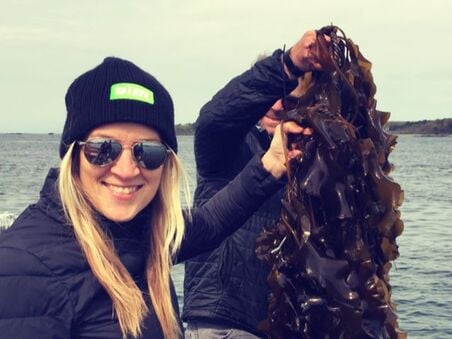
Ocean entrepreneur Beth Zotter and her team at Trophic LLC are creating plant-based protein from red seaweed, which has a high protein content and a remarkable umami flavor. Its “red-meat like attributes” are perfectly fit for vegan products—dulse, a little-known species of red seaweed, tastes like bacon when fried.

Beth Zotter holding red seaweed

Beth Zotter holds red seaweed that her team grew in New England.

Zotter is engineering high-tech sea farms that could drastically lower the cost of seaweed farming in the near future. In her words, seaweed can “feed the world.” She’s spot-on—seaweed is capable of producing five times as much protein per acre as soybeans, which is no small feat. Trophic is still in the development phase, so stay tuned!

Vegan Fish Saves Those in the Sea

Fish can feel pain. Scientists who study pain are in complete agreement that their pain response is basically identical to that of mammals and birds. These individuals love to play games, and some can even recognize themselves in a mirror. You can save sea life by always choosing vegan fish and seafood—check out some of our favorites below.

17 Fabulous Vegan Fish Recipes

The post These Food Scientists Keep Fish Alive and Oceans Thriving—Here’s How appeared first on PETA.

Senator Rand Paul Prompts Truth From Experimenters, PETA Thanks Him

When an animal experimenter tweeted that Sen. Rand Paul had described his experiments as “spraying alcoholic rats with bobcat piss,” he asked his peers on Twitter to “incorrectly summarize” their work.

The result was a refreshingly honest stream of professional confessions the likes of which PETA has never seen before. We researched the experimenters’ work and confirmed that what they say is actually accurate.

Here are two examples:

“Forces monkeys to become tweakers and then kills them”

—Posted by David Jentsch, SUNY Binghamton

“Deafens, murders, and mutilates mice”

—Posted by “MadScientistPhD,” who is most likely Mike Kasten, University of North Carolina School of Medicine

Many may consider Rand Paul to be controversial, but we just had to thank him.

“We urge you to keep telling it like it is and do all you can to redirect funds from animal studies to superior animal-free methods,” wrote PETA Senior Vice President Kathy Guillermo in a letter to Paul.

For more information, please visit PETA.org or follow the group on Twitter, Facebook, or Instagram.

PETA’s letter to Paul follows.

February 4, 2021

The Honorable Rand Paul

U.S. Senate

Washington, DC 20510

Dear Senator Paul,

On behalf of PETA and our 6.5 million members and supporters, I wish to thank you for your refusal to mince words when describing an animal experiment. According to @The_Gilp, whom we believe is Nicholas Gilpin, professor of physiology at Louisiana State University, you described his animal studies as “spraying alcoholic rats with bobcat piss.” This has inspired a tweet storm of confessions by animal experimenters, including these:

Forces monkeys to become tweakers and then kills them

Posted by David Jentsch, SUNY Binghamton

Deafens, murders, and mutilates mice

Posted by “MadScientistPhD,” who may be Mike Kasten, University of North Carolina School of Medicine

Traumatize teen rats and feed them comfort foods to death

Johnny Figueroa, Loma Linda University

This rare glimpse of truth-telling by those who imprison and harm animals in laboratories—despite the failure of 90% of basic research to lead to treatments for humans—is a rare and self-revelatory glimpse into a very secretive world. As it’s a world largely funded by American taxpayers, we certainly have the right to know what’s being done in our name and with our dollars. These descriptions are also alarming as we struggle in a pandemic. The need for medical research that doesn’t waste resources is evident. We have the COVID vaccines because companies, while conducting some animal studies, were allowed to bypass the years-long animal trials that are normally required.

Perhaps you will find the attached list of shockingly honest descriptions useful. While the experimenters were asked to “incorrectly summarize” their work as they imagine you would, we know from our research into their published papers and public records that these experimenters are admitting what they do behind closed laboratory doors.

We urge you to keep telling it like it is and do all you can to redirect funds from animal studies to superior animal-free methods. Toward that end, we invite you to review our strategy for this transition, which you can see here.

With respect,

Kathy Guillermo

Senior Vice President

Laboratory Investigations

PETA

The post Senator Rand Paul Prompts Truth From Experimenters, PETA Thanks Him appeared first on PETA.