
How PETA Legal Eagle Asher Smith Uses the Constitution to Protect Owls

PETA’s legal eagle Asher Smith — who previously helped secure the rescue of 25 big cats from roadside zoos featured in the Netflix series Tiger King — is a champion in the courtroom for animals. These days, you’ll find him using a somewhat surprising tool in his work to free 30 sensitive barn owls from a laboratory at Johns Hopkins University: the U.S. Constitution.
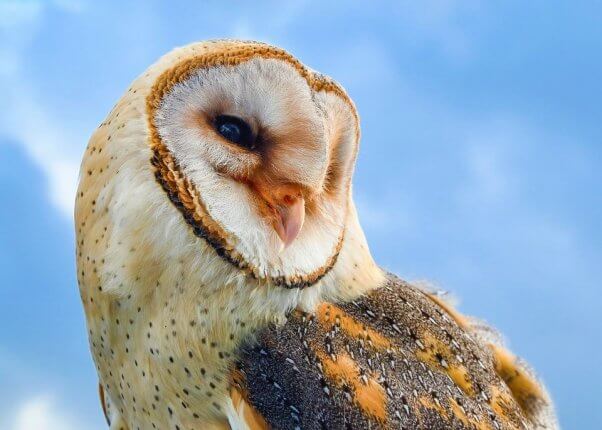
Asher Smith PETA lawsuit owls have rights

Asher Smith and PETA’s Lawsuit to Save Owls at Johns Hopkins  

As litigation manager for the PETA Foundation, Smith is suing U.S. Secretary of Agriculture Tom Vilsack. PETA and Smith’s lawsuit targets a 2002 law sponsored by the late Sen. Jesse Helms that prevents Vilsack from upholding federal Animal Welfare Act (AWA) protections owed to birds born in laboratories, including those who currently suffer at Johns Hopkins in crude and pointless sensory tests. Our lawsuit argues that the owls are protected by the Constitution, and PETA is calling for an immediate end to the cruel experiments.

The SeaWorld Case That Set a Legal Precedent

In a landmark 2011 case, the 13th Amendment—which abolished slavery—was used to argue that orcas at SeaWorld are enslaved individuals. Although they and their human advocates didn’t win that case, the court acknowledged that “fundamental constitutional concepts” could be applied to animals in other situations. The ruling left the door open for future cases—like Smith’s new lawsuit on behalf of the owls at Johns Hopkins—to argue that the Constitution legally protects the interests of other species, even if some humans remain unwilling to acknowledge that fact.

Like the SeaWorld case, Smith’s lawsuit relies on a concept that originally applied to humans: a bill of attainder.

What Is a Bill of Attainder? How Can It Help Owls at Johns Hopkins?

A bill of attainder refers to any legislative act that unfairly singles out a person or group and sets punishment for them without a trial. Smith’s case argues that the 2002 Helms Amendment to the AWA—which entirely excluded animals including birds, rats, and mice born in labs from the already meager protections of the existing legislation—constitutes an illegal bill of attainder. In this case, it condemns barn owls at Johns Hopkins to death and torture without a trial.

Today, even inanimate corporations can sue to escape bills of attainder. Smith believes that these owls—who are living, feeling individuals with complex needs—are granted similar protection by the Constitution.

Learn more about the case from Asher Smith on The PETA Podcast:

Regardless of the case’s outcome, the lawsuit will raise public consciousness about the plight of animals used in experiments. Although the idea of extending basic legal protections to other species may be met with skepticism by some humans, it’s important to remember that not too long ago, full rights were only granted to white, cisgender, heterosexual men in this country. Through perseverance, dedicated activists were able to use their words, their knowledge of the law, and their vision of an ethical world to create a more just society for women, people of color, the queer community, and so many others. We must include other species in our circle of compassion.

What You Can Do for Owls at Johns Hopkins

Funded by taxpayer money through the National Institutes of Health, Johns Hopkins experimenter Shreesh Mysore cuts into the skulls of barn owls, inserts electrodes into their brains, forces them to look at screens for hours a day, and bombards them with noises and lights.
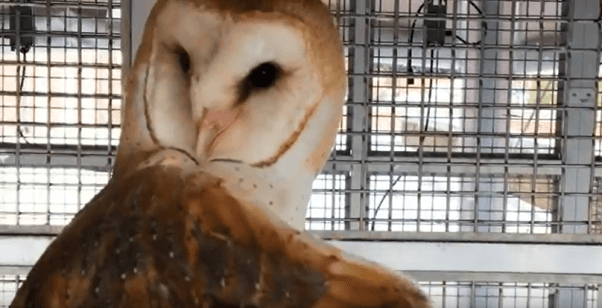
Johns Hopkins University owl torture

This owl is one of many imprisoned in Shreesh Mysore’s laboratory, where he cuts into their skulls and screws metal devices onto their heads in curiosity-driven experiments with no relevance to human health.

Barn owls—nocturnal hunters who would fly great distances in their natural habitat, mate for life, and exhibit empathy—are restrained in jackets or forced into plastic tubes so cramped that they can’t move their wings while experimenters measure their brain activity. For some experiments, Mysore restrains the fully conscious owls for up to 12 hours. During the course of these experiments, he eventually mutilates the brain tissue of the birds so severely that they become “unusable” to him—at which point he kills them.

Mysore claims that his experiments could help humans with attention-deficit/hyperactivity disorder (ADHD), but unlike us, owls have well-developed auditory and visual systems that are specialized for target selection. Blasting these animals with artificial stimulation while their brain activity is measured in a distressing and completely unnatural situation not only is cruel but also does nothing to further our understanding of ADHD in humans. PETA’s scientists have rebutted Johns Hopkins’ excuses for continuing these worthless experiments.

Hundreds of thousands of conscientious people have already called on the university to end these appallingly cruel, admittedly worthless, and apparently illegal brain experiments on barn owls. Joining them takes only a minute using your phone or computer, so what are you waiting for?

Take Action for Owls Now!

The post How PETA Legal Eagle Asher Smith Uses the Constitution to Protect Owls appeared first on PETA.
PETA Statement: First Drug-Free Kentucky Derby

Please see the following statement from PETA Senior Vice President Kathy Guillermo regarding the first Kentucky Derby in which all horses will run without Lasix:

While too many horses are still suffering and dying in the horse racing industry, the first drug-free Kentucky Derby—and Triple Crown—is an important step forward. Now, racing must boot the dopers out. Trainers who violate drug regulations must be slapped with more than small fines—their licenses should be permanently revoked.

PETA—whose motto reads, in part, that “animals are not ours to use for entertainment or abuse in any other way”—opposes speciesism, a human-supremacist worldview. For more information, please visit PETA.org.

The post PETA Statement: First Drug-Free Kentucky Derby appeared first on PETA.

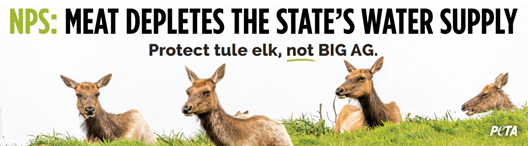
Tule Elk Kill Plan Brings Mobile Billboard to Point Reyes

Since the National Park Service (NPS) plans to promote livestock ranching on Point Reyes National Seashore—even though that means massive depletion of water resources and a death sentence for the tule elk who call the area their home—a mobile PETA billboard will be positioned all day tomorrow at a parking lot to call out the NPS for sucking up to the meat industry at the expense of wildlife and citizens’ water needs.

The NPS plan will allow cattle ranchers to keep over 5,500 cows on some 26,000 fenced-off acres of the seashore for 20 more years—which will exacerbate drought conditions. It takes an average of 1,799 gallons of water to produce 1 pound of cow flesh and 4.5 gallons of water to produce a gallon of cow’s milk, and livestock operations pollute water supplies with manure, hormones, and antibiotics. Water contamination from the existing ranches at Point Reyes is evidently a problem, as bacteria levels recently tested at up to 300 times higher than the state health standard.

“Killing wildlife to suck up to cattle ranching interests is disgraceful, insupportable, and unforgivable,” says PETA President Ingrid Newkirk. “PETA is calling on the National Park Service to protect Point Reyes, water resources, and its citizens’ interests, not those of the meat industry.”

One herd of tule elk is confined by a rancher’s fence to a peninsula, and drought conditions have resulted in a drastic drop in the water and natural food supply. Hundreds of elk reportedly died in 2020 because the fences stopped them from seeking food and water elsewhere. Only two other herds of tule elk remain at Point Reyes, and the NPS plan would allow some of them to be killed “consistent with desired conditions for the planning area”—in other words, as ranchers see fit.

The billboard will be parked at the Tule Elk Preserve parking lot at the end of Pierce Point Ranch Road all day tomorrow (May 1).

PETA—whose motto reads, in part, that “animals are not ours to eat”—opposes speciesism, which is a human-supremacist worldview. For more information, please visit PETA.org or follow the group on Twitter, Facebook, or Instagram.

The post Tule Elk Kill Plan Brings Mobile Billboard to Point Reyes appeared first on PETA.

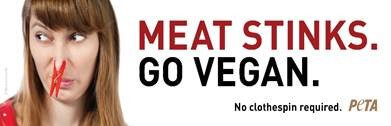
‘Poop Wall’ Spotlighted With ‘Meat Stinks’ PETA Billboard

The smelly 250-foot barrier of cow manure built by a local farmer during a property dispute has prompted PETA to place a billboard pointing out that what really stinks is harming the environment, our own health, and animals by turning them into food.

“Left alone, animals are clean, but step inside any enterprise where animals are confined in their own waste and you’ll need a gas mask or a clothespin on your nose,” says PETA President Ingrid Newkirk. “PETA’s billboard encourages everyone to adopt a clean conscience by going vegan.”

Cows in the meat industry are often confined to cramped, filthy feedlots without protection from the elements, while cows used for dairy are artificially inseminated—workers insert an arm into the animals’ rectum and a metal rod into their vagina—and sent to slaughter when their bodies give out. At the slaughterhouse, workers shoot cows in the head with a captive-bolt gun, hang them up by one leg, and cut their throat—often while they’re still conscious.

Each person who goes vegan saves the lives of nearly 200 animals a year and uses less water, combats deforestation, and shrinks their carbon footprint, as raising animals for food is a major producer of greenhouse gases, including carbon dioxide, methane, and nitrous oxide. According to the United Nations, a global shift toward vegan eating is necessary to combat the worst effects of climate change.

People who go vegan also reduce their risk of suffering from heart attacks, cancer, and diabetes and help prevent future epidemics and pandemics. SARS, swine flu, bird flu, and COVID-19 all stemmed from confining and killing animals for food.

PETA—whose motto reads, in part, that “animals are not ours to eat”—opposes speciesism, a human-supremacist worldview. For more information, please visit PETA.org or follow the group on Twitter, Facebook, or Instagram.

The post ‘Poop Wall’ Spotlighted With ‘Meat Stinks’ PETA Billboard appeared first on PETA.

Feds Cite 61 Bird Slaughterhouses in Four Months: PETA Seeks Criminal Probes

PETA has just obtained U.S. Department of Agriculture (USDA) records from between January 1 and May 18, 2020, revealing that inspectors cited 61 slaughterhouses on 143 occasions for abusing chickens, turkeys, and ducks in violation of the Poultry Products Inspection Act.

Workers beat, kicked, threw, ran over, scalded, and tore apart birds; left thousands to die on trucks in the cold and without food and water; and more. The reports include violations at 22 facilities run by the four largest chicken slaughterers in the country and slaughterhouses in 23 states—and because some of these incidents also appear to violate state cruelty-to-animals laws, PETA is asking local authorities to investigate and file appropriate charges against the slaughterhouses and workers responsible.

“Turkeys, ducks, and chickens experience thirst, hunger, fear, and pain, just as we do,” says PETA Senior Vice President of Cruelty Investigations Daphna Nachminovitch. “This type of misery is business as usual in the meat industry, and PETA urges anyone who still eats animals to spare a thought for these birds’ painful, terrifying deaths and go vegan.”

At a Tyson slaughterhouse, 17 chickens drowned when slaughter operations were paused for an unknown reason and the animals’ heads were in a tank of electrified water; at Pilgrim’s Pride, a worker threw a chicken into a barrier, killing the bird; at Sanderson Farms, a worker kicked a chicken into a conveyor belt; and at Perdue Farms, birds were scalded to death on seven days. At Hormel subsidiary Jennie-O Turkey, the nation’s second largest turkey slaughter company, workers handled turkeys so violently that their wings and legs were broken and their muscles were mutilated. There were also violations at other bird slaughterers when 2,700 chickens died in cold trucks overnight, 1,622 chickens died at a Costco supplier after being left in crowded coops without food or water for over 24 hours, and 9,150 hens died on three trucks overnight as the wind chill reached -32 degrees. The full document of violations is available here.

PETA—whose motto reads, in part, that “animals are not ours eat”—opposes speciesism, a human-supremacist worldview. For more information, please visit PETA.org or follow the group on Twitter, Facebook, or Instagram.

The post Feds Cite 61 Bird Slaughterhouses in Four Months: PETA Seeks Criminal Probes appeared first on PETA.