Armed with video footage showing California gubernatorial candidate John Cox interacting with an unrestrained Kodiak bear named Tag at a recent news conference in Sacramento, PETA fired off urgent letters to the U.S. Department of Agriculture and the California Department of Fish and Wildlife. We’re asking the agencies to investigate exhibitor Steve Martin’s Working Wildlife, which supplied the exploited bear, for apparent violations of both the federal Animal Welfare Act (AWA) and state regulations.
Steve Martin’s Working Wildlife has a long history of citations for violating the AWA, including by failing to provide animals with adequate veterinary care and locking chimpanzees in “night housing” for up to 18 hours a day. It’s imperative that authorities investigate this shady exhibitor before it can endanger anyone else.
John Cox's 1,000-pound bear stunt to recall Gavin Newsom slammed by PETA https://t.co/NnJWrhYyVb
During the news conference, Cox was filmed standing inside Tag’s temporary staging area without any barrier and feeding the bear—a 1,000-pound wild animal whose long, sharp claws could disfigure or even kill someone with a single swipe. For the remainder of the event, Tag was separated from the crowd of reporters by only a double-stranded electric wire fence.
“Bears like Tag should be living in a naturalistic environment at an accredited sanctuary, not being abused and used as money-making machines after having been torn away from their mothers. PETA is calling on authorities to investigate this incident and throw the book at everyone responsible for exploiting Tag and putting people in danger.”
—PETA Foundation Associate Director of Captive Animal Law Enforcement Debbie Metzler
Bears Like Tag Suffer When Used for Entertainment
Bears used for photo ops and other cheap forms of entertainment are separated from their mothers as infants. They’re forced into abusive training sessions in which they’re made to perform confusing tricks and dragged to events that can be very stressful to them, as these animals naturally shun humans and shy away from loud noises. Tag has been exploited numerous times, including in a social media stunt by Jason Momoa, at Dan Bilzerian’s 4/20 party, and in a Nickelodeon “talent” show.
What You Can Do
Never support any event or venue where bears are forced into stressful and dangerous hands-on encounters with humans. Tell your friends, family, and social media followers not to support them, either.
PETA makes it quick and easy to take action for animals using your phone or computer. It takes less than a minute to speak up, so what are you waiting for? Get started now:
Note: PETA supports animal rights, opposes all forms of animal exploitation, and informs the public about those issues. PETA does not directly or indirectly participate or intervene in any political campaign on behalf of or in opposition to any candidate for public office or any political party.
Dead fish on store shelves, feces piling up in cages, sick animals suffering inside severely crowded containers, reptiles deprived of proper heat, dead animals being cannibalized in small tubs, and animals gassed, frozen alive, and left for dead—that’s just the misery that PETA undercover investigators, whistleblowers, and government officials were able to note. Imagine the pain and suffering that goes undiscovered at Petco stores and in its suppliers’ mills.
Petco treats the sentient beings it sells as disposable merchandise, but the buck can stop with us, the consumers. For all these animals’ sakes, please don’t buy into the pain that Petco peddles.
How Much Does a Bird at Petco Cost?
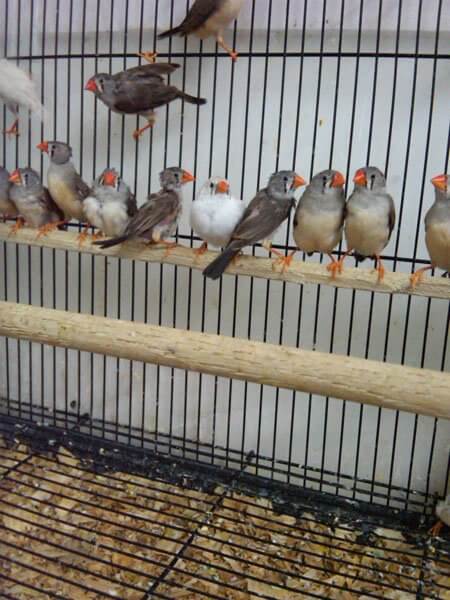
Ultimately, the cost of buying a bird at Petco may be that animal’s very life. We’ve been pushing Petco to end live-animal sales since the early 2000s, when we first owned stock in the company, which saw it end the sale of large birds in its stores and recommend and promote flight cages for all birds. But the big-box pet store hasn’t actually listened to the countless people who have begged it to stop exploiting all animals, including small birds, like these finches whom a PETA investigator observed while undercover at Sun Pet Ltd., an Atlanta-based wholesale animal dealer that supplies animals to numerous Petco stores:
Feather loss—as seen in these finches—frequently occurs when birds peck at one another, a sign of stress, which is often the result of severe crowding and continuous confinement.
Video footage and photos captured by PETA’s investigator revealed how thousands of birds and other small animals at Sun Pet Ltd.’s enormous warehouses experienced widespread suffering, including incidents in which a worker violently killed hamsters and a supervisor abusively handled hundreds of other animals.
Or consider this white-capped pionus, a species of parrot. A concerned good Samaritan noticed that the bird—whose price tag read 50% off $799—had apparently spent 14 months in a cage at his local Petco store, waiting to be purchased.
With PETA’s help, this good Samaritan adopted this white-capped pionus, whom he affectionately named Tegan, after she’d apparently spent more than a year in a cage at a Petco store.
During the Colorado Department of Agriculture’s (CDA) 2019 inspections, a “large amount of feces” was found in a parakeet cage at the Northglenn store. Several stores lacked essential documentation, including one that was without a certificate for conures (parrots) whom it had evidently held for more than a year.
And even when they’re not heinously abused, birds sold and kept as “pets” are denied the opportunity to satisfy one of their most natural instincts—to fly.
Does Petco Still Sell Fish?
Although PETA has repeatedly exposed cruelty to betta fish in Petco’s supply chain and at its stores, the company is still selling these animals in tiny containers, causing hundreds of thousands to suffer.
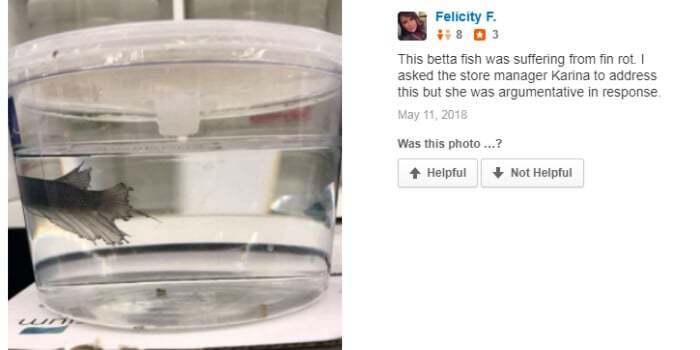
Petco stores’ own Yelp reviews are proof of just how miserable it is to be a betta fish on a store shelf: “They had multiple dead Betta Fish, with one of them having fungus growing on [them],” one reviewer in California commented. “I counted at least 10 dead bettas just molding in the jars,” Megan from Washington wrote after visiting another of the chain’s stores.
“This betta fish was suffering from fin rot,” this Petco reviewer pointed out. But a store manager was apparently reluctant to help.
PETA’s investigations revealed how betta fish are individually confined to small bags that contain hardly enough water to keep their bodies fully submerged and that are stuffed into boxes for transport. Many fish die before and during shipment to Petco retailers, which can take days. At the stores, they’re placed in tiny plastic cups, which are sometimes stacked directly on top of one another—even though Petco acknowledges on its website that the fish breathe by swimming to the surface.
The way Petco displays and sells bettas and other fish perpetuates harmful myths about the care of these complex animals. Minuscule plastic cups are never suitable containers for fish, who require gallons of filtrated, temperature-regulated water as well as enrichment and mental stimulation—all of which are denied to them when they’re kept in cups barely larger than their bodies.
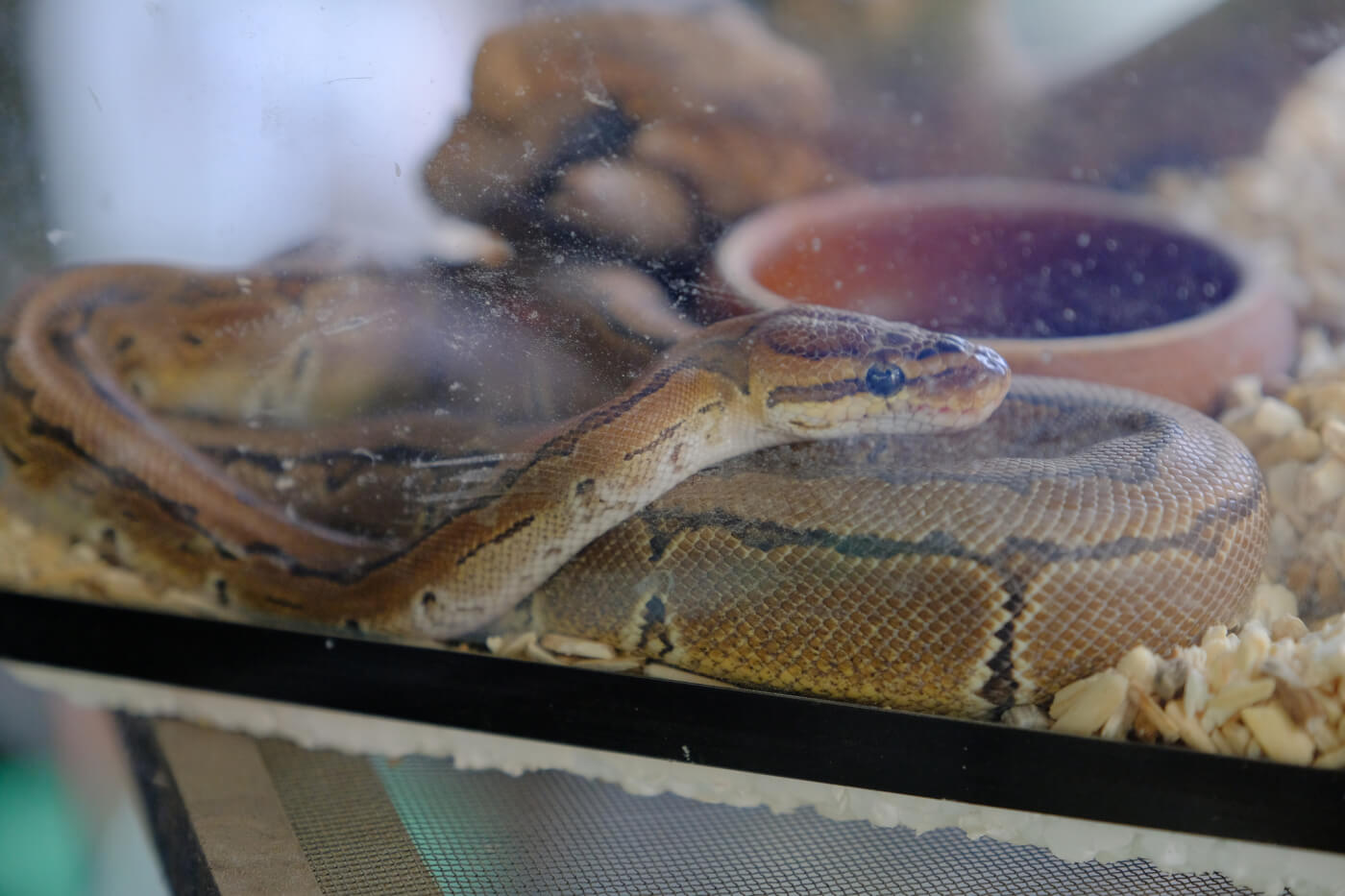
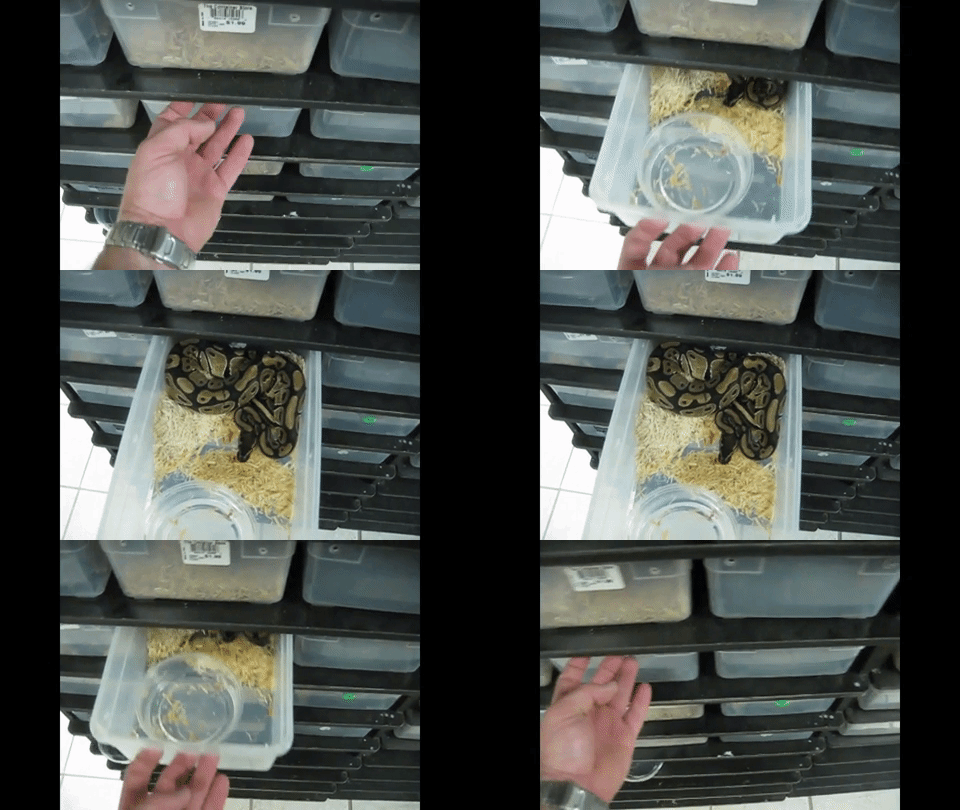
In their natural habitat, snakes warm themselves in the sun, cool off by burrowing underground, climb trees, and swim gracefully. Experts say it’s essential to snakes’ health and well-being to be able to stretch out to their full length, at a minimum. They also need exercise and room to move—one python who had been fitted with a tracking device traveled 22 miles in 75 days. They’re denied all this and more when they’re forced to live inside cramped glass tanks like those made by Zoo Med, which Petco sells and often keeps snakes in.
And if you’re wondering where the pet trade gets the snakes it sells, look to the multiple PETA undercover investigations and exposés that have revealed what it’s like to be a snake or any other animal at a breeding mill, where they’re frequently neglected—often to the point of death.
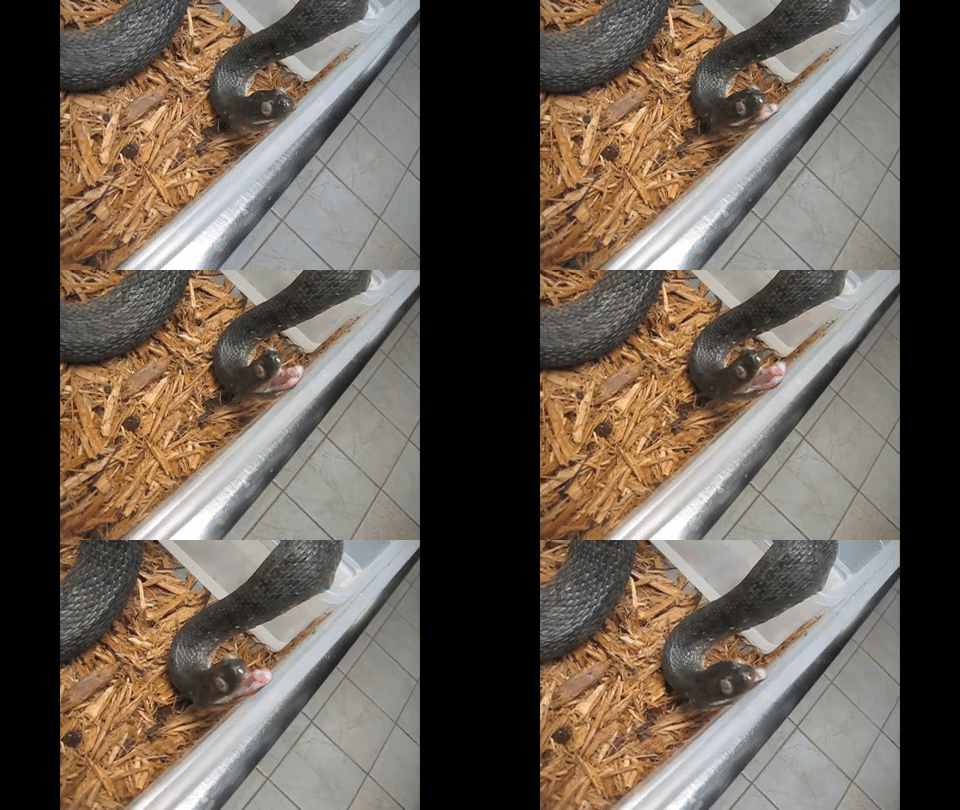
Denied adequate food, this water snake—a victim of the pet trade—is dying. This animal retained their eye caps after shedding, which was apparently caused by a vitamin A deficiency.
At supplier mills, snakes are often kept in enclosures like this one …
While undercover at a top reptile and mammal pet-trade supplier, a PETA investigator observed snakes kept in plastic, shoebox-like containers.
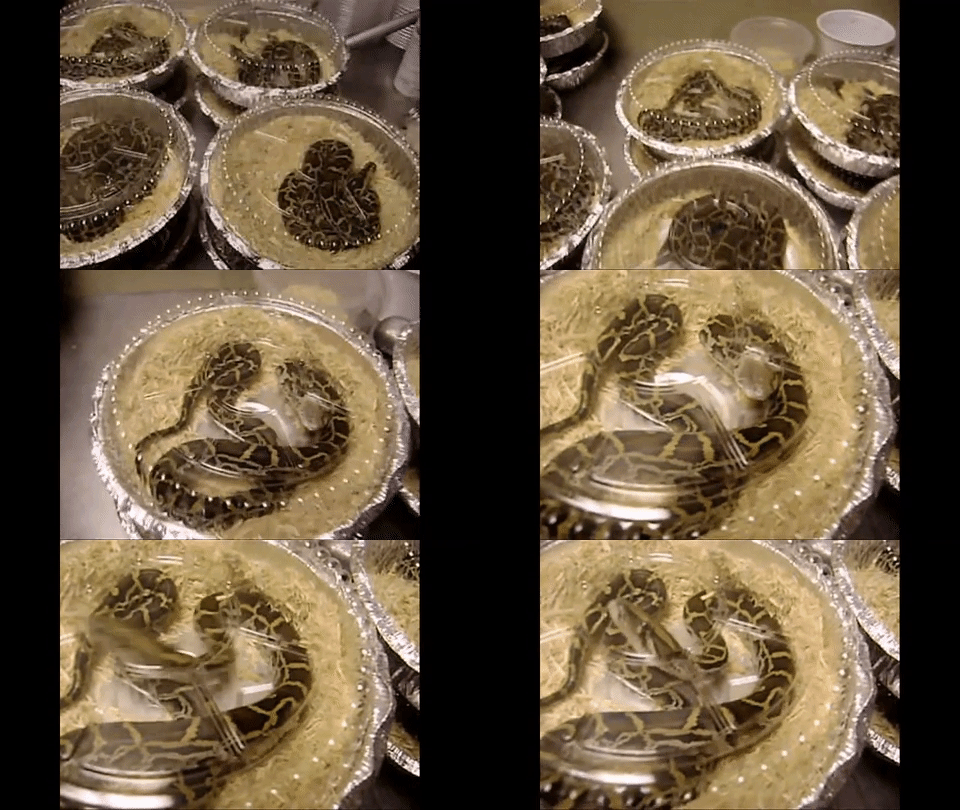
… or like these:
At a top reptile and mammal pet-trade supplier, a PETA investigator noted how snakes were kept in what look to be takeout-food containers.
PETA’s investigations and exposés have led to the seizure of tens of thousands of snakes and other animals from hellholes like the one above, but many exploitative pet-trade operations remain, which means that the best way to help snakes and other animals sold as “pets” at Petco and other stores is never to buy them.
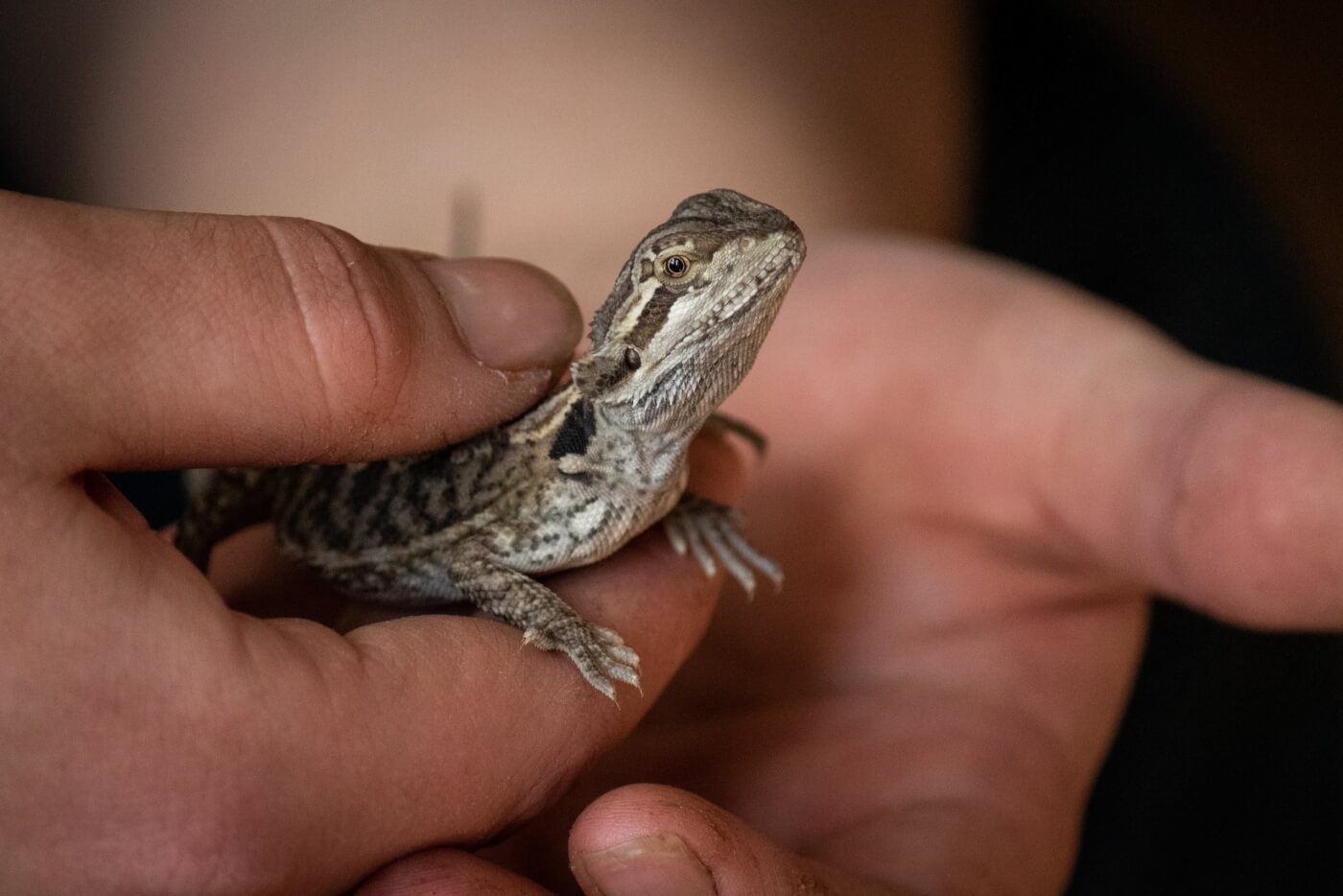
In 2019, damning CDA records revealed how at one Petco store in Northglenn, Colorado, workers failed to provide a thin leopard gecko with veterinary treatment over nine days. The animal lay motionless for at least two days before finally dying. Two other stores in the state also deprived reptiles of adequate heat and ultraviolet lighting. Also in Northglenn, iguanas, chameleons, and bearded dragons—who require basking temperatures in the mid-80s to low 90s—were in tanks as cold as 72 degrees.
In 2016, a Petco employee-turned-whistleblower contacted PETA when they felt compelled to report how animals were suffering and dying at the Texas store where they worked. According to the whistleblower, in just one week, two iguanas and a chameleon died from respiratory tract infections. For a month, management apparently refused to buy fresh vegetables for iguanas and tortoises. The whistleblower also told us about a python who apparently died at the store. The same evening of the whistleblower’s initial report, we sent our concerns to a Petco vice president, and the company sent a district manager out to visit the store. The manager did not identify all the issues that we noted but agreed that there was a need for additional training. However, to our knowledge, no further employee training was ever offered.
The Centers for Disease Control and Prevention and the Food and Drug Administration warn against keeping “pet” reptiles, because of the high risk of contracting potentially deadly salmonella. Turtles, lizards, and amphibians can carry salmonella bacteria on their skin and shells, and they can be found in the animals’ enclosures. The bacteria can be transmitted just from holding them, cleaning their enclosures in a sink, allowing them to walk around on floors or surfaces, or allowing children to touch them and then later touch their own mouths.
Learn more about why buying a reptile from Petco—or from anywhere else—would mean relegating a sensitive animal to a life of deprivation and suffering:
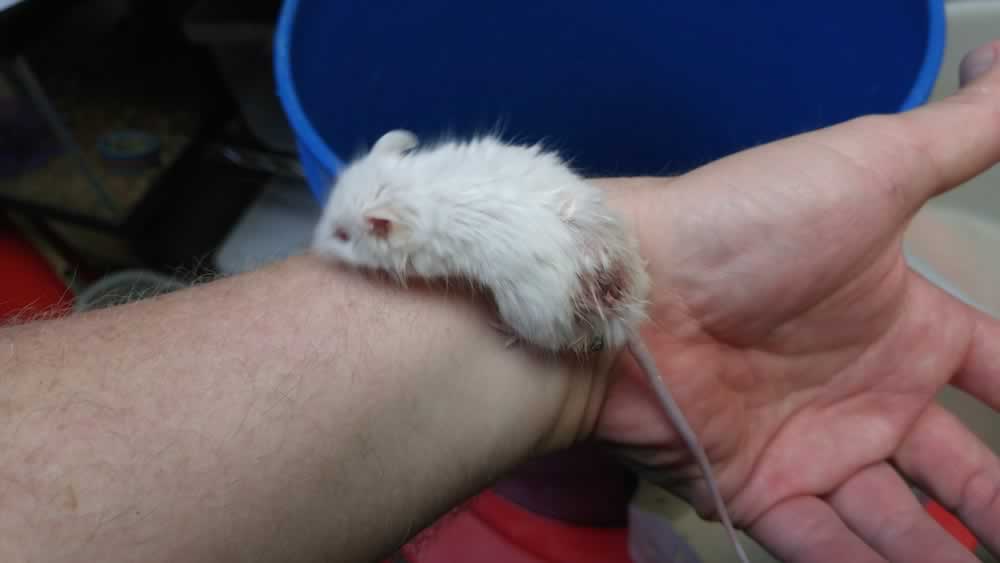
We’ve fielded too many calls to count from folks who have visited their local Petco store and were flabbergasted by the filth or neglect affecting the mice, rats, guinea pigs, and other small animals being housed in cages. A CDA inspector even noted that a ferret was suffering from a painful prolapsed rectum and a suspected upper respiratory infection, but the animal wasn’t provided with any veterinary care and died—reportedly as a manager was finally taking him or her to get treatment. This mouse …
Fighting is not normal among well-cared-for mice, but it can occur when they’re kept in stressful, crowded conditions and forced to compete for basic resources.
… was attacked by another at a Petco store in Texas and left wounded for at least four days—without being seen by a veterinarian—before finally being sold as live snake food.
PETA also exposed Petco’s partnership with Holmes Farm, a massive animal dealer in Pennsylvania that supplied hamsters and other small animals to the company and other pet stores.
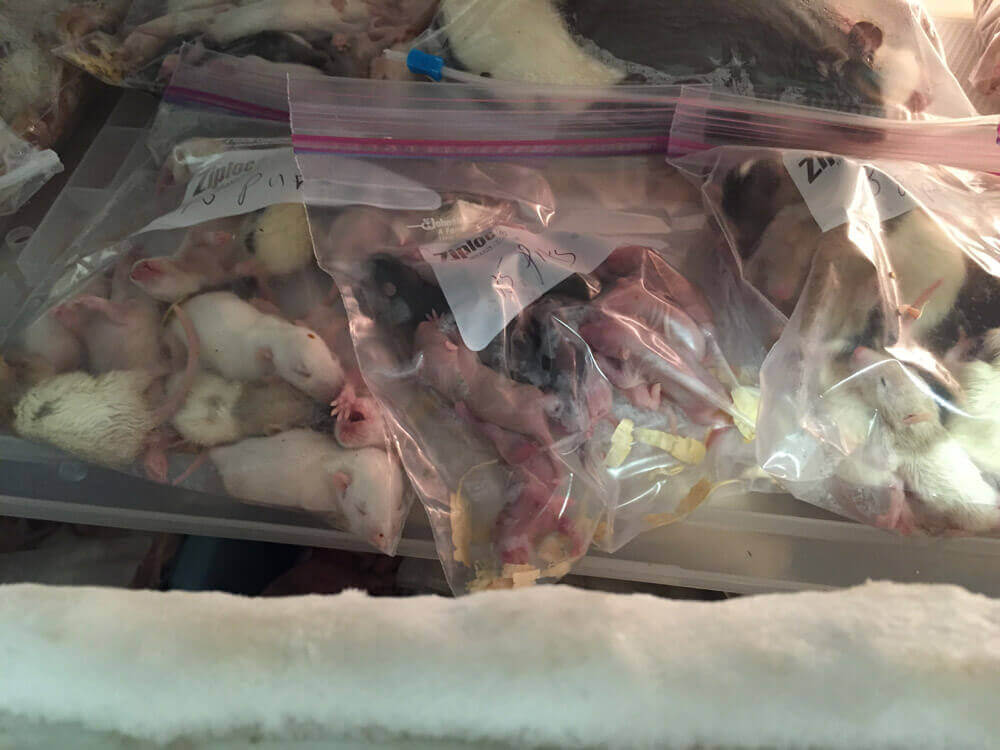
The rats in this photo continued to struggle in zipped-shut bags minutes after being put in a chest freezer at Holmes Farm, a massive animal dealer in Pennsylvania that supplied small animals to Petco and others.
Even after Petco representatives visited Holmes Farm—where animals were being confined to plastic bins, frozen alive, and crudely gassed to death—the chain continued to order and receive animals by the hundreds from the dealer.
Hamsters, chinchillas, guinea pigs, and other small animals are dying for lack of good homes and deserve the same consideration as dogs and cats, whose overpopulation crisis is well known.
Please never buy any animal, and let Petco know that you’ll be shopping elsewhere until it stops selling living, feeling beings:
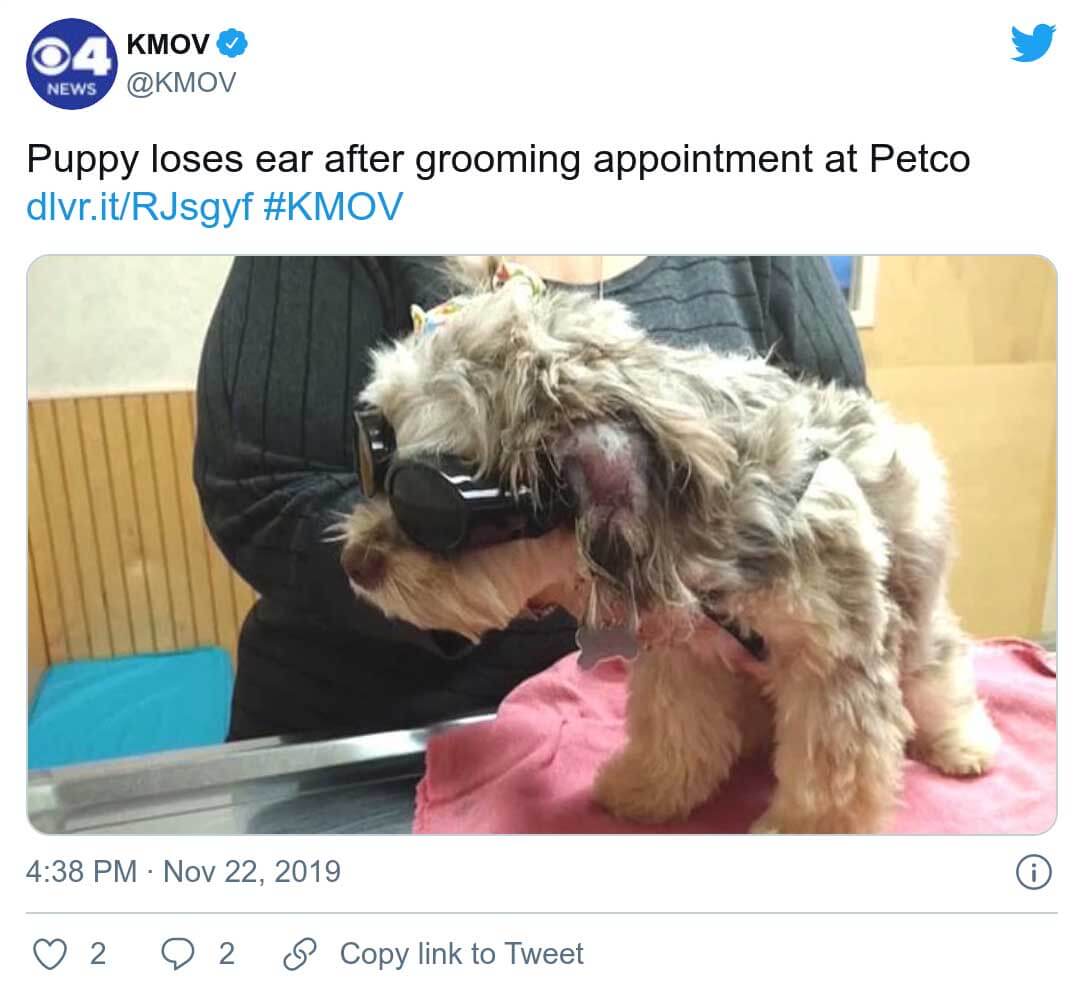
It’s impossible to know exactly how many dogs have died at Petco grooming salons or shortly after their appointments, but the chain’s long laundry list of incidents involving animals who have been traumatized, allowed to escape, severely injured, and—yes—even killed while being groomed certainly is telling. There was the Petco groomer who tied a rubber band around the ear of a dog named Baylee, cutting off his ear’s circulation and eventually requiring amputation.
That same month, Dali—an “active, healthy and hyper” dog—was dropped off by his guardian, Mafang Yao, at a Petco grooming center in California. It was the last time Yao would ever see Dali alive—when she returned to pick the dog up, she was told that he had experienced “breathing issues” during his appointment and later died.
Then there was Simba, who was allowed to escape from a kennel at a Petco store in Pennsylvania; 1-year-old Sarge, who died while being groomed after “protocols were not followed” at a New York Petco store; Baboo, a 7-year-old shih tzu who reportedly sustained a broken jaw during a grooming appointment at a New Jersey Petco store; and Oliver Buttons, an 18-month-old cairn terrier who needed stitches for lacerations to his face and neck as well as surgical glue for nicks all over his body that were inflicted by a Petco groomer in Wisconsin. You get the idea. Whether it’s selling animals or grooming them, Petco deals in volume.
Betta fish, snakes and other reptiles, birds, ferrets, chinchillas, and so many other animals are suffering in Petco stores and at the chain’s suppliers—they need us to take action right now. Implement activism through your consumerism by avoiding all Petco stores until the chain pledges to stop selling live animals. Instead, support retailers that don’t exploit live animals:
“Prevent Pandemics: Ban Exotic Skins.” That’s the message PETA supporters in stilettos, hazmat suits, and gas masks took to Hermès’ Madison Avenue boutique today following the designer’s decision to dig in its heels at its annual meeting of shareholders yesterday by refusing to answer the group’s question about an exotic-skins ban.
PETA—an Hermès shareholder—tried to confront executives over plans to build what would be Australia’s largest crocodile factory farm, noting that holding wildlife incruel, filthy conditions gave rise to COVID-19. Past PETA exposés have revealed that alligators and crocodiles are confined to dank pools and crowded concrete pits before workers cut into their spines while they’re still alive and peel off their skin. PETA’s full shareholder question is available here, and photos from the protest are available here.
“Savvy, eco-minded customers know what they want, and that’s mock croc and fake snake, not the skin of someone who was tortured,” says PETA Executive Vice President Tracy Reiman. “PETA urges Hermès to embrace innovative, fashion-forward materials, as other designers are—because a killer look doesn’t need to kill animals.”
PETA—whose motto reads, in part, that “animals are not ours to wear”—opposes speciesism, a human-supremacist worldview. For more information, please visit PETA.org or follow the group on Twitter, Facebook, or Instagram.
As interest in vegan eating soars nationwide and more households celebrate Mother’s Day brunch with eco- and animal-friendly dishes, PETA has put together a collection of vegan recipes that will be as impressive to readers’ moms as they are kind to hens and cows.
Readers can wow their families by serving up bagels piled high with smoky tomato lox and cashew cream cheese; a colorful, veggie-packed eggless quiche filled with mushrooms, tomatoes, and spinach; or chia-and-agave French toast topped with strawberries and coconut whipped cream. And yes, boozy Bloody Marys are vegan if splashed with anchovy-free Worcestershire sauce—there’s no geese in Grey Goose!
PETA’s guide to a vegan Mother’s Day is also a reminder that some of the best moms on the planet belong to other species, from cows—known to escape enclosures and travel for miles looking for their calves—to hens, who cluck softly to their babies before they’re even born. Going vegan saves nearly 200 of these gentle animals every year and helps humans by reducing their risk of suffering from cancer, heart disease, strokes, and diabetes. What better way to show mom that we care than by preparing foods that make her feel her best?!
More recipes are available on our website—they’re perfect for Mother’s Day and every day. For more information, please visit PETA.org or follow the group on Twitter, Facebook, or Instagram.
While many of us have found it a struggle to be mostly confined to our homes because of COVID-19 safety precautions, there are some among us for whom having family members constantly underfoot is their idea of heaven. We’re talking about our dogs and cats, of course.
As more and more cities and states re-open, many people will be heading back to work and school outside the home, and that’s going to be a painful adjustment for our four-legged friends.
Dogs and cats, like humans, are creatures of habit, and a dramatic shift in their routine can be extremely stressful. This can manifest in a variety of ways, including depression, separation anxiety, and even physical illness. If your “new normal” is going to include spending less time with your animal companions, take some time now to help them adjust to the change.
Help your dog or cat get used to your absence by gradually increasing the amount of time you spend away from the house. Start out by going through the motions of departure by picking up your keys and wallet and heading to the door without actually leaving. Next, go outside for a few minutes several times throughout the day so that your companion becomes accustomed to your leaving and understands that you’re coming back. After you work up to being gone for a few hours at a time, your four-legged friend will realize that this is part of the new routine.
Be sure your companion animals are getting plenty of exercise and stimulation. Make a habit of taking your dog for a morning walk. This may mean you have to get up earlier or skip the pre-work soy latte run or gym workout, but this is the highlight of your dog’s day—don’t skip it. Spend a minimum of 30 minutes a day playing with your cat, too. Getting plenty of exercise early in the day can help animals relax so they’ll spend more time napping and less time wondering where their family went.
Engage active animal minds and bodies by providing interactive toys (such as a hollow hard rubber toy filled with peanut butter or a puzzle treat dispenser for dogs and scratching posts, wand toys, laser pointers, catnip-filled items, and crinkly tunnels for cats). Giving your dog or cat a treat as you walk out the door can also help ease separation anxiety by associating your departure with something positive and rewarding.
Can’t get home at lunchtime to let your dog out? Arrange for a trusted friend, relative, or dog walker to do it. If your dog enjoys the company of other dogs, consider a carefully screened doggie daycare a few days a week. (You might also consider adopting a second animal for companionship.) Better yet, ask your employer about implementing a dog-friendly office policy.
Cats may seem aloof to the casual observer, but they can experience separation anxiety, too. Keep an eye out for stress-related behavior, such as overgrooming, lack of appetite, or urinating outside the litterbox. These can also be warning signs of serious illness, so the first order of business should always be to get a clean bill of health from your vet. Cats and dogs alike may benefit from calming natural supplements and pheromone diffusers as well as a radio tuned to classical or other relaxing music to help keep them in a serene state of mind.
Whatever you do, never crate your dog, especially while you’re away at work. A crate is not a “den”—it is a cage that prevents dogs from doing little more than standing up and turning around, if that. In addition to the sore muscles and aching joints that result from being forcibly immobilized for hours at a time, spending long, lonely hours in a cage will only make your dog more anxious, frustrated, and depressed.
When you get home, be sure to spend some quality time with your animal companions. Catch up on their brushing. Watch Jeopardy! together on the couch, Play a game of fetch or laser pointer. Visit the dog park for some canine camaraderie. Take a long, leisurely walk, and let them stop and smell the roses—not to mention the fire hydrants, for as long as they want to.
And, hey, if working from home appeals to you as much as it does to your furry family members —consider making it a permanent part of your post-pandemic program. Tell your boss that a very close family member needs you at home.

 animals’ sakes, please don’t buy into the pain that Petco peddles.