
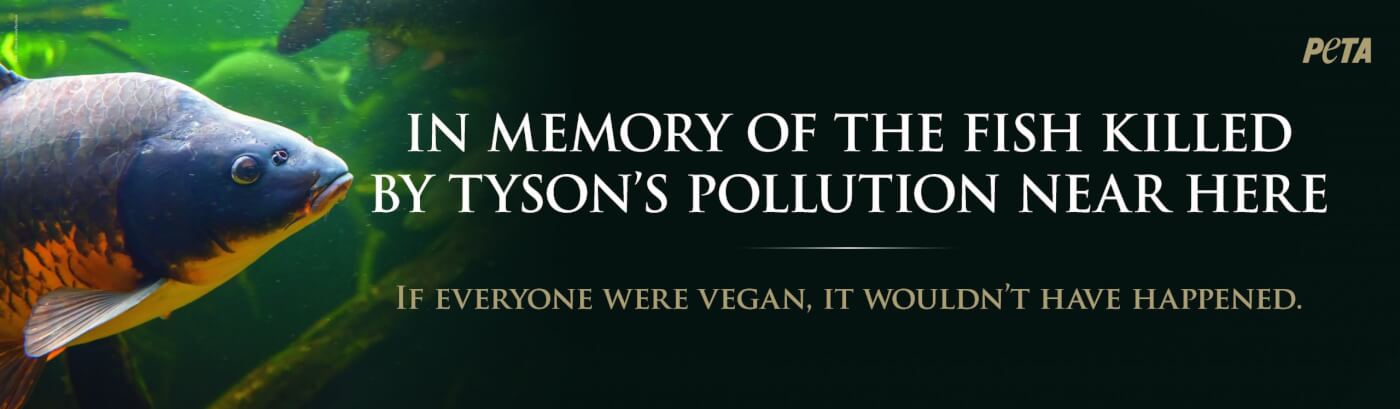
In Memory Of The Fish Killed By Tyson’s Pollution Near Here
The post In Memory Of The Fish Killed By Tyson’s Pollution Near Here appeared first on PETA.
Urgent: PETA Warns That Dogs Die in Hot Cars in Nova Scotia—Vital Tips Here
A dog was rescued after being left inside a hot car in Halifax, but for some dogs, help comes too late, including for a K-9 who recently died after being left behind in a patrol car. This year, 40 dogs have been reported dead from heat-related causes in the U.S. alone. (Figures are far likely higher, as most heat-related companion animal deaths go unreported.)
This week’s high temperatures put dogs at a high risk of enduring heat prostration and dying, so PETA is issuing an urgent warning to anyone with a dog: Never leave them inside vehicles, and please be sure to do the following.
- Touch the pavement before walks to ensure that it won’t burn dogs’ foot pads.
- Be alert to a long, curled-up tongue and heavy panting, as dogs cannot sweat as humans can and heat builds up inside their bodies.
- Walk only in the shade or on earth or grass, and never leave animals alone (This summer, PETA fieldworkers discovered the body of a dog who had died after being left chained up in the hot sun.)
Anyone who leaves animals in hot cars or outside to suffer in severe weather may be prosecuted for cruelty.
For more information, please visit PETA.org.
The post Urgent: PETA Warns That Dogs Die in Hot Cars in Nova Scotia—Vital Tips Here appeared first on PETA.
Urgent From PETA: Wildfire Survival Tips for Animals in Minnesota
Because the Greenwood fire continues to threaten Lake County and evacuations are underway, animals are likely to die if abandoned.
During evacuations, small animals such as cats, rabbits, birds, guinea pigs, and gerbils should be placed securely in carriers (birds should be covered), and dogs should be kept on a secure harness and leash. Take enough food for your animals to last several days. Horses, sheep, cows, llamas, and other animals should never be locked in stalls or otherwise confined, unable to flee the flames. If it’s impossible to remove them, they should be freed to attempt to survive. Anyone who sees animals in danger or distress should assist if possible but, if unable to help, should note their exact locations and alert authorities immediately.
Residents who remain in areas affected by smoke and falling ash should keep animals indoors and avoid all outdoor activities, such as running with dogs.
Animals must never be left behind. Anyone who evacuates and intentionally abandons animals to fend for themselves may be prosecuted.
Remember to make plans to ensure the safety of all animal companions in advance of trouble in order to avoid being caught unprepared:

PETA has released a wildfire-preparedness public service announcement featuring Dean Winters. PETA also offers a video about keeping animal companions safe during fires. For more information, please visit PETA.org.
The post Urgent From PETA: Wildfire Survival Tips for Animals in Minnesota appeared first on PETA.
South Carolina Scientist to Showcase Cutting-Edge Animal-Free Research at International Conference
A Columbia-based neuroscientist and PETA science advisor will be among the scientists presenting findings at the virtual conference of the 11th World Congress on Alternatives and Animal Use in the Life Sciences this week. Thousands of attendees will hear from Dr. Katherine Roe and other PETA scientists on matters ranging from scientific and ethical concerns regarding inflicting permanent brain damage on primates to toxicity testing on rabbits.
Roe earned bachelor’s degrees in biology and psychology from Syracuse University and a Ph.D. in psychology and cognitive science from the University of California–San Diego. She currently heads the Science Advancement and Outreach Division at PETA.
“PETA has more scientists working on non-animal testing methods than any other animal protection organization, and we’re proud to share our research at the premier conference on modern research,” says PETA Senior Vice President Kathy Guillermo. “Superior, cutting-edge tools are the future, and we’re eager to work with the global research community to advance their use.”
PETA scientists are chairing four sessions and will present two oral presentations and 16 posters. Posters by the group’s scientists, including Roe, will include the following.
- The Rodent in the Room—Considering Sentience in Research Programs Using Mice and Rats: This poster showcases how the mounting scientific evidence for sentience in animals commonly used in experimentation must be considered in harm/benefit analyses of biomedical research.
- Global Effort to End Animal Testing for Health Claims of Foods and Beverages: This poster highlights PETA’s successful efforts to get food and beverage companies to stop conducting tests on animals in order to make health claims about their products.
- International Harmonization of Non-Animal Methods for Biomedical Training: This poster shares information about the cost-effective, human-relevant technological advances that can replace the millions of dogs, cats, rabbits, and other animals used in biomedical training every year.
- The Problem of Pain in Animal Experimentation: This poster, to be presented by Roe, explores the scientific and ethical ramifications of the high rate of untreated pain in animals used in experiments.
- In Vitro Approach for Assessing Respiratory Toxicity in Human Lung Cells: This poster describes how human cell-based systems can replace the use of rats and mice in tests to assess how inhaled chemicals affect the lungs.
- International Approaches to Implementing Alternative Test Methods for Marine Biotoxins in Shellfish: This poster outlines how non-animal methods are superior for detecting toxins in shellfish than tests involving injecting them into the abdomens of mice.
- Certain Harms and Uncertain Benefits in Animal Models for the Study of Human Depression and Anxiety: This poster critiques several harmful and commonly used animal models of anxiety and depression, including the forced swim test, the tail suspension test, and the elevated plus maze.
- Ethical and Scientific Concerns Regarding the Continued Use of Experimentally Induced Brain Injuries in Primates: This poster, also to be presented by Roe, discusses whether inflicting permanent, debilitating brain damage on primates is ethically or scientifically justifiable.
The conference will screen the award-winning film Test Subjects, which profiles three PETA scientists who faced pressure in graduate school to experiment on animals. The group’s scientists will also present details on their Research Modernization Deal, a commonsense plan to phase out the use of ineffective animal tests in the U.S., the EU, and India.
PETA—whose motto reads, in part, that “animals are not ours to experiment on”—opposes speciesism, a human-supremacist worldview. For more information, please visit PETA.org or follow the group on Twitter, Facebook, or Instagram.
The post South Carolina Scientist to Showcase Cutting-Edge Animal-Free Research at International Conference appeared first on PETA.