Two dogs were left inside a hot car in Myrtle Beach, and similar reports nationwide are rolling in at an out-of-control rate. For some dogs, including a K-9 who recently died after being left behind in a patrol car, help comes too late. This year, 42 dogs have reportedly died from heat-related causes. (The actual figure is likely far higher, as most heat-related companion animal deaths go unreported.)
This week’s high temperatures put dogs at a high risk of enduring heat prostration and dying, so PETA is issuing an urgent warning to anyone with a dog: Never leave them inside vehicles, and please be sure to do the following:
Touch the pavement before walks to ensure that it won’t burn dogs’ foot pads.
Be alert to a long, curled-up tongue and heavy panting, as dogs cannot sweat as humans can and heat builds up inside their bodies.
Walk only in the shade or on earth or grass, and never leave animals alone (This summer, PETA fieldworkers discovered the body of a dog who had died after being left chained up in the hot sun.)
PETA thanks rescuers for taking action and urges everyone to support the Hot Cars Act of 2021, which would require automakers to install technology in vehicles in order to detect the presence of an animal or a child and alert drivers when someone is in the backseat.
Anyone who leaves animals in hot cars or outside to suffer in severe weather may be prosecuted for cruelty.
Please see the following statement from PETA and NYCLASS regarding Gov. Kathy Hochul’s awarding of the trophy for Travers Stakes winner Essential Quality:
It is disturbing that Kathy Hochul, New York’s first woman governor, coming in on the heels of a sexual harassment scandal, presented the trophy for the Travers Stakes winner, Essential Quality, whose owner, Mohammed bin Rashid Al Maktoum, is widely believed to have kidnapped his own daughters and threatened his former wife with violence. Gov. Hochul now leads a state that hands over $230 million annually in subsidy payments to the racing industry, part of which goes to line the pockets of billionaire owners like Al Maktoum. This corporate welfare must end now, and the hundreds of millions of dollars that are making the rich even richer should go to New Yorkers.
PETA—whose motto reads, in part, that “animals are not ours to use for entertainment or abuse in any other way”—opposes speciesism, a human-supremacist worldview. For more information about PETA’s investigative newsgathering and reporting, please visit PETA.org or follow the group on Twitter, Facebook, or Instagram.
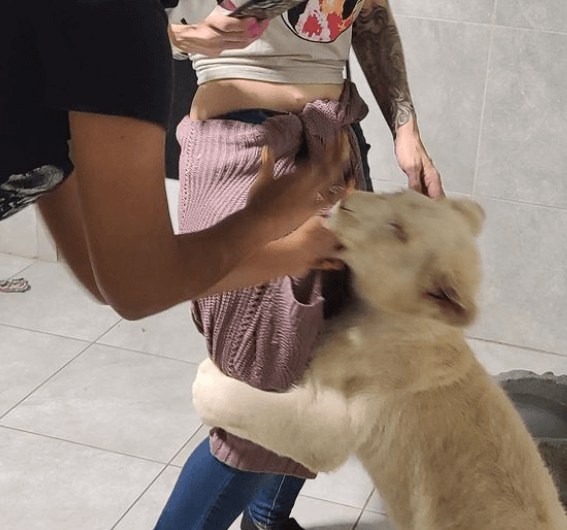
After PETA alerted the U.S. Department of Agriculture (USDA) to Instagram posts showing dangerous, hands-on public encounters with lion cubs at Mario Tabraue’s shady roadside zoo, the Zoological Wildlife Foundation (ZWF)—a facility featured in Tiger King—the agency issued critical citations to ZWF on July 15 for the following violations:
Failing to ensure the safety of animals and the public, after a lion cubbit a guest during a hands-on encounter
Failing to maintain dangerous animals under the direct control of a handler, after ZWF allowed public contact with a large lion cub over 16 weeks of age
PETA alerted the USDA to this photo and the one below it, both uploaded to Instagram in since-deleted posts. “My souvenir was I got bit by one of them,” the patron wrote.
The recent inspection report confirmed that the USDA slapped ZWF with several citations for failing to meet even the minimum requirements of the federal Animal Welfare Act. This newly released report also cites the facility for not having an enrichment program for primates.
The USDA previously cited ZWF in relation to its primate housing: It confined two incompatible macaques together, and one chased and bit the other, leaving her with bleeding wounds.
This isn’t the first time a human at Zoological Wildlife Foundation (ZWF) has been bitten by an animal there.
Late last year, the Florida Fish and Wildlife Conservation Commission (FWC) issued the facility a written warning after a child was bitten by a juvenile chimpanzee named Limbani.
The FWC advised ZWF to stop allowing public contact with the 40 plus–pound chimpanzee immediately, but evidence from social media indicates that the roadside zoo allowed members of the public to have full contact with him since then—even as he grew larger, stronger, and more dangerous.
Limbani just turned 5—about the age that, in nature, he would’ve weaned from his mother and become more independent. Unfortunately, ZWF stole him from his mom when he was just an infant. He’s never lived in a social group with his mother or siblings as he should have.
Mario Tabraue: Zoological Wildlife Foundation (ZWF) Owner Has a Long Rap Sheet
The owner of ZWF is felon Mario Tabraue of Tiger King infamy, a man whose current business model centers on exploiting baby exotic animals for publicity stunts and dangerous, hands-on encounters with the public.
In the 1980s, Tabraue’s exotic-animal business served as a front for his drug-smuggling enterprise. He was sentenced to 100 years in prison for convictions of racketeering and narcotics violations and was implicated in the dismemberment and burning of the remains of a former federal informant. However, Tabraue was released after serving only 12 years when he testified against other criminals.
Big cats and chimpanzees are intelligent, self-aware animals. Those held at profit-hungry tourist attractions—even some that are deceptively called “sanctuaries” or “rescues”—endure heartbreaking physical and psychological abuse that’s inflicted in order to force them to tolerate direct contact with the public. It’s little wonder that so many reach their breaking point.
What You Can Do
Never buy a ticket to roadside zoos that allow dangerous, hands-on contact with big cats or other species. Encourage your friends, family members, and social media followers to do the same.
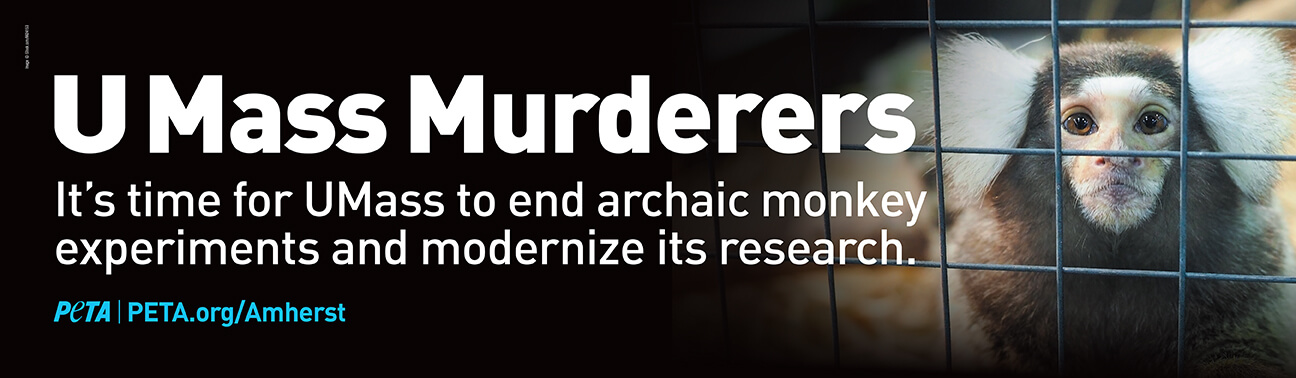
Tomorrow, University of Massachusetts–Amherst (UMass) Chancellor Kumble Subbaswamy will wake up to a new PETA mobile billboard rolling through his neighborhood, which slams the school for caging, tormenting, and killing marmosets to study menopause—a condition that marmosets do not experience. In a push to end backward research at UMass, the billboard will also take to the streets of downtown Amherst to alert students, faculty, and others near campus.
Raking in nearly $4 million from taxpayers, UMass experimenter Agnès Lacreuse drills holes in the skulls of the small monkeys, threads electrode leads through their abdomens, zip-ties them into restraining devices, and overheats them with hand warmers purportedly to simulate menopausal hot flashes.
“These painful studies can’t tell us a thing about menopause, but UMass carries on knowing that marmosets’ cooperative and gentle nature is easy to exploit,” says PETA Vice President Dr. Alka Chandna. “PETA urges Chancellor Subbaswamy to use taxpayers’ hard-earned dollars on modern test methods, not bogus, cruel experiments.”
The group notes that animals also suffer because of the negligence of UMass experimenters and laboratory staff. Reports document violations of federal animal welfare guidelines: Mice have drowned, birds have starved to death, and zebrafish have died from overheating. In one incident, experimenters failed to give necessary pain relief to several hundred mice who had just undergone surgery.
A Pew Research Center poll found that the majority of U.S. adults oppose the use of animals in scientific research. And studies show that a staggering 90% of basic research, most of which involves animals, fails to lead to treatments for humans.
PETA—whose motto reads, in part, that “animals are not ours to experiment on”—opposes speciesism, a human-supremacist worldview. For more information, please visit PETA.org or follow the group on Twitter, Facebook, or Instagram.