
Top N.Y. Horse Trainer Agrees to Settle Another Federal Lawsuit on Wage Theft

Asmussen Racing Stable just agreed to settle with the U.S. Department of Labor over alleged violations of the Fair Labor Standards Act for failing to pay overtime to 170 employees, including grooms and hot walkers at New York state tracks between 2016 and 2020. According to the proposed settlement documents, Steve Asmussen, owner of the stable, is required to pay $600,000 in back wages and penalties.

Asmussen, who just set the record for the most races won by any Thoroughbred trainer, also paid fines and back wages in 2015, after a 2013 PETA investigation revealed that, in addition to other abuse, he neglected to pay laborers their fair wages.

PETA’s investigation revealed that Asmussen and assistant trainer Scott Blasi misused medications, ordered undocumented workers to obtain fake identification and Social Security cards or quit, demanded long hours of workers for little pay, and forced undocumented laborers to sleep in barns and tack rooms.

“PETA found that Asmussen cheated his way to victory on the backs of exploited employees and injured horses—and he hasn’t changed,” says PETA Senior Vice President Kathy Guillermo. “The feds are putting criminal horse trainers on notice with this lawsuit.”

PETA notes that this is the third lawsuit brought by the U.S. Department of Labor against Asmussen and that the horse-training industry is rife with labor violations. In 2020, trainer George Weaver settled with the agency for $425,000 after it said that he had failed to pay employees the required hourly wage and for overtime. And in 2019, trainer Chad Brown, who has won four consecutive Eclipse Awards for outstanding trainer, paid $1,617,673 for violations that included failing to provide wages promised and misrepresenting job terms and conditions.

The proposed settlement documents are available on request. PETA—whose motto reads, in part, that “animals are not ours to abuse for entertainment”—opposes speciesism, a human-supremacist worldview. For more information, please visit PETA.org or follow the group on Twitter, Facebook, or Instagram.

#

The post Top N.Y. Horse Trainer Agrees to Settle Another Federal Lawsuit on Wage Theft appeared first on PETA.
‘Donkey’ Business at Greek Consulate

On Friday, a “herd” of donkey-masked PETA supporters will buck, kick, and cause a commotion outside the Consulate General of Greece as they call for an end to Santorini’s notoriously cruel donkey rides. The action follows PETA investigations revealing that donkeys are beaten by tourist touts, who force them to stumble up more than 500 slippery steps with tourists on their backs.

When:      Friday, September 10, 12 noon

Where:     Consulate General of Greece, 2441 Gough St., San Francisco

“Forcing donkeys to carry tourists up this steep incline leaves the animals exhausted, aching, and bloodied,” says PETA President Ingrid Newkirk. “PETA wants the Greek government to stop treating these long-suffering donkeys as if they were taxis.”

PETA—whose motto reads, in part, that “animals are not ours to abuse in any way”—opposes speciesism, a human-supremacist worldview.

For more information, please visit PETA.org or follow the group on Twitter, Facebook, or Instagram.

The post ‘Donkey’ Business at Greek Consulate appeared first on PETA.

PETA to Brandish ‘Bloody’ Bags Outside Hermès

In response to video footage released by the Kindness Project showing crocodiles on Hermès-owned farms in Australia confined to concrete pens, electrocuted, knifed, shot, and mutilated with screwdrivers, PETA will descend on the brand’s flagship store in a sea of “blood” to shame the “luxury” brand for its exotic-skin sales. The exhibition is part of a massive international campaign that features additional “bloody” happenings in countries from Australia and Austria to Spain and Switzerland.

When:      Hermès, 691 Madison Ave., New York City

Where:      Wednesday, September 8, 12 noon

“No purse is worth an animal’s agonizing death,” says PETA Executive Vice President Tracy Reiman. “PETA is calling on Hermès to listen to the outcry against cruelty to crocodiles and bag exotic skins.” 

PETA—whose motto reads, in part, that “animals are not ours to wear”—opposes speciesism, a human-supremacist worldview. For more information, please visit PETA.org or follow the group on Twitter, Facebook, or Instagram.

The post PETA to Brandish ‘Bloody’ Bags Outside Hermès appeared first on PETA.

Shanah Tovah! Here Are 3 Ways You Can Keep Animals in Mind on the Jewish New Year

There’s something really special about setting positive goals during the Jewish High Holy Days, Rosh Hashanah and Yom Kippur. Rosh Hashanah—or the Jewish New Year—marks a personal milestone for me: It’s when I went vegan. Since Rosh Hashanah is a time to reflect and welcome change, I asked myself, “Why do we welcome some animals in our home but condemn others to a life of suffering and death before being served on our plates?” and “Don’t other animals want to live as much as I do?” In the days leading up to Yom Kippur—the Jewish Day of Atonement that is typically observed by fasting for 25 hours—I decided to help our fellow animals by not eating, wearing, or exploiting them in any way.

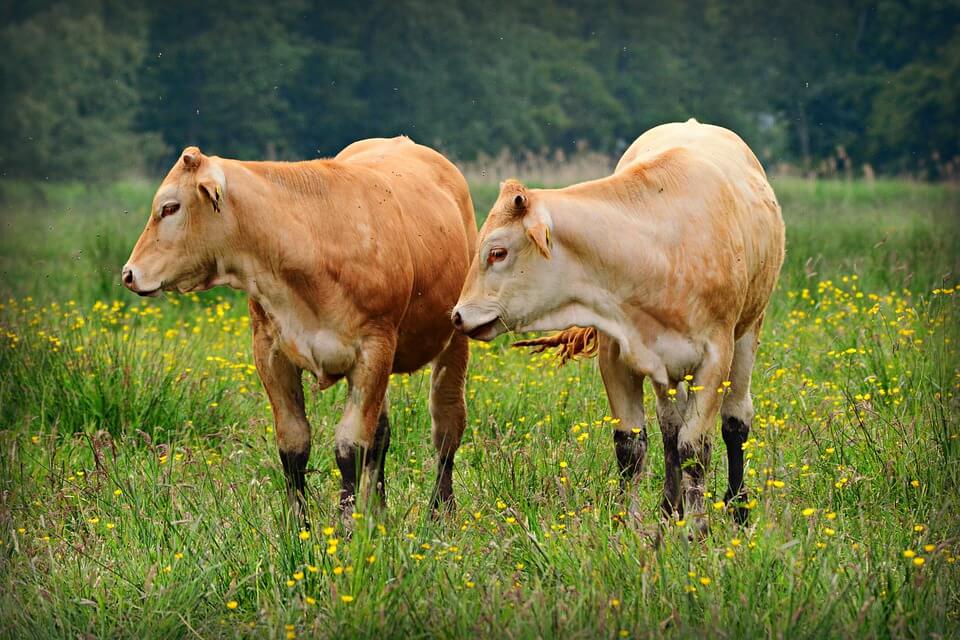
Two brown cows in a field of flowers

Since I became vegan many Rosh Hashanas ago, I keep our fellow animals in mind during the High Holy Days—and there are many ways everyone can. Here are three ways to help animals during the Jewish New Year:

Prepare a vegan feast.

Dipping apples in honey is a classic Rosh Hashanah tradition that symbolizes the hope for a sweet new year—but we don’t have to use honey from exploited bees to participate. Swap out the honey for something just as sweet like maple syrup, agave nectar, brown rice syrup, or date syrup. If you really want to sweeten the deal, get creative: Vegan chocolate sauce and vegan caramel are perfect additions to your Rosh Hashanah spread.

It’s my personal belief that no Jewish spread is complete without challah, and it’s always better home-baked! Whether you like to kick it up a notch with raisins or vegan chocolate chips or keep it classic, try PETA’s foolproof recipe for vegan challah.

If you don’t look forward to eating matzo ball soup on Jewish holidays, I can’t relate. Veganize your savory soup this year with PETA’s recipe for perfectly fluffy matzo dumplings.

Reflect on speciesism.

During the High Holy Days, we’re encouraged to take time for introspection. One way we can include our fellow animals in this practice is to consider their complex inner lives, emotions, and relationships. Cows are deeply devoted to their young and mourn the loss of their loved ones, chickens pass down knowledge from generation to generation, mother pigs “sing” to their babies while nursing, and all animals can suffer. Sensitive cows, chickens, pigs, and others don’t want to spend their lives deprived of important relationships and confined to cramped, filthy, windowless sheds.

Take action.

Introspection is important, and it’s even better when we follow it with action. Participate in PETA’s action alerts to help animals who are suffering for experiments, food, fashion, and entertainment. Pledge to go vegan, and order PETA’s free vegan starter kit to help you get started. There are countless ways to make a difference—like taking PETA’s 3-Week Vegan Challenge.

*****

Don’t just start the Jewish New Year off on a good note—keep it going! If you want to join the millions of compassionate supporters who are helping PETA stand up for animals, consider offering a kind donation:

Donate Now to Help PETA End Speciesism

The post Shanah Tovah! Here Are 3 Ways You Can Keep Animals in Mind on the Jewish New Year appeared first on PETA.