The post Megan Fox and Machine Gun Kelly Adoption Street Art Blitz appeared first on PETA.

respect nature & human rights
Longtime local resident Andrew Andrada is a plaintiff in a class-action lawsuit against Vital Farms Inc.—a case in which PETA Foundation lawyers and co-counsel just won a precedent-setting victory when a motion to dismiss the suit was rejected by the court. Andrada and fellow consumers allege that they were misled into buying the company’s eggs at a premium price because of its false claims that it treats hens ethically and humanely.
The lawsuit indicates that Andrada regularly purchased the Texas-based company’s eggs because he believed that Vital Farms provided hens with “freedom from undue pain and distress.” He would not have agreed to the company’s high prices—which are up to seven times higher than the price of ordinary store-bought eggs—had he known “the truth about Vital’s practices.” A Texas federal court judge has now found that Andrada and the other plaintiffs raised valid legal claims when alleging that Vital Farms knowingly makes deceptive assertions about hens’ humane treatment.
Despite its claims, the company does the following:
“Andrew Andrada was deliberately misled into believing that Vital Farms treats animals with respect, when it sends them to slaughter and purchases from hatcheries that grind chicks up alive,” says PETA Foundation Director of Litigation Asher Smith. “PETA is working to ensure that this case puts a stop to and punishes dishonest marketing tactics that betray kind consumers.”
The nine plaintiffs—including individuals from New York City; Los Angeles and Marina del Rey, California; Warren, Michigan; and Cooper City, Florida—are also represented by Richard L. Stone of Blackner Stone & Associates and Jesse Weiss of Edmundson Shelton Weiss PLLC.
PETA—whose motto reads, in part, that “animals are not ours to eat”—opposes speciesism, a human-supremacist worldview. For more information on PETA’s investigative newsgathering and reporting, please visit PETA.org or follow the group on Twitter, Facebook, or Instagram.
The post Crosby Resident Sues Major Egg-Seller appeared first on PETA.
Circuit Judge Jason J. Elmore of the 28th Circuit Court has just ruled that 39 dogs seized by the Missaukee County Sheriff’s Office from breeder John D. Jones’ unlicensed kennel in January not be returned to his custody and instead be placed for adoption by the animal control agencies in Clare, Grand Traverse, Roscommon, and Wexford counties, which are currently caring for them after assisting with their seizure.
The Missaukee County District Court also found probable cause for Jones’ felony charge of neglecting more than 25 animals; two felony charges of assaulting, resisting, and/or obstructing police officers; and two new felony charges related to his practice of severing puppies’ dewclaws and twisting off their tails without administering any pain relief, which an expert testified was extremely painful and disgusting. Jones is scheduled to be arraigned on the five felonies and three related misdemeanors on Friday.
“This ruling means that these 39 long-suffering dogs will have a chance to find loving homes, and the urine-soaked boxes, freezing cold, barren outdoor cages, and Jones’ chronic neglect of their basic needs can fade from their memories,” says PETA Vice President of Evidence Analysis Daniel Paden. “PETA is celebrating a new beginning for these dogs and looks forward to seeing Jones banned for life from possessing more animals.”
Today’s developments follow a PETA investigation revealing daily neglect at Jones’ breeding operation, a four-day sit-in at the Missaukee County Sheriff’s Office by PETA members calling for action, and the seizure of the dogs on January 7. PETA’s video footage and photos showed that Jones left the small, short-haired dogs penned outside in subzero wind chills, snow, and mud—often without drinkable water. One dog, Amos, died overnight.
PETA—whose motto reads, in part, that “animals are not ours to abuse in any way” and which opposes speciesism, a human-supremacist worldview—notes that this was the third time law-enforcement authorities have confiscated dogs from Jones. In 2008, approximately 85 dogs were seized from him in Barry County, and in 2013, authorities seized at least 165 dogs from him in Missaukee County.
For more information on PETA’s investigative newsgathering and reporting, please visit PETA.org or follow the group on Twitter, Facebook, or Instagram.
The post Just In: Court Saves 39 Dogs From Local Breeder After PETA Investigation appeared first on PETA.
“Surplus” killings; rotten, moldy meat for food; being forced to compete on bloody paws until some inhale their own vomit and die; a body count of more than 150. Make no mistake—for dogs bred and used for the Iditarod, life both on and off its trail of suffering is hell on Earth.
Learn what each stage of existence is really like for dogs used for the Iditarod:
Thousands of puppies are born each year for the dog-sledding industry—but only a few hundred will actually compete in the Iditarod. Breeders of dogs used in sledding have freely admitted that “surplus” dogs are killed. They may be killed if they aren’t fast or fit enough for competition or if they don’t meet certain aesthetic standards—for example, if they have white paw pads.
 © CCI Entertainment
At a kennel reportedly owned by Dallas Seavey, the now five-time Iditarod winner who was also implicated in a dog-doping scandal, a whistleblower reported finding a litter of seven newborn puppies who had died within the past month without any veterinary intervention.

These puppies, seen chewing on Pedialyte-soaked sponges, later allegedly died.
Those who aren’t killed as puppies are chained for most of their lives, starting as early as 6 months old, even in the bitter cold and biting wind. Many dogs at these breeding compounds have frozen to death or died of complications from eating rocks—likely because they were intensely frustrated from spending years on a chain.

Some die of starvation, while others are fed rotten or moldy meat.
Many who survive spend their lives in pain, as injuries and illnesses often go untreated. A PETA eyewitness exposé revealed that at a kennel operated by former Iditarod champion John Baker and by Katherine Keith, the two refused to take Birch, a puppy with an extremely painful spinal cord injury, to a veterinarian.
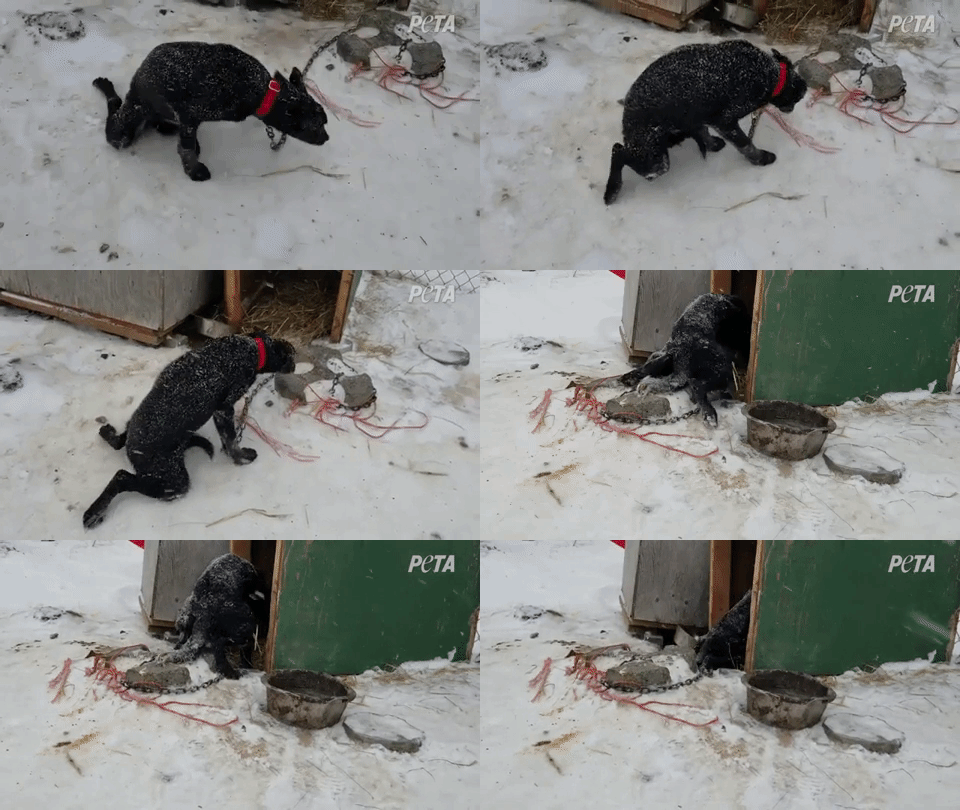
This is Birch. She endured horrific neglect at this “kennel” co-owned by former Iditarod champion John Baker. Despite sustaining a crippling, extremely painful spinal cord injury when she was just a puppy, she was denied veterinary care and chained in the freezing cold 24/7.
Aside from the race itself, “training” may be the only time that dogs bred for sledding get to move farther than the limit of the short rope or chain that restrains them. Instead of living indoors as a loved and respected member of the family—as all dogs should—they are forced by mushers to pull heavy sleds for more than 50 miles at a time. Mushers deprive them of water and often strike them in the face or kick them in the testicles or anus. Mushers terrorize dogs into continuing on—even with bloody paws. They force dogs to run.

Mushers and kennel operators have even killed dogs who weren’t fit or fast enough, because to mushers, it’s “better to have a dead dog” than a “dog [who] slows down the team.”
More than 150 dogs have died during the Iditarod since it began, and those are just the reported deaths. The leading cause of death for dogs forced to race is aspiration pneumonia—caused by inhaling their own vomit. Others who have been killed have suffocated, suffered heatstroke or hypothermia, or been struck by vehicles.

Because dogs are forced to pull sleds up to 100 miles a day in some of the worst weather conditions on the planet, including 40 mph winds, whiteouts, and temperatures as low as minus 50 degrees, those who survive are often left with debilitating and horrific injuries, including persistent lung damage. While at three-time Iditarod champion Mitch Seavey’s kennel, PETA’s eyewitness observed one dog, Captain, who had open, infected wounds on his neck that smelled like rotting flesh. A worker—who wasn’t a veterinarian—squeezed pus and tore tissue out of the wounds barehanded, then sprayed them with a fungicide. Injuries like these continue to go untreated in the off-season.

For these dogs, there’s no retirement plan. Even those who “win” and survive the race are chained back up and forced to exist in the very same conditions they’ve known their entire lives. Take Snickers …
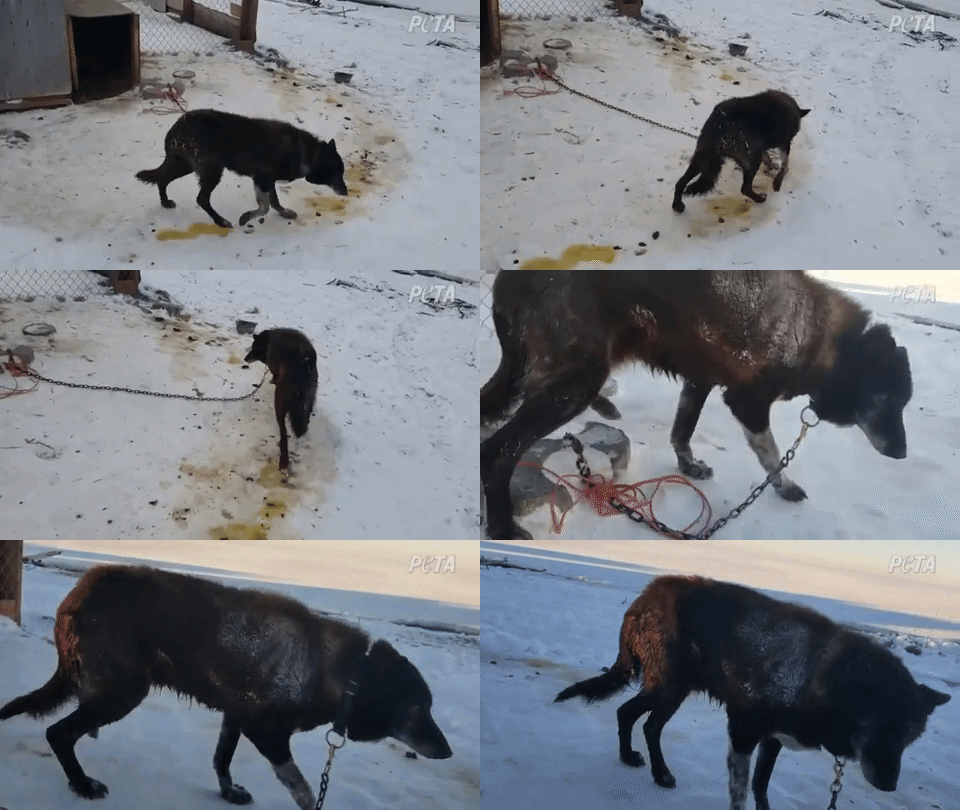
Rather than providing Snickers with the veterinary care and comfort that she desperately needed, former Iditarod champion John Baker chained the elderly dog beside the frozen sea, all alone and unable to escape the Arctic cold.
… who was one of Baker’s lead dogs in 2011, when he won the Iditarod. When Snickers was 11 years old, PETA’s eyewitness found her limping and suffering from chronic, painful arthritis. Like with Birch, Baker admitted that he needed to “put [Snickers] out of her misery”—he said that he planned to shoot her but had not yet done so because “I just don’t have a good place to bury her.”
PETA has been taking down the Iditarod sponsor by sponsor. Nearly all major companies—including Millennium Hotels and Resorts, ExxonMobil, Chrysler, Alaska Airlines, Coca-Cola, Jack Daniel’s, State Farm, and Wells Fargo—have listened to PETA and dropped their sponsorships. Tell Liberty Media/GCI to do the same:
The post What Is Life Really Like for a Dog Bred to Race in the Iditarod? appeared first on PETA.
Make lunchtime exciting for your kids with a bento box filled with vegan goodies. Bento boxes reduce waste by eliminating the need for disposable bags. They also allow for portion control while encouraging picky eaters to try new foods. Plus, they’re fun to put together!
Your child may inspire their classmates with fun, healthy cuisine, too! Nutritionists and physicians advise people of all ages to eat foods powered by plants, as they’re good sources of protein, iron, and calcium without animal fat. And the Academy of Nutrition and Dietetics states that “[w]ell-planned vegan … diets are appropriate for all stages of the life cycle, including during pregnancy, lactation, infancy, childhood, and adolescence.”
We’ve compiled a list of ideas and tips to inspire your inner bento artist.
No one needs to steal milk from a mother cow and her calf, especially with all the delicious vegan cheese on the market. Vegan cheese—often made from nuts like cashews, almonds, and macadamias—contains no cholesterol, rennet, or any other disgusting ingredients found in dairy cheese.
Transform a serving of rice into your child’s favorite cartoon character, and pack some vegan chicken on the side. Chickens are perhaps the most abused animals on the planet, but thanks to vegan chicken, no one needs cruelty to satisfy their cravings.
We get it—life is hectic. Prep this snack box for a quick fix that doesn’t sacrifice nutrition or flavor. Fresh berries, trail mix, and hummus-stuffed mini peppers can power your kiddo through the rest of their school day.
Tofu is excellent for picky eaters because it takes on whatever flavor you add to it. Plus, choosing tofu over animal flesh is a compassionate, eco-friendly choice: It takes more than 2,400 gallons of water to produce 1 pound of beef, whereas producing 1 pound of tofu requires only 244 gallons of water.
Pizza just got more fun! Use mini cutouts to make the vegan cheese into cute shapes for topping an English muffin.
PB&J sandwiches are lunch box staples—and they’re (usually) vegan! Make sure that your peanut butter doesn’t contain honey: Like other animals exploited on factory farms, honeybees are victims of unnatural living conditions and genetic manipulation. You can also make your own ravishing raspberry jam with our recipe.
Need some kelp with your lunchtime art? Try making seaweed wraps into fun shapes—such as characters from Star Wars—that your kids would be excited to see (and eat!).
White bean hummus is a savory vegan option for a scrumptious sandwich. Try cutting it into a heart shape, and let your kids know that they’re eating with compassion: Every person who ditches animal flesh saves nearly 200 animals per year!
If you’re running short on time, see what you have in the fridge. Give those leftovers a bento box makeover. With embellishments, leftovers can be a fast yet impressive lunch.
Need some more inspiration? Check out this TikTok mom’s beautiful bento ideas. They’re truly vegan art!
@plantnats My kids vegan bento lunchbox – photo dump. Everyday is leaning #vegan #plantbased #vegantiktok #plantnats #veganmom #vegankidsmeals #veganbento #veganlunch #veganlunchbox #veganmama #vegankids #schoollunch #bento #bentobox #kidsbento #ヴィーガン #プラントベース #ビーガン #ヴィーガン弁当 #ヴィーガンママ #ヴィーガン子育て #子供弁当 #ヴィーガンランチ
♬ My Neighbor Totoro – Ending Theme Song (Piano Version) – Streaming Music Studios
Share your bento box designs on social media—we want to see them! When your friends “ooh” and “aah” over your child’s healthy, cute vegan lunch, why not encourage them to save animals, too? They can order their own free vegan starter kit.
The post Vegan Bento Box Ideas for Kids: Spark Your Culinary Creativity Here appeared first on PETA.