Today, a worker at Wooten’s Everglades Airboat Tours was attacked and had to be hospitalized after stepping into a tiger’s enclosure and sustaining injuries in an attack. Below, please see a statement from PETA Foundation Associate Director of Captive Animal Law Enforcement Debbie Metzler:
This incident could easily have turned deadly, but as long as the public believes it can ever be safe to pet a tiger, harass wild animals, or even step into their enclosures, this will happen again. That’s why PETA is pushing for the Big Cat Public Safety Act to pass and urging the public to avoid any place that exploits big cats for big bucks.
PETA—whose motto reads, in part, that “animals are not ours to use for entertainment”—opposes speciesism, a human-supremacist worldview. For more information, please visit PETA.org or follow the group on Twitter, Facebook, or Instagram.
Jewish delis are staple establishments in many cities, and now, vegan Jewish chefs are stepping up to make traditional dishes using ingredients that are kinder to animals. From fresh bagels with vegan schmears and fish-free lox to Reuben sandwiches made with seitan or tempeh, it’s now easier than ever to get your favorites with the rise of vegan Jewish delis nationwide. Historic establishments are even expanding their menus, adding vegan options to cater to compassionate customers. Here are some places that are offering animal-friendly fare:
With two locations in Portland and one in San Diego, Ben & Esther’s offers all the classic fare, like freshly baked bagels, babka, and challah. It even makes its own fish-free lox and whitefish in-house, available by the pound. And don’t forget to pick up some hamentashen for Purim or noodle kugel for Hanukkah. Seriously—this place has everything.
Grass Fed is a Kosher-certified vegan butcher shop founded by Rob and Nora Rubel. It specializes in plant-based meats such as pastrami, roast beef, and chopped liver. The shop also offers freshly made sandwiches, hamantaschen, pizza, and more.
Owner Megan Tucker started Mort and Betty’s as a way to honor her traditions and culture while making them more animal-friendly. She serves delicious Jewish staples, like matzo ball soup, latkes, babka, and more, all using locally sourced ingredients as much as possible. Mort and Betty’s has weekly pop-ups on Saturdays at Crafted Kitchen and Sundays at Smorgasburg LA.
As the world’s first vegan Jewish deli, Sam & Gertie’s set the standard. It serves all the traditional favorites with an animal-free twist: chopped liver, smoked whitefish, potato knishes, corned beef, and so much more.
Vegan options include Vegan Lox + Eggs (made with smoked carrot and scrambled tofu), Vegan Reuben Sandwich (with roasted beets, smoked carrot, and cashew cheese), and the Vegan Lox Bagel Plate (with black garlic tahini and whipped tofu).
For a more modern twist on deli fare, try Larder, where chefs are experimenting with locally sourced veggies to create delicious vegan dishes. Vegan options are always available, but the menu changes frequently, so call ahead for the latest offerings. Previous specials have included a Vegan Fried Bologna Sandwich and a mushroom-based Vegan Pastrami Sandwich.
Proper Bagel brings a taste of New York City to the South. It offers two types of vegan cream cheese (scallion and cinnamon hazelnut), a housemade vegan veggie burger, and other rotating specials.
At Saul’s, you can find classic bagels with vegan cream cheese, along with Middle Eastern–inspired dishes like pita sandwiches with falafel or yuba (tofu skins). It also serves a Mushroom Reuben, which can be made vegan by asking for no Swiss cheese and no Russian dressing.
Vegan options at Zingerman’s include the Soy Vey! sandwich, which comes with tempeh, barbecue sauce, mustard, red onions, and pickles on toasted bread. The deli also has a vegetarian hash that can be made vegan by requesting no sour cream and no butter on the toast.
Vegan Jewish Deli Staples
If you aren’t near any of these spots, don’t worry—it’s easy to find or make your favorite Jewish deli staples at home.
Vegan corned beef: Find Unreal Deli’s Corn’d Beef at Kroger and other grocery stores, or make vegan corned beef yourself with this seitan recipe.
Vegan challah: Order some vegan challah bread to be shipped to your home, or make it yourself with this recipe from Make It Dairy Free.
Vegan babka: There’s nothing like a layered chocolate babka—make it at home with this recipe from Post Punk Kitchen, or order one for delivery.
*****
Going vegan is the best thing you can do for animals, the planet, and your personal health. Make the change by taking our 3-Week Vegan Challenge and ordering a free vegan starter kit:
As severe storms and possible tornadoes are forecast to affect much of the South this week, PETA has released tips for keeping animals safe:
Animals should never be left chained or penned up outside, where they have no escape from strong winds, flying debris, and collapsing structures. Dogs have been sucked into the air—doghouse and all—during tornadoes, so animals must be brought inside to safety.
Guardians must also bring animals with them if it becomes necessary to move to a stronger structure or take shelter underground.
Anyone who sees animals in distress and is unable to help should note the animals’ locations and alert authorities immediately.
PETA has prepared disaster-preparedness PSAs. This video stars Dean Winters, and this one tells the real-life story of a man reunited with his dog after a tornado. For more information, please visit PETA.org or follow us on Twitter, Facebook, or Instagram.
Emory University and the affiliated Yerkes National Primate Research Center seem incapable of maintaining even minimum standards of animal care in their laboratories. But rather than directing funds toward cleaning up their act and ensuring that the animals they imprison receive some modicum of proper care, they’ve chosen to shell out big bucks to pay their lawyers to keep you from finding out what goes on in their secretive laboratories.
PETA unearthed federal records showing that the U.S. Department of Agriculture (USDA) cited Emory on September 6, 2017, after inspectors found one monkey almost entirely bald and another with reddened skin and hair loss running the length of her spine and tail. Such hair loss indicates profound psychological distress. Another monkey was described in the inspection report to be suffering from a large, open wound on her leg, for which she had not received veterinary care. In a report dated September 20, 2021, USDA inspectors documented that a weanling spiny mouse was found dead in a cage, smashed between a feeder and a wall. An investigation determined that the mouse had died from trauma when staff failed to notice the animal when reattaching the feeder, crushing him or her.
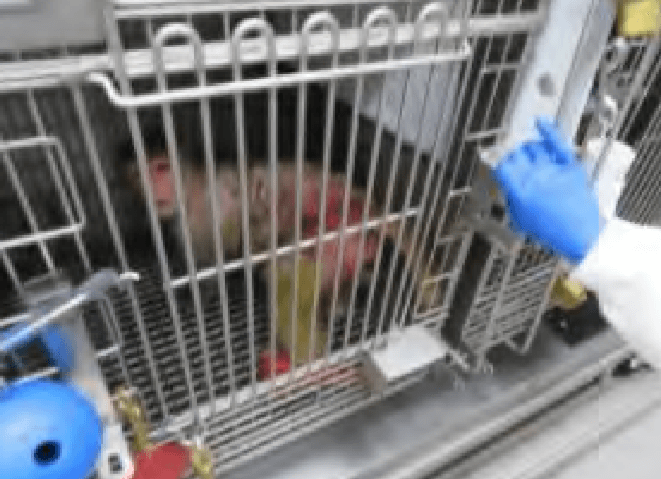
This photo taken in 2017 of an older female Macaque imprisoned at Emory University shows a hideous wound on her thigh. It was the result of incompetence and neglect on the part of school, which continues unabated today.
All these incidents are clear violations of the federal Animal Welfare Act, which establishes the bare-minimum standards of care for animals in laboratories. They’re indicative that something is horribly wrong in the facility, and Emory and Yerkes have been caught mistreating animals other times, too. But instead of correcting this continuing pattern of abuse and neglect, these institutions hid behind their high-priced lawyers, who waged an effort to get the USDA reports scrubbed of the citations so the public would never see the facilities’ glaring failures.
In its appeal to the USDA regarding the citation for the crushed mouse, Emory argued, essentially, What’s one death, really? The appeal asked the agency to scrub the violation because “[i]t was the only event of its type [at] Emory University.” The USDA, thankfully, told it to take a hike. The citation stands.
Yerkes was successful in getting the citation associated with the monkeys’ extreme hair loss erased from the record. And the citation associated with the monkey with the gaping open wound was also expunged from the record—but after PETA complained, it was reinstated.
In spite of receiving public money—hundreds of millions of taxpayer dollars—Emory and Yerkes clearly do not want the public to know the truth about what goes on in their animal laboratories. Don’t let these institutions’ shocking display of entitlement allow them to hide cruel and illegal activities from the public.
Please take a minute today to urge the National Institutes of Health to consider the science of animal sentience, including its own, and stop conducting and funding experiments on animals: