
The post Talk to Us! Stop Hurting Marmosets! (UMass) appeared first on PETA.
Traumatized Baby Monkey Decries Cruelty at Primate Research Centers in Provocative Street Art
Starting today, local residents will be confronted by images of a cowering baby monkey torn away from her mother to be imprisoned and tormented by experimenters. Colombian street artist Praxis has joined forces with PETA to plaster busy downtown streets in Sacramento and the University of California–Davis campus with thought-provoking street art demanding that the University of California’s California National Primate Research Center (CNPRC) lose both its federal funding and its license to conduct experiments.

“Compassionate Davis residents should know that the UC-Davis primate center is tormenting sensitive monkeys in failed experiments,” says PETA Senior Vice President Kathy Guillermo. “PETA’s collaboration with Praxis is pushing for UC-Davis to shut down this laboratory and send the monkeys to reputable sanctuaries where they could live in peace.”
In 2021, PETA obtained federal documents revealing incompetence and neglect of monkeys at the CNPRC—including many serious incidents that violated the federal Animal Welfare Act.
Several infant monkeys died after dye meant to mark their mothers got in their mouths and eyes, and an infant rhesus macaque’s finger got stuck in her cage bars. Another infant monkey died of heat stress, and yet another was severely injured when staff placed her in the wrong outdoor enclosure and she was attacked by other stressed monkeys. Staff injected 54 titi monkeys with a vaccine that was inappropriate for their species, and three of them developed such severe complications that they had to be euthanized.
Despite decades of promises, billions of dollars, and tens of thousands of dead monkeys, the CNPRC and the country’s other six national primate research centers have failed to deliver effective vaccines against HIV, malaria, tuberculosis, and other diseases. In 2015, Harvard University shut down the New England Primate Research Center after controversies involving systemic neglect and mistreatment of monkeys—and PETA is calling on UC-Davis to follow suit.
PETA—whose motto reads, in part, that “animals are not ours to experiment on”—opposes speciesism, a human-supremacist worldview. For more information on PETA’s newsgathering and reporting, please visit PETA.org or follow the group on Twitter, Facebook, or Instagram.
The post Traumatized Baby Monkey Decries Cruelty at Primate Research Centers in Provocative Street Art appeared first on PETA.
Leather Destroys: It’s Killing Animals and Our Planet
You’ve probably heard the phrase “dress for the job you want,” but there’s no standard uniform for environmental heroes. We know one thing without a doubt, though: Leather made from animals’ skin is one of the worst things for the environment and the other species with whom we share the planet. Read on to find out how leather destroys and why it has no place in your wardrobe, then discover how you can dress for kindness and success.
Is Vegan Leather Better for the Planet Than Animal Skins?
Yes! According to the Higg Materials Sustainability Index, leather made from cow’s skin contributes more to global warming, water pollution, water depletion, and greenhouse-gas emissions than any synthetic or plant-based vegan leather. Cow leather has nearly 10 times the negative environmental impact of plant-based leathers, such as Piñatex, and nearly six times that of polyurethane, a synthetic vegan fabric.
Animals Don’t Have to Die—Rock Plant-Based Leather Instead
More than a billion cows, sheep, and other animals are killed annually for their skins worldwide. Much of the leather sold in U.S. stores comes from countries where animal welfare laws are nonexistent or largely unenforced.
In Thailand and Cambodia, PETA entities’ eyewitnesses saw workers repeatedly bashing cows in the head with sledgehammers. In India, herds of sensitive, social cows are often forced to march hundreds of miles to their deaths, through scorching heat and dust, without food and water. The animals’ tails are deliberately broken, and tobacco and chili peppers are rubbed into their eyes to drive them on or force them to stand when they collapse. In Brazil—the world’s single largest source of animal hides—a video exposé from PETA U.S. revealed that gentle cows and bulls were burned in the face with hot irons, beaten, and electroshocked.

The next time you shop, remember whose skin you’re purchasing and think of what they were forced to endure to be used for a jacket or belt. There are many innovative, animal-friendly ways to achieve the leather aesthetic—including using fruits. That’s right, you can dress with the ingredients of your favorite drink and wear leather made from pineapples, cacti, and grapes!
Leather Is a Human Rights Issue, Too
There’s nothing natural or eco-friendly about leather. Turning a cow’s skin into leather is one of the most unnatural processes—halting decomposition through chemical baths and dehydration. Formaldehyde, coal-tar derivatives, and various oils, dyes, and finishes—some of which are cyanide-based—are used to turn animal skins into finished leather goods.
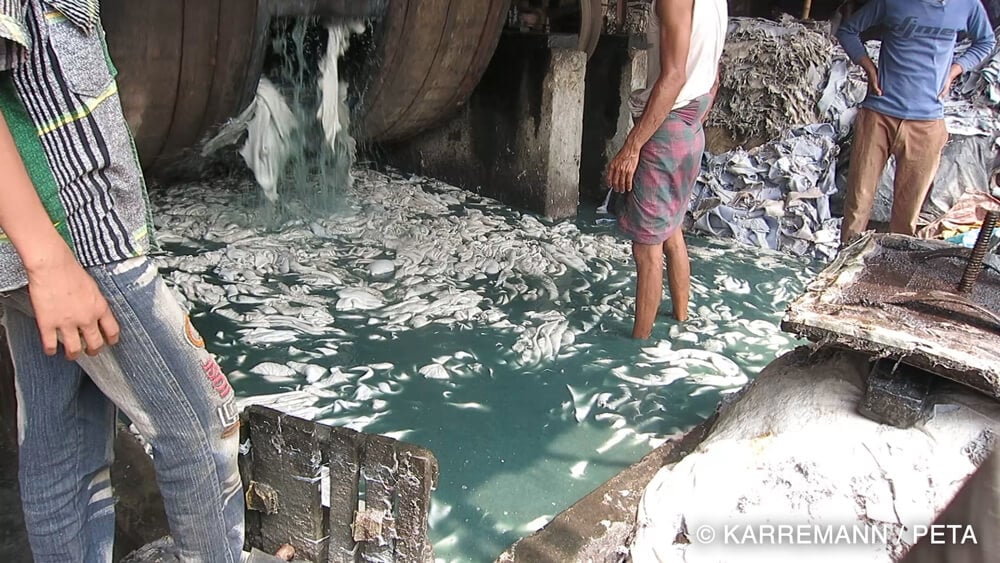
This toxic waste runs off into local water sources in countries like Bangladesh, poisoning entire ecosystems and giving tannery workers skin cancer at rapid rates. An estimated 90% of Bangladeshi workers will die before the age of 50 due to the hazardous production of leather.
Speak for the Trees—and the Rivers, Land, and Animals
Raising cows requires thousands of acres of land be cleared of trees and wildlife. Up to 80% of deforestation in the Amazon rainforest has been caused by cattle ranchers destroying land to raise animals for their skins and flesh.

Beyond the gruesome ways in which farmers and ranchers treat the animals they exploit for their bodies, manure and fertilizer from cattle ranches can leach nitrogen and phosphorus into the ground and waterways. This leads to “dead zones,” kills fish and plants, and throws the balance of entire ecosystems out of whack. Animal agriculture, one of the leading causes of the climate crisis and deforestation, consumes over one-third of the world’s finite freshwater sources and takes up 70% of all agricultural land. Think of the damage that we could prevent if more people wore vegan!
Urge Levi’s to Go Green—for Real
Levi’s claims that sustainability is sewn into the fabric of everything that it does, from its manufacturing process to its climate change initiatives. Yet the company continues to use cows’ skin for the patches on its jeans. Committing to using only vegan leather on its jean patches would be an easy first step toward legitimizing the company’s claims of being a sustainable and compassionate industry leader. By doing so, Levi’s would join the ranks of von Holzhausen, Tesla, and Jon Bon Jovi’s clothing line, all of which have already made the switch to vegan leather.

Let Levi’s know that it must replace animal skin with vegan leather in its products immediately if it truly intends to protect the planet.
Urge Levi’s to Go Green By Ditching Leather
The post Leather Destroys: It’s Killing Animals and Our Planet appeared first on PETA.
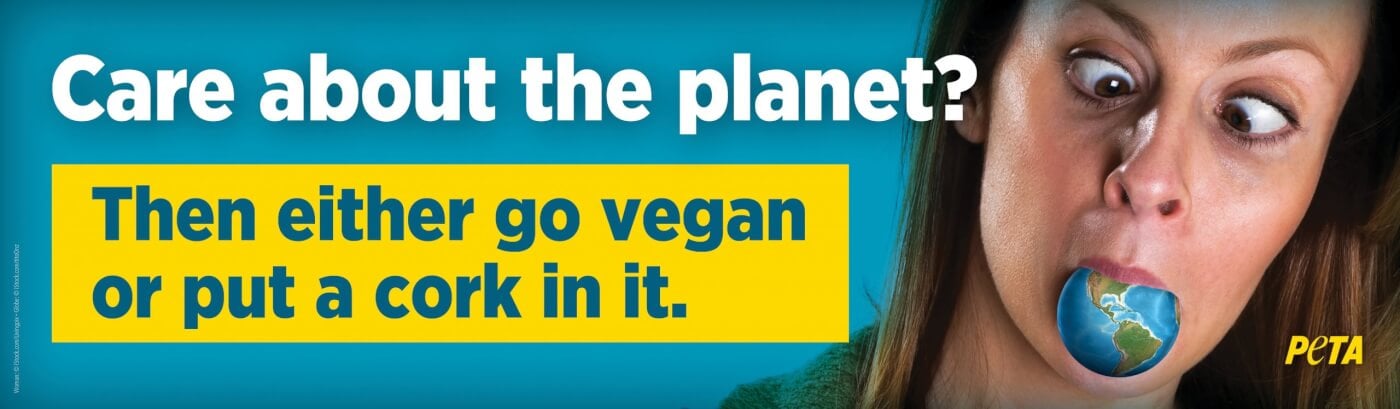
Care About The Planet? Then Either Go Vegan Or Put A Cork In It
The post Care About The Planet? Then Either Go Vegan Or Put A Cork In It appeared first on PETA.
U.S. Senators ‘Horrified’ Over ‘Breadth and Depth of Mistreatment’ Occurring at Notorious Beagle Breeder
A laboratory-supplying beagle-breeding factory farm—it was the PETA undercover investigation heard round the world. U.S. Sens. Mark R. Warner and Tim Kaine (both D-Va.) are speaking out for thousands of beagles suffering at the massive facility operated by Envigo in Cumberland, Virginia, that breeds dogs for experimentation. In their letter sent today to Animal and Plant Health Inspection Service (APHIS) Administrator Kevin Shea, Sens. Warner and Kaine wrote:
It is clear to us that Envigo has been derelict in its duty to provide for the humane care of its dogs, and is unable to abide by the basic standards set forth by the Animal Welfare Act. The role of the U.S. Department of Agriculture (USDA) in ensuring humane treatment of animals extends beyond routine and focused inspections. Congress has provided USDA with broad authority to apply penalties to violators of the Animal Welfare Act. To our knowledge, APHIS has not yet exercised such authority despite Envigo’s repeated failures in providing adequate care to the 5,000 dogs entrusted to its care.
“In light of persistent and egregious violations of the AWA, we believe that APHIS should immediately suspend the license of the Envigo breeding facility,” the senators also wrote.
The PETA undercover investigation into the massive Envigo-owned breeding factory found 5,000 beagle dogs and puppies intensively confined to small, barren kennels and cages 24/7. At Envigo, where dead and dying puppies were an almost daily occurrence, workers with no veterinary credentials stuck needles into puppies’ heads; injected euthanasia drugs directly into puppies’ hearts without sedation, causing them immense pain; deprived nursing mother dogs of food for up to two days; sprayed dogs with high-pressure hoses, leaving them drenched; and caused them to suffer in other ways.
In July, the USDA cited Envigo for 26 violations of the AWA. In October, a team of USDA officials conducted a multiday inspection of the puppy mill. The USDA corroborated PETA’s findings and cited Envigo for 13 more violations. Between these months, the USDA found that at Envigo, only 17 staff members were employed to supply direct care to 5,000 dogs and puppies; more than 300 puppies’ deaths were attributed to “unknown causes”; one dead puppy was found eviscerated, and records showed that her kennelmates had “chewed on” her corpse; three dogs had been killed in fights; 71 others had been injured by dogs in adjacent kennels; 24 dogs and puppies were missing; and nine dogs who had been injured when “body parts” were pulled through a kennel wall by other dogs and bitten, causing “physical harm and unnecessary pain,” were put down.
Following a November inspection, Envigo was cited for 26 additional violations, including for killing young puppies via intracardiac injection without pre-sedation, a method that causes pain and discomfort and is deemed unacceptable by the American Veterinary Medical Association; denying dozens of dogs care for “severe dental disease,” “severe medical conditions of the ears, eyes, feet, skin, haircoat, and poor body condition,” “lameness,” “weakness,” “lethargy,” and “traumatic wounds”; and depriving multiple dogs of adequate protection from the elements as well as depriving 742 young dogs and puppies of adequate space. Inspectors also found 21 puppies damp, shivering, and cold, and according to facility records, “25 additional puppies had been found dead with cause of death attributed to cold exposure … over the last 8 weeks.”
This 3-week old puppy wasn’t moving when he was found trapped under a kennel in a feces & urine pan.
Envigo is STILL breeding dogs for experiments even after @USDA cited it for 70 violations.
Take action to hold Envigo accountable & #protectbeaglesinVA! https://t.co/gce2ZEAZMm pic.twitter.com/2SbjIEZlAR
— PETA (@peta) March 28, 2022
As revealed in a report posted on March 28, the USDA had cited Envigo again on March 18 for five more violations of the AWA (including for documented injuries like lacerations, bite wounds, bruised and damaged extremities, ear damage, and tail damage, for which eight dogs were put down), bringing the facility’s total to 73 violations since July 2021.
Please, click below to join PETA, these and other members of Congress, and countless others in urging USDA authorities to take immediate enforcement action against Envigo:
And follow the Virginia Coalition for Beagle Protection on Facebook and Twitter for the latest on the landmark bills being introduced by legislators in Virginia who are working to protect dogs trapped at Envigo:
Note: PETA supports animal rights, opposes all forms of animal exploitation, and educates the public on those issues. PETA does not directly or indirectly participate or intervene in any political campaign on behalf of or in opposition to any candidate for public office or any political party.
The post U.S. Senators ‘Horrified’ Over ‘Breadth and Depth of Mistreatment’ Occurring at Notorious Beagle Breeder appeared first on PETA.